
 Worksheets
EDP Midterm
Total questions: 40
Worksheet time: 30mins
What step means to share your solution with others?
Define the Problem
Brainstorm
Select the Plan
Communicate
Engineers realize that their prototype does not work after testing it several times. What must they do next?
Make iterations or improvements
Communicate the Design
Select the Plan
Test it more
Engineers built a prototype of their design. What is the next step?
Research
Test
Improve
Communicate
What is the study and collecting of information about something?
Communicate
Constraints
Brainstorm
Research
According to the Engineering Design Process...
You can do whatever you want
You are always right
You are always wrong
Making mistakes is ok
What should you do after you Identify the Problem?
Improve the Prototype
Make a Prototype
Research the Problem
Test the Prototype
What is the first step in the Engineering Design Process?
Select the Plan
Define the Problem
Communicate
Test
If your design doesn't work, you must go back and improve your prototype. What step is this in the Engineering Design Process?
Communicate
Research
Define the Problem
Iterate
What are the "criteria" in the Engineering Design Process?
All the factors that will not work
All the factors that make the solution expensive
All the factors that limit the solution
All the factors the solution must have
What is a "constraint" in the Engineering Design Process?
All the factors that make the solution harmful
All the factors that make the solution expensive
All the factors that limit a solution
All the factors that make the solution better
After you brainstorm all the possible solution to your problem, what is the next step?
Define the Problem
Communicate
Select the Plan
Prototype
You can improve your prototype by
Thinking about what worked well and what doesn't
Share your prototype and get feedback from others
Brainstorm ideas of how to fix the problems
All of the above
Where do engineers store all their ideas?
In their brain!
On a computer
In their Engineering Notebook
In a personal journal
Choose the correct order for the steps of the Engineering Design Process
Identify Constraints; Brainstorm Solutions; Define Problem; Select Best Solution; Communicate Solution; Prototype/Test/Iterate
Define Problem; Identify Constraints; Prototype/Test/Iterate; Brainstorm Solutions; Communicate Solution; Select Best Solution
Define Problem; Identify Constraints; Brainstorm Solutions; Select Best Solution; Prototype/Test/Iterate; Communicate Solution
Define Problem; Brainstorm Solutions; Communicate Solution; Select the Best; Identify Constraints; Prototype/Test/Iterate
Engineers plan on developing a new drill for use on oil rigs. What should the engineers do first in order to develop the new drill?
Brainstorm different types of drills
Determine the materials needed to build the new drill
Conduct research on features for a new drill
Build a prototype of the new drill
A team of engineers is asked to design a scooter for less than $30. They decide that they will only use recycled materials. Which of the following is the team’s constraint?
designed to appeal to kids
made out of recycled materials
cost less than $30 to produce
runs faster than other scooters

What is this measuring tool?
Vernier Caliper
Digital Caliper
Dial Caliper
Micrometer

0.987 in.
4.887 in.
4.987 in.
0.887 in.

What is the measurement shown?
0.48 in.
4.48 in.
.448 in.
0.048 in.

Reading #1: What is the reading of this Dial Caliper?
3.67"
1.567"
0"
0.700"
1.600"

What is the reading of this caliper?
2.192 in.
3.192 in.
3.292 in.
3.922 in.
Ratio between a Model/drawing and an Actual object
Scale
Annotation
Label
Dimension

The type of technical drawings pictured here
Endothermic
Isometric
Orthographic
Explosive

The six possible 2d projections of a 3d object are called this
orthographic views
photographic
pictorial
technical

Which views most commonly get drawn for multiview drawings?
front, rear, right side
front, top, left side
front, top, right side
front, top, right, left, rear, bottom

Which orthographic view shows the width and height of an object?
front
left
right
top

Which orthographic view shows the width and depth of an object?
front
left
right
top
Which type of line shows a feature that cannot be seen in a particular view?
center
hidden
projection
miter
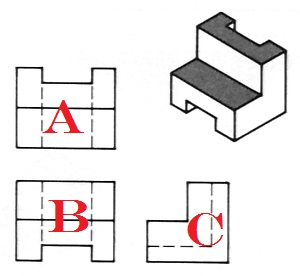
What view would go in position B of a multiview sketch?
Top
Front
Right side
A solid line used on a drawing to represent a side or feature of a part.
Object Line
Orthographic Projection (multiview)
Plane
Radius

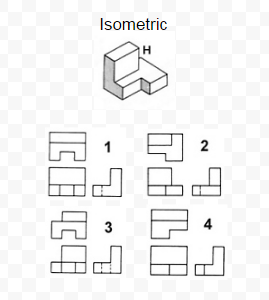
Which diagram below shows the right view of this object?


Recognize the view for the given isometric figure.
Top view
Right side view
Left side view

Hidden Line
Cutting Plane Line
Dimension Line
Leader Line

Which is the correct front view of the figure provided?


What is the purpose of the extrude feature in Onshape?
To create a 3D solid by extending a 2D sketch in a specific direction.
To create a 2D sketch by extending a 3D solid in a specific direction.
To rotate a 3D solid around a specific axis.
To mirror a 2D sketch across a specific plane.
Rounds off sharp interior and exterior edges
Chamfer
Fillet
Center point circle
Parallel
Makes a line or lines vertical
Vertical
Horizontal
Parallel
Perpendicular
Makes two lines intersect creating 90 degree angles
Parallel
Perpendicular
Horizontal
Vertical
Makes a line or plane touching, but not intersecting, a curve or curved surface
Midpoint
Coincident
Concentric
Tangent

