
 Worksheets
2025 AP Biology Midterm Review
Total questions: 60
Worksheet time: 1hrs 9mins

monosaccharides, fatty acid and glycerol, amino acids, and nucleotides are examples of _____________.
Elements
Compounds
Macromolecules
Monomers
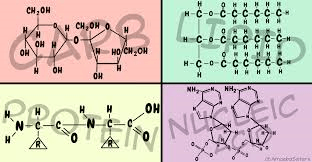

What macromolecule is shown above?
Carbohydrate
Lipid
Protein
Nucleic Acid

Which biomolecule is this a picture of?
Protein
Nucleic Acid
Lipid
Carbohydrate

Which of the following statements is/are true regarding the chemical reaction illustrated in Figure 5.5?
It is a hydrolysis reaction.
It is a hydrolysis reaction and it results in a peptide bond.
It results in a dehydration reaction that is breaking the two amino acids apart.
It is a dehydration reaction that is joining two amino acids together.
Which macromolecule(s) have sulfur?
Carbohydrates
Proteins
Nucleic Acids
Fats

A scientist grew Chlorella, a single-celled photosynthetic algae, for three weeks in a laboratory culture. The culture medium contained dissolved carbon and other nutrients.
Scientists measured the beginning and the end of the three week period. Based on the results of the graph which nutriets were absent from the culture medium?
phosphorus
nitrogen
oxygen
sulfur
1.) They act like gatekeepers, only let certain things in.
2.) Enzyme receptors embedded in the membrane.


Your gums are swollen. How will rinsing with warm salt water help the swelling?
swollen gums will absorb the salt
salt lowers the temp
salt goes against the concentration gradient
water in the gums will diffuse out of the cells


Which of the following cells is most efficient?
Note: SA = surface area V = volume
SA: 4 V: 1
SA: 3 V: 2
SA: 2 V: 3
SA: 1 V: 4
Why is the inner membrane of the mitochondria highly folded?
Increase volume of mitochondria
Increase in surface area for oxidative phosphorylation
Decrease volume of mitochondria
Decrease in surface area for oxidative phosphorylation
Pathway to exocytosis
Rough ER → Golgi → Membrane
Rough ER → Lysosome → Membrane
Smooth ER → Golgi → Membrane
Smooth ER → Lysosome → Membrane
If the intracellular concentration is 1.0 M and extracellular concentration is 0.4M. Which direction does water flow?
Both in and out (equilibrium)
Into the cell
Out of the cell
Extracellular solution is 0.5M and the cell is 1.0M – which direction will water flow?
Into cell towards hypertonic solution
Into cell towards hypotonic solution
Out of cell toward hypertonic solution
Out of cell toward hypotonic solution
What is the ionization constant of sucrose?
0
1
24
48
What is the ionization constant of sodium chloride?
0
1
2
3
The H+ concentration gradient is formed to
make NADPH
split a water molecule
generate ATP
form water
Rubisco is important in which step of photosynthesis
energizing the electrons in chlorophyll
carbon fixation when CO2 is connected to RUBP during calvin cycle
regeneration phase as RUBP is made during calvin cycle
reduction of the carbon chain during the calvin cycle
If the proton (H+) pump in the thylakoid was not working which molecule could not be made during the light reaction?
NADPH
ATP
Water
Oxygen gas
Which of the following would have the least affect on photosynthetic rate?
increase the temp from 20°C to 30°C
increasing the CO2 from 400 ppm to 600ppm
increasing the light intesity from 40 Watts to 60 Watts
increasing the amount of O2 from 20% to 30% in the air
Label the parts of the enzyme model

You have discovered an enzyme that can catalyze two different chemical reactions. Which of the following is most likely to be correct?
The enzyme contains a-helices and b-pleated sheets.
The enzyme is subject to competitive inhibition and allosteric regulation.
Two types of allosteric regulation occur: The binding of one molecule activates the enzyme, while the binding of a different molecule inhibits it.
Either the enzyme has two distinct active sites or the reactants involved in the two reactions are very similar in size and shape.
Match the following
Binds to active site to slow reaction
Competitive
Binds at a different spot on enzyme to change shape
Allosteric
Binds to active site
Substrate
Speeds up a chemical reaction without being used up
Catalyst
Part of enzyme where reactants bind to
Active Site
Where does glycolysis take place?
Cytosol
Mitochondrial matrix
Mitochondrial cristae
Stroma
Thylakoid membrane
What is the input of glycolysis?
Glucose
Pyruvate
NADH
G3P
What is the output of glycolysis?
Glucose
2 pyruvate
2 NADH
2 ATP
2 FADH2
Where does the Krebs Cycle take place?
Cytosol
Mitochondrial matrix
Mitochondrial cristae
Stroma
Thylakoid membrane
What is the input of the Krebs Cycle?
Pyruvate
Acetyl CoA
Glucose
NADH
Where does oxidative phosphorylation take place?
Cytosol
Mitochondrial matrix
Mitochondrial cristae
Stroma
Thylakoid membrane
What is the main function of oxidative phosphorylation?
To complete the breakdown of glucose
To generate a proton gradient and synthesize ATP
To split a glucose molecule in half and synthesize NADH
Which step of cellular respiration REQUIRES oxygen?
Glycolysis
Krebs Cycle
Oxidative Phosphorylation
Calvin Cycle
Which step can be performed by prokaryotes AND eukaryotes?
Glycolysis
Krebs Cycle
Oxidative Phosphorylation
Calvin Cycle
Which of the following are structural polysaccharides?
Cellulose
Glycogen
Chitin
Starch
Which of the following are storage polysaccharides?
Cellulose
Glycogen
Chitin
Starch
Which of the following element(s) are found in proteins?
Carbon / Hydrogen
Oxygen
Phosphorus
Nitrogen
Sulfur
Which of the following is the monomer of a protein?
Amino acid
Monosaccharide
Nucleotide
Steroid
Which of the following bonds is found in the secondary structure of a protein?
Hydrogen
Peptide
Covalent
Ionic
Which of the following structures involves the R groups interacting in a single polypeptide?
Primary
Secondary
Tertiary
Quaternary
The amino acid glutamic acid has a R group with a negative charge. During folding, which of the following describes the orientation of the R group?
Exterior of protein due to negative charge providing hydrophilic properties
Exterior of protein due to negative charge providing hydrophobic properties
Interior of protein due to negative charge providing hydrophobic properties
Interior of protein due to negative charge providing hydrophilic properties
Which of the following identifies the number of water molecules needed to remove the amino acids from a polypeptide with 20 amino acids?
19
20
21
22
What are two types of Nucleic acids?
DNA & BNA
DNA & NNA
RNA & fRNA
DNA & RNA

