
Font size
 Worksheets
Epidemiology Midterm 1
Total questions: 49
Worksheet time: 55mins
There are 3 ways we measure frequency: _____, _____, and _____.
(a)
Match the types of errors (in analytical studies)
The null hypothesis (H0) is false and is rejected
Correct!
Probability = 1 - β
The null hypothesis (H0) is true and is rejected
Type I error
The null hypothesis (H0) is true and is not rejected
Correct!
Probability = 1 - α
The null hypothesis (H0) is false and is not rejected
Type II error
The probability of making a type I error is the ______ represented by the Greek letter ____ (type the word out for this) and is also known as the P-value.
If confidence is 95%, this = _____
(a)
A) A type ___ error results in the groups being compared declared as not being different, when they are
(If power = 80%, β = 20%)
B) The Z alpha level is:
Type I, higher in a 1 sided hypothesis
Type I, lower in a 1 sided hypothesis
Type II, higher in a 1 sided hypothesis
Type II, lower in a 1 sided hypothesis
(a) describes the probability of detecting an effect if it truly exists and is of some magnitude (e.g., 80%)
Match the following scientists to their contribution
Determined that soot was the occupational carcinogen causing rising rates of cancer, particularly scrotal cancer in chimney sweeps (child workers)
Sir Percival Pott
Believed that cholera was caused by miasma aka bad air arising from decaying organic matter
William Farr
Observed high incidence of mothers dying from puerperal fever (also known as childbed fever) after delivery, suggested washing medical instruments with chlorine to avoid cross contamination with cadaverous material
Ignaz Semmelweis
In 1879, he isolated Streptococcus from the blood of women with childbed fever
Louis Pasteur
Required sample size, n, generally INCREASES (or in other words, you usually need a bigger sample size or more people to sample) as these factors...
Power
Confidence
Size of difference between groups
Variance of estimate
Precision
Allowable error
(a) describes how tight the confidence interval is around your estimate and depends on sample size, variability within the population, and the sampling strategy. It is represented by the letter _ (upper case) and is also known as the allowable error. Smaller ranges are better for this measure!
The following describes one of the types of non-probability sampling. This occurs when investigator chooses what they deem to be units that are representative of the population (can be difficult to justify in real life – if you knew the answer, you would not be conducting a study!). It is often seen in pretesting – researchers often design a questionnaire and test it with individuals to ensure they can understand it.
Nothing can be extrapolated as a random population is not being used as a sample, but rather people who the researcher thinks may be good for the study based on the known characteristics of the population.
Purposive sample
Judgment sample
Convenience sample
In systematic random sampling, a formula is used to determine the sampling interval. Please provide me that formula with the variables included.
The following describes one of the types of non-probability sampling.
Units are chosen because they are easy to obtain (e.g., animals in traps found in herds close to U of G - such as those within 100 km). It is often used in analytical studies and is not truly representative as it is not random - this does not make it bad per se, but inherent bias is present during sampling based on convenience (as we saw in class)
Purposive sample
Judgment sample
Convenience sample
Match the following sampling considerations into non-statistical (resources available to meet study objectives) or statistical (minimize errors while still being able to detect a difference between groups if a difference truly exists)
Power
Type I errors
Type II errors
Confidence
Hypotheses
Time
Money
Sampling frame
Research objective
The following describes one of the types of non-probability sampling.
Units are chosen based on certain attribute(s), which is not entirely representative, but useful in its own way! It is often used in qualitative research.
Purposive sample
Judgment sample
Convenience sample
Two major types of sampling - ______ sampling is when a sample is drawn without a formal random process. There are _ types of this sampling - the probability of being sampled is UNKNOWN.
In contrast, ______ consists of _ different types in which a formal random process is used to draw the sample (e.g., random number generator, names drawn from a hat – has to be TRULY random). Each individual has a known, non-zero, probability of being sampled that we should be able to calculate.
Do not type the word sampling. For blank 2 and 4, type the number.
(a)
A) _____ problems have straight-forward, step-by-step solutions, though their trajectory can be predictable
_____ problems are composed of many interconnected parts and are unpredictable, often requiring an innovative response with expertise across disciplines
B) Incidence and prevalence will generally not change, and in-migration (people entering the population) roughly equals out-migration (people exiting the population) and as such, prevalence is roughly proportional to incidence x duration of disease.
Complex, Complicated, True
Complex, Complicated, False
Complicated, Complex, True
Complicated, Complex, False
A) We have an absolutely accurate (perfect) gold standard test to determine which individuals are and are not diseased - one of our assumptions include only that the outcome is ____, meaning that there are only two options (diseased / not diseased)
B) False negatives & positives impact ______ because truly D+ and D- individuals get misclassified (go into the wrong cells of the 2x2 table)
(a)
Reorder the main stages in sampling
Determine who to sample
Determine how you will choose these subjects
Determine how many you’ll need to be confident in your
findings

What kind of probability sampling is this describing?
Stratified random sampling
Multi-stage sampling
Systematic random sampling
______ is the degree of certainty about your estimation process (commonly __%). The ______ represents a range of values around the sample estimate that include the true mean / proportion of the source population.
The true value represents the actual value in the population – the value you would obtain if you did a census.
(a)
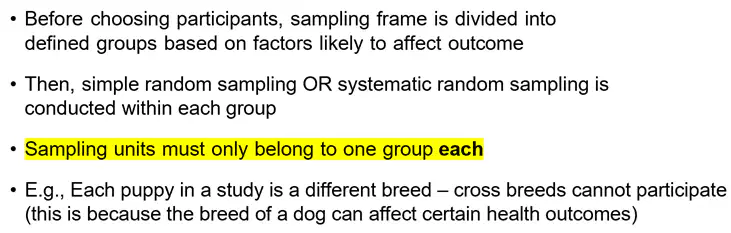
What kind of probability sampling is this describing?
Stratified random sampling
Multi-stage sampling
Systematic random sampling
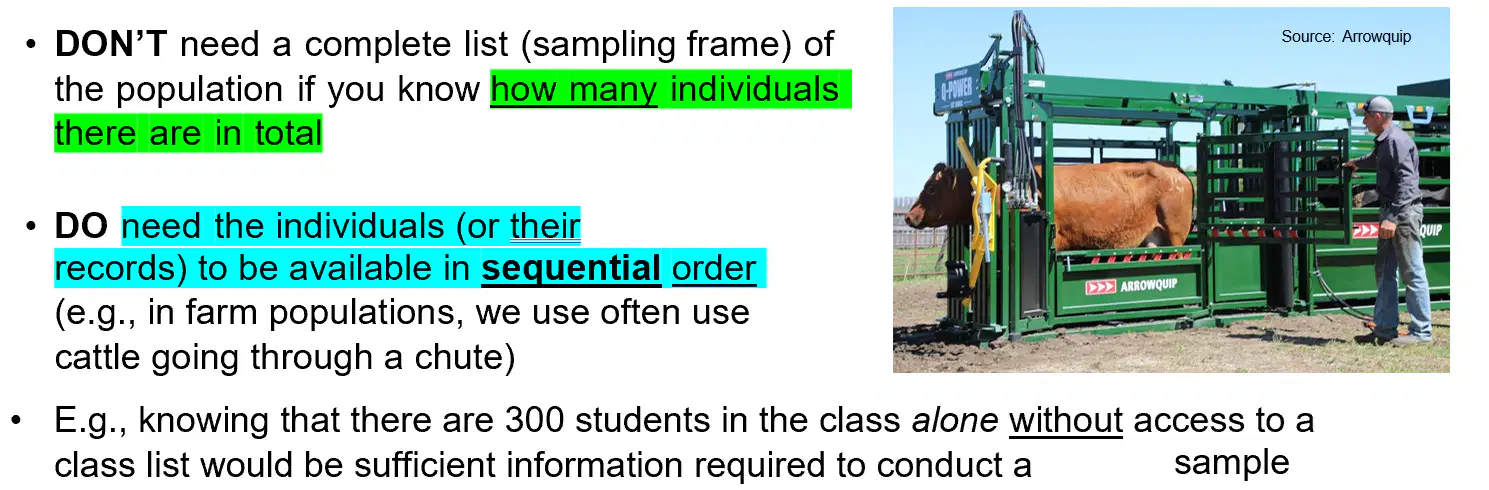
What kind of probability sampling is this describing?
Stratified random sampling
Multi-stage sampling
Systematic random sampling

What kind of probability sampling is this describing?
Stratified random sampling
Multi-stage sampling
Systematic random sampling
A) _____ refer to continuous outcomes (e.g., a study measuring the average level of water contamination in a community, average weight of dogs attending a veterinary clinic, etc.).
B) _____ refer to categorical outcomes like research questions with yes or no answers (e.g., measuring the proportion of people with food poisoning in the population)
C) The Z alpha number for 95% confidence is _____.
(a)

What kind of probability sampling is this describing?
Stratified random sampling
Multi-stage sampling
Systematic random sampling
There are two main types of studies in epidemiology, which each have different methods of determining sample size.
A(n) ____ study describes characteristics of a population and results in descriptive statistics about the status of health or disease in the population.
A(n) ___ study analyzes relationships between risk factors (exposures or determinants) and health outcomes in a population. It makes comparisons between groups to figure out what risk or protective factors are associated with health outcomes.
(a)
Identify the point at which tertiary prevention (e.g., therapy) should be implemented.
The transmission of pathogens from wild animals to humans (disease transferring from animal to human population) is called...
(a)
Match the categories of the 2x2 table
False negative
c
True positive
a
False positive
b
True negative
d
A horizontal form of transmission is ______, in which contact between a person and contaminated object – called a _____ (what we are being told to avoid touching, such as a table, tap in a bathroom, etc.)
E.g., a sick person has some sort of infectious material (e.g., particles) and touches something – that is, an intermediary such as a door handle – that later someone else touches. Person 2 touches their mouth and infectious material enters their body
(a)
Which of the following are proportions?
Prevalence
Incidence risk
Incidence rate
_______ describes indirect protection from an infectious disease that happens when a population is immune (a large proportion of non-susceptible individuals are present in the population). It can be _____ induced or ______ induced.
Do not type the word induced!
(a)
Prevalence vs. Incidence
Determined through 2 (or more) measurements
Determined through single measurement
Examines study population to see what proportion has disease
Total disease in numerator (new and old)
New cases only in numerator
Probability of GETTING disease
Probability of BECOMING diseased
Probability of DEVELOPING disease
Examines disease-free population from baseline following for disease development over time
Probability of HAVING disease
Probability of BEING diseased
Who has the disease RIGHT NOW?
Who CURRENTLY has the disease?
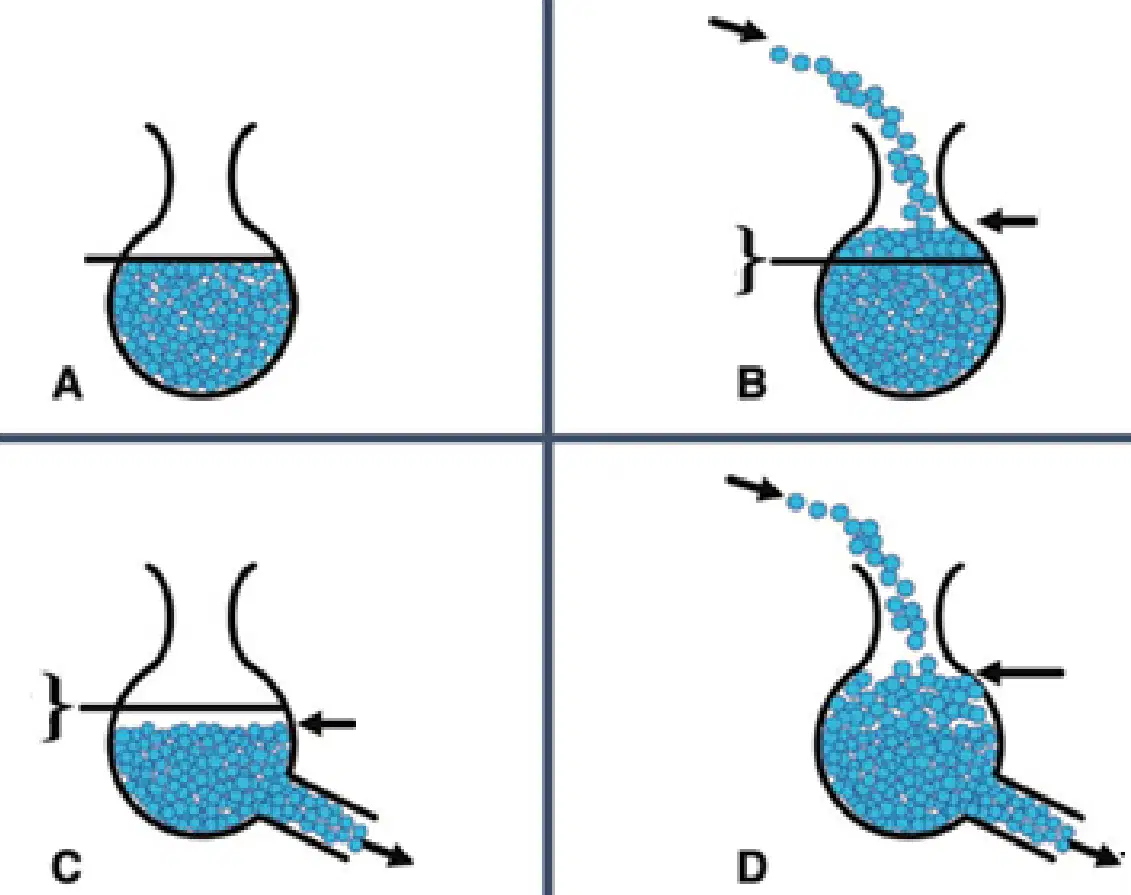
Panel A)______ represents existing cases in a population
Panel B) _______ can be INCREASED through _____ (the addition of new cases)
(a)
Match the definition to the term
Describes risk of becoming affected by a disease during time t
Attack “rate”
Deaths from any cause
Crude mortality risk or rate
Proportion of individuals with a specific disease that die as a result of that disease during a given time period
Case fatality “rate”
Sickness from a specific cause
Cause-specific morbidity risk or rate
What are the four types of temporal patterns?
(a)
Match the era to epidemiology approach at the time:
Clinical epidemiology &
Pharmacoepidemiology
1980s
Communicable diseases were the major cause of death at the time (infectious – that which spread)
1800s
Molecular, Genetic, & Social epidemiology including biological pathways that lead to disease, determining what counts as quality of life – not just living and being free of disease (health & well-being)
1990s
Chronic diseases & Seroepidemiology (blood testing to identify biological markers) which included cardiovascular research, cancer research, etc.
1950s
The term (a) means to bring down the cases below the health case system capacity
From which population should you be able to list all members (sampling units) of this population - that is, the sampling frame?
Sample population
Target population
Source population
A) ______ is used to characterize the distribution of disease or patterns in disease occurrence in a population and involves the 5 W's - we ask 4 of them to help us understand ____?
B) For microorganisms (e.g., bacteria, viruses, fungi, plants, etc.), it is important to understand how they spread between hosts, which is known as their _____, which has two general categories; ____ & _____ , which is further classified into 6 types.
(a)
A) True or false? To be diseased means that the host is invaded by microorganisms, the organisms multiply, and the host’s immune system responds
B) In chronic diseases (e.g., cancer), _______ whereas in acute diseases, ________
True, Prevalence < Incidence, Prevalence > Incidence
True, Prevalence > Incidence, Prevalence < Incidence
False, Prevalence < Incidence, Prevalence > Incidence
False, Prevalence > Incidence, Prevalence < Incidence
The ______ is the thing you are interested in (e.g., a person), while the _____ is a list or database of every person/individual or every "blank A".
(a)
Why were mothers dying from childbed fever after delivery 5x more in the wards with medical students and doctors than midwifes?
Religious support during birth with midwifes was better
After death, autopsies were conducted by doctors & med students who had poor hygiene practices
Positioning of mothers during birth were harder during delivery causing strain
Medical students had more experience than midwives in delivery - techniques were much more advanced
_____ describes how well the study population reflects the source population - the goal of epidemiology is to maximize this by using sampling techniques and good study design to ensure the conclusions we draw are valid.
_____ starts at the study population and goes all the way up to the target population and describes how generalizable are the results from our study population to the target population. In other words, it asks how well the study results can be
extrapolated to the target population.
(a)
Match the following scientists to their contribution
Disliked variolation, treated smallpox with cowpox pustule - 1st administered vaccination
Edward Jenner
First clinical trial in determining scurvy was causes by lack of citrus fruits in Navy diet
James Lind
Cholera
John Snow

A) Smallpox was eradicated in ____ while _____, an infectious disease of cattle and buffalo, was eradicated in 2011
B) The time between the exposure to sufficient cause of a disease and when the pathological process is detectable (though before symptoms occur) is known as the ______.
The time between the exposure to sufficient cause of a disease and when symptoms occur (clinical disease is evident) is known as the _____
C) ____ is the proportion of unaffected individuals who on average, will develop the disease of interest over a specific time period
(a)
Identify the point at which secondary prevention (e.g., screening) should be implemented.
How you go about choosing subjects for a sample will have an impact on the _____ of your results – how _____ will your conclusions be based on how you sampled? Who are you interested in and how do you get those people in your sample?
If your subjects are not truly representative of the population of interest (i.e., the one you’d like to say something about), then your conclusions may be ____ (i.e., wrong)!
(a)
Identify the point at which primary prevention (e.g., vaccination) should be implemented.
The epidemiological triad consist of _____, _____, and _____ whose interactions at one point in time will lead to _____ at both the individual & population level
(a)

