wayground logo

Free Printable Worksheets

Font size

S
M
L
XL
Worksheets

Electric Magnetism

Total questions: 160

Worksheet time: 2hrs 18mins

Name
Class
Date
1.
What is the symbol for Current
a)
C
b)
Q
c)
I
d)
A
2.
What is the unit for Current
a)
C
b)
Q
c)
I
d)
A
3.
What is the unit for Charge
a)
C
b)
Q
c)
I
d)
A
4.
What is the symbol for Charge
a)
C
b)
Q
c)
I
d)
A
5.

What is a formula to calculate Charge

a)

Q=Ixt

b)

Q=I/t

c)

Q = VxE

d)

Q = V/E

6.

Which of the following describes current

a)

Current is the rate of flow of electrical charge.

b)

Current is the capacity of a physical system to do work.

c)

The current across an electrical component is the electrical energy supplied to it.

d)

A unit of matter that expresses the extent to which it has more or fewer electrons than protons.

7.

How much charge must pass by a point in 10 s for the current to be 0.50 A?

a)

0.05C

b)

5.0C

c)

20C

d)

2.0C

8.

What charge do electrons have?

a)

+1

b)

-2

c)

-1

d)

0

9.

A charge of 6C flows in 4s. What is the current?

a)

10A

b)

24A

c)

1.5A

d)

2A

10.

A charge of 800C flows through a 20A current. How long does it flow for?

a)

20s

b)

40s

c)

60s

d)

1600s

11.
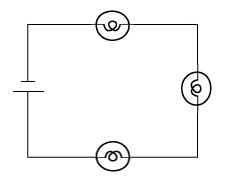
This is an example of a _______ circuit
a)
open
b)
series
c)
parallel
d)
square
12.
The picture shows an electrical circuit. This circuit is a series circuit because: 
a)
It has 3 light bulbs.
b)
The same current flows through all three light bulbs.
c)
It uses a single battery.
d)
The electrical current is divided between the three light bulbs.
13.
This circuit has more than one loop. When one light goes out, the others stay on. 
a)
closed circuit
b)
series circuit
c)
parallel circuit
d)
open circuit
14.
A series circuit has ____ path(s) that the electric current can take. 
a)
One
b)
Two 
c)
Three 
d)
Four
15.
What type of circuit is used in your house?
a)
Light Circuits
b)
The best circuits
c)
Series Circuits
d)
Parallel Circuits
16.

If the reading of A1 is 0.3 A, what is the reading of ammeter A2?

a)

0.1 A

b)

0.2 A

c)

0.3 A

d)

0.4 A

17.

A parallel Electric circuit was set up as shown in the diagram. The reading of Ammeter A1 is _________ A.

a)

0.1 A

b)

0.12 A

c)

0.7 A

d)

0.21 A

18.

A parallel circuit is set up using 3 similar lightbulbs as shown in the diagram. If the ammeter reading of A1 is 1.2 A, what is the reading of Ammeter A2 is _________ A

a)

0.1 A

b)

0.2 A

c)

0.3 A

d)

0.4 A

19.

A parallel circuit is set up using 3 similar lightbulbs as shown in the diagram. If the ammeter reading of A3 is 0.2 A, what is the reading of Ammeter A1 is _________ A

a)

0.1 A

b)

0.2 A

c)

0.4 A

d)

0.6 A

20.

What is wrong with this circuit diagram?

a)

There is only one cell

b)

A ammeter should be connected in parallel

c)

The ammeter should be connected in series

21.

Which ammeter will have the biggest reading?

a)

Ammeter 1

b)

Ammeter 2

c)

They will be the same

22.

In which of these two circuits is the current the same at all points?

a)

A

b)

B

23.

Which instrument is shown in the picture?

a)

voltmeter

b)

ammeter

c)

multimeter

d)

thermometer

24.

what is the current at point a?

a)

0.4A

b)

0.2A

c)

0.1A

d)

0A

25.

What is the current at point a and b?

a)

a=0.3A b=0.3A

b)

a=0A b=0A

c)

a=0.6A b=0.3A

d)

a=0.6A b=0.6A

26.

What is the current at point a?

a)

a=0.4A

b)

a=0.2A

c)

a=1.0A

d)

a=0.6A

27.

If Ammeter 1 + 4 both show a current of 4 amps. What will Ammeter 2 + 3 show?

a)

Ammeter 2 = 4 amps & Ammeter 3 = 4 amps

b)

Ammeter 2 = 2 amps & Ammeter 3 = 2 amps

c)

Ammeter 2 = 1 amps & Ammeter 3 = 3 amps

d)

Ammeter 2 = 3 amps & Ammeter 3 = 1 amps

28.

What is the equation that links charge (Q), current (I) and time (t)?

a)

Charge = Current x Time, or Q=It

b)

Charge = Current / Time, or Q=I/t

c)

Charge = Time / Current, or Q=t/I

29.

What is charge measured in?

a)

Electrons

b)

Current

c)

Ohms

d)

Coulombs

30.

Complete the equation: Charge = ................ x ..............

a)

Time, Current

b)

Current , Voltage

c)

Resistance, Voltage

d)

Current , Time

31.

Calculate the charge and give the unit when a current of 0.15 A flow around the circuit for 20 seconds.

a)

133.33 C

b)

1.5 C

c)

0.0075 C

d)

3 C

32.

Why must parts of a circuit be properly connected before the bulb can light up?

a)

To ensure that the bulb can light up.

b)

To ensure that the battery can produce light in a closed circuit.

c)

To ensure that electric current can flow through the closed circuit.

33.

What is the definition of electrical current?

a)

The opposition to the flow of electrons

b)

The rate of flow of charge

c)

The work done on each coulomb of charge

d)

Electrons moving around

34.

Current flows through a wire for 3.5 minutes. How many seconds is this?

a)

150

b)

190

c)

210

d)

305

35.

The current in a wire is 1.2kA. What is the current in Amps?

a)

120A

b)

12A

c)

0.12A

d)

1200A

36.

How much charge flows through a wire in 80s if the current is a constant 5.4A?

a)

432C

b)

360C

c)

524C

d)

344C

37.

The total charge that flows though a wire in 25s is 1kC. What is the average current through the wire?

a)

20,000A

b)

0.04A

c)

40A

d)

25A

38.

A 3A current flows through a television. How long would it take for 1500C to flow through it?

a)

4500s

b)

500s

c)

50s

d)

450s

39.

Calculate current if a charge of 10 Coulombs flows past a point in 5 seconds

a)

2 Amps

b)

50 Amps

c)

0.5 Amps

40.

Calculate the charge that passes a point in 20 seconds if 500mA flows for this time.

a)

10 000 Coulombs

b)

25 Coulombs

c)

10 Coulombs

d)

0.025 Coulombs

41.

The correct symbol equation is:

a)

Q = I / t

b)

I = Q x t

c)

t = I / Q

d)

Q = I x t

42.
For a circuit to work the circuit must be…
a)
closed
b)
open
c)
on
d)
charged up
43.
In a single, closed loop (circuit) the current…
a)
is different on each branch
b)
is the same everywhere
c)
varies around the circuit
d)
steps up and down
44.
Current is...
a)
moving protons
b)
moving electrons
c)
measured in volts
d)
measured in ohms
45.
Voltage is simply defined as...
a)
what 'pushes' electrons
b)
what 'stops' electrons
c)
moving electrons
46.
An object through which electrons can easily flow is called a(n) ___________.
a)
Conductor
b)
Insulator
47.
current is measured in....
a)
volts
b)
amps
c)
watts
d)
mph
48.
Potential energy can be converted into _________________.
a)
food & waste
b)
water & light
c)
light & heat
d)
heat & food
49.

One watt is equal to,

a)

one meter per second

b)

one Joule per second

c)

One ampere per second

d)

one farad per second

50.

Electric power is defined as,

a)

the rate of conversion of temperature

b)

the rate of conversion of current

c)

the rate of conversion of electric energy

d)

none of the above

51.
Electrical power can be calculated using
a)
Resistance x Voltage
b)
Voltage x Current 
c)
Voltage ÷ Current
52.
The voltage supplied to a circuit is 17 V and the current running through is 10 A. What is the power generated?
a)
170 W
b)
170 A
c)
1.7 V
d)
1.7 W
53.
Voltage is measured in __.
a)
volts.
b)
watts.
c)
coulombs. 
54.
The movement of electrons from atom to atom in a line results in a flow of _____. 
a)
amperage.
b)
electric current.
c)
electromagnetic connectors. 
55.
As the resistance of a circuit increases, the current will
a)
increase
b)
decrease
c)
stay the same
56.
Current has units: 
a)
kilowatt·hour 
b)
ampere 
c)
coulomb 
d)
volt 
57.
Which best describes a parallel circuit?
a)
Electricity flows along one pathway.
b)
The flow of electricity comes from one source. 
c)
Electricity flows along more than one pathway. 
d)
The flow of electricity comes from more than one source. 
58.
What 'flows' in a wire?
a)
Protons
b)
Neutrons
c)
Atoms
d)
Electrons
59.
What kind of circuit is this?
a)
series
b)
parallel
60.

In a parallel circuit, if one connection is broken, all of the connections stop working.

a)

True.

b)

False.

61.

Which statement is true?

a)

The light bulb will light up because the circuit is complete.

b)

The light bulb will light up because the circuit is broken.

c)

The light bulb will not light up because the circuit is complete.

d)

The light bulb will not light up because the circuit is open.

62.

What type of circuit is the image showing?

a)

Parallel

b)

Series

c)

No circuit

63.
A Charging system producing 14.5 Volts with a current flow of 43.5 Amps, what is the circuit resistance
a)
58 Amps
b)
0.33 Amps
c)
13 Amps
d)
1 Amp
64.
How many Volts would it take to push 1 Amp through a resistance of 1 Ohm
a)
10 volts
b)
1 volt
c)
48 volts
d)
5 volts
65.
If the current through a circuit is 2 A and the resistance of a light bulb in the circuit is 10 Ohms, what is the voltage difference across the light bulb?
a)
5 V
b)
12 V
c)
0.2 V
d)
20 V
66.
What would the circuit resistance be if a 7.5 Amp draw was present with the engine running and the charging system producing 15 Volts
a)
15 Ohms
b)
4 Ohms
c)
0.3333 Ohms
d)
2 Ohms
67.
Voltage is measured in __.
a)
volts.
b)
watts.
c)
coulombs. 
68.
The movement of electrons from atom to atom in a line results in a flow of _____. 
a)
amperage.
b)
electric current.
c)
electromagnetic connectors. 
69.
Current has units: 
a)
kilowatt·hour 
b)
ampere 
c)
coulomb 
d)
volt 
70.
Which best describes a parallel circuit?
a)
Electricity flows along one pathway.
b)
The flow of electricity comes from one source. 
c)
Electricity flows along more than one pathway. 
d)
The flow of electricity comes from more than one source. 
71.
What 'flows' in a wire?
a)
Protons
b)
Neutrons
c)
Atoms
d)
Electrons
72.
What kind of circuit is this?
a)
series
b)
parallel
73.

In a parallel circuit, if one connection is broken, all of the connections stop working.

a)

True.

b)

False.

74.

Which statement is true?

a)

The light bulb will light up because the circuit is complete.

b)

The light bulb will light up because the circuit is broken.

c)

The light bulb will not light up because the circuit is complete.

d)

The light bulb will not light up because the circuit is open.

75.

What type of circuit is the image showing?

a)

Parallel

b)

Series

c)

No circuit

76.
this is the symbol for a _____?
a)
switch
b)
light 
c)
battery
d)
wires
77.
How should you put in an Ammeter?
a)
In Parallel
b)
In Series
78.
A voltmeter should be placed ........... in a circuit
a)
in parallel
b)
in series
c)
in order
d)
upside down
79.
What would the voltmeter read
a)
1V
b)
2V
c)
3V
d)
6V
80.
Which Voltmeter will give the lowest reading?
a)
V1
b)
V2
c)
V3
81.

_____ instrument is used to measure the voltage.

a)

Ammeter

b)

Ohmmeter

c)

Voltmeter

d)

Galvanometer

82.

Magnetic field is a scalar quantity.

a)

True

b)

False

83.

The magnetic field lines are__________.

a)

curves

b)

closed loops

c)

lines

84.

Direction of magnetic field produced by a current carrying loop can be found by using

a)

Fleming's Right hand rule

b)

Clock Rule

c)

Fleming's Left hand rule

d)

Maxwell's corkscrew rule

85.

Refer the diagram. A wire carries a current, creating a magnetic field around itself as shown. The current in the wire is:

a)

Directed to the right

b)

Directed to the left

c)

Equal to the magnetic field

d)

n the same direction as the magnetic field

86.

Refer the diagram. The right face of the loop acts as North pole and left side of loop acts as south pole

a)

False

b)

True

87.

Who was the first to observe the magnetic effect of electric current?

a)

Faraday

b)

Oersted

c)

Volta

d)

Ampere

88.

Magnetic field inside a long solenoid carrying current is

a)

same at all points (uniform)

b)

different at poles and at the centre

c)

zero

d)

different at all points

89.

The relative strength of the magnetic field is shown by the degree of closeness of the field lines.

a)

false

b)

true

c)

can't say

90.

No two field-lines are found to cross each other.

a)

true

b)

false

91.

A wire is parallel to the lines of the force of the magnetic field and the current flows in the wire. Then

a)

The wire will experience a force along the direction of the magnetic field

b)

The wire will not experience any force

c)

The wire will experience the torque

d)

The wire will experience a perpendicular force

92.
What do the lines around this magnet represent?
a)
North Pole
b)
South Pole
c)
Magnetic Declination
d)
Magnetic Field
93.
As the distance between two magnets increases (they get farther apart), the force between them:
a)
Increases
b)
Decreases
c)
Stays the Same
94.
If you cut a magnet in half, what happens to the poles?
a)
One half gets the North Pole, the other half gets the South Pole
b)
Both halves get only a North Pole
c)
Both halves get only a South Pole
d)
Both halves get a North pole and a South Pole
95.
If the North Pole of a permanent magnet is placed next to a compass as seen in the picture, which direction will the needle move?
a)
Clockwise
b)
Counter-clockwise
c)
It will not move
d)
Need more information
96.
An electromagnet's poles may be reversed by:
a)
decreasing the voltage of the coil
b)
increasing the number of coils
c)
changing the direction of current flow
d)
altering the material used to make the coils
97.
In un-magnetized materials the domains are __________ aligned.
a)
super
b)
slightly
c)
randomly
d)
always
98.
What kind of magnet can be turned on and off?
a)
refridgerator magnet
b)
electromagnet
c)
magnetite
d)
iron
99.
The strongest part of a magnet is...
a)
the bars.
b)
the force field.
c)
the poles. 
d)
the middle.
100.

If a glass plate is placed over a magnet and iron filings are sprinkled over the glass, a pattern will be visible. What does this pattern indicate?

a)

The magnetic field

b)

The electrostatic field

c)

The piezoelectric effect

d)

The chemical reaction of the magnet and the filings

101.
What do the lines around this magnet represent?
a)
North Pole
b)
South Pole
c)
Magnetic Declination
d)
Magnetic Field
102.
If you place the North pole of a magnet next to the South pole of another magnet, they will:
a)
Attract
b)
Repel
c)
Do nothing
d)
Shatter
103.
A paper clip is an example of a:
a)
magnetic material
b)
permanent magnet
c)
bar magnet
d)
insulator
104.
What happens when two north poles of a magnet are placed together?
a)
they repel
b)
they attract
c)
they cancel each other out
d)
the strength of the magnet is doubled
105.
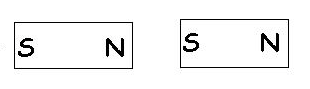
Magnets that are arranged like this will _______. 
a)
move away from each other (repel)
b)
move towards each other (attract)
106.
Two south poles will...
a)
attract
b)
repel 
107.
What will happen when these magnets are brought close together?
a)
They will attract each other.
b)
They will repel each other.
c)
Both magnets will turn to the left
d)
Both magnets will turn to the right
108.
A simple electromagnet can be made with which of the following?
a)
an electric current
b)
a turbine and nail
c)
a nail, a wire, and a battery
d)
a compass and a battery
109.
Magnetism is a type of ____________
a)
force
b)
book
c)
plant
d)
animal
110.
When two magnets attract, they ______________
a)
push apart
b)
change color
c)
get colder
d)
pull together
111.
When two magnets repel, they ________________
a)
change color
b)
pull together
c)
push apart
d)
get colder
112.
Magnets have a north and a south ___________
a)
shape
b)
color
c)
pole
d)
region
113.
Two north poles will attract.
a)
True
b)
False
114.
What would we call a nail that can pick up a paperclip because it is touching a magnet?
a)
temporary magnet
b)
poles
c)
force
d)
detector
115.
The force of magnetism is stronger when magnets are ________________
a)
cold
b)
round
c)
closer together
d)
farther apart
116.
Surrounding every magnet is a __________  __________.
a)
magnetic field
b)
electrical current
c)
another magnet
117.
How many poles does a magnet have?
a)
1
b)
2
c)
3
d)
4
118.
Magnets that are arranged like this will _______. 
a)
move away from each other (repel)
b)
move towards each other (attract)
119.
What happens if you cut a bar magnet in half?
a)
You get two North pole magnets
b)
You get two South pole magnets
c)
You get a North pole magnet and a South pole magnet
d)
You get two smaller magnets, each with a North and South pole
120.
The strongest point on a magnet is located
a)
In the magnetic field
b)
Center of the magnet
c)
At the Poles (close)
d)
At the Poles (further away) 
121.
GLASS
Magnetic or Non-Magnetic?
a)
magnetic
b)
non-magnetic
122.
NICKEL
Magnetic or
Non-Magnetic?
a)
magnetic
b)
non-magnetic
123.
How is a permanent magnet DIFFERENT from a temporary magnet?
a)
A permanent magnet attracts materials made of iron.
b)
A permanent magnet has poles.
c)
A permanent magnet has a magnetic field.
d)
A permanent magnet keeps its magnetism for a long time.
124.
On Earth, where is Magnetic North approximately located?
a)
The Equator
b)
The North Pole
c)
The South Pole
d)
New Brighton
125.
As the distance between two magnets increases (they get farther apart), the force between them:
a)
Increases
b)
Decreases
c)
Stays the Same
126.
A refrigerator magnet is an example of a:
a)
magnetic material
b)
permanent magnet
c)
horseshoe magnet
d)
temporary magnet
127.
A paper clip is an example of a:
a)
magnetic material
b)
permanent magnet
c)
bar magnet
d)
insulator
128.
If the North Pole of a permanent magnet is placed next to a compass as seen in the picture, which direction will the needle move?
a)
Clockwise
b)
Counter-clockwise
c)
It will not move
d)
Need more information
129.
This is an example of...
a)
attraction
b)
repulsion
130.

Which of the following is NOT a (ferro)magnetic metal?

a)

Copper

b)

Nickel

c)

Cobalt

d)

Iron

131.

What name is given to those parts of a magnet where the magnetic effect is most concentrated?

a)

Terminals

b)

Alloys

c)

Poles

d)

Attractors

132.

Which of the following is NOT found in the Periodic Table of the Elements?

a)

Selenium

b)

Steel

c)

Titanium

d)

Tin

133.

From the following list of forces, which is the odd-one-out?

a)

Weight

b)

Magnetism

c)

Electrostatics

d)

Friction

134.

The south-pole of a powerful bar magnet is brought close to a brass ring. Which of the following best describes what will happen?

a)

Nothing

b)

Attraction

c)

Levitation

d)

Repulsion

135.

The south-pole of a powerful bar magnet is brought to within 1 cm of a steel paperclip. Which of the following best describes what will happen?

a)

Nothing

b)

Attraction

c)

Repulsion

d)

Contraction

136.

Which of the following correctly describes the direction of a magnetic field?

a)

Strong to Weak

b)

North to South

c)

South to North

d)

Weak to Strong

137.

Which of the following could be repelled by the NORTH pole of a bar magnet.

a)

A pencil

b)

A steel paperclip

c)

A gold coin

d)

A magnet

138.

Which of the following arrangement of poles will produce a force of REPULSION?

a)

North - North

b)

North - South

c)

South - North

d)

South - South

139.

A steel paperclip (which is itself not a magnet) is attracted to the South pole of a bar magnet. This paperclip then exerts an attractive force on a second paperclip. What is this an example of?

a)

Electromagnetism

b)

Induced magnetism

c)

Permanent magnetism

d)

Ultra-magnetism

140.

Which of the following terms is used to describe the type of magnetism that is not easily removed?

a)

Induced magnetism

b)

Fixed magnetism

c)

Permanent magnetism

d)

Electromagnetism

141.

Which of the following best describes the magnetic field that surrounds a current-carrying wire?

a)

A double-helix

b)

Figure-of-eight

c)

A solenoid

d)

A circle with the wire at its centre

142.

What name is given to a coil of copper wire?

a)

Transformer

b)

Electromagnet

c)

Solenoid

d)

Monopole

143.

Which of the following has NO EFFECT on the strength of an electromagnet?

a)

The number of turns (loops) on the solenoid.

b)

The current that is flowing through the solenoid.

c)

The type of metal core placed through the solenoid.

d)

The government.

144.

In Fleming's Left-Hand Rule, what does the index finger indicate?

a)

The direction of the force on the wire.

b)

The direction of the current that flows through the wire.

c)

The direction of the magnetic field.

d)

The direction of the voltage that makes the current flow.

145.
Magnetism is generated by moving
a)
protons.
b)
electrons.
c)
neutrons.
d)
elements.
146.
What do the lines around this magnet represent?
a)
North Pole
b)
South Pole
c)
Magnetic Declination
d)
Magnetic Field
147.
If you place the North pole of a magnet next to the South pole of another magnet, they will:
a)
Attract
b)
Repel
c)
Do nothing
d)
Shatter
148.
A paper clip is an example of a:
a)
magnetic material
b)
permanent magnet
c)
bar magnet
d)
insulator
149.
What happens when two north poles of a magnet are placed together?
a)
they repel
b)
they attract
c)
they cancel each other out
d)
the strength of the magnet is doubled
150.
In un-magnetized materials the domains are __________ aligned.
a)
super
b)
slightly
c)
randomly
d)
always
151.
Region around a magnet in which magnetic force can act.
a)
Magnetic field 
b)
Magnetic force
c)
Domain
d)
Perimeter
152.
Two south poles will...
a)
attract
b)
repel 
153.
Magnets that are arranged like this will _______. 
a)
move away from each other (repel)
b)
move towards each other (attract)
154.
The strongest part of a magnet is...
a)
the bars.
b)
the force field.
c)
the poles. 
d)
the middle.
155.
Iron and steel can become _____.
a)
magnetized
b)
transformed into plastics
c)
lined up to the poles
d)
part of the equator
156.
What will happen when these magnets are brought close together?
a)
They will attract each other.
b)
They will repel each other.
c)
Both magnets will turn to the left
d)
Both magnets will turn to the right
157.
As the distance between two magnets increases (they get farther apart), the force between them:
a)
Increases
b)
Decreases
c)
Stays the Same
158.
If you cut a magnet in half, what happens to the poles?
a)
One half gets the North Pole, the other half gets the South Pole
b)
Both halves get only a North Pole
c)
Both halves get only a South Pole
d)
Both halves get a North pole and a South Pole
159.
What is responsible for the Magnetic Field around Earth?
a)
The Earth's crust
b)
The Earth's molton iron core
c)
The Earth's mantel
d)
The Sun
160.
An electromagnet's poles may be reversed by:
a)
decreasing the voltage of the coil
b)
increasing the number of coils
c)
changing the direction of current flow
d)
altering the material used to make the coils