wayground logo

Free Printable Worksheets

Font size

S
M
L
XL
Worksheets

ELS Mega Reviewer for 2nd Quiz

Total questions: 142

Worksheet time: 3hrs 50mins

Name
Class
Date
1.

Which layer of the atmosphere has meteors?

a)

troposphere

b)

stratosphere

c)

mesosphere

d)

thermosphere

2.

Which layer of the atmosphere contains the ionosphere?

a)

troposphere

b)

stratosphere

c)

mesosphere

d)

thermosphere

3.

Which layer of the atmosphere has weather?

a)

troposphere

b)

stratosphere

c)

mesosphere

d)

thermosphere

4.

Which layer of the atmosphere contains the ozone?

a)

troposphere

b)

stratosphere

c)

mesosphere

d)

thermosphere

5.

Temperature increases with height in the ______ due to solar radiation.

a)

troposphere

b)

stratosphere

c)

mesosphere

d)

thermosphere

6.

Temperature increases with height in the ______ due to the ozone trapping heat.

a)

troposphere

b)

stratosphere

c)

mesosphere

d)

thermosphere

7.

Temperature decreases with height in the ______ because there is nothing but thin air.

a)

troposphere

b)

stratosphere

c)

mesosphere

d)

thermosphere

8.

Temperature decreases with height in the ______ because the heat from the surface rises and cools.

a)

troposphere

b)

stratosphere

c)

mesosphere

d)

thermosphere

9.

Which is not a factor that influences daily weather?

a)

heat

b)

air pressure

c)

elevation

d)

moisture

10.

What is the term for the day to day conditions of the atmosphere?

a)

weather

b)

climate

c)

hurrican

d)

global wind

11.

Which prevailing wind can be found between 30 and 60 degrees latitude?

a)

trade winds

b)

horse winds

c)

eaterlies

d)

westerlies

12.

Which prevailing wind can be found between 60 and 90 degrees latitude?

a)

trade winds

b)

horse winds

c)

eaterlies

d)

westerlies

13.

Which prevailing wind can be found between 0 and 30 degrees latitude?

a)

trade winds

b)

horse winds

c)

eaterlies

d)

westerlies

14.

Which gas makes up the largest portion of air?

a)

oxygen

b)

nitrogen

c)

carbon dioxide

d)

methane

15.

What do you call the part of the atmosphere where molecules escape into space?

a)

doldrums

b)

ionosphere

c)

exosphere

d)

dead zone

16.

Ray of sunlight hitting the equator directly results in:

a)

fires

b)

cold weather

c)

a low pressure system

d)

a high pressure system

17.

What protects the earth from harmful UV rays from the sun?

a)

clouds

b)

ionosphere

c)

nitrogen gases

d)

the ozone

18.

Which type of cloud is this?

a)

cirrus

b)

stratus

c)

cumulus

19.

Which type of cloud is this?

a)

cirrus

b)

stratus

c)

cumulus

20.

Which type of cloud is this?

a)

cirrus

b)

stratus

c)

cumulus

21.
Which factor does NOT affect temperature: 
a)
Latitude.
b)
Distance from the sea.
c)
Longitude. 
d)
Altitude.
22.

Areas near the sea are cooler in summer and warmer in winter.

a)

True

b)

False

23.

What causes changes in seasons?

a)

The earth spinning

b)

The earth tilting on its axis

c)

The earth revolving around the sun

d)

The earth's elliptical orbit

24.

In New York State there is a greater chance of precipitation falling as snow in January than in March, because in January the Northern Hemisphere is tilted:

a)

toward the Sun, and temperatures are warmer

b)

toward the Sun, and temperatures are colder

c)

away from the Sun, and temperatures are warmer

d)

away from the Sun, and temperatures are colder

25.
Several months during the year that have similar temperatures 
a)
Season
b)
climate
c)
weather
d)
Summer
26.
Rain, snow sleet, or hail that falls from the clouds in the sky
a)
humidity
b)
liquid
c)
precipitation
d)
weather
27.
Average weather conditions of a region year after year
a)
weather
b)
season
c)
cold front
d)
climate
28.
Which observation describes a change in climate rather than a change in weather?
a)
The thunderstorm dropped about three centimeters of rain today.
b)
The average summer temperatures have increased over the last ten years.
c)
 The snowfall in this area was more this week than it was last week.
d)
The average wind speed in April was less than it was in March.
29.
Which statement about Hawaii refers to its climate?
a)
A blizzard occurs on one of Hawaii’s tallest mountain peaks.
b)
A high temperature of 37.8°C was recorded earlier today in Hawaii.
c)
The mountains were shaded by cumulus clouds on a Tuesday afternoon.
d)
The coolest months are February and March.
30.
Two major factors used to identify climate are?
a)
longitude and latitude
b)
temperature and precipitation
c)
lattitude and temperature
d)
layers in the atmosphere
31.

A small, very intense cyclonic storm with exceedingly high winds, most often produced along cold fronts in conjunction with severe thunderstorms

a)

hurricane

b)

tornado

c)

air mass

d)

cold front

32.

Lines of latitude are also known as:

a)

parallels

b)

perpendiculars

c)

longitude

d)

rungs

33.

Lines of latitude run in which direction?

a)

east and west

b)

north and south

34.

Lines of latitude measure _______ and __________ from the equator?

a)

east and west

b)

north and south

35.

Lines of longitude run in which direction?

a)

east and west

b)

north and south

36.

Lines of longitude measure ________ and ___________ from the Prime Meridian

a)

east and west

b)

north and south

37.

The areas between the equator and 30 degrees North/South is known is also known as _________ AND ____________.

a)

low latitudes

b)

high latitudes

c)

tropical climate zone

d)

temperate climate zone

e)

arctic climate zone

38.

The areas between the 30 and 60 degrees North/South is known is also known as _________ AND ____________.

a)

middle latitudes

b)

high latitudes

c)

tropical climate zone

d)

temperate climate zone

e)

arctic climate zone

39.

The areas between the 60 and 90 degrees North/South is known is also known as _________ AND ____________.

a)

middle latitudes

b)

high latitudes

c)

tropical climate zone

d)

temperate climate zone

e)

arctic climate zone

40.

The climatic effect shown in this photo where one side of the mountains receives less precipitation is known as:

a)

rainshadow

b)

monsoon

c)

rain cycle

d)

wind convection

41.

Which theory proposes that the universe originated from a singularity and underwent rapid expansion?

a)

Steady State Theory

b)

String Theory

c)

Cyclic Universe Theory

d)

Big Bang Theory

42.

The Steady State Theory suggests that the universe:

a)

originated from a singularity.

b)

experiences continuous cycles of expansion and contraction.

c)

is composed of vibrating strings.

d)

is a computer simulation.

43.

String Theory and Brane Theory seek to unify which two fundamental forces?

a)

electromagnetic and gravitational

b)

gravitational and strong nuclear

c)

weak nuclear and strong nuclear

d)

electromagnetic and weak nuclear

44.

What does the Inflation Theory explain about the early universe after the Big Bang?

a)

rapid expansion

b)

cyclic patterns

c)

collisions of branes

d)

continuous creation of matter

45.

The Multiverse Theory proposes the existence of:

a)

a single universe with perfectly tuned properties.

b)

multiple universes with different properties.

c)

a simulated reality.

d)

a cyclic universe.

46.

Which theory suggests that the universe is a computer simulation?

a)

Inflation Theory

b)

Quantum Fluctuation Hypothesis

c)

Simulated Universe Hypothesis

d)

Ekpyrotic Universe Theory

47.

The Cyclic Universe Theory proposes that the universe experiences:

a)

rapid expansion from a singularity.

b)

continuous cycles of expansion and contraction.

c)

vibrations of strings.

d)

collisions of branes.

48.

The Quantum Fluctuation Hypothesis suggests that the universe:

a)

emerged from a singularity.

b)

experiences continuous cycles of expansion.

c)

originated from a quantum fluctuation.

d)

is composed of vibrating strings.

49.

Mythological Theories explain the origin of the universe through:

a)

empirical evidence and observations.

b)

mathematical models and calculations.

c)

deities and cosmic forces in cultural narratives.

d)

quantum fluctuations in the vacuum.

50.

The Simulated Universe Hypothesis raises questions about:

a)

the fine-tuning of the universe.

b)

the origin of quantum fluctuations.

c)

the nature of reality and our existence.

d)

the expansion of the universe.

51.

Which theory suggests that the universe emerged from a collision of branes?

a)

String Theory

b)

Inflation Theory

c)

Simulated Universe Hypothesis

d)

Ekpyrotic Universe Theory

52.

Which theory proposes continuous creation of matter to maintain a constant density universe?

a)

Big Bang Theory

b)

Steady State Theory

c)

Multiverse Theory

d)

Inflation Theory

53.

The main implication of String Theory and Brane Theory is to:

a)

explain the early expansion of the universe.

b)

address the fine-tuning of the universe.

c)

unify quantum mechanics and gravity.

d)

suggest the existence of multiple universes.

54.

The Cosmic Microwave Background Radiation is evidence supporting:

a)

the Cyclic Universe Theory.

b)

the Big Bang Theory.

c)

the Inflation Theory.

d)

the Quantum Fluctuation Hypothesis.

55.

Which theory proposes that the universe experiences eternal cycles of expansion and contraction?

a)

Big Bang Theory

b)

Multiverse Theory

c)

Cyclic Universe Theory

d)

String Theory

56.

Which theory addresses the fine-tuning of the universe by suggesting multiple universes with different properties?

a)

Simulated Universe Hypothesis

b)

Quantum Fluctuation Hypothesis

c)

Steady State Theory

d)

Multiverse Theory

57.

Which theory suggests that the universe emerged from a quantum fluctuation caused by the Heisenberg Uncertainty Principle?

a)

Ekpyrotic Universe Theory

b)

Inflation Theory

c)

Quantum Fluctuation Hypothesis

d)

Steady State Theory

58.

The main implication of the Inflation Theory is to explain:

a)

the origin of mythological narratives.

b)

the fine-tuning of the universe.

c)

the continuous creation of matter.

d)

the rapid expansion of the early universe.

59.

Which theory proposes that our reality is a computer simulation?

a)

Inflation Theory

b)

Simulated Universe Hypothesis

c)

Big Bang Theory

d)

Cyclic Universe Theory

60.

The primary focus of the Cyclic Universe Theory is on:

a)

unifying quantum mechanics and gravity.

b)

explaining the early expansion of the universe.

c)

proposing multiple universes with different properties.

d)

eternal cycles of expansion and contraction.

61.

The solar nebula that formed our solar system was thought to be put in motion by a ______.

a)

nearby supernova

b)

black hole

c)

creative intelligence

d)

condensation nucleus

62.

What is most likely to be found in a nebula?

a)

planets

b)

asteroids

c)

stars

d)

gas clouds

63.

The scientist who first challenged the Earth-centered Universe model was _______.

a)

Newton

b)

Ptolemy

c)

Copernicus

d)

Galilei

64.

All of the following are hypotheses of the formation of the solar system EXCEPT

a)

Big Bang Hypothesis

b)

Nebular Hypothesis

c)

Protoplanet Hypothesis

d)

Encounter Hypothesis

65.

Our solar system began as a ________.

a)

quasar

b)

neutron star

c)

nebula

d)

atom

66.

What is the age of our solar system?

a)

4.7 billion years old

b)

4.6 million years olm

c)

500 billion years old

d)

17.2 billion years old

67.

The expansion of the universe is ________.

a)

a steady process with no identifiable events

b)

a steady process that is punctuated by abrupt transitions

c)

a jumpy process that is completely unpredictable.

d)

no longer occurring today.

68.

What are Nebular Clouds?

a)

an interstellar cloud of dust, hydrogen, helium and other ionized gases

b)

an increase (or decrease) in the frequency of sound, light, or other waves

c)

the galaxy that contains our Solar System

d)

a particle attracts every other particle in the universe

69.

Which of the following puts the events in order from first to last?

a)

Big Bang, our sun, first star, life on Earth

b)

Big Bang, first star, our sun, life on Earth

c)

Big Bang, life on Earth, our sun, first star

d)

First star, Big bang, life on Earth, our sun

70.

A model of the universe in which Earth is at the center of the revolving planets and stars. This includes the sun revolving around the Earth. This model is no longer supported.

a)

Heliocentric

b)

Geocentric

c)

Paleozoic

d)

Mesozoic

71.

Which of the following is not a gas giant?

a)

Jupiter

b)

Mercury

c)

Pluto

d)

Saturn

72.
Which BEST describes the rock cycle?
a)
New rocks form from older rocks.
b)
Lunar rocks change into terrestrial rocks.
c)
Rocks in the ocean become rocks on land.
d)
Layers of rock are broken by faults.
73.
How are sedimentary rocks, such as shale and sandstone, formed?
a)
Particles are changed into liquids.
b)
Particles are compressed into layers.
c)
Particles are melted together by magma.
d)
Particles are heated by the Sun.
74.
In order for sediments to become rock, the sediments are generally
a)
liquefied.
b)
compacted.
c)
returned to their origins.
d)
mixed with organic material.
75.
One condition necessary to produce diamonds is
a)
low temperatures
b)
quick cooling
c)
intense pressure
d)
high altitude
76.
Which of these substances is a mineral?
a)
sandstone
b)
granite
c)
quartz
d)
coal
77.
Which processes must occur in order for an igneous rock to change into a metamorphic rock?
a)
heating and pressure
b)
compaction and cementation
c)
melting and cooling
d)
uplift and erosion
78.
Which process forms the mineral halite?
a)
the slow crystallization of magma deep in the crust
b)
the cementing together of sediment particles
c)
the hardening of lava in seawater
d)
the evaporation of seawater
79.
Which process forms both metamorphic and sedimentary rock?
a)
recrystallization
b)
heating
c)
weathering
d)
compacting
80.
When buried sediments are subjected to pressure, the mineral grains are squeezed together. This causes
a)
layers to rise to the surface
b)
new rock to be formed
c)
earthquakes
d)
volcanoes
81.
Which processes change magma into igneous rock?
a)
weathering and erosion
b)
heat and pressure
c)
compaction and cementation
d)
cooling and crystallization
82.
Gneiss is a rock because it
a)
is hard and round.
b)
has crystals.
c)
is made of minerals.
d)
has mass.
83.
Which statement is true about rocks?
a)
Magma is made of solid rock.
b)
Rocks are made of one or more minerals.
c)
Crystals are made of rocks.
d)
Minerals are made of one or more rocks.
84.
Minerals are made of one or more
a)
minerals.
b)
sediments.
c)
elements.
d)
rocks.
85.
One rock was formed from rapidly cooling lava and is smooth and glassy. The other rock was formed from slow-cooling magma, so has large crystals. Which rock property is represented by these characteristics?
a)
color
b)
texture
c)
fracture
d)
hardness
86.
Which sentence BEST describes a process in the rock cycle?
a)
Sedimentary rocks can melt to become metamorphic rocks.
b)
Volcanoes can deposit sedimentary rock to form mountains.
c)
Metamorphic rocks can form by the weathering process.
d)
Igneous rocks can become metamorphic and sedimentary rocks.
87.
Which process causes sand grains to stick together to form sandstone?
a)
cementation
b)
abrasion
c)
combustion
d)
erosion
88.
Which type of rock is formed when particles are compacted and cemented together?
a)
igneous
b)
metamorphic
c)
sedimentary
d)
metallic
89.
Coal is formed from
a)
plant remains decomposed under pressure.
b)
melted and cooled metamorphic rock.
c)
natural gas subjected to heat.
d)
seas that have evaporated.
90.
Sedimentary rock forms when rock is first
a)
broken down by weathering.
b)
melted into liquid magma.
c)
exposed to great temperature.
d)
crystallized into natural glass.
91.
Minerals are formed by which process?
a)
sedimentation
b)
metamorphosis
c)
fault lines moving
d)
magma cooling
92.

What layer of the earth is made of liquid magma?

a)

innner core

b)

mantle

c)

crust

d)

outer core

93.
What layer of the earth is made of soild iron and nickel?
a)
innner core
b)
mantle
c)
crust
d)
outer core
94.
naturally occuring chemical element or inorganic compound thats exists as a solid
a)
rock
b)
mineral
c)
ore
d)
natural gas
95.
Which is not a characteristic of all minerals?
a)
definite chemical composition
b)
man-made
c)
organic
d)
soild
96.
You scratch rocks together to see which one leaves a mark, what are you testing?
a)
luster
b)
hardenss
c)
streak
d)
density
97.
If you scrape a rock across a piece of porcelain, what identification property are you testing?
a)
luster
b)
hardenss
c)
streak
d)
density
98.
solid combination of one or more minerals found in the earth’s crust
a)
rock
b)
mineral
c)
ore
d)
natural gas
99.

Which is TRUE about the continental crust?

a)

It is thinner than oceanic crust

b)

It is denser than oceanic crust

c)

It is thicker but less dense than the oceanic crust

d)

It is thinner and more dense than the oceanic crust

100.

Earth’s lithosphere is made up of what layer/s?

a)

Crust

b)

Mantle

c)

Crust and Mantle

d)

Crust and upper mantle

101.

Which is NOT true about the lithosphere?

a)

It has the same thickness everywhere

b)

It is the outermost part of the earth

c)

It is composed of the continents and the ocean floor

d)

It varies in thickness

102.
Which of the following is a fossil fuel?
a)
Wind
b)
Coal
c)
Solar
d)
Biomass
103.
What characteristic do all renewable resources share?
a)
Produced by waste products
b)
Form underground from dead organisms.
c)
Replaced in a short period of time
d)
Allow energy to pass through them easily
104.
Petroleum and natural gas form from...
a)
strong winds
b)
cooled magma
c)
radioactive materials
d)
remains of plants and animals 
105.
The careful use of a resource is....
a)
recycling
b)
pollution
c)
depositing
d)
conservation
106.
The type of energy that cattle create is ________? 
a)
biomass
b)
solar
c)
natural gas
d)
nuclear
107.
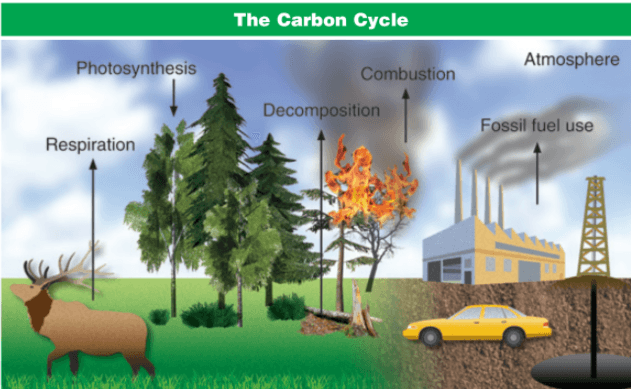
Carbon enters the living world through the process of _____.
a)
photosynthesis
b)
respiration
c)
combustion
d)
decomposition
108.
In the atmosphere, carbon attaches to oxygen to form _____.
a)
C
b)
O
c)
CO
d)
C6H12O6
109.
The process of burning is called _____.
a)
decomposition
b)
combustion
c)
respiration
110.
In this diagram, how many ways can carbon enter the living world?
a)
one
b)
two
c)
three
d)
four
111.
Burning fossil fuel has which effect in the carbon cycle?
a)
It removes carbon dioxide from the atmosphere.
b)
It puts carbon dioxide under the ground.
c)
It adds carbon dioxide to the atmosphere.
d)
It has no effect in the carbon cycle.
112.
What word describes when water is attracted to other substances?
a)
cohesion
b)
adhesion
c)
capillary action
d)
surface tension
113.

When water and other liquids stick together to form drops or thin films called ________________.

a)

adhesion

b)

capillary action

c)

cohesion

d)

surface tension

114.
molecule in which opposite ends have opposite electric charges
a)
cohesion
b)
polar molecule
c)
hydrogen bond
d)
solution
115.
Why does ice float?
a)
As water freezes, it expands and its density decreases.
b)
As water freezes, it takes up more hydrogen from the atmosphere, causing it to have a greater buoyancy.
c)
As water freezes, air becomes trapped between the hydrogen bonds of water molecules.
d)
As water freezes, it takes up more oxygen from the atmosphere, causing it to have a greater buoyancy.
116.
The reason the water balloon did NOT pop while held over a flame is water's _________.
a)
Less dense than air.
b)
Hydrogen bonds between water molecules.
c)
polarity.
d)
high specific heat capacity.
117.
Water is a universal solvent because it...
a)
It can be found anywhere
b)
It freezes when it gets cold
c)
floats when frozen
d)
Dissolves most substances
118.
The fact that ice floats on liquid water is due to the fact that water's solid is ___________ than it's liquid form
a)
less polar
b)
more polar
c)
less dense
d)
more dense
119.
Water striders can walk across the surface of calm water. Their feet push the surface of the water down slightly, but they do not break the surface. Why?
a)
The insects are light enough so they do not break the hydrogen bonds holding the water molecules together
b)
The insects actually use their wings to hover slightly above the water’s surface and they only skim it with their feet.
c)
The insect’s feet are non-polar, so they are repelled by the polar water molecules and are pushed away from the water’s surface.
d)
The insects are small enough to see the individual water molecules, so they are able to step carefully from one molecule to the next
120.
A general definition of cohesion is the attraction of:
a)
particles of the same substance
b)
particles of a different substance
c)
particles of both the same and different substances
d)
particles of neither the same or different substances
121.

What property of water allows water to flow against gravity?

a)

Polarity

b)

Cohesion

c)

Capillary Action

d)

Adhesion

122.
Which of these is an example of precipitation?
a)
snow
b)
air
c)
clouds
d)
vapor
123.
Which is the opposite of condensation?
a)
runoff
b)
evaporation
c)
precipitation
d)
transpiration
124.
Snow, sleet, hail, and rain are all examples of  ________________. 
a)
evaporation
b)
condensation
c)
accumulation
d)
precipitation
125.
What does groundwater do?
a)
It sends water to our buildings, houses, and water transplant places
b)
Goes to the sky
c)
Goes to the sun
d)
Provides rivers
126.
When water _________, dew forms.
a)
Melts
b)
Evaporates
c)
Condenses
d)
Precipitates
127.
Fresh water makes up what percent of the Earth's water?
a)
5%
b)
10%
c)
4%
d)
3%
128.
Most of the Fresh water on Earth is
a)
in the ocean
b)
underground
c)
frozen
d)
in rivers
129.
Fresh water gathers in depressions in the ground.  These are called
a)
Lakes
b)
Oceans
c)
Glaciers
d)
the polar cap
130.
A watershed is an 
a)
area that drains into a stream or river
b)
section of land that juts into the ocean
c)
the shoreline of the ocean
d)
the end of a continent
131.
Which three words have the same meaning of an area of the ocean partially enclosed by land?
a)
watershed, cliff, valley
b)
gulf, bay, sea
c)
water table, aquifer, glacier
d)
delta, beach,shoreline
132.
The largest reservoir of fresh water on Earth is found in 
a)
glaciers
b)
harbors
c)
gulfs
d)
bays
133.

What % of earth's water is drinkable fresh water ?

a)

less than 5% but higher than 3%

b)

less than 3% but higher than 1%

c)

less than 70% but higher than 5%

d)

less than 1%

134.

6.What % of earth's water is in the ocean?

a)

70%

b)

85%

c)

90%

d)

97%

135.
What causes surface currents?
a)
wind
b)
salinity
c)
temperature
d)
density
136.
What causes deep currents?
a)
differences in density
b)
wind
c)
weather
d)
Coriolis effect
137.
Which process will increase the salinity of ocean water?
a)
evaporation
b)
currents
c)
Coriolis effect
d)
density
138.
How are salts added to the ocean?
a)
precipitation
b)
evaporation
c)
erosion from land
d)
density
139.
What is a flat plain deep in the ocean?
a)
abyssal plain
b)
trench
c)
mid ocean ridge
d)
continental shelf
140.
What underwater features are formed at plate boundaries?
a)
trenches and mid-ocean ridges
b)
continental shelf and slope
c)
abyssal plains and mountains
d)
guyots and seamounts
141.
We have _____ tides each day.
a)
1 high and 1 low
b)
2 high and 2 low
c)
4 high
d)
it depends
142.
What causes tides?
a)
wind
b)
differences in density
c)
gravity from the moon
d)
plate tectonics