
 Worksheets
Finals Prep-Year Recap (2022)
Total questions: 141
Worksheet time: 23hrs 55mins
Measure weight using a ______________
balance
machine
lever
N/A
If water spills on the lab bench you should let the teacher/instructor know immediately
True
False
A _______ is used for a rough measurement of liquid
Flask
Beaker
Graduated cylinder
Test tube
N/A

This is ______ mm
1.4
14
0.14
N/A
Base unit for volume/liquids is the _____ and it's symbol is ______
milliliter - mL
milliliter- Lr
liter - L
gram - gr
N/A
Never put a _____________directly under the ________________________
graduated cylinder - faucet
graduated cylinder - scale
beaker - faucet
beaker - scale
graduated cylinder - faucet
N/A
You can only drink water in the laboratory area. No other foods or drinks
True
False
Report any accidents to the teacher _____________, no matter how minor, including reporting any burn, scratch, cut, or corrosive liquid on skin or clothing.
by the end of class
after the lab is done
once you've helped the person
N/A
Inform the teacher _________________ of any equipment not working properly.
Immediately
after you and one other group member has attempted to fix it
When Mr. Avila visits your station
N/A
Prepare for each laboratory activity by _____ instructions before coming to class. Follow all directions.
skimming
reading all
memorizing all
N/A
Notify the teacher of any spill on the floor or work space
_____________
Only if it is flammable
Once the lab is done
When Mr. Avila visits the station
N/A
Always _________ before leaving
clean the lab area
submit late work
put lab equipment in a pile
N/A
Base unit for weight/solids is the _____ and it's symbol is ______
milligram - mg
gram - gr
gram - g
milligram - mm
N/A
Kilogram (symbol)
kL
kgr
kdg
kgs
N/A
Measure weight using a ______________
scale
machine
analytical beam
lever
N/A
If water spills on the lab bench you should let the teacher/instructor know immediately
True
False
The metric system is based on ___________
Decimals
The number 10
Fractions
Coefficients
N/A
A _______ is used for an exact measurement of liquid
Flask
Beaker
Graduated cylinder
Test tube
N/A
A _______ is used for a rough measurement of liquid
Flask
Beaker
Graduated cylinder
Test tube
N/A
This is ______ mm
1.4
14
0.14
N/A

This is _________ mm
0.18
1.8
18
N/A
Base unit for volume/liquids is the _____ and it's symbol is ______
milliliter - mL
milliliter- Lr
liter - L
gram - gr
N/A
Base unit for volume/liquids is the _____ and it's symbol is ______
milliliter - mL
milliliter- Lr
liter - L
gram - gr
N/A
This is _________ mm
0.18
1.8
18
N/A
Which unit of the metric system is used for measuring VOLUME?
Meters
Liters
Grams
Ounces
What base unit is used in the metric system to measure LENGTH?
Meters
Liters
Grams
Miles
What unit is used for measuring MASS in the metric system?
Grams
Liters
Meters
Miles
The Canary current is part of the _________ gyre
North Atlantic
South Atlantic
North Pacific
N/A
The south Atlantic gyre would move
clockwise
counterclock wise
The Brazil Current belongs to the ______ gyre
South Pacific
North Atlantic
South Atlantic
N/A
In the coordinate system longitude is the _______number
1st
2nd
3rd
N/A
The north pacific current is followed by -->
california current
kurishio current
____________move with the currents and transmit their location.
Drifter
Fixed Bouy
Tracer
N/A
The gulf stream is followed by -->
North Atlantic Current
North Pacific Current

Which number is the Benguela Current?
11
13
7
N/A
Which number is the North Pacific Current?
1
12
18
N/A

What gyre is this? You should know this without your map
NPG
NAG
SAG
N/A

What gyre is this? You should know this without your map
NPG
NAG
SAG
N/A

What gyre is this? You should know this without your map
NPG
NAG
SAG
N/A
You can measure ______ with grams.
N/A
volume
conductivity
melting point
If an object has a density of 1.2 g/mL and you put it into water, will it sink or float?
sink
float

An object is 4 g and is 2 g/cm3.
D=
m=
v=
0.5 cm3
2 cm3
3 cm3
N/A
Box is 2 cm x 1 cm x 4 cm and weighs 8 grams.
D=
m=
v=
16 g/cm3
1 g/cm3
0.75 g/cm3
N/A
An object is 16g and is 4cm3.
D=
m=
v=
64 cm3
4 cm3
0.25 cm3
N/A
An object is 2 cm3 and is 4g/cm3.
D=
m=
v=
2 g
8 g
0.50 g
N/A
An object is 2 cm3 and is 4g/cm3.
D=
m=
v=
2 g
8 g
0.50 g
N/A
An object is 4g and is 2cm3.
D=
m=
v=
0.50 g/cm3
N/A
Chemistry is the study of _______ and how it can change
neutrons
bonds
protons
N/A
In a _____ bond two atoms share electrons equally
Ionic
Hydrogen
Covalent
N/A
water molecules sticking to other objects _____
hydrohesion
N/A
cohesion
polarhesion
In a _____ bond two atoms share electrons unequally
Ionic
Hydrogen
Covalent
N/A
water molecules sticking to itself is _____
hydrohesion
adhesion
cohesion
polarhesion
N/A
On a water molecule oxygen has a slightly _______ charge
positive
negative
neutral
N/A
On a water molecule hydrogen has a slightly _______ charge
positive
negative
neutral
N/A
There are ____ states of water
5
4
3
N/A
When one atom transfers (takes away) an electron to another atom creating 2 charged particles (+ & -).
idelic bond
Non-covalent bond
saturated bond
N/A
______symbol for Sodium
So
Cl
K
N/A
______symbol for Chloride
Ch
Ce
Co
N/A
______symbol for Carbonate
CO3-
CO4-
CO2-
N/A
the property of water that allows it to absorb and store heat is known as ___________________
Heat Capacity
Heat Retention
Heat Absorbtion
N/A
___________is the gas used for Photosynthesis
Carbon Dioxide
Nitrogen
Oxygen
N/A
___________is the gas used for respiration
Carbon Dioxide
Carbon
Calcium Chloride
N/A

The____________ bond holds water molecules (2 of them) together. Shown as dashed lines
Hydrogen
Polar Ionic
Covalent
N/A
On a water molecule hydrogen has a slightly _______ charge
positive
negative
neutral
N/A
On a water molecule hydrogen has a slightly _______ charge
positive
negative
neutral
N/A
_______shows how energy is transferred from one organism to another. Typically 4-5 organisms
Food Web
Food Supply
Energy Pyramid
N/A
________is any organism that eats only producers.
1st Consumer
2nd Consumer
3rd Consumer
N/A
On average ______% of energy moves on to the next level of the food chain
90
10
50
N/A
Photosynthesis produces ________ (sugar) for the system
fructose
maltose
N/A
glucose
_________A living part of an organism's habitat.
biotic factor
nonbiotic factor
ecofactor
N/A
You make a 7000 ml batch of sea monkeys.
You and your team take 4 samples. Each sample is 2ml. There were a total of 80 sea monkeys.
a =
2
3500
8
75
N/A
You make a 7000 ml batch of sea monkeys.
You and your team take 2 samples. Each sample is 5ml. There were a total of 80 sea monkeys.
N=
90800
36000
56000
85000
N/A
There are a total of 500 desks in the U building. Your team samples 20 desks. They find a total of 90 pieces of gum.
n=
90
10
3500
2880
N/A
________ is an organism that obtains energy by only eating autotrophs
Herbivore
Omnivore
Photoivore
N/A
There is a 1000 square meter forest. You go and sample 4 square meters. You count a total of 50 trees. N =
12500
80
800
N/A
You make a 4800 ml batch of sea monkeys.
You and your team take 3 samples. Each sample is 5 ml There were a total of 340 sea monkeys. N=
90800
108800
50000
85000
N/A
On the second day you capture 500 fish and 16 have the mark. You originally marked 80 fish. What is the estimated population size N=
2500
1000
50
N/A
On the second day, you capture 455 fish and 8 have the mark. You originally marked 45 fish.
n =
11
25
275
N/A
On the second day, you capture 455 fish and 8 have the mark. You originally marked 45 fish.
n =
11
25
275
N/A
Seaweed/algae/Phytoplankton are considered _____ level consumers
1st
2nd
N/A
0
____% of energy lost from one level to the next
10
20
N/A
90
_____________ is a diagram that shows the complex feeding relationships between organisms in an ecosystem
Food Web
Food Supply
Energy Pyramid
N/A
__________________: Method used for medium to large size organisms.
Mark and recapture
Mark and release
Random sampling
N/A
For our class you need at least ______ plots/squares to get an average when doing random sampling
2
3
4
5
N/A

In this diagram, the orca would be considered a ____ level consumer
6
5
4
3
N/A
________ is an organism is eating 2nd level and 3rd level consumers if would be considered a
Carnivore
Herbivore
Omnivore
N/A
Glucose Formula _______________
C6H12O6
C3H2O6
C12H12O6
N/A
C8H10O6
Level 0 had 7500 calories. Level 3 would receive ______________ calories.
0.75
7.5
75
0.075
N/A
________ is an organism that obtains energy by eating autotrophs and/or heterotrophs.
Herbivore
Carnivore
Omnivore
N/A
________ is a diagram that shows the complex feeding relationships
Food Web
Food Supply
Energy Pyramid
N/A
____________ are at the base of the food chain
1st level consumers
producers
heterotrophs
N/A
Zooplankton
_____________4000-6000m
Epipelagic
Hadelpelagic
Mesopelagic
N/A
Marine Algae live in the __________ zone
abyssopelagic
epipelagic
bathypelagic
N/A
Which of the following has light, AND is enough for photosynthesis to occur?
epipelagic
bathypelagic
hadalpelagic
N/A

C is the __________
Stem
Holdfast
Stipe
N/A
Connector
___________________ would be unicellular algae
uniplankton
phytoplankton
seaweeds
N/A
Has chlorophyll A and C
Red seaweed pigments
Brown seaweed pigments
Green seaweed pigments
N/A
What is the process (equation) for photosynthesis?
6CO2 + C6H12O6 --> 6H2O + 12O
6CO2 + 6H2O -> C6H12O6 + 6O2
2CO2 + C6H12O6 --> 6H2O + 6O2
N/A

Belongs to Phylum_______
Phaeophyta
Rhodophyta
Chlorophyta
N/A

Coralline red algae
Phaeophyta
Rhodophyta
Chlorophyta
N/A

This would be
Feather boa
Sea Palm
Bull Kelp
N/A

sea lettuce
rockweed
bull kelp
giant kelp
N/A
_____________4000-6000m
Epipelagic
Hadelpelagic
Mesopelagic
N/A
Has chlorophyll A and C
Red seaweed pigments
Brown seaweed pigments
Green seaweed pigments
N/A
What percent of ocean species live in the first light layer?
85-90
15-35
35-70
N/A
Which of the following is the correct order of the light zones?
EMBHA
EHMAB
EMHBA
N/A
_____________200-1000m
Epipelagic
Hadelpelagic
Abyssopelagic
N/A
The correct order of the zones
Epipelagic
Mesopelagic
Bathypelagic
Abyssopelagic
Hadalpelagic
Which of the following has light, but NOT enough for photosynthesis to occur?
epipelagic
bathypelagic
hadalpelagic
N/A
Sea Sacs
Red Seaweed Examples
Green Seaweed Examples
Brown Seaweed Examples
N/A
Bull Kelp
Red Seaweed Examples
Green Seaweed Examples
Brown Seaweed Examples
N/A
Red seaweed pigments
Has red pigments
Brown seaweed pigments
Has Chlorophyll A & C
Green seaweed pigments
Has Chlorophyll A
Sea Lettuce
Red Seaweed Examples
Green Seaweed Examples
Brown Seaweed Examples
N/A
The part of a seaweed that "looks" like a root but is not
float
blade
holdfast
N/A
What are the starting products of Photosynthesis
6H2O +12 CO2
12 H2O + 6 CO2
6H2O + 6 CO2
N/A
___________________ would be multicellular algae
uniplankton
phytoplankton
seaweeds
N/A

This bond is responsible for
cohesion
hydrohesion
adhesion
N/A


The slightly positive oxygen will be attracted to the positive chloride ion
True
False
If the volume of an object is 40 ml and the mass is 80 g then the density would be 0.5 g/ml
True
False
You put 5g of salt in 1000 ml of water. The salinity is _____________ ppt
5
0.005
10
5000
N/A
You put 10 g of salt in 2000 ml of water. The salinity is _____________ ppt
5
200
20,000
50
N/A
You put 3 g of salt in 3000 ml of water. The salinity is _____________ ppt
9000
0.003
0.03
N/A
You put 5 g of salt in 500 ml of water. The salinity is _____________ ppt.
If you had a 1000 ml of this how much salt would it have?
10
100
2500
N/A
You put 4 g of salt in 250 ml of water. The salinity is _____________ ppt.
If you had a 1000 ml of this how much salt would it have?
16
1000
62.5
0.016
N/A
You have a solution that is 200 ppt and you have 2000 ml of it. How many grams of salt.
200 g
100 g
40 g
N/A
You have a solution that is 20 ppt and you have 1500 ml of it. How many grams of salt.
30 g
15 g
10 g
N/A
You can only drink water in the laboratory area. No other foods or drinks
True
False

1.5 m = ______________mm
15
150
1500
N/A

200 cm = _____ m
2
200000
0.2
N/A
50 kg = _____ m
5
50000
5000
N/A
50000 cm = _____ kg
0.5
5
50000000
N/A
5000

600L = _____________kL
0.6
6
600000
N/A
400L =_____________cL
400
40000
0.04
N/A

9g = _____________dg
90
9
0.09
N/A
Long hair should be ______ during lab
tucked into a shirt or sweater
in a headband
braided
N/A
An object is 20 cm3 and is 4g/cm3.
D=
m=
v=
80 g
5 g
0.20 g
N/A

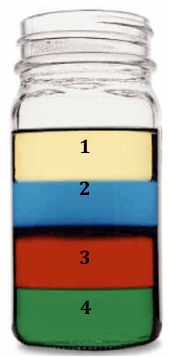
The mass of an object is 20 g
The volume is 20 cm3
The density is
1 g/cm3
10 g/cm3
0.5 g/cm3
N/A

