
 Worksheets
Unit 1: The Science of Life & Unit 2: Basic Chemistry (Part 1)
Total questions: 143
Worksheet time: 1hrs 12mins
Which step usually comes first in a scientific investigation?
Observation of something happens
Data collection after results
Conclusion is written first
Experiment and testing begin
What is a hypothesis?
A proven scientific law
A testable possible explanation
A description of equipment used
A list of final results
Which choice shows the best order of investigation steps?
Observation → Question → Hypothesis → Experiment
Experiment → Data → Question → Conclusion
Question → Conclusion → Experiment → Observation
Hypothesis → Conclusion → Data → Question
Biology is mainly the study of what?
Rocks and earth layers
Stars and space objects
Weather and climate patterns
Life and living things
A theory is best described as which statement?
A tool scientists use
A unifying explanation
A guess with no testing
A single experiment
Which is one characteristic of life?
All living things are made of cells
Living things never change
Living things need no energy
Living things have no DNA
Which characteristic matches homeostasis?
Using energy to grow
Maintaining stable internal conditions
Dividing into new cell types
Responding to physical stimuli
What does reproduction involve for living things?
Organisms avoid any change
Energy is never used to grow
Cells stop dividing forever
Genes act as the blueprint for life
Which statement describes growth and development?
DNA is not needed for cells
Organisms cannot respond to stimuli
Living things never change over time
Cells divide and turn into different types
Which phrase describes evolution?
Instant change in one day
Only chemical changes happen
Experience change over time
No change through generations
Organic molecules are mainly made from which element?
Oxygen is always the base
Nitrogen builds every part
Carbon is the key element
Hydrogen forms all parts
An atom contains which three particles?
Energy, matter, light
Carbon, oxygen, nitrogen
Cells, genes, proteins
Protons, neutrons, electrons
In a sodium atom, how many electrons are present if there are 11 protons?
Nine electrons match
Ten electrons remain
Twelve electrons stay
Eleven electrons balance
How many neutrons are in a common sodium atom?
Fourteen neutrons present
Eight neutrons present
Twelve neutrons present
Ten neutrons present
What is an element?
A molecule with several parts
A substance that cannot be broken down
A material made of many atoms
A substance broken down easily
What are chemical symbols like Cl, Na, and Fe?
Nicknames for compounds
Pictures for reactions
Codes for laboratory tools
Abbreviations for elements
How many atoms are in the molecule CuSO4?
Five atoms total
Seven atoms total
Four atoms total
Six atoms total
How many different elements are in CuSO4?
Four different elements
Three different elements
Two different elements
Five different elements
What causes a covalent bond between atoms?
Breaking into new elements
Sharing of electrons
Loss of all protons
Absorbing extra neutrons
Which action shows responding to stimuli?
A plant grows toward light
A rock changes its shape
Water boils without heat
Salt turns into sugar
What causes an ionic bond to form between atoms?
Transferring electrons between atoms
Sharing pairs of electrons
Breaking all electron shells
Adding extra neutrons to atoms
When an atom gains electrons, what charge does it have?
Positive overall charge
Negative overall charge
Neutral overall charge
Double positive charge
Which set lists basic properties of water?
Only adhesion without cohesion
Dry and dissolves oils easily
Nonpolar and repels ions
Polar with cohesion and adhesion
Oil and water do not mix because:
Both are ionic substances
Water is polar and oil is nonpolar
Both are polar substances
Water is nonpolar and oil is polar
On a pH scale, where are acids, bases, and neutral substances located?
Acids middle, bases high, neutral low
All are evenly spaced randomly
Acids low, bases high, neutral middle
Acids high, bases low, neutral middle
Which elements are found in carbohydrates?
Carbon, hydrogen, oxygen
Nitrogen, carbon, sulfur
Oxygen, sodium, chlorine
Hydrogen, helium, neon
What are the building blocks of carbohydrates called?
Polypeptides units
Monosaccharides sugars
Fatty acids chains
Nucleotides bases
Glucose is a monosaccharide while sucrose is a disaccharide. What does this mean?
Glucose has two sugar units
Sucrose has one sugar unit
Both have three sugar units
Glucose has one sugar unit
Which is a function of starch, glycogen, and cellulose?
All three store energy in humans
Cellulose stores energy in animals
Glycogen supports plant cell walls
Starch stores energy in plants
What are the building blocks of fat?
Glycerol and fatty acids
Amino acids and peptides
Monosaccharides units
Nucleotides and bases
How many different amino acids build proteins?
25 amino acids
20 amino acids
15 amino acids
10 amino acids
What is the main energy source for humans according to this unit?
Proteins from meats
Carbohydrates sugars
Water and minerals
Fats and oils
Which statement best describes an enzyme?
A fat that protects organs
A protein that slows reactions
A protein that speeds body reactions
A carbohydrate that stores energy
What helps an enzyme recognize the right molecule to act on?
Its overall electric field
Its substrates and active site
Its fatty acid tails
Its extra neutrons
Which conditions can affect how an enzyme works?
Altitude and gravity
Color and texture
Temperature and pH concentration
Wind and sunlight
What does magnification allow a microscope to do?
Make objects appear larger
Make colors change quickly
Make living cells glow
Make samples freeze solid
What does resolution allow a microscope to do?
Measure object mass precisely
Detect heat from samples
Create 3D moving images
Distinguish small close objects
Which lenses on a microscope are right above the slide on the stage?
Coarse focus knobs on the arm
Objective lenses near the stage
Eyepiece lenses at the top
Condenser lenses under the stage
Which set lists the three common objective powers on a light microscope?
Low, medium, high power
Small, larger, largest zoom
Short, middle, longest lens
Starter, regular, expert mode
How do you find total magnification on a microscope?
Subtract objective from eyepiece
Divide eyepiece by objective
Add eyepiece and objective
Multiply eyepiece by objective
What does field of view mean when looking through a microscope?
The white circle you can see
The black edges around glass
The metal frame of the scope
The pointer line inside lens
Which objective has the largest field of view on a microscope?
Scanning objective lens
High power objective
Oil immersion lens
Medium power objective
Which statement describes the cell theory?
All living things are made of cells
Only animals are built from cells
Cells are only for tiny organisms
Cells appear from nonliving matter
Order these from simplest to most complex: organs, atoms, tissues, molecules, organ systems, cells.
Atoms, molecules, organelles, cells, tissues, organs, organ systems
Molecules, atoms, cells, organelles, organs, tissues, organ systems
Cells, tissues, atoms, molecules, organs, organ systems
Organ systems, organs, tissues, cells, molecules, atoms
Which structure provides support for plant cells and is not in animals?
Endoplasmic reticulum
Central vacuole sack
Flexible cell membrane
Cell wall around the cell
Which organelle produces ATP energy for the cell?
Nucleus in center
Golgi body stacks
Ribosomes on RNA
Mitochondria in cytoplasm
Where does photosynthesis happen inside plant cells?
Lysosomes breaking waste
Ribosomes building proteins
Mitochondria making ATP
Chloroplasts with green pigment
Which is a key difference between prokaryotic and eukaryotic cells?
Both have a nucleus shell
Prokaryotes have many nuclei
Neither cell type has DNA
Eukaryotes have a nucleus
On which organelle are proteins synthesized?
Golgi shipping packages
Nucleus storing DNA codes
Mitochondria power house
Ribosomes making chains
Which organelles are found in plant cells but not animal cells?
Cell wall and chloroplasts
Ribosomes and cytoplasm
Nucleus and mitochondria
Golgi and lysosomes
Which polysaccharide makes up most of the plant cell wall?
Glycogen energy store
Cellulose fiber chains
Starch sugar coils
Chitin insect shells
Which polysaccharide stores glucose in plant cells?
Sucrose in vacuoles
Cellulose in walls
Starch in plastids
Glycogen in animals
What is the main component of the cell membrane?
Phospholipids in layers
Cellulose tough fibers
Proteins only strands
Cholesterol wax rings
Which best states the function of the nucleus?
Breaks down old organelles
Packages molecules for use
Controls activities, stores DNA
Makes proteins for export
What thread-like organelles help filter debris from entering the lungs?
Cilia moving mucus
Villi absorbing food
Flagella pushing cells
Microtubules giving shape
Which cell part controls movement of materials into and out of the cell?
Nucleus control center
Rough ER network
Cell membrane barrier
Mitochondria powerhouse
What is homeostasis?
Keeping internal conditions stable
Breaking down food for energy
Moving water out of the cell
Storing genetic instructions
What happens at the rough endoplasmic reticulum?
Protein synthesis with ribosomes
Lipid storage and release
DNA replication for division
Waste breakdown by enzymes
As a cell gets larger, what changes make transport harder?
Volume grows faster than surface area
Surface area grows faster than volume
Surface area and volume stay equal
Both surface area and volume shrink
What is active transport?
Water flow across a membrane
Diffusion using transport proteins
Movement down concentration without energy
Movement against concentration using energy
Which process brings materials into the cell?
Endocytosis inward movement
Exocytosis outward movement
Osmosis water balance
Mitosis cell division
The double layer of phospholipids in membranes is called the:
Phospholipid bilayer structure
Protein filament meshwork
Carbohydrate capsule coat
Nucleic acid lattice
Which proteins send signals from outside the cell to inside?
Ribosomal proteins builders
Carrier proteins transporters
Marker proteins nametags
Receptor proteins messengers
In a saltwater solution, what is the solute?
Salt that gets dissolved
Water that does dissolving
Air bubbles floating
Sugar crystals forming
What does a marker protein help do?
Pump water out of cell
Attach ribosomes to ER
Break sugars into energy
Identify the cell for immunity
Which statement describes diffusion?
Water moves through a membrane only
Proteins build new membranes
Molecules move high to low concentration
Ions move against gradient using ATP
Osmosis is best described as:
Movement of solids across a membrane
Bulk movement by vesicles
Diffusion of water across a membrane
Active pumping of sodium ions
Facilitated diffusion uses what to help particles cross?
Transport proteins in membranes
Energy from ATP molecules
Large vesicles and vacuoles
Sugar chains on lipids
Why are diffusion, osmosis, and facilitated diffusion called passive?
They do not require energy (ATP)
They need constant cell energy
They only move against gradients
They stop at the cell membrane
Which factors can affect diffusion speed?
Color, shape, smell, taste
Sunlight, wind, sound, gravity
Length, width, height, weight
Gradient, temperature, size, permeability
What do channel proteins form to let polar substances pass?
Doughnut-shaped openings
Long fibers and ropes
Flat sheets and layers
Sticky traps and nets
Cells use ATP to pump sodium ions out; which proteins then carry sodium back in with other substances?
Carrier proteins co-transport
Receptor proteins signal
Structural proteins support
Marker proteins label
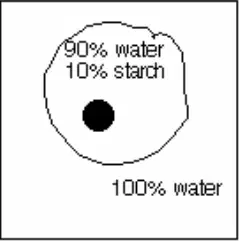
A cell with 90% water inside is placed in pure water. What type of solution is outside the cell?
Supertonic to the cell
Isotonic with the cell
Hypotonic to the cell
Hypertonic to the cell
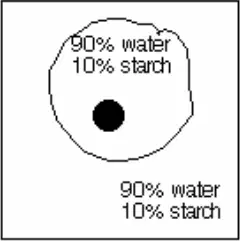
When the outside and inside of a cell both have 90% water and 10% starch, the solution is called what?
Plasmolyzed cell state
Isotonic with the cell
Hypotonic to the cell
Hypertonic to the cell
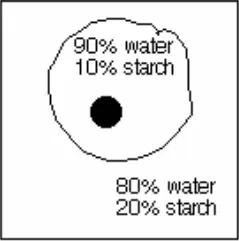
A cell in 80% water outside and 90% water inside is in which type of solution?
Aquatonic to the cell
Isotonic with the cell
Hypertonic to the cell
Hypotonic to the cell
Which process moves molecules across the membrane without using cellular energy?
Exocytosis with energy use
Endocytosis requiring ATP
Passive transport without ATP
Active transport using ATP
Which statement best describes water movement for a cell in a hypertonic solution?
Water enters until the cell swells
Water moves equally both directions
Water leaves and the cell shrinks
Water movement stops completely
Which equation correctly shows photosynthesis?
C6H12O6 + 6O2 → 6CO2 + 6H2O + ATP
6CO2 + 6H2O + light → C6H12O6 + 6O2
6CO2 + 6O2 + light → H2O + glucose
C6H12O6 → 6CO2 + 6O2 + light
Which equation represents cellular respiration?
6CO2 + ATP → C6H12O6 + 6O2
C6H12O6 + light → 6CO2 + 6O2 + ATP
C6H12O6 + 6O2 → 6CO2 + 6H2O + ATP
6CO2 + 6H2O + light → C6H12O6 + 6O2
What are the reactants needed for photosynthesis?
Water and carbon dioxide
Oxygen and ATP
Glucose and oxygen
Water and glucose
What is the ultimate source of energy for life on Earth?
Earth’s core
ATP
Glucose
The sun
What is a photon?
A packet of light energy
A packet of heat energy
A packet of sound energy
A packet of chemical energy
The color we see is the light reflected, while other accessory pigments do what with all other light?
reflect more wavelengths of light
absorb all other light wavelengths
scatter light in the air
transmit light through leaves
Which statement best explains the difference between producers and consumers?
Consumers make food using sunlight
Consumers store sunlight inside leaves
Producers eat other organisms for energy
Producers make their own food using sunlight
Which definition matches heterotrophs?
Organisms that breathe oxygen at night
Organisms that only absorb sunlight
Organisms that make their own food
Organisms that must consume food for energy
Which definition matches autotrophs?
Organisms that consume food for energy
Organisms that live without sunlight
Organisms that make their own food
Organisms that hibernate in winter
What happens to chlorophyll in leaves during the fall?
Chlorophyll absorbs less oxygen
Chlorophyll turns into sugars
Chlorophyll breaks down in leaves
Chlorophyll becomes brighter green
What color is chlorophyll?
yellow
green
red
blue
Chromatography is best described as which technique?
Freezing pigments to preserve them
Heating pigments to change color
Separating pigments by how fast they move
Mixing pigments to create new colors
Identify the inputs to the light reaction.
Water, carbon dioxide, glucose
Light, oxygen, ATP, NADPH
Light, carbon dioxide, chlorophyll
Light, water, ADP, NADP+
Identify the outputs of the light reaction.
Oxygen, ATP, NADPH
Glucose, ATP, NADP+
Carbon dioxide, glucose, water
Oxygen, ADP, NADP+
Light is absorbed by which molecule embedded in the thylakoid membrane?
Glucose
ATP
Chlorophyll
NADPH
Where does the light reaction occur inside the chloroplast?
Mitochondria inner space
Thylakoid membrane chloroplast
Cytoplasm of the cell
Stroma region of chloroplast
What is another name for the Calvin Cycle?
Light independent reactions
Light dependent reactions
Electron transport reactions
Photosynthetic light cycle
What is the main output of the Calvin Cycle, and what is it used for?
ATP used for muscle movement
Glucose used for energy and building
NADPH used for absorbing light
Oxygen used for breathing
When and where can the dark reaction occur?
Only at night in thylakoids
Anytime in stroma of chloroplasts
Anytime in mitochondria matrix
Only in daytime in stroma
During photosynthesis, where does oxygen come from?
Breaking down carbon dioxide gas
Splitting of water in light reactions
Calvin Cycle releases oxygen
Using oxygen stored in leaves
Which parts of the cell are involved in cellular respiration?
Ribosomes and Golgi body
Vacuoles and lysosomes
Nucleus and chloroplasts
Cytoplasm and mitochondria
NAD+ and FAD+ are best known as what?
Sugar transporters
Oxygen producers
Electron acceptors
Light energy carriers
Which statement describes fermentation?
Aerobic process making ATP with oxygen
Anaerobic process making ATP without oxygen
Reaction that breaks down chlorophyll
Process storing sunlight in chlorophyll
How does fermentation differ in animals versus plants?
Animals use alcoholic fermentation
Plants use lactic acid fermentation
Animals use oxygen to make ATP
Animals use lactic acid fermentation
Which type of fermentation causes muscle soreness?
Lactic acid fermentation
Alcoholic fermentation
Calvin Cycle fermentation
Water-splitting fermentation
Which list shows the correct order of aerobic respiration steps?
Glycolysis, electron transport, Krebs cycle
Krebs cycle, electron transport, glycolysis
Electron transport, glycolysis, Krebs cycle
Glycolysis, Krebs cycle, electron transport
About how many ATP are made from one glucose in aerobic respiration?
36–38 ATP total
8–10 ATP total
100–120 ATP total
2–4 ATP total
Where is energy stored in an ATP molecule?
In bonds between phosphate groups
Inside the sugar ribose ring
In the adenine nitrogen base
Around the cell membrane proteins
What is the best definition of mitosis?
Division of a nucleus making two identical cells
Copying DNA without splitting the cell
Joining two cells to form one larger cell
Division that makes four different cells
Put the mitosis stages in the correct order.
Telophase, Anaphase, Metaphase, Prophase
Metaphase, Prophase, Telophase, Anaphase
Prophase, Metaphase, Anaphase, Telophase
Anaphase, Telophase, Prophase, Metaphase
What happens during anaphase of mitosis?
Sister chromatids separate and move apart
Chromosomes line up across the center
Nuclear membrane breaks down
Two new nuclei finish forming
Which sequence correctly names the cell cycle?
Interphase, Mitosis, Cytokinesis
Cytokinesis, Interphase, Mitosis
Mitosis, Cytokinesis, Interphase
Interphase, Cytokinesis, Mitosis
During which stage does a cell spend most of its time?
Metaphase stage mostly
Interphase stage mostly
Mitosis stage mostly
Cytokinesis stage mostly
Which statement describes a chromatid and a centromere?
Chromatid is DNA base; centromere is outer cell wall
Chromatid is cell fluid; centromere is the nucleus center
Chromatid is a full chromosome; centromere makes spindle fibers
Chromatid is half a duplicated chromosome; centromere joins sisters
Which choice explains haploid versus diploid?
Haploid one set of chromosomes; diploid two sets
Haploid two sets of chromosomes; diploid one set
Haploid only X chromosomes; diploid only Y
Haploid no chromosomes; diploid many sets
Homologous chromosomes are best described as what?
Identical copies, carry no genes, from neither parent
Same size and shape, carry same genes, one from each parent
Random pieces, carry extra genes, from a grandparent
Different sizes, carry unrelated genes, both from one parent
How many chromosomes are in human haploid and diploid cells?
Haploid 23; Diploid 23
Haploid 12; Diploid 24
Haploid 23; Diploid 46
Haploid 46; Diploid 92
How does a bacterial cell divide?
By budding making three small cells
By mitosis making four different cells
By meiosis making many varied cells
By binary fission making two identical cells
Why is Meiosis I called reduction division?
DNA amount stays exactly the same
Only cytoplasm is reduced, not chromosomes
Chromosome number reduces from diploid to haploid
Chromosome number increases to double haploid
What is nondisjunction and one result in humans?
Chromosomes melt away; can cause hair loss
Chromosomes copy twice; can cause taller height
Chromosomes fail to separate; can cause Down syndrome
Chromosomes skip prophase; can cause colds
During prophase in mitosis, which events occur first?
Chromosomes uncoil; nuclear pores open; cell rests
Chromosomes line up; centrioles disappear; cytokinesis begins
Chromosomes split; nuclei reform; spindles vanish
Chromosomes condense; nuclear membrane breaks; spindles form
During metaphase of mitosis, what key event happens?
Cell grows and copies its DNA
Nuclear membranes reform fully
Chromosomes line up at the cell center
Sister chromatids move to opposite poles
During telophase of mitosis, what completes forming?
Nuclear membranes reform around chromosomes
Spindle fibers begin to form quickly
Chromosomes condense into thick rods
DNA is copied for the first time
Which part of aerobic respiration produces most ATP?
Krebs cycle matrix step
Glycolysis cytoplasm step
Fermentation backup step
Electron transport chain step
Which cell type is haploid in humans?
Skin cells on your arm
Gametes like eggs and sperm
Brain nerve cells
Muscle cells in your leg
Which process can create genetic variation during cell reproduction?
Chromosome crossing over
Cells skipping mitosis
Chromosome copying only
Nucleus staying the same
Which stage of mitosis shows chromosomes lined up in the middle of the cell?
Metaphase stage
Prophase stage
Telophase stage
Interphase stage
What is the main purpose of a Punnett square?
Predict possible offspring traits
Measure cell sizes in tissues
Count chromosomes in a cell
Draw family trees for ancestors
Genotype is best described as
A blood type group
A person’s visible trait
A cell’s energy source
An organism’s allele combination
If T is dominant and t is recessive, which genotype is heterozygous?
Tt genotype
TT genotype
tt genotype
ttT genotype
Why are males more likely to show X‑linked traits?
They have one X chromosome
They have two X chromosomes
They have larger cells
They have more DNA bases
Which three events can lead to genetic variation?
Dominance, recessiveness, codominance
METAPHASE, ANAPHASE, TELOPHASE
Photosynthesis, respiration, digestion
Mutation, crossing over, independent assortment
In a simple dominance cross, which allele masks the other?
Dominant allele
Silent allele
Codominant allele
Recessive allele
What molecule is the genetic material for all living things?
Amino acid chains
Deoxyribonucleic acid
Starch sugar units
Mineral salt crystals
Griffith’s experiments helped show that
Traits skip meiosis
Proteins create sunlight
DNA can transform bacteria
Cells breathe underwater
Avery and Hershey‑Chase provided evidence that
Protein, not DNA, is genetic
RNA, not DNA, makes bones
Sugar, not DNA, stores energy
DNA, not protein, carries heredity
Watson and Crick discovered the DNA
Double helix structure
Square lattice shape
Triple spiral shape
Single loop shape
Which pairing correctly matches genotype and phenotype?
Genotype: allele combo; phenotype: observable traits
Genotype: blood type test; phenotype: gene location
Genotype: family tree; phenotype: cell division stage
Genotype: visible height; phenotype: DNA letter order
What did Chargaff contribute to our understanding of DNA?
Sugars bond to phosphate only
A=T and G=C pairing rule
RNA pairs A=U in cells
DNA is made of proteins
What are the three parts of a nucleotide?
Deoxyribose sugar, phosphate group, nitrogenous base
Ribose sugar, lipid tail, amino group
Protein chain, fatty acid, water
Phosphate only, sugar only, base only
Identify the basic building block of DNA and its components.
Nucleotide: deoxyribose sugar, phosphate group, nitrogenous base
Chromosome: protein, water, salt
Amino acid: ribose sugar, lipid, nitrogen gas
Cell: cytoplasm, membrane, chlorophyll
The backbone of DNA is composed of what two molecules?
Proteins and lipids alternating
Nitrogen bases and amino acids alternating
Water molecules and salts alternating
Phosphate group and deoxyribose sugars alternating
Describe the molecule of DNA using the terms pyrimidine and purine.
Flat ladder with ionic bonds; purines U or C; pyrimidines A or G
Single helix with covalent bonds; purines T or C; pyrimidines A or G
Triple helix without bonds; purines are bases only; pyrimidines are sugars
Double helix with hydrogen bonds; purines A or G; pyrimidines T or C
Name the four nitrogen bases in DNA.
Adenine, Uracil, Guanine, Cytosine
Uracil, Thymine, Guanine, Adenine
Cytosine, Ribose, Adenine, Thymine
Adenine, Thymine, Guanine, Cytosine
What is the complementary strand of G G C A T T A G C T A G C T A?
CCGTAATCGATCGAT
CCGTAAUCGATUGA
GGCAATTCGATCGA
TTGCAAUAGCUAGU
Explain the process of DNA replication, making sure to include the enzymes.
Polymerase melts sugars; ligase breaks bonds; helicase repairs
Sugars unzip; bases float; proteins randomly attach
Ligase unwinds; helicase glues; polymerase stops copying
Helicase unwinds; DNA polymerase builds and proofreads; ligase glues

