
 Worksheets
ESS Midterm Review (Units 1 & 2)
Total questions: 141
Worksheet time: 2hrs 58mins

What does it mean when light from a galaxy is redshifted?
The galaxy is moving towards us
The galaxy is moving away from us
The galaxy is not moving
The galaxy is getting smaller
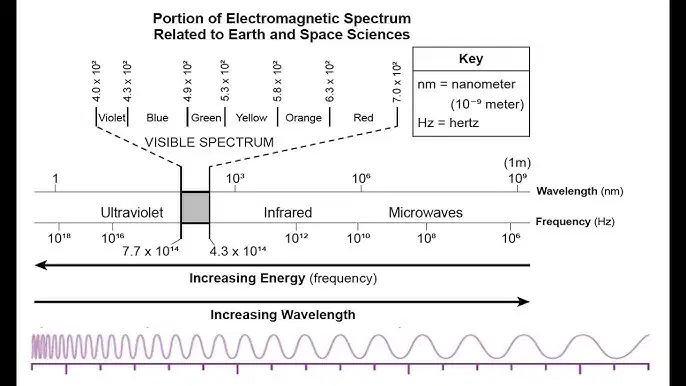
Redshifted light has (a) waves and indicates that an object is moving (b) from us.
Which of the following is evidence for the Big Bang theory?
Most galaxies emit blueshifted light
Most galaxies emit redshifted light
Most galaxies do not emit any light
Most galaxies emit green light
Blueshifted light has (a) waves and indicates that an object is moving (b) us.

Cosmic background radiation is leftover energy from the _____
Nuclear Fusion
Blue Shift
Big Bang
Sun

Which of the following is NOT true about cosmic background radiation?
It is present everywhere in space
It appears to be coming from all directions in the universe
It is only found near stars
It serves as evidence for the Big Bang
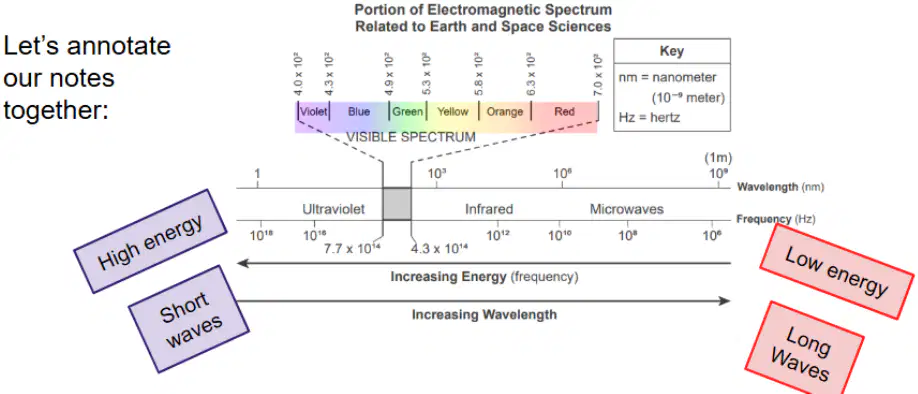
As wavelength increases toward the right end of the electromagnetic spectrum, visible light shifts toward the _____ end of the spectrum.
Blue
Red
Green
Violet
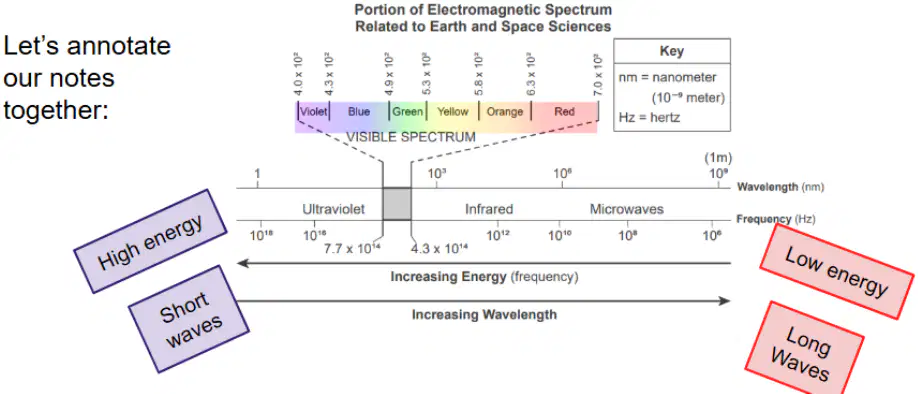
In the electromagnetic spectrum, high energy waves have _____ wavelengths.
Long
Short
What is a self-luminous object made of gas found in outer space that radiates electromagnetic energy?
Planet
Moon
Star
Galaxy
______ produce extremely great quantities of energy through the process of nuclear fusion.
Stars
Planets
Moons
Galaxies
What is the process of making new elements inside the star through nuclear fusion called?
(a)
The most important characteristic that will determine the type of life cycle a star will undergo is its ________.
color
temperature
luminosity
mass
Which of the following is an example of an indirect relationship?
A) As one value increases, the other value increases
B) As one value increases, the other value decreases
C) Both values remain constant
D) Both values decrease together
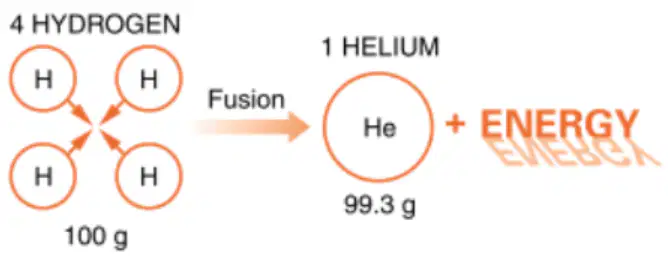
What are the products of the nuclear fusion of 4 hydrogen atoms?
1 Helium atom and energy
2 Helium atoms and energy
1 Oxygen atom and energy
4 Helium atoms and energy
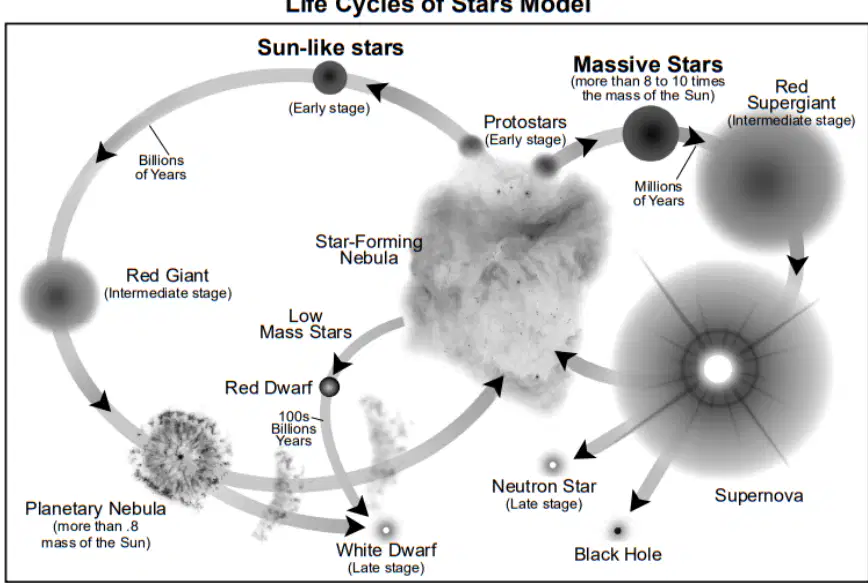
Refer to the 'Life Cycles of Stars Model' diagram. What is the correct sequence for the life cycle of our Sun (and stars with a similar mass)?
A) Red Giant, Planetary Nebula, White Dwarf
B) Red Supergiant, Supernova, Black Hole
C) Red Dwarf, White Dwarf
D) Protostar, Neutron Star, Black Hole
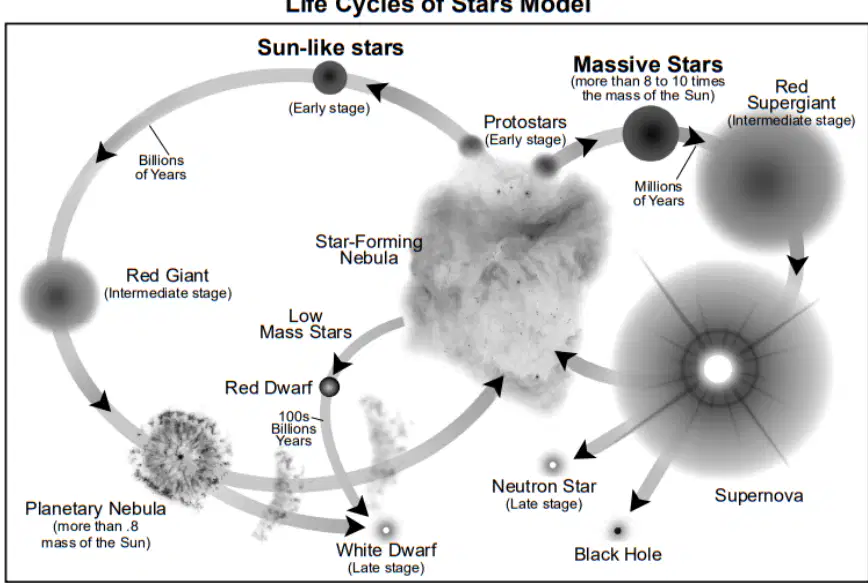
Refer to the 'Life Cycles of Stars Model' diagram. What is the correct sequence for the life cycle of massive stars?
A) Red Supergiant, Supernova, Neutron Star or Black Hole
B) Red Giant, Planetary Nebula, White Dwarf
C) Red Dwarf, White Dwarf
D) Protostar, White Dwarf, Black Hole
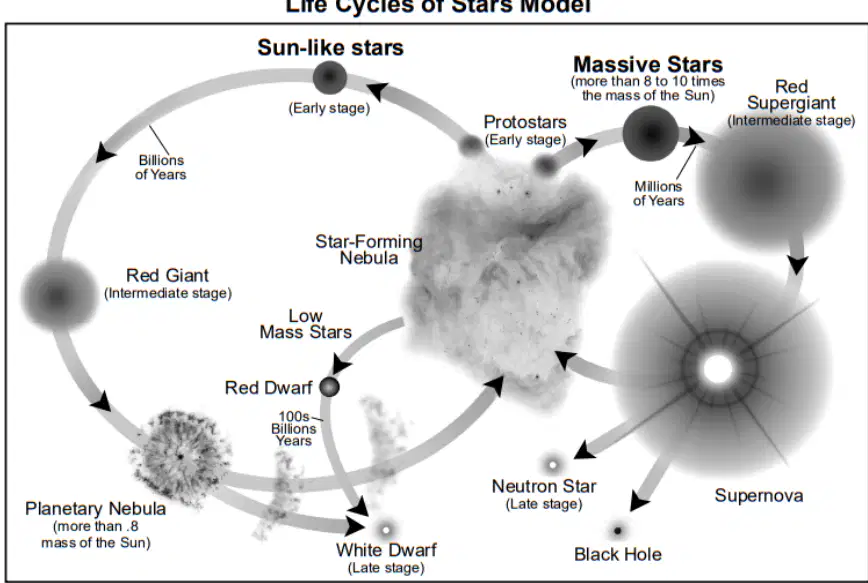
Refer to the 'Life Cycles of Stars Model' diagram. What is the correct sequence for the life cycle of low mass stars?
A) Red Dwarf, White Dwarf
B) Red Giant, Planetary Nebula, White Dwarf
C) Red Supergiant, Supernova, Black Hole
D) Protostar, Neutron Star, Black Hole
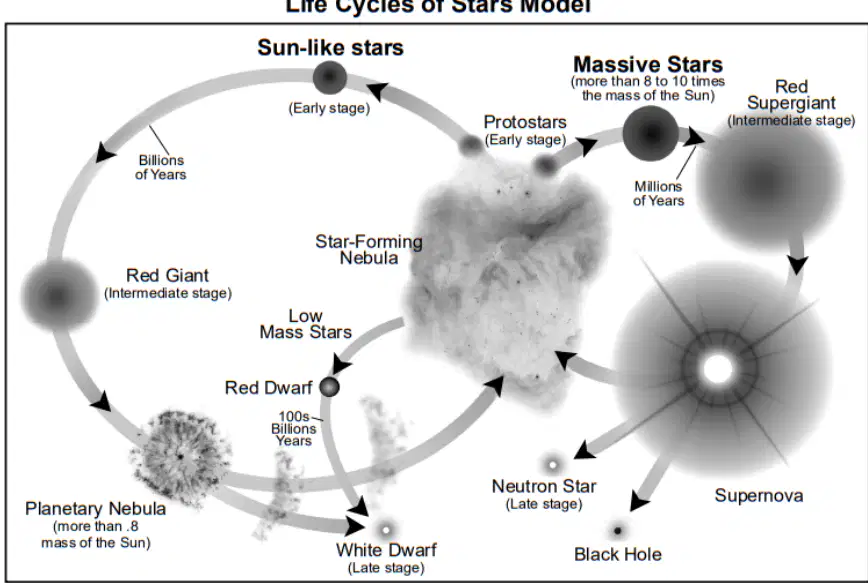
Refer to the 'Life Cycles of Stars Model' diagram. Stars like our Sun live for ________ of years.
millions
100s of billions
hundreds
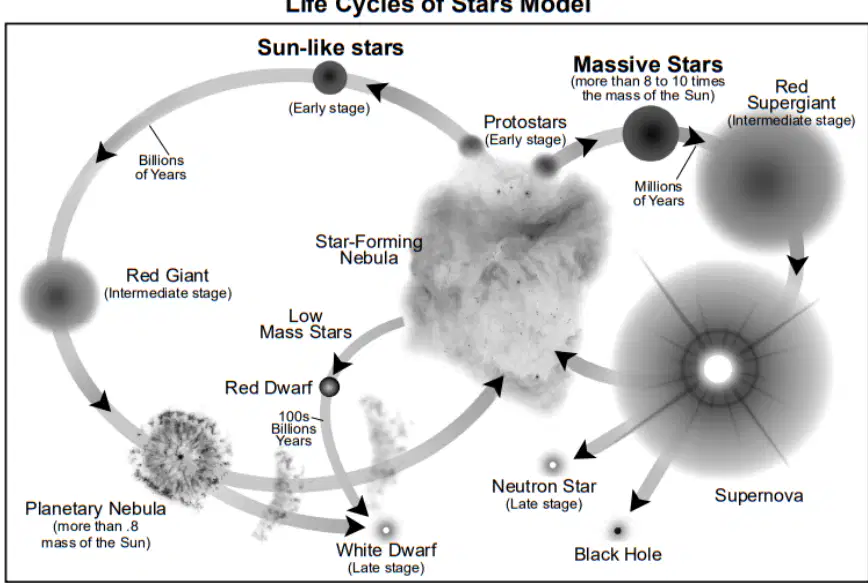
Refer to the 'Life Cycles of Stars Model' diagram. Massive stars live for (a) of years.
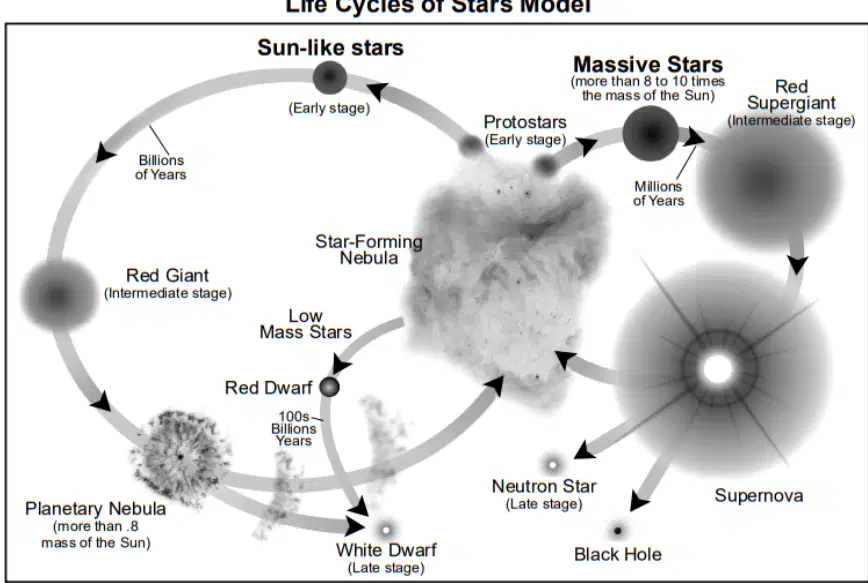
Refer to the 'Life Cycles of Stars Model' diagram. Low mass stars live for 100s of billions of years. Therefore, we know that the smaller the mass, the _______ the lifetime of the star. This is an example of an _______ relationship.
shorter, direct
longer, direct
longer, indirect
shorter, indirect
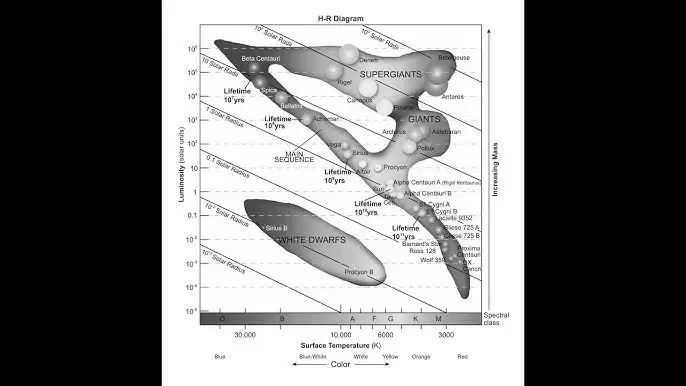
According to the HR diagram and the facts provided, which colored stars are the coolest (less than 3,000 K)?
Blue
Red
White
Yellow
According to the HR diagram, the Sun has an approximate temperature of
(a) , it is considered a (b) star, and it is categorized as spectral class (c) .
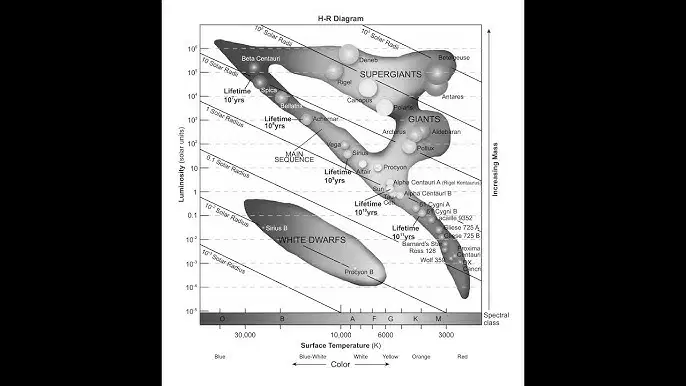
According to the HR diagram and the facts provided, which colored stars are the hottest (more than 30,000 K)?
Blue
Red
Orange
Yellow
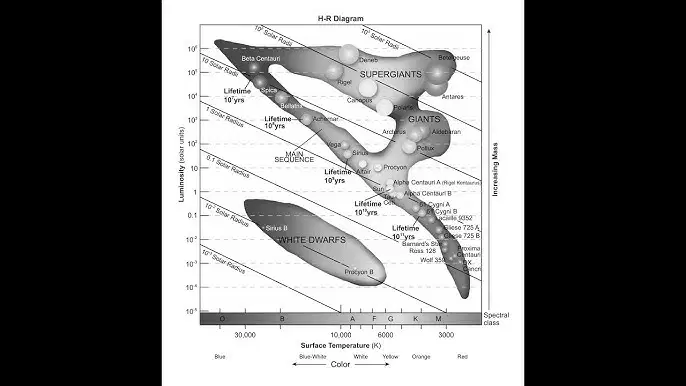
According to the HR diagram, bigger stars have a (a) luminosity (top of chart).
What is nucleosynthesis?
The process where stars create new elements by fusing smaller atoms together
The process where stars lose mass over time
The process where stars cool down and become white dwarfs
The process where stars split into two smaller stars
Stars spend most of their life cycle as ________ before reaching their end stages.
red giant star
white dwarf stars
supergiant stars
Stars with larger masses:
Burn fuel slower
Burn fuel quicker
Have weaker gravity
Start out with less fuel
Larger stars have stronger (a) which causes faster fusion, producing heavier elements.
Which of the following is NOT true about stars with larger masses?
A) They burn fuel quicker
B) They have stronger gravity
C) They start out with less fuel
D) They produce heavier elements
Stellar Nucleosynthesis takes place through the process of (a) in the center of stars.
Fusion takes place in the center of stars because it is extremely ______ and there is an extreme amount of pressure.
cold
dry
wet
hot
No star can fuse elements heavier than ______. Once this element is created, a star has reached the end of its fuel source and begins to collapse, leading to a supernova explosion.
hydrogen
helium
carbon
Elements that are much heavier than Iron were formed from the process of ______.
supernova nucleosynthesis
stellar nucleosynthesis
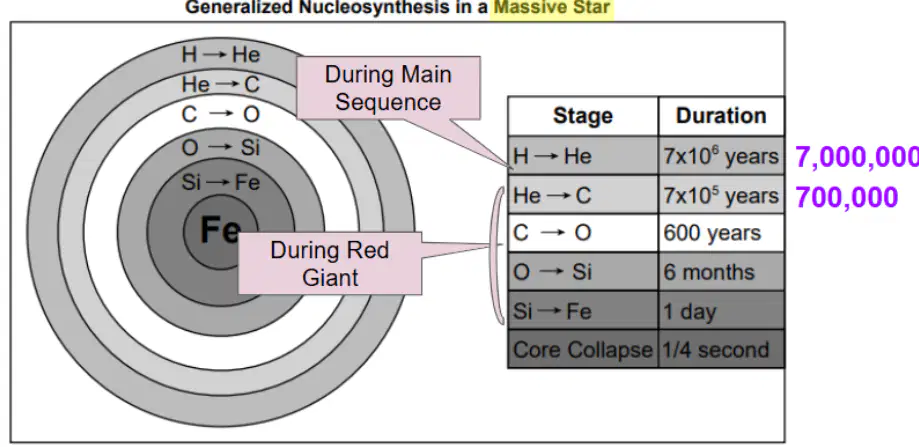
According to the diagram 'Generalized Nucleosynthesis in a Massive Star', which element is formed during the main sequence stage?
Helium
Carbon
Oxygen
Iron
During a star’s main sequence stage, it spends a long time converting (a) into helium while the star is considered stable and within equilbrium.
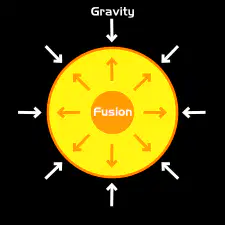
At equilibrium, the force of fusion is equal to the force of (a)
During the red giant phase, elements are converted into heavier elements at a faster rate due to increased.
temperature and pressure
light and sound
gravity and magnetism
distance from Earth
The Sun gives off solar radiation in the forms of UV light, visible light, & infrared light (heat). These are all forms of ______________ radiation
hydrogen
electromagnetic
helium


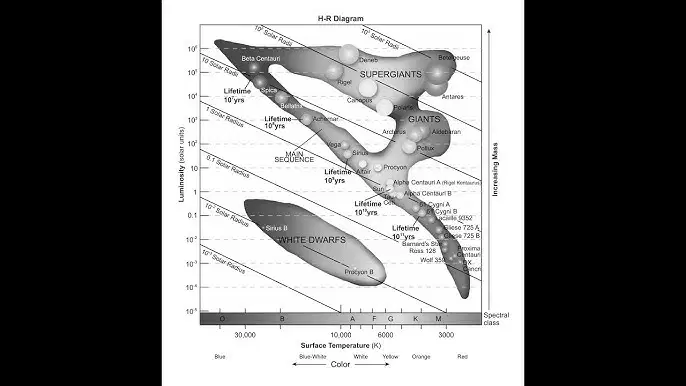
Which statement describes the general relationship between the temperature and the luminosity of main sequence stars?
As temperature decreases, luminosity increases
As temperature decreases, luminosity remains the same
As temperature increases, luminosity increases
As temperature increases, luminosity remains the same.

Which star has the lowest temperature? Refer to the diagram.

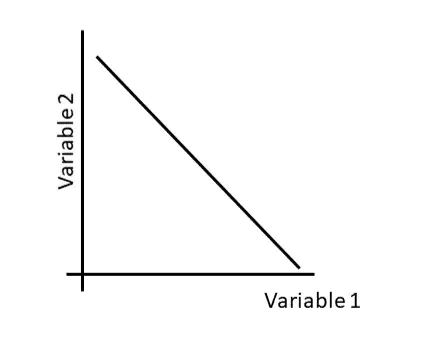
This attached graph depicts that as variable 1 increases, variable 2 also increases. This is known as a ______ relationship.
direct
indirect
The approximate age of the universe is estimated to be
4.6 million years
4.6 billion years
13.8 million years
13.8 billion years

The top spectra is the laboratory spectra and is not moving. What type of shift is shown with the bottom spectra and is the object moving towards or away from the observer?
Red Shift
Towards
Red Shift
Away
Blue Shift
Towards
Blue Shift
Away

What shape is this galaxy?
Elliptical
Irregular
Barred-Spiral
Spiral
What do many stars together make up?
A planet
A solar system
A galaxy
A moon
What is the significance of the redshift observed in distant galaxies?
It indicates that the universe is contracting
It shows that the universe is static and unchanging
It suggests that the universe is expanding
It proves that galaxies are moving towards us

Match the following stages with the corresponding star types after the main sequence.
supergiant
High mass star
protostar
Early stage star
black dwarf
End stage of a low mass star
red giant
Late stage of a low mass star


Sunspots tend to occur in cycles which occur ever ______ years.
2
5
11
65

1- Sunspots occur in regions of the sun…
where strong magnetic fields block convective cells
where weak magnetic fields poke through the surface
where there are holes in the surface
What is the outermost layer of the Sun called?
Chromosphere
Photosphere
Corona
Core
Which layer of the Sun is located directly below the Corona?
Radiative Zone
Core
Chromosphere
Convection Zone
Identify the part of the Sun that is the centermost layer.
Core
Radiative Zone
Convection Zone
Photosphere

What Type of Graph is shown?
Direct
Indirect
Cyclic
Constant

What Graphing relationship is being shown
Direct
Indirect
Cyclic
Constant
What is at the middle of a Heliocentric system?
Mars
Moon
Sun
Earth
What does the Geocentric system look like?
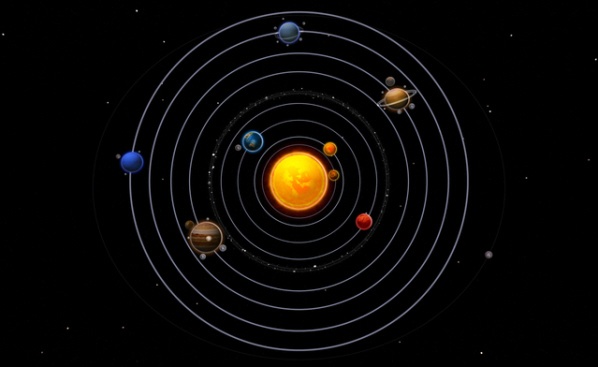
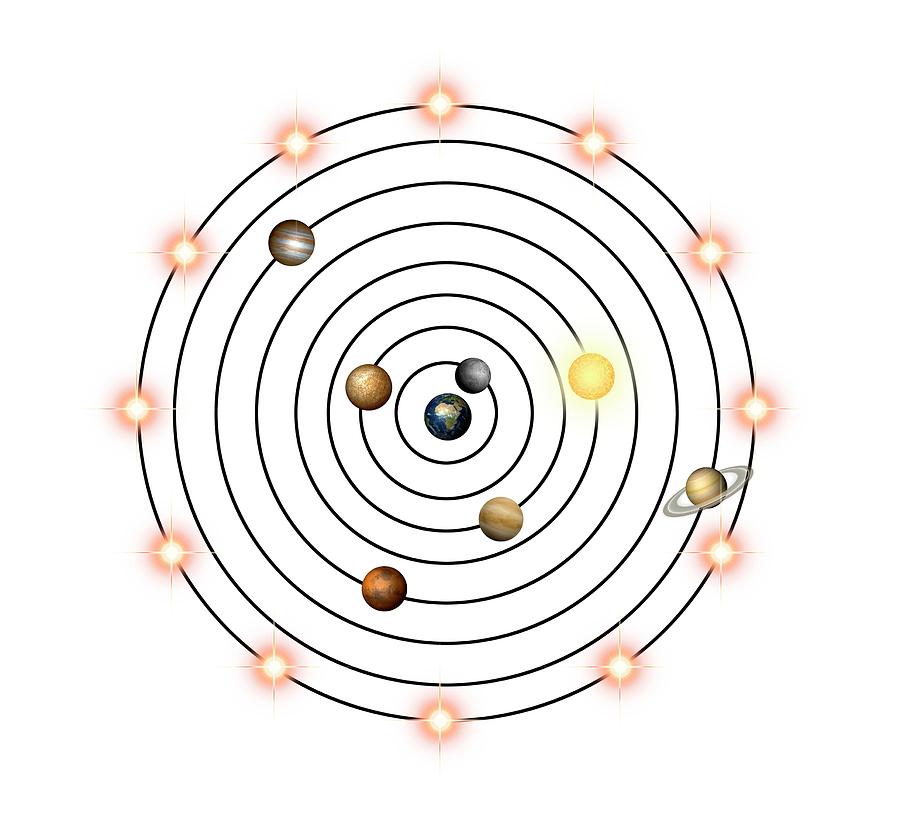
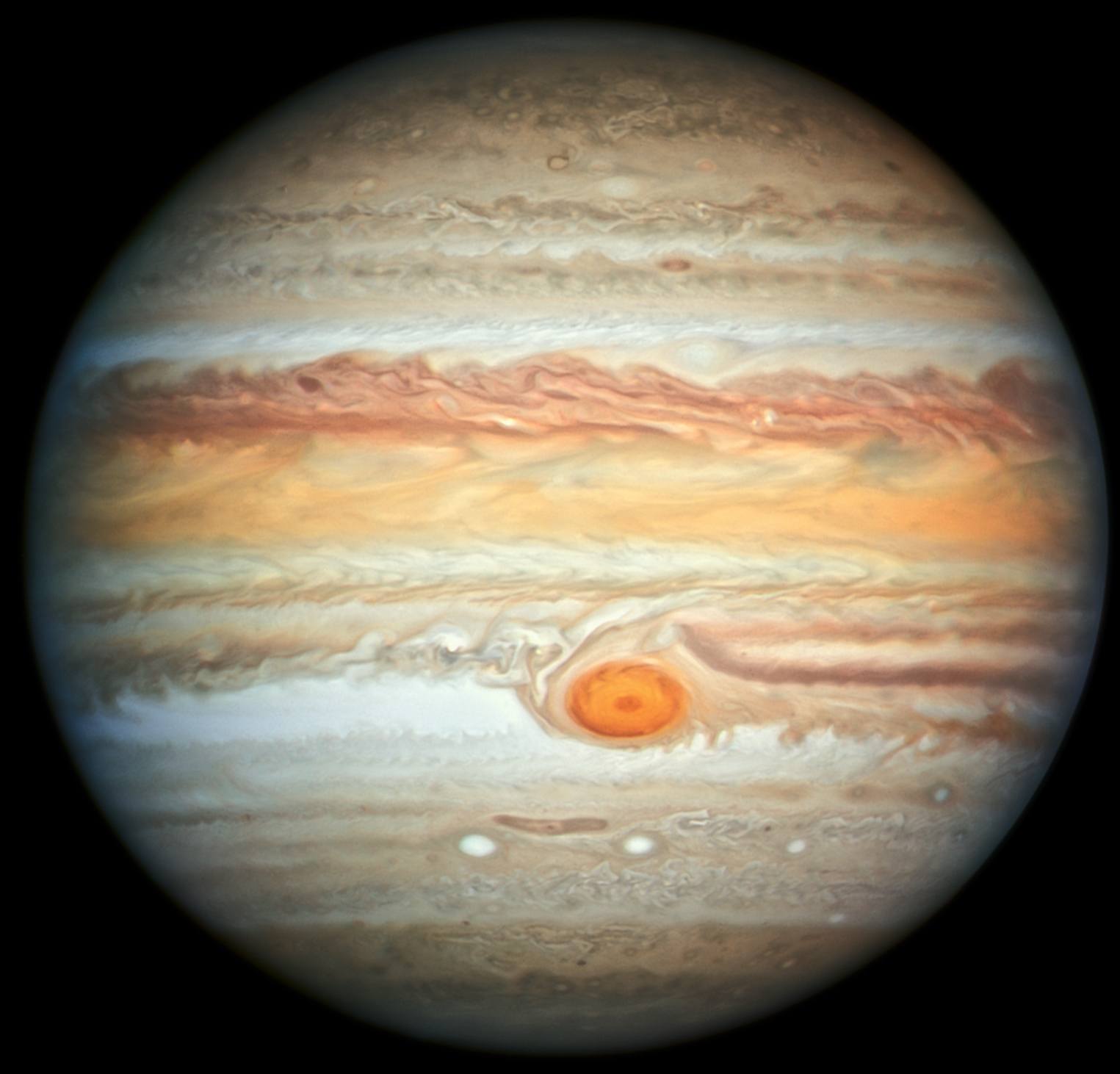
What does the Heliocentric system look like?


What is the period of revolution of Mercury?
88 days
59 days
57.9 days
224.7 days
Saturn is how many millions of km away from the sun?
1426.7 million km
2871.0 million km
778.4 million km
227.9 million km
What is the period of rotation for the Earth’s moon?
27.3 days
149.6 days
27.0 days
Which planets orbit most eccentric?
Neptune
Mars
Earth
Jupiter
Which planet is the largest?
Saturn
Uranus
Neptune
Jupiter
Which planets period of revolution is shorter than its period of rotation?
Jupiter
Mercury
Earth
Venus
The 4 planets closest to the sun are called
Terrestrial planets
Gas giants

The 4 inner planets in order are
Mercury, Earth, Venus, Mars
Mars, Venus, Earth, Mars
Jupiter, Saturn, Uranus, Neptune
Mercury, Venus, Earth, Mars
Select 2 choices that are characteristics of the terrestrial planets
Made of gases
rocky surface
many moons
rings
few moons

Planets that are closer to the sun
take more time to orbit
take less time to orbit

The 4 terrestrial planets are larger than the 4 gas giants
True
False
Pluto is the only dwarf planet.
true
false

Select the correct answer. According to Newton’s law of universal gravitation, what is the effect of gravity on two objects as the distance between them increases?
The force of gravity increases.
The force increases by twice the previous amount.
There is no effect on the force of gravity.
The force of gravity decreases.
According to Kepler’s first law, the shape of a planet’s orbit around the Sun is (a)
The effect observed in a planet’s speed in its orbit as it travels away from the Sun is that it (a) .
What does Waning mean
Decreasing
Growing
What does waxing mean
Growing
Decreasing
which one is a new moon


_______are daily changes in ocean water levels along the coasts.
Waters
Tides
Colors
Earths
Why do we not experience eclipses every month?
The moon is stubborn.
The Moon's orbit is tilted
Moon is smaller than the Sun
Earth's orbit is tilted

Which location would a 1st quarter moon be visible?
2
3
5
7

How long is one lunar cycle?
29.5 months
29.5 days
29.5 weeks
30 days
The sun, the moon, and Earth are nearly in a line during a new moon. The gravity of the sun and the moon pull in the same direction causing a ______ ____
Spring Tide
Neap Tide
High Tide
Low Tide

Is this alignment for a solar or lunar eclipse?
Solar
Lunar
Closest to the sun
Spring tide
Perihelion
Aphelion
Equinox
What happens during a solar flare or coronal mass ejection (CME)?
small amounts of solar energy is released
large amounts of solar energy are released
solar energy is released at the same rate of the solar wind
nothing
How can you describe a cyclic phenomenon?
It does not repeat.
It repeats.
There is no way to tell.


A star will spend ______ of it's life turning hydrogen into helium.
100%
20%
90%
50%
______ occur by plate boundaries.
Eathquakes
Volcanoes
Earthquakes and volcanoes
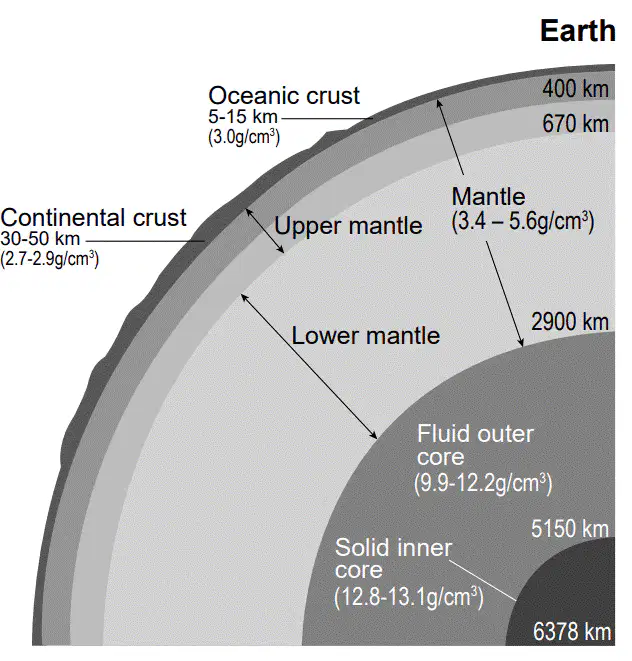
From the top of the stiffer mantle to the center of Earth, the rock material is inferred to be
solid all the way to the center of the inner core
solid, then liquid to the center of the inner core
solid, then liquid, then solid again to the center of the inner core
solid, then liquid, then gaseous to the center of the inner core
What happens to temperature, pressure, and density as you go deeper towards the Earth's interior?
they increase
they decrease
they remain the same
the increase and decrease

Vibrations caused when stress makes rocks pass their elastic limit.
epicenter
Earthquake
strike-slip
surface wave

What seismic activity is found at a transform plate boundary?
Trenches
Subduction
Volcanoes
Earthquakes

The Modified Mercalli scale rates the amount of damage from an earthquake
true
false

Location H is located at which coordinates?
60oN, 120oE
90oN, 30oE
10oS, 40oW
30oN, 90oE


Which of the following causes Earth's tectonic plates to move?
Energy from the Sun
Magnetic Pole Reversal
Convection currents in the mantle
Faults in Mountain Ranges


This igneous rock's large crystals indicate that it is...
extrusive, and formed deep underground.
intrusive, and formed near the surface.
intrusive, and formed deep underground.
extrusive, and formed near the surface.
What is the relationship between crystal size and cooling time ?
slower cooling = smaller crystals
slower cooling = larger crystals
faster cooling = larger crystals
faster cooling = more crystals
Extrusive igneous rocks have (a) crystals because they form (b) .
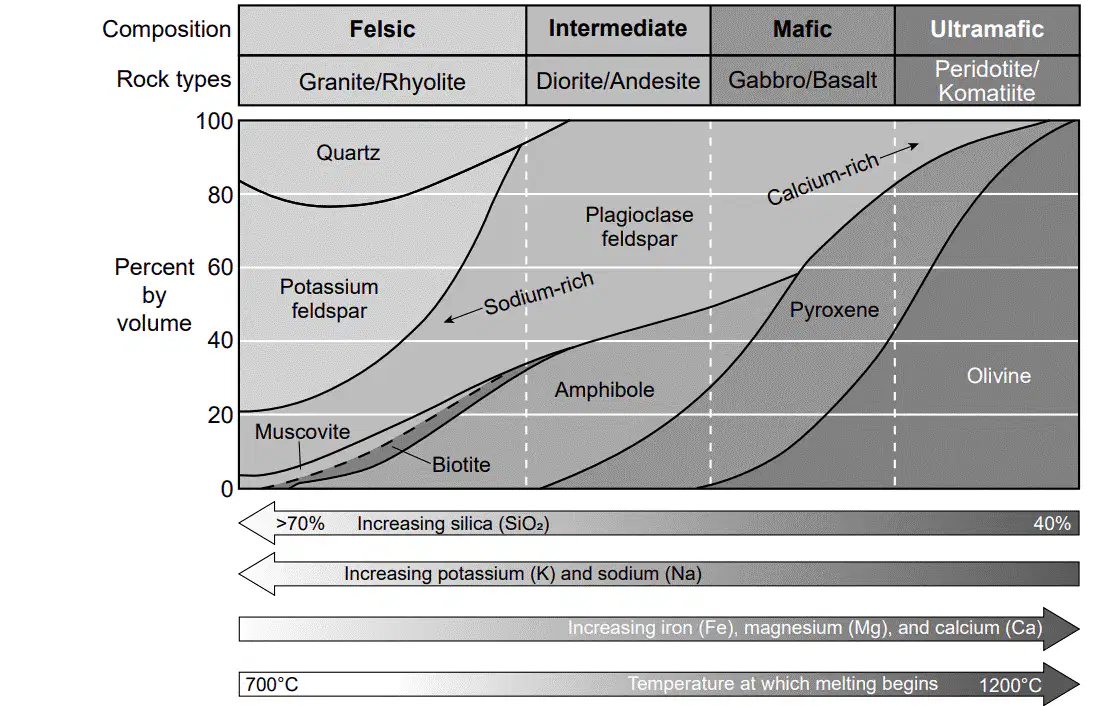
Using your ESSRT, complete the following. Granite is a (a) rock that contains minerals such as (b) and potassium feldspar. Due to the large observable crystals that formed from a slow cooling process, it is classified as an (c) igneous rock.
Scientists know that Earth's outer core is liquid because....
P-waves can't travel through it
S-waves can't travel through it
They are just guessing
They've taken direct samples

What is happening in the picture?
layers of the Earth are changing positions
the inner and outer core are solid
convection currents are causing the tectonic plates to move
the mantle is growing

Click the island that is the oldest
What geologic feature will occur at a hot spot ?
volcano
folded mountain
deep sea trench
crevasse
What evidence did Wegener use in his theory of continental drift?
Continents fitting together/matching-up like puzzle pieces
matching fossils found on continents now separate by oceans
Sea-floor spreading begins at the
Deep ocean trench
Mid-ocean ridge
Continent's edge

The average density of continental crust is 2.8 g/cm3 and the average density of oceanic crusts is 3.2 g/cm3. If these two plates came together, what would happen?
The two plates would push apart and form a rift zone.
The oceanic plate would rise up over the continental plate.
The oceanic plate would sink under the continental plate.
The two plates would meet head on and rise up to form mountains.
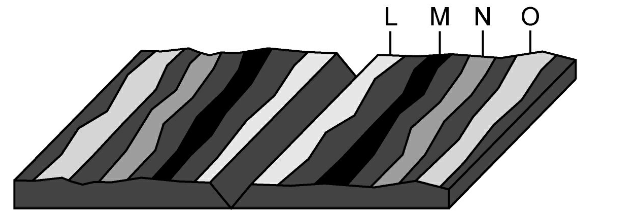

What type of boundary does Seafloor Spreading occur?
Convergent
Subduction
Collision
Divergent

When a continental plate collides with another continental plate what type of land form will be created?
mid ocean ridges
mountain ranges
islands
deep see trenches

The process where cold, dense oceanic slabs are subducted under continental lithosphere.
Slab Pull
Ridge Push
Magnetic Reversal
Convection Current

According to the dating of rocks on the seafloor, how does the age of rocks change relative to their distance from the ridge?
Rocks are oldest at the ridge and get younger as you move away.
Rocks maintain a constant age regardless of their distance from the ridge.
Rocks are youngest at the ridge and get older as you move away.
The age of rocks decreases with depth, not distance from the ridge.
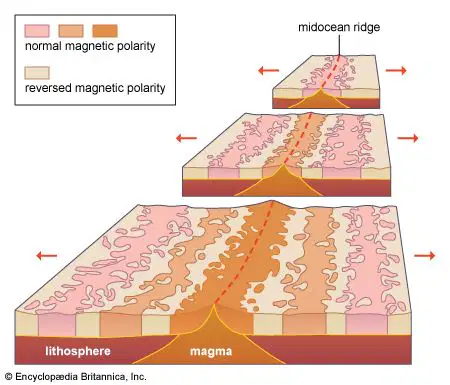
What does the cooling lava at mid-ocean ridges record that serves as evidence of seafloor spreading?
The age of the oceanic crust
The salinity of the ocean water
The polarity of the magnetic field at that point in geologic time
The temperature of the ocean at the time of eruption

Based on Bowen’s Reaction Series, the last material to crystallize at the lowest temperature in granitic igneous rock is
olivine
quartz
amphibole
pyroxene
How are igneous rocks formed?
Sediment forming together
Heating and pressure
Melting and cooling
Deposition

Which cross-sectional diagram of a portion of the crust and
mantle best shows the pattern of mantle convection currents that are believed to cause the formation of a mid-ocean ridge?
1
2
3
4

The recrystallization of unmelted material under high temperature and pressure results in
metamorphic rock
sedimentary rock
igneous rock
volcanic rock
Where can most metamorphic rock be found?
As part of mountain ranges
At the bottom of oceans
Lake beds
Deep in the Earth, near the mantle
At a continental-continental convergent boundary, which type of metamorphism should be occurring?
contact metamorphism, due to the intense heat of the magma chamber
regional metamorphism, due to the intense heat of the magma chamber
regional metamorphism, due to the intense pressure
contact metamorphism, due to the intense pressure
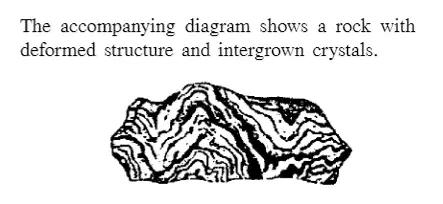
The rock was probably formed by:
A. sediments that were deposited on the ocean floor
B. heat and pressure that changed a preexisting rock
C. volcanic lava that cooled on Earth's surface
D. a meteor impact on Earth's surface.

