
 Worksheets
Year 9 Chem Revision
Total questions: 140
Worksheet time: 1hrs 25mins
The word equation for an acid reacting with a metal is
acid + metal → salt + carbon dioxide + water
acid + base → salt + water
acid + metal → salt + hydrogen
acid + metal → salt + water
The word equation for an acid reacting with a metal is
acid + metal → salt + carbon dioxide + water
acid + base → salt + water
acid + metal → salt + hydrogen
acid + metal → salt + water
Properties of bases are
feel soapy and neutralise acids
irritate your skin and react with metals to produce bubbles
taste sour and turn litmus red
have pH less than 7
Properties of bases are
feel soapy and neutralise acids
irritate your skin and react with metals to produce bubbles
taste sour and turn litmus red
have pH less than 7
Which of the following values would represent the pH of a strong base?
1
8
7
13
Which of the following values would represent the pH of a strong base?
1
8
7
13
Which of the following is NOT a characteristic of an acid?
sour taste
corrosive
turns litmus paper blue
neutralises bases
Which of the following is true .
Acids and bases form hydroxide ions in solution
Acids form hydroxide ions and bases hydrogen ions in solution
Acids form hydrogen ions in solution, bases do not form ions in solution
Acids form hydrogen ions in solution and bases hydroxide ions
Which of the following is true .
Acids and bases form hydroxide ions in solution
Acids form hydroxide ions and bases hydrogen ions in solution
Acids form hydrogen ions in solution, bases do not form ions in solution
Acids form hydrogen ions in solution and bases hydroxide ions
A substance that is 3 on the pH scale would be a(n):
acid
base
neutral
solute
A substance that is 3 on the pH scale would be a(n):
acid
base
neutral
solute
Indigestion occurs when
stomach acid rises into the oesophagus, causing burns, because it is corrosive
the pH in the stomach is too high, so the stomach lining is damaged
there is not enough stomach acid to digest food sufficiently
stomach acid has reacted with carbonates to form carbon dioxide
When the pH of your pool is too high, algae and bacteria can flourish, what do you need to add to lower it
salt (e.g. sodium chloride)
chlorine
hydrochloric acid
sodium carbonate
When the pH of your pool is too high, algae and bacteria can flourish, what do you need to add to lower it
salt (e.g. sodium chloride)
chlorine
hydrochloric acid
sodium carbonate
Which of the following is a neutralisation reaction?
metal + acid → salt + hydrogen
metal + acid → salt + water
carbonate + acid → salt+ carbon dioxide + hydrogen
base + acid → salt + water
Which of the following is a neutralisation reaction?
metal + acid → salt + hydrogen
metal + acid → salt + water
carbonate + acid → salt+ carbon dioxide + hydrogen
base + acid → salt + water
Acid rain is caused by
pollutants in the air such as SO2 and NO2 reacting with oxygen
acids in the rain reacting with rocks containing carbonates
pollutants in the air such as SO2 and NO2 reacting with water
global warming, heating the earth's atmosphere
Acid rain is caused by
pollutants in the air such as SO2 and NO2 reacting with oxygen
acids in the rain reacting with rocks containing carbonates
pollutants in the air such as SO2 and NO2 reacting with water
global warming, heating the earth's atmosphere
When nitric acid is added to magnesium metal a reaction occurs and a gas is produced. The products of this reaction are:
magnesium nitrate and hydrogen gas.
magnesium carbonate and carbon dioxide.
magnesium chloride and hydrogen gas.
magnesium sulphate and carbon dioxide.
When nitric acid is added to magnesium metal a reaction occurs and a gas is produced. The products of this reaction are:
magnesium nitrate and hydrogen gas.
magnesium carbonate and carbon dioxide.
magnesium chloride and hydrogen gas.
magnesium sulphate and carbon dioxide.
An alkali is produced when
A salt dissolves in water
A base dissolves in water
An acid dissolves in water
An acid reacts with a base
An alkali is produced when
A salt dissolves in water
A base dissolves in water
An acid dissolves in water
An acid reacts with a base
Which of the following substances is alkaline
dishwashing liquid
vinegar
distilled water
milk
Which of the following substances is alkaline
dishwashing liquid
vinegar
distilled water
milk
Indicators
have a very high pH
change colour to show the pH of a substance
change colour in the presence of salts
have a very low pH
Indicators
have a very high pH
change colour to show the pH of a substance
change colour in the presence of salts
have a very low pH

If all three indicators were added to a mystery solution and it turned green, what pH is the solution likely to be
2 - 4
4 - 7
7 - 9
9 - 11

If you added universal indicator to hydrochloric acid, what colour would it turn
blue
green
yellow
red
If you added universal indicator to hydrochloric acid, what colour would it turn
blue
green
yellow
red
Which of these compounds is NOT an acid?
HCl
H2SO4
CH3COOH
H2O
Which of these compounds is NOT an acid?
HCl
H2SO4
CH3COOH
H2O
Acids are neutralised by...
Bases
Metals
Water
Hydrogen gas
Bases are neutralised by...
Acids
Metals
Water
Hydrogen gas
A neutralisation reaction produces...
Acids
Bases
neutral water
pH > 7
A neutralisation reaction produces...
Acids
Bases
neutral water
pH > 7
Acids have a pH
greater than 7
lower than 7
equal to 7
Acids have a pH
greater than 7
lower than 7
equal to 7
Bases have a pH...
greater than 7
lower than 7
equal to 7
Bases have a pH...
greater than 7
lower than 7
equal to 7
Water has a pH...
greater than 7
lower than 7
equal to 7
When equal amounts of acid are mixed with a base they produce a solution with a pH...
Greater than 7
Lower than 7
Equal to 7
Acids release...
Hydrogen ions
Hydroxide ions
Sodium ions
Hydrogen gas
Acids release...
H+
OH-
H2
Bases release...
H+
OH-
H2
Bases release...
Hydrogen ions
Hydroxide ions
Sodium ions
Hydrogen gas
The formula for hydrochloric acid is...
HCl
H2Cl
H2SO4
HSO4
The formula for hydrochloric acid is...
HCl
H2Cl
H2SO4
HSO4
The formula for sulfuric acid is...
HCl
H2Cl
H2SO4
HSO4
The formula for sulfuric acid is...
HCl
H2Cl
H2SO4
HSO4
Vinegar CH3COOH is ...
An acid
A base
A salt
Vinegar CH3COOH is ...
An acid
A base
A salt
H+ + OH- --> H2O Is a chemical equation showing...
A neutralisation reaction
An acid-metal reaction
An acid-carbonate reaction
H+ + OH- --> H2O Is a chemical equation showing...
A neutralisation reaction
An acid-metal reaction
An acid-carbonate reaction
H+ + OH- --> H2O Is a chemical equation showing...
An acid-base reaction
An acid-metal reaction
An acid-carbonate reaction
H+ + OH- --> H2O Is a chemical equation showing...
An acid-base reaction
An acid-metal reaction
An acid-carbonate reaction
Which of these compounds is NOT an acid?
HCl
H2SO4
CH3COOH
NaOH
Which of these compounds is NOT an acid?
HCl
H2SO4
CH3COOH
NaOH
An indicator that turns pink in basic medium is ________.
Phenolphthalein
Turmeric Powder
Red litmus paper
Blue Litmus Paper
What would be the name of the following ionic compound Mn(NO3)2 ?
Manganese nitrate
Manganese nitrite
Manganese nitride
Manganese nitroxide
Manganese dinitride
What would be the name of the following ionic compound KMnO4 ?
Potassium permangernate
Potassium manganese oxide
Potassium magnesium oxelate
Potassium chromate
Potassium permanganite
What would be the name of the following ionic compound SnCrO4 ?
Tin chromate
Tin chromoxide
Tin chromoxite
Tin chromo tetraoxate
Tin chromium oxygen
What would be the name of the following ionic compound AlPO4 ?
Aluminium phosphate
Aluminium phosphide
Aluminium phosphoxite
Aluminium oxophosphide
Which of these is a polyatomic cation?
Ammonium
Nitrate
Carbonate
Phosphate
What would be the name of the following ionic compound CuS ?
Copper sulphide
Copper sulphate
Copper sulphite
What would be the name of the following ionic compound CuSO4 ?
Copper sulphide
Copper sulphate
Copper sulphite
What would be the name of the following ionic compound CuSO4 ?
Copper sulphide
Copper sulphate
Copper sulphite
Which of these polyatomic anion has a charge of 3- ?
Nitrate
Carbonate
Phosphate
Sulphate
Which of these polyatomic anion has a charge of 3- ?
Nitrate
Carbonate
Phosphate
Sulphate
The formula for zinc nitrate would be...
Zn(NO3)2
ZnN2O6
Zn2NO3
ZnNO3
2ZnNO3
The formula for zinc nitrate would be...
Zn(NO3)2
ZnN2O6
Zn2NO3
ZnNO3
2ZnNO3
The formula for lithium carbonate would be...
Li2CO3
Li3CO2
LiCO
LiC3O
Li3C2O
The formula for lithium carbonate would be...
Li2CO3
Li3CO2
LiCO
LiC3O
Li3C2O
The cation in KBr is...
Potassium
Bromine
The anion in NaCl is...
Sodium
Chlorine
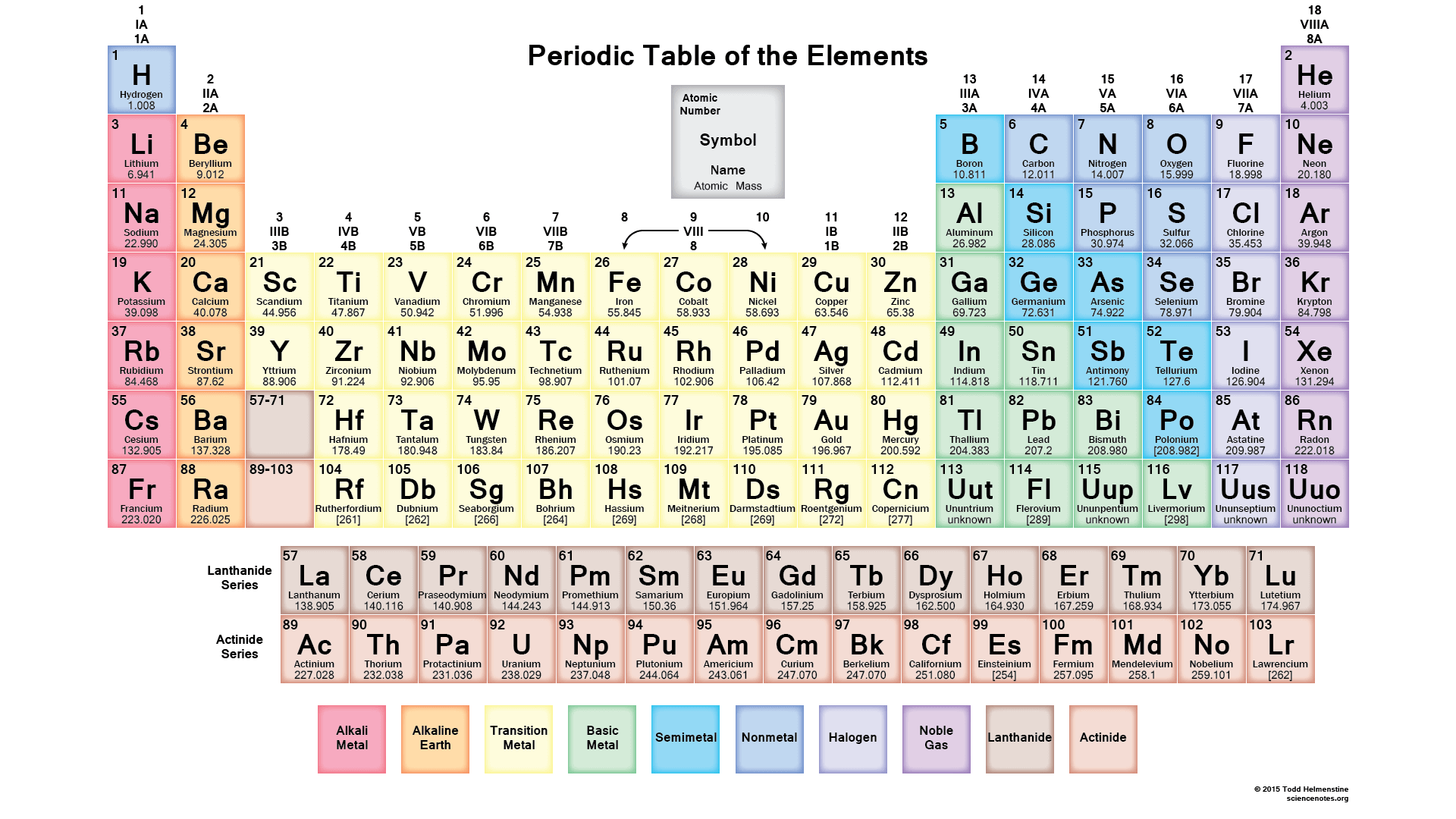
Vertical columns on the periodic table are called ___?
groups
periods
rows
families
Vertical columns on the periodic table are called ___?
groups
periods
rows
families

Which color on the image of the periodic table corresponds with the halogens.
red
black
blue
orange
Which color on the image of the periodic table corresponds with the halogens.
red
black
blue
orange
Which color on the image of the periodic table corresponds with the noble gases.
red
black
blue
orange
Which color on the image of the periodic table corresponds with the noble gases.
red
black
blue
orange
Which color on the image of the periodic table corresponds with the transition metals.
red
black
blue
orange
Which color on the image of the periodic table corresponds with the transition metals.
red
black
blue
orange
Horizontal rows on the periodic table are called ___?
groups
periods
rows
families
Horizontal rows on the periodic table are called ___?
groups
periods
rows
families
Which family of elements reacts violently with water and exposure to oxygen?
alkali metals
alkaline earth metals
lanthanides
actanides
transition metals
Which family of elements reacts violently with water and exposure to oxygen?
alkali metals
alkaline earth metals
lanthanides
actanides
transition metals
The periodic table is mostly comprised of what type of element?
Metals
Nonmetals
Metalloids
When a halogen such as Chlorine, combines with an alkali metal to produce a what?
compound
salt
mineral
acid
When a halogen such as Chlorine, combines with an alkali metal to produce a what?
compound
salt
mineral
acid
Which family of elements does not combine with other elements unless under special conditions in a laboratory?
Noble gases
Halogens
Metalloids
Alkaline earth metals
Actinides
Which family of elements does not combine with other elements unless under special conditions in a laboratory?
Noble gases
Halogens
Metalloids
Alkaline earth metals
Actinides
Sulphuric acid + sodium carbonate
-->
Sulphuric acid + sodium carbonate
-->
Hydrochloric acid + magnesium hydroxide -->
Hydrochloric acid + magnesium hydroxide -->
Sulphuric acid + sodium carbonate
-->
Sulphuric acid + sodium carbonate
-->
What is the formula for Magnesium Chloride?
MgCl
MgCl2
MnC
MnCl2
Select the types of intermolecular forces
Hydrogen bonding
Covalent bonding
Metallic bonding
Dispersion forces
What is the name for FeSO4?
Iron(II) Sulphate
Lead(II) Sulphate
Fluorine Sulphate
Francium Sulphide
Beryllium Oxide (BeO), is what type of compound?
Metallic
Covalent
Ionic
Diprotic
Select all of the covalent compounds
O3
H2O
NH3
NaCl
Manganese is a non-metal
True
False
How many valence electrons does Boron have?
1
7
3
5
Iodine is a metal
True
False
Which of these molecules are polar?
H2O
NH3
C2H5OH
CO2
The strongest intermolecular force is:
Dipole-Dipole
Dispersion forces
Hydrogen Bonding
What is the name of Ba(NO3)2?
Barium Dinitrate
Beryllium Nitrate
Barium Nitrate
Boron Nitrate
Select the diatomic molecules
OH
NaCl
H2
N2
What is the formula for Tin(II) Chloride?
Se2Cl2
Sn2Cl
SnCl2
SeCl2
Select all that have ionic bonds
NaCl
MgCl2
KI
NO2
How many valence electrons does carbon have?
1
2
6
4
How many valence electrons does lithium have?
1
2
3
4
What shape is carbon dioxide?
Tetrahedral
Linear
Trigonal Planar
T-shape
Select all that have linear geometry
BeH2
HCN
H2O
NO2
What is the formula for Titanium(II) Selenide?
T2S
TiSe
TiSe2
TiS2
Which is the lewis structure for ammonia?


All solutions are
coloured
colourless
clear
concentrated
What is the correct chemical formula for potassium oxide?
K2O
KO
KO2
KO4

For which element is this the electron configuration?
Cl
O
Na
F

