
 Worksheets
Muscular System
Total questions: 144
Worksheet time: 1hrs 13mins
What are the components of a skeletal muscle?
Bones, tendons, ligaments, and cartilage
Muscle fibers, connective tissue, blood vessels, and nerves
Fat cells, skin, hair, and nails
Organs, blood cells, nerves, and glands
What are the different types of muscle fibers and their characteristics?
Cardio-twitch (Type C) and strength-twitch (Type S) fibers
Long-twitch (Type L) and short-twitch (Type S) fibers
Slow-twitch (Type I) and fast-twitch (Type II) fibers
Smooth-twitch (Type III) and rough-twitch (Type IV) fibers
How do slow-twitch and fast-twitch muscle fibers differ in terms of function?
Slow-twitch muscle fibers are used for quick, powerful movements
Slow-twitch and fast-twitch muscle fibers have the same function
Functionally, slow-twitch muscle fibers are used for endurance activities and are fatigue-resistant, while fast-twitch muscle fibers are used for quick, powerful movements and fatigue more quickly.
Fast-twitch muscle fibers are fatigue-resistant
How do muscles work together to produce movement?
By inflating and deflating like a balloon
By remaining completely still
By contracting and relaxing in a coordinated manner
By expanding and contracting randomly
Explain the role of agonist and antagonist muscles in movement.
Agonist muscles and antagonist muscles both work together to initiate movement.
Agonist muscles work in opposition to control the movement, while antagonist muscles initiate movement.
Agonist and antagonist muscles have the same role in movement.
Agonist muscles initiate movement, while antagonist muscles work in opposition to control the movement.
What are some common muscle disorders and diseases?
Muscular dystrophy, myasthenia gravis, fibromyalgia, muscular atrophy
Alzheimer's disease, Parkinson's disease, Multiple sclerosis
Hypertension, Asthma, Migraine
Arthritis, Osteoporosis, Diabetes
The muscular system interacts with the skeletal system by:
smooth muscles are joined with spongy bone via cartilage
skeletal muscles pull on joints to permit movement
cardiac muscle is connected to the ribs
skeletal muscles are joined to one another via ligaments
The sliding filament theory explains which of the following?
muscle extensions
muscle inductions
muscle contractions
muscle formation
Which parts of the muscular system have striations? select ALL that apply
cardiac muscle
skeletal muscle
smooth muscle
none of the above
Smooth muscle is present in your:
heart
digestive system
skeletal system
skeletal muscle
Which parts of your muscular system are voluntary? Select ALL that apply.
cardiac muscle
skeletal muscle
smooth muscle
none of the above
Smooth muscle lacks:
ATP
calcium
involuntary contractions
striation
Which of the following is a way that the skeletal system is necessary for the muscular system's function?
the skeletal system has joints, which are what the muscular system pulls on to move
the skeletal system provides structure for the muscular system
the skeletal system provides calcium, which the muscles require along with ATP to contract
all of the above
Which of the following is a secondary function of the muscular system?
motion
oxygen circulation
support and protection
thermoregulation
The muscular system interacts with the skeletal system by:
smooth muscles are joined with spongy bone via cartilage
skeletal muscles pull on joints to permit movement
cardiac muscle is connected to the ribs
skeletal muscles are joined to one another via ligaments
The sliding filament theory explains which of the following?
muscle extensions
muscle inductions
muscle contractions
muscle formation
What type of muscle is voluntary?
Skeletal
Cardiac
Smotth
What type of muscle has striations? Choose all that apply.
Skeletal
Cardiac
Smooth

What type of muscle tissue is shown?
Skeletal
Cardiac
Smooth
What part of skeletal muscle attaches to the bone that moves when a muscle contracts?
Origin
Body
Insertion
What ion is released from the muscle cell when a nerve impulse arrives?
Sodium
Calcium
Potassium
Chloride
All of the following are functions of the muscular system (check all that apply)
Posture
Heat production
Blood production
Movement
This autoimmune disease causes muscle weakness and immobilization of your limbs.
Carpel tunnel syndrome
Duchenne Muscular Dystrophy
Myasthenia gravis
Polio
Genetic disorder that progressively replaces muscle with fat and fibrous tissue leading to muscle wekaness
Fibromyalgia
Duchenne Muscular Dystrophy
Myasthenia gravis
Polio
The prime mover for forearm extension.
Quadriceps
femoris
Triceps brachii
Biceps brachii
Tibialis anterior
The prime mover for inhalation.
Adductors
Latissimus dorsi
Epicranius
Diaphragm
The large triangular muscle of the lower back.
Diaphragm
Adductors
Latissimus dorsi
Tibialis anterior
The main muscles of the inner thighs.
Quadriceps
femoris
Hamstrings
Adductors
Tibialis anterior
The antagonist in forearm flexion.
Biceps brachii
Tibialis anterior
Triceps brachii
Latissimus dorsi
The prime movers that allow your jaw to close so that you can chew your food are the
buccinator and orbicularis oris
orbicular oculi and masseter
masseter and temporalis
epicranius and temporails
What are the three major types of muscles in the muscular system?
Skeletal, smooth, and nerve muscle
Cardiac, smooth, and bone muscle
Skeletal, cardiac, and smooth muscle
Cardiac, nerve, and bone muscle
What are the functions of the muscular system?
Movement of the body, maintain posture, and circulate substances
Circulate blood, digest food, and cognitive function
Protect organs, produce hormones, and absorb nutrients
Generate heat, store nutrients, and filter waste
What is the role of muscles in the movement of the skeletal system?
Muscles stabilize joints during complex movements
Muscles help keep the body in the correct position while sitting
Muscles contract and pull on the bones of the skeletal system to produce voluntary movement
Muscles provide a protective covering for internal organs
How do muscles contribute to the stability of the body?
By contracting and pulling on the bones
By working alongside tendons and ligaments to stabilize joints during complex movements
By generating 85% of the body's heat
By allowing for the movement of substances through ducts and vessels
What is one way muscles protect internal organs?
By producing voluntary movement
By providing a protective covering and absorbing shock at moving joints
By generating heat during shivering
By facilitating circulation of substances through ducts and vessels
How do muscles contribute to heat production in the body?
By stabilizing joints during movements
By helping maintain posture
By contracting to generate 85% of the body's heat; shivering produces extra heat in cold temperatures
By protecting internal organs
What role do muscles play in the circulation of substances within the body?
They help maintain body posture
They generate body heat
They protect internal organs
They allow for the movement of substances through ducts and vessels of other organ systems
What is contractility in the context of muscle characteristics?
The ability to return to its original length
The ability to stretch beyond its original length
The ability to shorten and thicken with force
The ability to respond to a stimulus
What does excitability refer to when discussing muscles?
The ability to return to its original length
The ability to stretch beyond its original length
The ability to shorten and thicken with force
The ability to respond to a stimulus
What does extensibility mean in terms of muscle properties?
The ability to return to its original length
The ability to stretch beyond its original length
The ability to shorten and thicken with force
The ability to respond to a stimulus
What is the definition of elasticity in muscle characteristics?
The ability to return to its original length
The ability to stretch beyond its original length
The ability to shorten and thicken with force
The ability to respond to a stimulus
Where is smooth muscle found?
In the heart
In the walls of hollow organs, blood vessels, and ducts
Attached to bones
In the lungs
What is the role of cardiac muscle?
Voluntary movement
Transporting substances
Contracting the heart to pump blood
Moving the limbs
What type of control is cardiac muscle under?
Voluntary
Involuntary
Semi-voluntary
Not controlled
Where are smooth muscles located?
Attached to skeletal bones
Muscular walls of the heart
Walls of hollow organs, vessels, glands
Throughout the entire body
Which type of muscle has cylindrical branching fibers with dark striations and disks in its appearance?
Skeletal
Smooth
Cardiac
Non-striated
What is the speed of contraction for smooth muscles?
Fast
Slow
Medium
Variable
What feature do muscle fibers have that gives skeletal muscles their distinctive appearance?
Smooth texture
Striations
Uniform color
Flexibility
What is the main job of skeletal muscle?
To pump blood
To digest food
To contract and move the body
To protect internal organs
Skeletal muscle is under what type of control?
Involuntary control
Voluntary control
Automatic control
Reflexive control
How does skeletal muscle behave when it contracts?
Slowly with little force
Rapidly with great force, but fatigues quickly
Continuously without fatigue
Weakly and only when stimulated
How does smooth muscle contraction compare to skeletal muscle contraction?
It contracts faster and sustains the contraction longer
It contracts slower and sustains the contraction shorter
It contracts faster and sustains the contraction shorter
It contracts slower but can sustain the contraction longer
How does cardiac muscle differ from smooth muscle in terms of control and fatigue?
Cardiac muscle is under voluntary control and gets fatigued easily
Cardiac muscle is under involuntary control and gets fatigued easily
Cardiac muscle is under voluntary control but does not get fatigued easily
Cardiac muscle is under involuntary control and does not get fatigued easily
How many types of muscles are there in the muscular system according to the review?
2
3
4
5
What do skeletal muscles consist of?
Short, branched cells
Long cylindrical cells called muscle fibers
Flat cells with multiple nuclei
Small, spindle-shaped cells
How does skeletal muscle behave when it contracts?
It contracts slowly with minimal force and fatigues slowly
It contracts rapidly with great force and fatigues quickly
It contracts moderately with moderate force and does not fatigue
It contracts continuously without fatigue
What is the term for a bundle of muscle fibers?
Epimysium
Perimysium
Endomysium
Fascicle
How many skeletal muscles are there approximately in the human body?
500
650
800
1000
What is the name of the muscle that is found on the chest and is known as a major push muscle?
Deltoid
Pectoralis Major
Biceps Brachii
Serratus Anterior
Which of the following muscles is located in the calf area?
Gracilis
Sartorius
Gastrocnemius
Rectus Abdominus
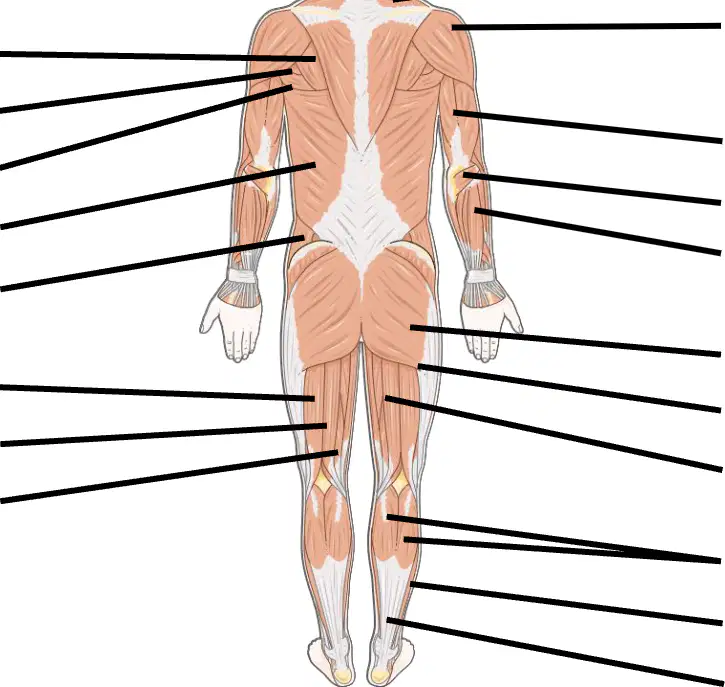
Identify the muscle that is connected to the Calcaneal (Achilles) Tendon as shown in the diagram.
Soleus
Gastrocnemius
Gluteus Maximus
Adductor Magnus
What is the term used for the attachment site of a muscle tendon to a stable bone?
Insertion
Origin
Flexion
Extension
What does the insertion of a muscle refer to?
The attachment to a stable bone that does not move during muscle contraction
The attachment to a mobile bone that moves during muscle contraction
The middle part of the muscle
The attachment to any bone regardless of movement
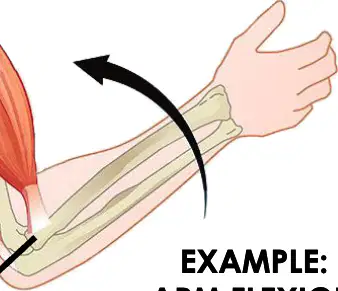
Which action is used as an example to explain the concept of muscle origin and insertion in the image?
Leg extension
Arm flexion
Shoulder abduction
Knee flexion
Why do muscles work in antagonistic pairs?
Because one muscle can push and the other can pull
To increase the strength of the contraction
Because muscles can only pull, not push, so an opposing motion is needed
To allow for faster movement
What is the role of the agonist muscle?
It relaxes to allow movement
It provides the force to move a bone by contracting
It opposes the prime mover
It contracts to return a bone to its original position
What is the role of the antagonist muscle?
It provides the main force for a movement
It contracts at the same time as the agonist
It opposes the agonist and relaxes
It helps in pushing the bone
What is one of the functions of the muscular system?
Producing heat
Digesting food
Regulating body temperature
Filtering blood
All of the following are functions of the muscular system (check all that apply)
Posture
Heat production
Blood production
Movement
Which of the following correctly represents the hierarchical organization of the muscular system from largest to smallest?
A) Muscle fiber → Fascicle → Muscle → Myofibril
B) Muscle → Fascicle → Muscle fiber → Myofibril
C) Myofibril → Muscle fiber → Fascicle → Muscle
D) Fascicle → Muscle fiber → Myofibril → Muscle
A doctor examines a patient with a muscle disorder affecting only involuntary muscles. Which function is most likely affected?
A) Lifting objects
B) Digesting food
C) Walking
D) Writing

Structure G is the _______.
Triceps brachii
Biceps brachii
Brachialis
Iliopsoas
Structure F is the _______.
Triceps brachii
Biceps brachii
Brachialis
Iliopsoas

Structure FF is the ____________.
Soleus
Gastrocnemius
Fibularis longus
Extensor digitorum longus
Structure GG is the ____________.
Soleus
Gastrocnemius
Fibularis longus
Extensor digitorum longus
Structure P is the ____________.
Soleus
Tibialis anterior
Fibularis longus
Extensor digitorum longus
Structure K is the ____________.
Rectus femoris
Iliopsoas
Fibularis longus
Sartorius
Structure BB is the _______.
Internal oblique
External oblique
Rectus abdominis
Intercostals
Structure AA is the _______.
Internal oblique
External oblique
Rectus abdominis
Intercostals
Structure W is the _______.
Pectoralis major
External oblique
Deltoid
Intercostals
Structure U is the _______.
Pectoralis major
External oblique
Deltoid
Sternocleidomastoid
Structure Z is the _______.
Internal oblique
External oblique
Rectus abdominis
Intercostals
Structure D is the _______.
Deltoid
Trapezius
Sternocleidomastoid
Pectoralis major
Structure C is the _______.
Deltoid
Trapezius
Sternocleidomastoid
Pectoralis major

Structure B is the
Masseter
Orbicularis oculi
Temporalis
Frontalis

Which of the following is structure S?
Gluteus medius
Gluteus maximus
Latissimus dorsi
Adductor muscle
Which of the following is structure Q?
Gluteus medius
Gluteus maximus
Latissimus dorsi
Deltoid
Which of the following is structure A?
Triceps brachii
Brachialis
Brachioradialis
Deltoid

Structure T is the ___________.
Adductor
Iliotibial tract
biceps femoris
Gastrocnemius
Structure i is the ___________.
Adductor
Iliotibial tract
biceps femoris
Gastrocnemius
Structure L is the ___________.
Fibularis longus
Soleus
Achilles tendon
Gastrocnemius
Structure H is the ___________.
Fibularis longus
Iliotibial tract
Achilles tendon
Gastrocnemius
Structure J is the ___________.
Soleus
Iliotibial tract
Achilles tendon
Gastrocnemius
Which of the following is structure P?
Triceps brachii
Brachialis
Brachioradialis
Deltoid
Movement of the arm/leg away from the midline
adduction
eversion
inversion
abduction
Movement of arm/leg toward the midline
flexion
extension
adduction
abduction
Movement to bend a joint
extension
circumduction
eversion
flexion
Movement to straighten a joint
extension
flexion
dorsiflexion
pronation
Arm Flexion


Arm Extension
Abduction


Adduction
Movement of the arm/leg away from the midline
adduction
eversion
inversion
abduction

Which action points the toes away from the shin?
Inversion
Eversion
Dorsiflexion
Plantar flexion

Which action bends a joint, or decreases the angle between bones?
Circumduction
Rotation
Extension
Flexion

The triceps brachii straightens the forearm to increase the angle between the humerus and ulna. This is an example of
Circumduction
Rotation
Extension
Flexion
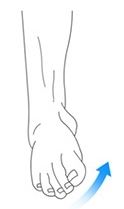

Which shoulder motion is illustrated in the picture?
rotation
adduction
flexion
extension


Turning the hand so that the palm is upward or facing anteriorly (in anatomical position).
supination
pronation
flexion
dorsiflexion


Identify the joint action being performed.
Circumduction
Lateral Rotation
Medial Rotation
Eversion
Examples of a Ball & Socket Joint are found in the
Shoulder
Knee
Hip
Ankle
Which of the following is a characteristic feature of fast-twitch muscle fibers?
High endurance
High myoglobin content
Fatigue quickly
Primarily use aerobic respiration

For the arm to be in the position of the picture, the bicep must be __________ and the tricep must be________________
relaxed (extended), relaxed (extended)
contracted (flexed), contracted (extended)
relaxed (flexed), contracted (extended)
contracted (flexed), relaxed (extended)
Muscles are needed for what?
movement
decoration
pump blood
no one knows
How are muscles named ?
by location
by fiber direction
by the number of divisions
all these are correct

What muscle does the action shown here at letter D (not the neck)?
rectus abdominis
pectoralis major
deltoid
external obliques

name the muscle
Vastus Medialis
Vastus Intermedius
Rectus Femoris
Vastus Lateralis

What muscle is this?
Soleus
gastrocnemius
Semimembranosus
Semitendinosus

#3
rectus femoris
vastus medialis
gracilis
sartorius

#5
recuts femoris
vastus medialis
vastus lateralis
adductor group
lifting the foot closer to your shin (up)
dorsiflexion
plantarflexion
eversion
inversion
pointing foot toward the ground
dorsiflexion
plantarflexion
inversion
eversion

The lateral motion TOWARDS the midline is called ______.
adduction
abduction
circumduction
opposition


Name this movement
inversion
plantar flexion
eversion
dorsiflexion

Name this movement
adduction
abduction
flexion
extension

Name this movement
extension
flexion
adduction
abduction

Name this movement
adduction
abduction
inversion
eversion

Name this movement
inversion
eversion
adduction
abduction

Name this movement
ulnar deviation
supination
pronation
radial deviation

Name this movement
supination
pronation
ulnar deviation
radial deviation

Name this movement
eversion
inversion
plantarflexion
dorsiflexion

