
 Worksheets
SOL Review Questions 1/3
Total questions: 144
Worksheet time: 1hrs 12mins
Which of the following best describes Earth's orbital position in our solar system?
Outside of three smaller planets
Outside of the gas giants
An outer planet
An inner planet
The Southern Hemisphere is warmer in January than in July because —
it is experiencing summer
the cold winds are concentrated in the Northern Hemisphere
the sun puts out more energy
the hole in the ozone layer allows more heat into the atmosphere
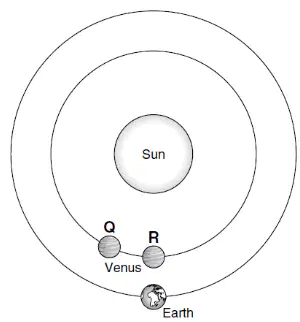
Based on the drawing, what is the main reason that Venus would appear brighter at point Q rather than at point R as seen from the Earth?
The planet is closer to the Earth at point Q than at point R.
More of the visible side of the planet is illuminated at point Q than at point R.
The planet appears overhead against a dark sky when it is at point Q but not at point R.
Light from the planet at point Q is less affected by the sun's gravity than at point R.

Which image below best represents our galaxy?
Image F
Image G
Image H
Image J
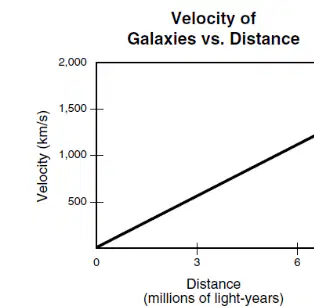
In the late 1920s, Edwin Hubble and Milton Humason determined the distance to a number of galaxies and the velocity of those galaxies relative to the Earth. The graph shows the early results that were obtained. What approximate ratio did the scientists calculate between velocity and distance based on these early findings?
150 kilometers per second per one million light years
300 kilometers per second per one million light years
450 kilometers per second per one million light years
600 kilometers per second per one million light years
A student sees a very bright star in the sky and thinks it might be the planet Venus. Which observation would lend support to this conclusion?
After a few minutes, its position relative to the surrounding stars has changed significantly.
After an hour, its position relative to the horizon has changed.
After an hour, its brightness has faded significantly.
After a month, its position relative to the surrounding stars has changed.
Gas and dust in interstellar nebulae can form —
stars
comets
meteors
asteroids
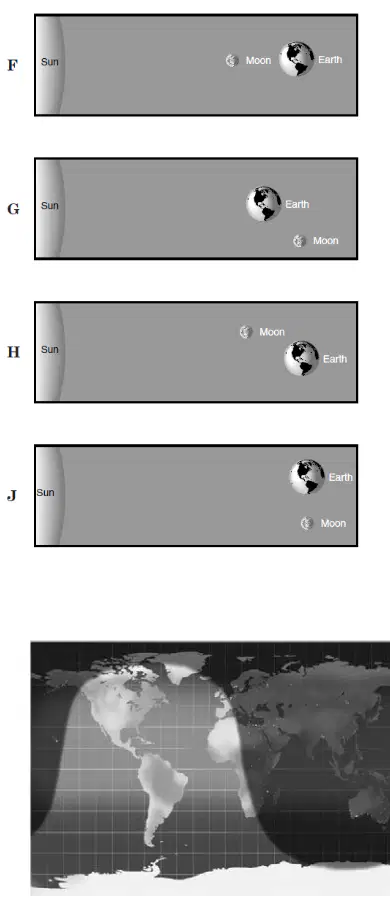
Which of these will cause the greatest high tides?
Image F
Image G
Image H
Image J
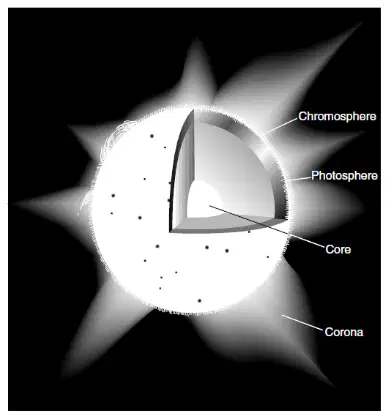
Which layer of the sun is seen during a total solar eclipse?
Chromosphere
Photosphere
Core
Corona
Which planet has the shortest day?
Mercury
Venus
Jupiter
Saturn
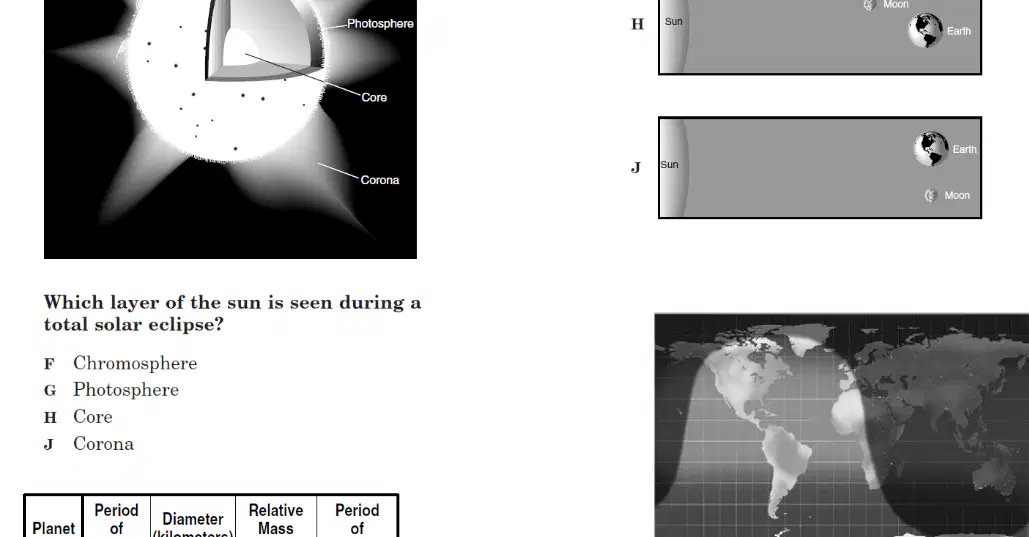
The picture shows an infrared composite of the Earth as seen by a weather satellite system. What does the dark shaded area on this map represent?
The moon's shadow
Thick cloud cover
Nighttime
Ocean currents
Which planet in the solar system has an orbit so eccentric that it crosses the orbit of another planet?
Mars
Mercury
Jupiter
Pluto
What is the approximate percentage of the Earth that is illuminated by the sun at any given time?
10%
25%
50%
90%
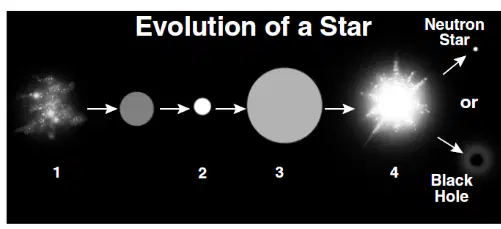
Which of the above evolutionary stages of a massive star is called a supernova?
1
2
3
4
Which planet rotates the fastest?
Mercury
Mars
Jupiter
Saturn
Photographs of the surface of Mars reveal the presence of sand dunes that shift over time. These dunes demonstrate the presence of what phenomenon on Mars?
Precipitation
Winds
Magnetic pole reversals
Plate tectonics
The first manned-mission to land on the moon was commanded by Neil Armstrong and was called —
Apollo 11
Gemini 3
Viking 2
Mariner 7
When Venus passes between the Earth and the sun, it is visible as a tiny black dot on the sun's bright disk. Why is Mars never visible in this same way?
The orbit of Mars is more eccentric than that of Venus.
The orbit of Mars is outside that of the Earth's orbit.
Mars is too small to be seen against the backdrop of the sun.
Mars shines too brightly to be visible against the sun.
The sun emits energy by converting hydrogen into helium. What is this process called?
Fusion
Fission
Sunspot formation
Solar wind
Periodically, there are spectacular meteor showers on Earth. These showers usually occur because the Earth's orbit passes through the remains of —
a star
a comet
solar flares
the rings of Saturn
A person weighs more on the Earth than on the moon because the Earth has a greater —
density
atmospheric pressure
magnetic strength
gravitational pull
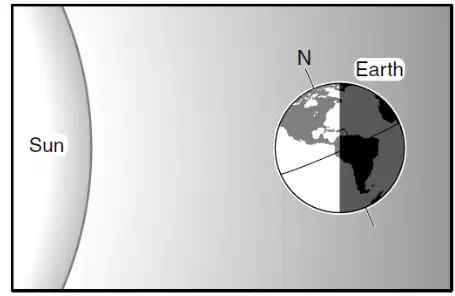
When the Earth is at its greatest distance from the sun, its Northern Hemisphere is tilted toward the sun, as shown in the drawing. What season takes place in the Southern Hemisphere at this time?
Spring
Summer
Autumn
Winter
The numerous rocks orbiting the sun between Jupiter and Mars are —
comets
asteroids
meteorites
satellites
Which element in Earth's atmosphere is essential for human life and is extremely rare or nonexistent in the atmospheres of other planets in our solar system?
Carbon dioxide
Hydrogen
Nitrogen
Oxygen
The pole star, Polaris, is nearly stationary and straight overhead when seen from the North Pole. When viewed from the Equator, it —
is nearly stationary and on the horizon
is nearly stationary and directly overhead
rises barely above the eastern horizon, moves along the southern horizon, and sets in the West
rises straight up in the East, passes directly overhead, and descends straight down in the West
About how long does it take the Earth to make one complete rotation on its axis?
one day
one week
one month
one year
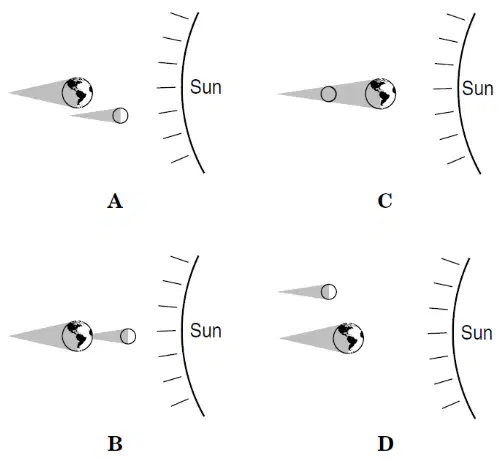
Which diagram represents the placement of the sun, Earth, and moon during a lunar eclipse?
diagram A
diagram B
diagram C
diagram D
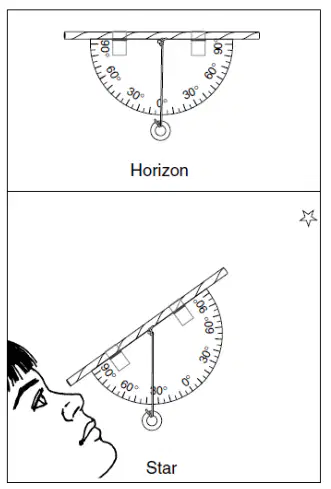
What is the position of the star above the horizon?
35°
40°
55°
60°
Parallax can be used to measure a star’s —
distance from Earth
atmospheric temperature
gravitational strength
surface composition
Which of these measurements allows scientists to compare the brightness of stars?
absolute magnitude
critical density
orbital velocity
red shift
Which of these planets travels around the Sun in less time than it takes Earth to complete one revolution?
Mars
Saturn
Mercury
Uranus
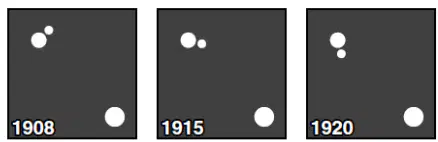
The pictures show the same stars at different times. Which hypothesis is best supported by these data?
The stars are moving toward one another.
The three stars are moving very fast.
One star is moving around another star.
The biggest star is closest to the Earth.
A star might be much brighter than it appears to be. This is called the star’s absolute magnitude. The difference in apparent magnitude and absolute magnitude is due primarily to the star’s —
surface temperature
motion through the universe
diameter
distance from the Earth
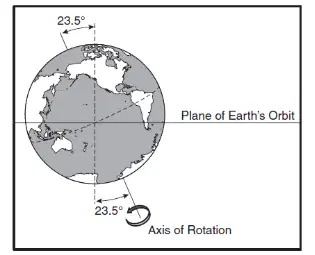
Earth’s axis of rotation is tilted 23.5° relative to the plane of its orbit, which helps to cause —
the seasons
day and night
the lunar phases
high and low tides
A student claims that the full Moon occurs about once a month. What process will verify the student’s claim?
hypothesizing
theorizing
predicting
observing
Why does erosion not occur on the moon?
The rock surface of the moon is too hard.
There is no animal life.
There is no wind or rain.
The gravitational pull of the moon is too weak.
Which planet has a fierce hurricane-like storm that is several times the size of Earth?
Mars
Venus
Saturn
Jupiter
In 1912, an astronomer at Arizona’s Lowell Observatory noticed that the lines in the spectra of most galaxies shifted toward the red end of the spectrum. Another American astronomer, Edwin Hubble, later interpreted this discovery as evidence that —
galaxies were once part of one huge megagalaxy
an explosion will one day result from the pressure building as the galaxies expand
galaxies are moving away from each other in a constantly expanding universe
the largest galaxies are slowly engulfing their smaller neighbors
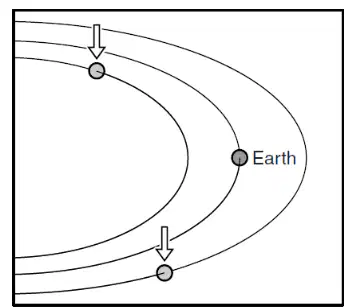
In addition to Earth’s orbit, which planets’ orbits are shown?
Mars and Jupiter
Jupiter and Saturn
Venus and Mars
Mercury and Venus
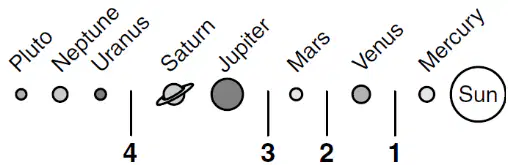
At what position would Earth be found in the solar system diagram shown above?
1
2
3
4
During which portion of the Earth’s revolution around the sun is the Northern Hemisphere tilted toward the sun?
Vernal equinox
Summer solstice
Autumnal equinox
Winter solstice
What element is the main component of most stars?
Nitrogen
Iron
Hydrogen
Oxygen
Why do stars appear to change position during the night?
Earth rotates on its axis.
Earth revolves around the sun.
The stars are moving away from each other.
Stars are very far away from the solar system.
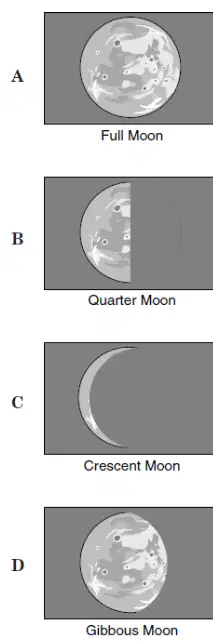
During which of these phases of the moon will the tides be highest?
Full Moon
Quarter Moon
Crescent Moon
Gibbous Moon
Orbital velocity is the average speed of a planet moving through space in its orbit around the sun. Which of the following planets has the fastest orbital velocity?
Mercury
Jupiter
Mars
Pluto
Which of these causes days and nights?
The orbit of the Earth around the sun
The revolution of the moon around the Earth
The rotation of the moon on its axis
The rotation of the Earth on its axis
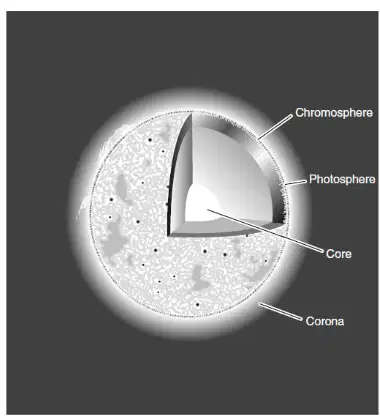
Which layer of the sun is the most dense?
Chromosphere
Photosphere
Core
Corona
Because of the unique position of the Earth in the solar system, life has flourished due to the presence of —
helium
volcanoes
liquid water
salt
Which of these facts is the best supporting evidence that the universe is expanding?
The stars vary in chemical composition.
The galaxies are moving away from each other.
The galaxies can spin to form eddies.
The universe is filled with galaxies of different sizes.
A light-year measures —
brightness
distance
radiation
time
Which planet is often called "Earth's twin" because it is similar in mass and diameter to the Earth?
Mars
Mercury
Venus
Pluto
Saturn's volume is 762 times the volume of Earth, and yet its mass is only about 95 times that of Earth's mass. This is due to Saturn's —
low density
temperature
thousands of rings
distance from the sun
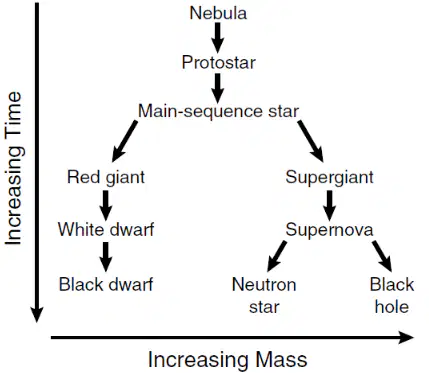
Using the diagram titled "The Life Cycle of a Star," what is the first stage in the life cycle of a star?
Black hole
Dwarf star
Main-sequence star
Stellar nebula
Ozone molecules protect Earth from the harmful effects of the sun by —
insulating the temperature at the poles
condensing water particles in clouds
regulating the heat from the sun
absorbing ultraviolet radiation
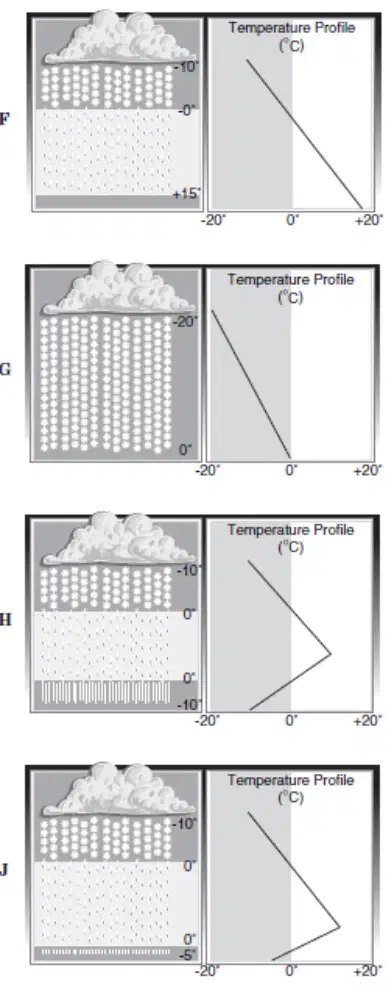
In which of the graphs would the precipitation at ground level most likely be rain?
Graph F
Graph G
Graph H
Graph J
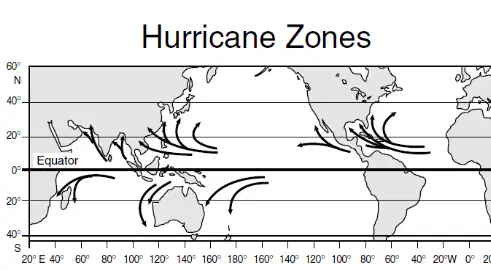
According to the map, most hurricanes occur where —
the oceans are warmest
the landmasses are largest
the atmosphere is driest
areas of greatest population exist
Release of CFCs and similar compounds are a possible cause of —
destruction of ozone in the upper atmosphere
acid rain in the northeast U.S.
greenhouse gas build-up in the lower atmosphere
increase in atmospheric carbon dioxide concentration
Based on the above symbols, which of the following represents a wind speed of 30 knots?
Symbol A
Symbol B
Symbol C
Symbol D
A volcanic eruption can affect the atmosphere by —
reducing the amount of water vapor in the atmosphere
adding large quantities of several gases, such as sulfur dioxide, to the atmosphere
clearing away nearby clouds, increasing the amount of sunshine
increasing the amount of oxygen due to escaping gases
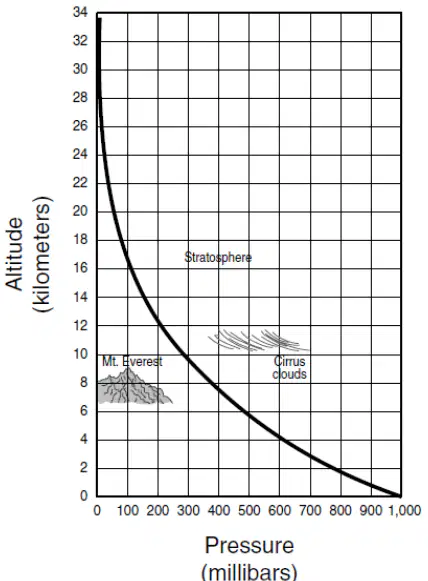
The chart shows the relationship between altitude and air pressure. What is the approximate air pressure at an altitude of 22 kilometers?
40 millibars
120 millibars
200 millibars
400 millibars
People have tried many methods to artificially produce rain. One method, called cloud seeding, involves airplanes dropping particles of silver iodide onto clouds to help the clouds produce rain droplets. These silver iodide particles act as —
hailstones
dew points
electrical charges
condensation nuclei
Which of these is important in the formation of clouds?
The relative length of day and night
The Coriolis effect
The melting of the polar ice caps
The cooling of air as it rises
If there were a slight increase in the amount of solar energy that reached the Earth, there would be an immediate increase in —
erosion
evaporation
volcanic activity
groundwater flow
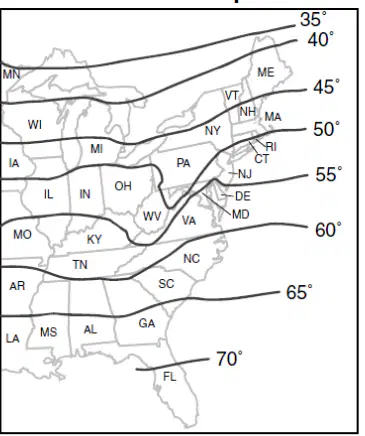
According to this map, the mean annual temperature for most of the eastern half of Virginia is between —
45°F and 50°F
50°F and 55°F
55°F and 60°F
65°F and 70°F
What is one of the major indications that the Earth's climate has varied over time?
Land forms carved by glaciers in temperate areas
Depletion of oxygen in lakes and rivers
Ocean currents
Magnetic reversals in layers of rock
What causes currents in the atmosphere?
Ocean waves and currents
Pressure from the ozone layer
Solar heating of the upper atmosphere
Warm air rising and cold air sinking
Moist air from the Pacific Ocean rises and cools as it passes from west to east over the Sierra Nevada Mountains. Once it is over the mountain range, the air descends and warms on the other side. What is the result of the air ascending, then descending over the mountains?
Desert on the west side of the mountains and heavy rains on the east side
Heavy rains on the west side of the mountains and desert on the east side
Heavy rains on the west side of the mountains and year-round snow on the east side
Desert on the east and west sides of the mountains and heavy rains on top of the mountains
Water vapor is lighter than many atmospheric gases such as oxygen, nitrogen, and carbon dioxide. Why then doesn’t water vapor rise above these other gases to a higher level of the atmosphere?
Water vapor contains other elements that give it weight
The cool atmosphere condenses the rising water vapor and causes it to fall back to Earth
The water molecules are attracted to molecules of heavier gases and remain in the lower regions of the atmosphere
There is an attraction among the water vapor molecules to hold them together close to the Earth
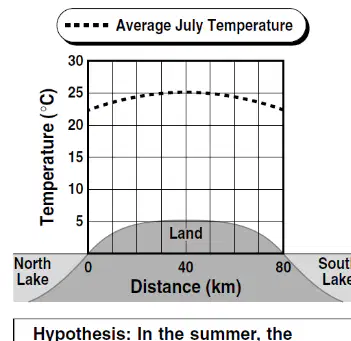
Hypothesis: In the summer, the warmest air will be closest to South Lake. According to the data shown by the graph, the warmest air during the summer will be found —
closest to North Lake
above South Lake
above the land between the lakes
closest to the water level of the lakes
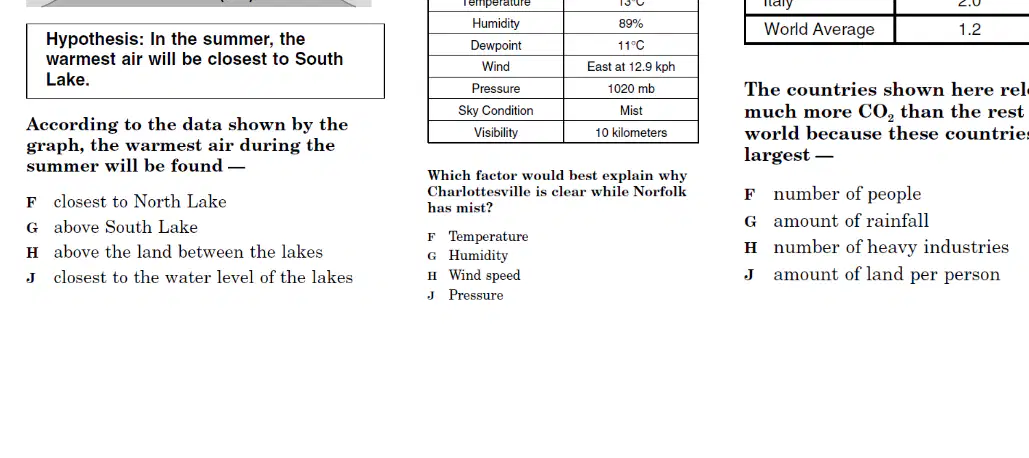
Which factor would best explain why Charlottesville is clear while Norfolk has mist?
Temperature
Humidity
Wind speed
Pressure
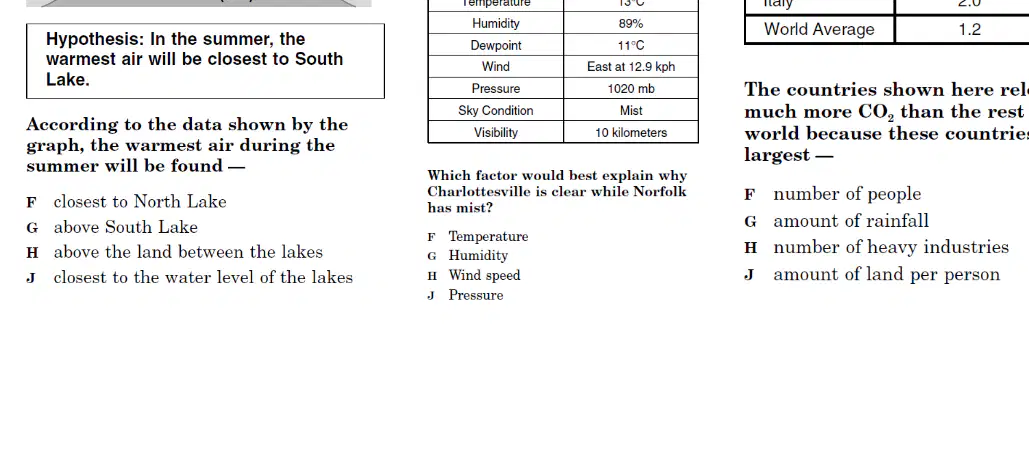
The countries shown here released much more CO2 than the rest of the world because these countries have the largest —
number of people
amount of rainfall
number of heavy industries
amount of land per person
Which of these is likely to occur after moist air is cooled below its dew point?
Water condenses.
Evaporation increases.
Ice crystals melt.
Winds are generated.
Most water leaves the ocean through evaporation and returns to the ocean through —
surface runoff
ground water
transpiration
precipitation
Cloudy nights can be warmer than clear nights because clouds trap heat —
generated from tropical winds
produced by the friction of air particles
released from Earth’s interior
absorbed by Earth during daylight hours
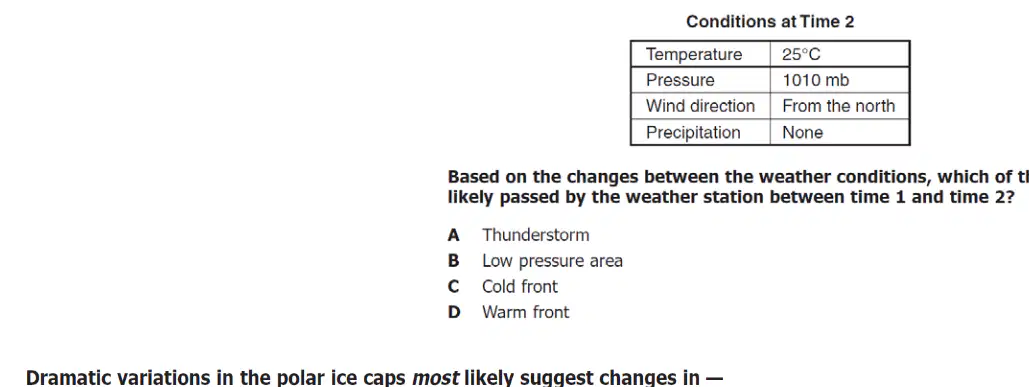
Based on the changes between the weather conditions shown in the tables, which of these most likely passed by the weather station between time 1 and time 2?
Thunderstorm
Low pressure area
Cold front
Warm front
Dramatic variations in the polar ice caps most likely suggest changes in —
the Moon’s orbit
Earth’s climate
ebb and flow of tides
global water consumption
Which of these would most likely occur as the ice caps melt?
The Earth would become cooler.
The sea would cover more land.
The rivers would flow more rapidly.
The rain would be more acidic.
On clear nights in late summer and early fall in the Shenandoah Valley, why does ground fog form in the low areas near the Shenandoah River?
Cool, descending air meets moist air in the low areas near the river.
Cool, moist air ascends from the river to the hilltops.
Warm winds bring moisture from the hills down into the valley.
There is more air pollution in the evenings.
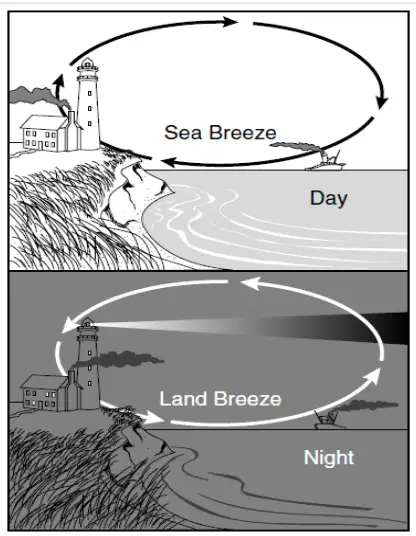
What would explain the change in the direction of air movement from daytime to night?
Water is always cooler than land.
Land temperature changes more quickly than water temperature.
Cool air rises more quickly than warm air.
The sun warms the moist ocean air more than the dry land air.
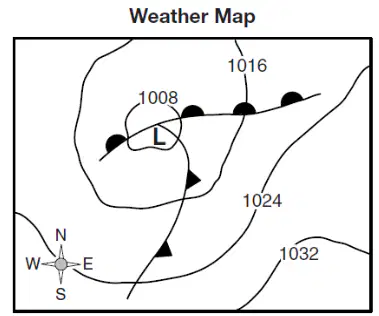
The label L indicates an area of low —
temperatures
pressure
altitude
rainfall
Students plan to use several rain gauges to compare average monthly rainfall on Virginia’s Coastal Plain and Piedmont regions. Which of these variables should be manipulated?
Height of the gauge
Brand of the gauge
Size of the gauge
Location of the gauge
Which of the following was primarily responsible for the development of life outside of the oceans?
A decrease in atmospheric hydrogen
A decrease in atmospheric carbon dioxide
An increase in atmospheric nitrogen
An increase in atmospheric oxygen
The ozone layer protects life on Earth from —
ultraviolet rays
gamma rays
infrared rays
x-rays
Approximately 99.7% of all water on Earth is found in oceans, seas, ice, and the atmosphere. Based on this information, which statement is most accurate?
The Earth’s freshwater supply is infinite.
Less than 0.3% of Earth’s water is drinkable.
Humans are not dependent on ocean water.
The water cycle returns all usable water to the sea.
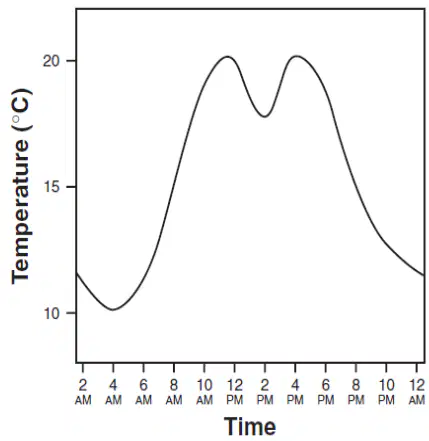
The graph shows the outdoor temperature at a certain location during a 24-hour period. What possible occurrence happened at 2:00 p.m.?
Daylight-savings time
Eclipse of the moon
A solar storm
Thunderstorm passes
A rain forest is found at the base of Mt. Kilimanjaro, and the summit is snowcapped. Which of the following would best account for this?
Temperature differences due to elevation changes
Climate differences due to seasonal changes
Differences in precipitation due to formation of a rain shadow
Climate changes due to changes in latitude
Land breezes and sea breezes are created by the differences in —
the Earth’s tilt on its axis
solar radiation reaching the Earth’s surface
the heat capacity between water and land
the living organisms occurring in the land and sea
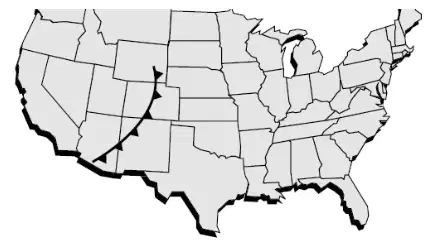
On weather maps, there are lines with tiny triangles on one side. This represents —
cold air moving in the direction the triangles point
cold air moving opposite the direction the triangles point
warm air moving in the direction the triangles point
warm air moving opposite the direction the triangles point
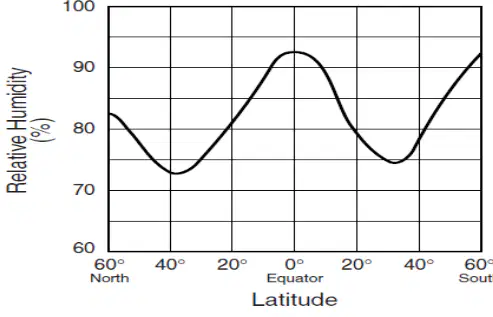
Hypothesis: The average relative humidity decreases north and south of the equator. According to the data shown in the graph, the hypothesis is only correct for latitudes —
up to 40° from the equator
from the poles to 40° from the equator
between 20° and 60° from the equator
farthest from the equator
Ocean → Evaporation → Condensation Which of these would come next in the water cycle?
Aeration
Sedimentation
Deposition
Precipitation
The two most common ions found in ocean water are —
chloride and sodium
potassium and calcium
phosphate and nitrate
magnesium and sodium
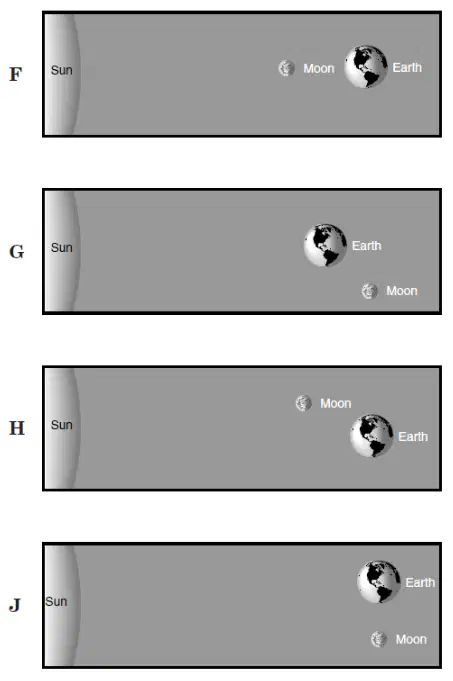
Which of these will cause the greatest high tides?
Configuration F
Configuration G
Configuration H
Configuration J
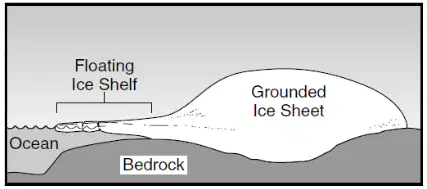
Why is the ice shelf floating?
The ice is melting faster than it can sink.
The ice is less dense than the ocean water.
The ice is warmer than the ocean water.
The ocean water is filled with vegetation that keeps the ice from sinking.
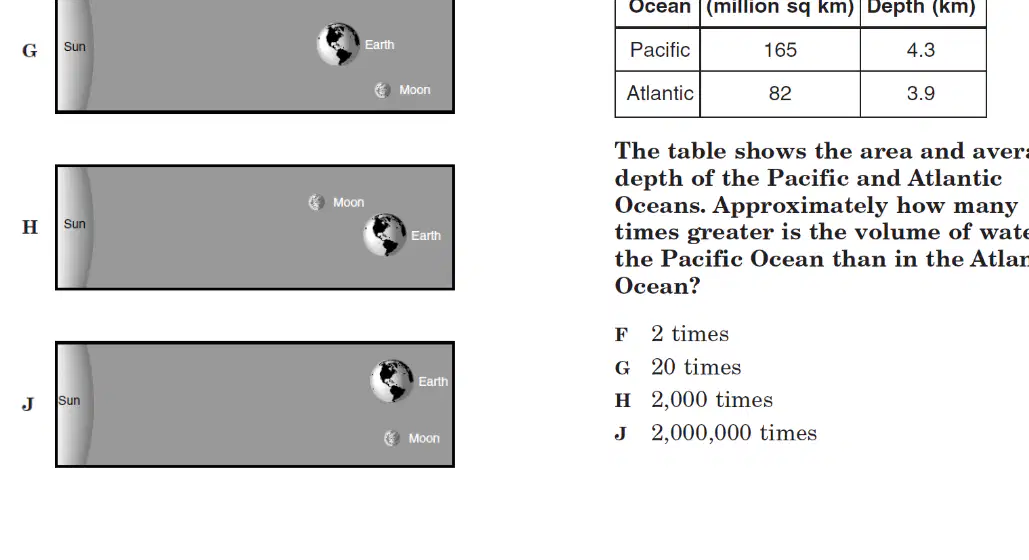
The table shows the area and average depth of the Pacific and Atlantic Oceans. Approximately how many times greater is the volume of water in the Pacific Ocean than in the Atlantic Ocean?
2 times
20 times
2,000 times
2,000,000 times
The Marianas Trench in the Pacific Ocean is 36,160 feet below sea level. This deep oceanic trench is caused by —
swift ocean currents eroding away the ocean floor
the collapse of an empty magma chamber in a large volcano
excessive boat traffic disrupting the normal sedimentation process
two tectonic plates colliding and one plunging below the other
A boat will float higher in the Atlantic Ocean than it will in the Potomac River because ocean water has —
a lower freezing point
more organisms in it
more oxygen in it
a greater density
Oil spills have a tremendous impact on the ocean environment, and the oil must be cleaned up after these spills. A new technique for cleaning oil from beaches is called bioremediation. This technique uses naturally occurring bacteria to break down the oil. How is this accomplished?
The bacteria bind with the oil and bring it to land.
The bacteria pull the oil down to the ocean floor.
The bacteria chemically change the oil into less harmful substances.
The bacteria die and absorb the oil.
Only 3% of the Earth's water is fresh water. The world's oceans contain the rest of the Earth's water. Of that 3%, three-fourths is tied up in glaciers, ice caps, and snow fields. Antarctic glaciers contain nearly 85% of all the ice in the world, and floating sea ice in the Arctic contains 10% of the ice. Sea ice freezes from ocean water, but the salt is excluded in the freezing process, resulting in mostly freshwater ice. Where is the remaining 5% of the world's permanent supply of ice and snow?
High mountain peaks
Permanent Arctic blizzards
Floating icebergs
Drifting Antarctic snow
Fish are abundant in areas where the ocean is upwelling because it —
causes currents that carry fish into the area
brings nutrients to the surface
causes surface turbulence that attracts fish
changes tidal flow in that area
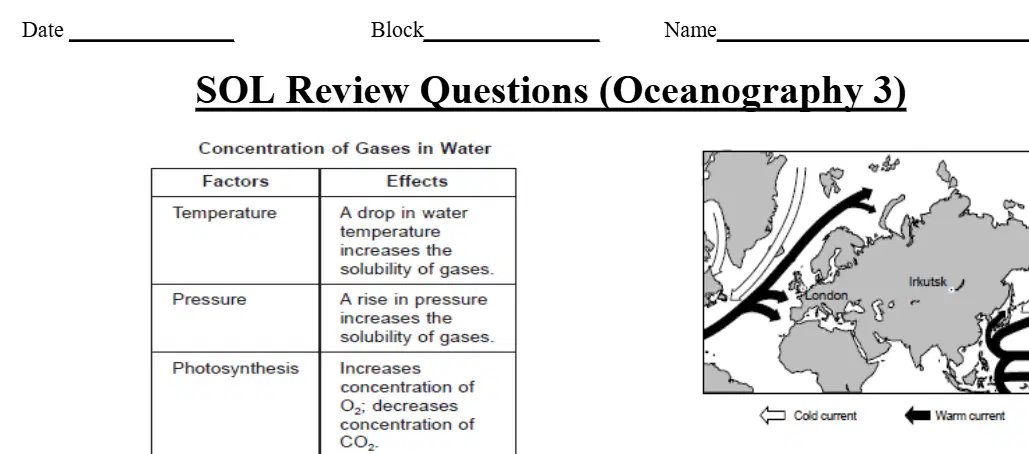
Oxygen must be dissolved in ocean water in order to sustain animal life. Using the above table as a guide, which human activity should be regulated because of the difficulty it causes for sea creatures to breathe?
Piping heated waste water into the ocean
Excessive motorboat traffic
Growing seaweed as a food source
Scuba diving around coral reefs
Seawater is typically denser than freshwater due to seawater's —
higher salinity
lower freezing point
smaller mass
greater depth
Which of these describes the most common way that material is added to a continental shelf?
Evaporation from continental watersheds
Deposition of continental sediments
Eruption of continental volcanoes
Subduction of continental plates
Which of these are caused primarily by the gravitational force between Earth and the Moon?
Tides
Seasons
Prevailing winds
Magnetic poles
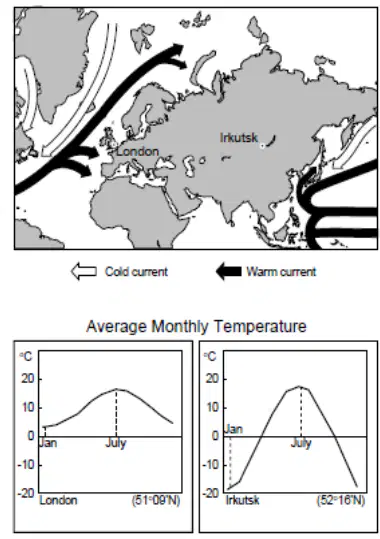
London and Irkutsk are located at approximately the same latitude. What would help explain why London experiences a more moderate range of temperatures than does Irkutsk?
A large lake keeps Irkutsk cool.
Irkutsk has fewer trees than London has.
High mountains near London block cold winds.
Warm ocean currents influence London's climate.
The surface of the sea is not level due to all of the following except —
currents
tides
salinity
winds
The accumulated salts in seawater make the seawater much more dense than fresh water. One of the characteristics of salt water is that it has —
higher levels of dissolved oxygen than fresh water
a lower freezing point than fresh water
decreased buoyancy for swimmers
ninety elements that are easily extracted from seawater
Many species of the order Cetacea (whales, dolphins, and porpoises) have become so scarce that they are now protected under international law. Which of the following probably did not contribute to the decline in these populations?
Whaling industry
Fishing nets
Ocean pollution
Greenhouse effect
Which of the following would have the greatest salinity?
Arctic
Atlantic
Mediterranean
Pacific
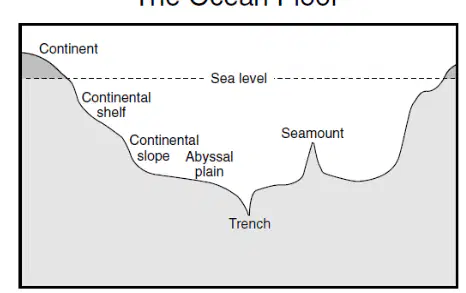
At which ocean feature would the greatest amount of water pressure be exerted?
Continental shelf
Continental slope
Abyssal plain
Trench
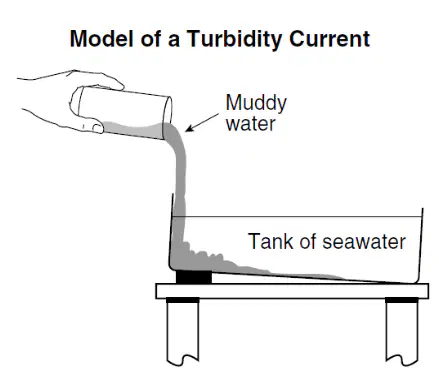
What does the diagram illustrate about turbidity currents?
They move along the bottom.
They stop moving as soon as they reach the ocean floor.
They are temperature-dependent.
They only occur in salt water.
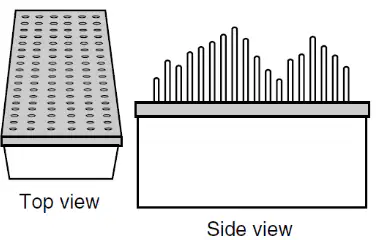
Pictured above is a shoebox with rows of holes in the top, large enough for straws to fit through. By placing straws through the holes, students have to determine the shape of an unseen object in the box. This activity simulates the technology used to map the seafloor. What is that technology called?
Laser beams
Doppler radar
Sonar
Seismology
All of the following features of the ocean indicate tectonic activity except —
abyssal plains
mid-ocean ridges
seamounts
trenches
Why is the surface temperature of the oceans more variable than the water near the ocean floor?
Most energy is exchanged at the surface.
Most animals live near the surface.
The water is less dense at the surface.
The salt concentration is more variable at the surface.
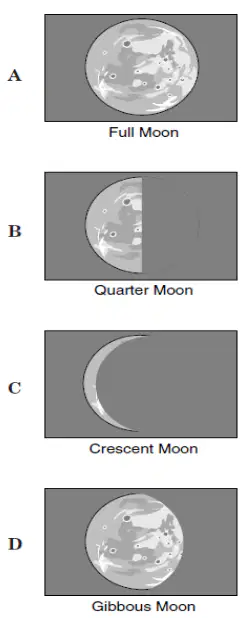
During which of these phases of the moon will the tides be highest?
Full Moon
Quarter Moon
Crescent Moon
Gibbous Moon
Rivers, springs, and aquifers are all -
frozen in winter
human-made structures
located above ground
sources of fresh water
Sinkholes associated with natural processes are characteristic of what type of bedrock?
Limestone
Granite
Basalt
Gneiss
Porosity is the amount of pore space in soils. Permeability is the ability of water to pass through the soil. Why do some soils have high porosity but low permeability?
Some soils have large pores that do not lead anywhere but simply hold groundwater.
Sandy soils dry out quickly, and the pore space fills with air which blocks the downward flow of water.
Some soils have a large volume of pore space, but the individual pores are too small to allow water to pass through.
Water with dissolved iron cannot pass through the magnetic field of soils that are rich in magnetite.
According to the above diagram, the water supply will be most consistent in well —
1
2
3
4
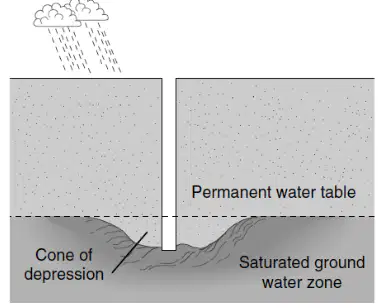
This picture shows a simple well that was dug down to the groundwater. What probably caused the lower level of groundwater, known as a "cone of depression," in the vicinity of the well?
The weight of the atmosphere presses down on the groundwater in the well.
The ground below the well acts as a vacuum sucking out the water.
Gravity pulls down the water beneath the well.
As water is drawn from the well, it takes time for the groundwater to percolate through the soil and restore the level.
Limestone chips dissolve after they are placed in a beaker of dilute acid. Which geologic process is this most similar to?
Faulting
Folding
Weathering
Subduction
During droughts, lack of rain can lead to wells drying up. This is because the drought has lowered the —
water table
water trough
zone of aeration
zone of porosity
In karst regions, caves are carved by the flow of water through limestone bedrock. How do the stalagmites and stalactites in the caves develop?
They are carbonate deposits formed by dripping water in air-filled cavities.
They are granite intrusions that remain behind after water dissolves the surrounding limestone.
They are crystals that grow as water hollows out the cavern.
They are carvings made in limestone by the swirling water as it hollows out the cavern.
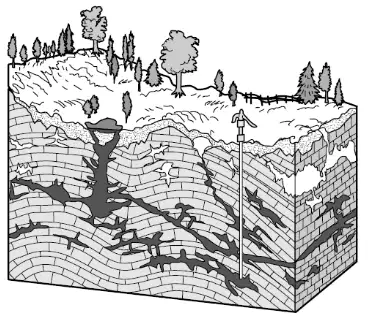
The picture above shows that one of the main pollution problems associated with sinkholes is that —
they can destroy roadways
tractors can fall into them
homes can be damaged by them
they can connect directly to the water table
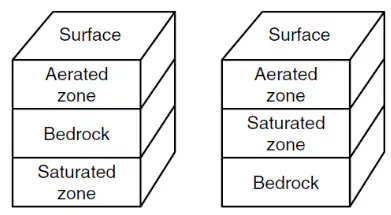
Which diagram below best represents the most common arrangement of zones in a water table?
Surface → Aerated zone → Bedrock → Saturated zone
Surface → Bedrock → Aerated zone → Saturated zone
Surface → Aerated zone → Saturated zone → Bedrock
Surface → Bedrock → Saturated zone → Aerated zone
Which type of land cover absorbs the most rainwater?
Grassland
Crop land
Bare clay soils
Asphalt streets
Which of the following can result when underground water is heated by hot igneous rock?
Metamorphism
Geysers
Salt domes
Karst topography
In Virginia and some other parts of the world, water has carved vast caverns out of underground limestone deposits. Water, however, must contain dissolved carbon dioxide in order to break down the limestone. What role does the carbon dioxide play?
It supports the microscopic plant life that destroys the limestone.
It raises the freezing point so the underground water continues to flow all winter.
In water it forms an acid which reacts with limestone to produce a water-soluble substance.
It reduces viscosity so the water flows more quickly.
Which of these describes the area immediately below a water table?
Zone of aeration
Capillary zone
Recharge zone
Zone of saturation
All of the following may be found deep in a natural cave EXCEPT —
groundwater
mineral deposits
photosynthetic organisms
stalagmites
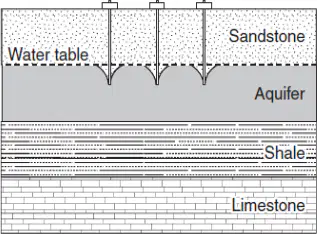
The three wells shown provide water for a growing city. What is the most likely effect on the system if six new wells are brought into production as the population increases?
The limestone layer will collapse.
The shale layer will shrink.
The aquifer will increase in volume.
The water table will drop.

Which of these pieces of basalt rock has probably been in a river the longest?
Piece A
Piece B
Piece C
Piece D
The layer in the above soil profile that has the most humus is —
1
2
3
4
Barrier islands are low and narrow sandy islands that form a rim offshore from a coastline. These islands protect inland shores from the surf, especially during storms. These islands are becoming increasingly developed because people want to live by the open ocean, yet the islands themselves are not permanent. Why aren’t the islands permanent?
People develop the islands and remove sand during housing construction.
Offshore earthquakes cause the islands to sink below sea level.
The wind and the waves are constantly redistributing the sand.
Development companies mine the sand for use in inland construction projects.
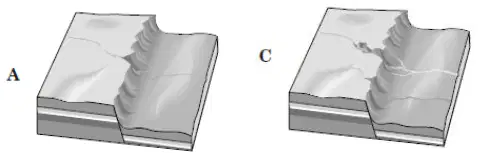
The pictures show different stages in the development of a river valley. Which picture shows the first stage of development?
A
B
C
D
Organic matter in soil is made from —
weathered parent rock
decayed plants and animals
acid rain
carbon dioxide
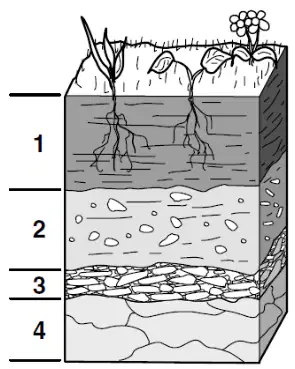
Which layer of the above soil profile would be affected the most by weathering and erosion?
1
2
3
4
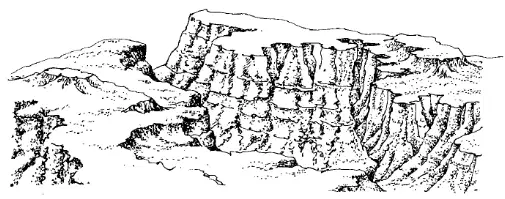
The canyon shown in the picture was most likely formed by —
a volcano
high winds
earthquakes
running water
Why does erosion not occur on the moon?
The rock surface of the moon is too hard.
There is no animal life.
There is no wind or rain.
The gravitational pull of the moon is too weak.
Virginia has large deposits of sand and gravel. These are usually found in areas where —
water once flowed
lava once covered the ground
swamps once were present
the water table was once very low
Which of the following is an example of chemical weathering?
Splits in a rock due to tree roots
Pulverized rock resulting from a landslide
A rock broken into chunks after being carried by rapidly flowing water
The dissolving of limestone by acid rain
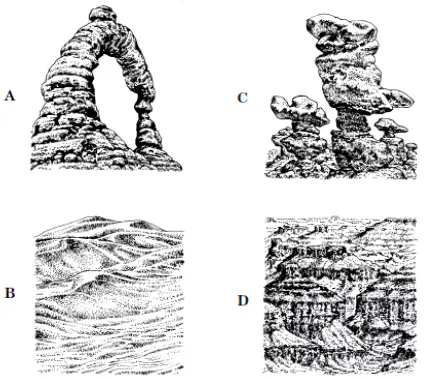
Which of these best shows wind-deposited sediments?
A
B
C
D
Why does water move more slowly through clay than through humus?
Clay has greater permeability.
Clay has very small pore spaces.
Clay prevents capillary attraction of water.
Clay reduces evaporation rates.
Photographs of the surface of Mars reveal the presence of sand dunes that shift over time. These dunes demonstrate the presence of what phenomenon on Mars?
Precipitation
Winds
Magnetic pole reversals
Plate tectonics
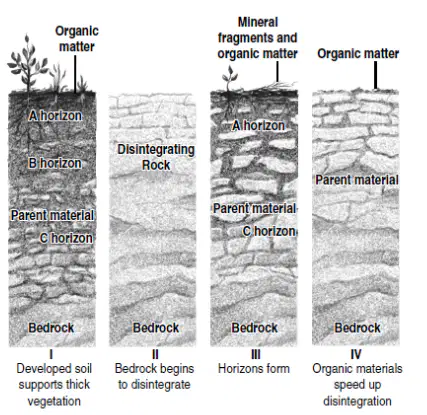
The pictures above represent various stages of soil development. The correct order in which these pictures should be ordered is —
I, II, IV, III
III, I, II, IV
II, IV, III, I
III, II, IV, I

