wayground logo

Free Printable Worksheets

Font size

S
M
L
XL
Worksheets

2021 Fall Biology Review

Total questions: 144

Worksheet time: 2hrs 24mins

Name
Class
Date
1.

Which statement below is a part of cell theory?

a)

all living things are made of cells

b)

cells are the basic unit of life

c)

new cells come from existing cells

d)

these are all parts of cell theory

2.

When a plant cell becomes turgid in a hypotonic solution it is because...

a)

water has flowed into the cell

b)

water has flowed out of the cell

c)

salts have entered the cell

d)

salts have exited the cell

3.

ALL cells contain which of the following? Check ALL that apply.

a)

genetic information

b)

nucleus

c)

ribosomes

d)

cytoplasm

e)

cell membrane

4.

What is the major observable difference between prokaryotes and eukaryotes?

a)

prokaryotes have a nucleus and eukaryotes do not

b)

eukaryotes have a nucleus and prokaryotes do not

c)

both prokaryotes and eukaryotes contain many different organelles

d)

prokaryotes contain ribosomes and eukaryotes do not

5.

What type of cell is pictured here?

a)

animal cell because of the cell wall

b)

plant cell because of the cell wall

c)

animal cell because of the nucleus

d)

plant cell because of the nucleus

6.

What type of cell is pictured here?

a)

animal cell because of the nucleus

b)

animal cell because there is no cell wall

c)

animal cell because there is a mitochondria

d)

animal cell because there are ribosomes

7.

The structure labelled B is a(n)

a)

protein

b)

carbohydrate

c)

phospholipid

d)

cholesterol

8.

The structure shown here is mainly made up of...

a)

protein

b)

carbohydrate

c)

phospholipid

d)

cholesterol

9.

The movement of materials from high concentration to low concentration is called...

a)

exocytosis

b)

endocytosis

c)

molecular transport

d)

diffusion

10.

Molecules that are to large to cross the cell membrane can enter the cell passively by...

a)

osmosis

b)

facilitated diffusion

c)

molecular transport

d)

endocytosis

11.

The sodium-potassium pump is an example of...

a)

active transport

b)

passive transport

c)

osmosis

d)

diffusion

12.

A major difference between active transport is...

a)

active requires energy and passive does not

b)

passive requires energy and active does not

c)

active moves with the gradient and passive moves against the gradient

d)

active and passive both require energy

13.

A cell is in a solution and does not change size. The solution would be considered...

a)

isotonic

b)

hypotonic

c)

hypertonic

d)

sortatonic

14.

What is true about pure water and animal cells?

a)

it is always hypotonic and will cause cells to swell and burst

b)

it is always hypertonic and will cause cells to swell and burst

c)

it is always isotonic and will cause cells to swell and burst

d)

pure water has no effect on animal cells

15.

Very large molecules can leave the cell actively by...

a)

exocytosis

b)

endocytosis

c)

osmosis

d)

diffusion

16.

When cells are in a hypertonic solution...

a)

water will enter and the cell will swell

b)

water will move back and forth at the same rate

c)

water will not move across the membrane

d)

water will leave the cell and it will shrivel

17.

A hypertonic solution has...

a)

more solute outside of the cell than inside

b)

less solute outside of the cell than inside

c)

equal amounts of solute inside and outside of the cell

d)

no solutes

18.

What has the job of supporting and protecting the cell?

a)

ribosomes

b)

cell wall

c)

mitochondria

d)

chloroplasts

19.

Which organelle makes proteins according to the DNA?

a)

ribosomes

b)

smooth ER

c)

Golgi body

d)

vesicles

20.

What organelle is covered in ribosomes?

a)

smooth ER

b)

rough ER

c)

Golgi body

d)

mitochondria

21.

What organelle makes lipids and detoxifies the body?

a)

Rough ER

b)

Smooth ER

c)

Mitochondria

d)

Vacuoles

22.

What describes part of the path of a protein?

a)

ribosome in rough ER to Golgi to vesicle

b)

ribosome in smooth ER to vacuole to Golgi

c)

ribosome in Golgi to smooth ER to vesicle

d)

ribosome to chloroplast to smooth ER to vesicle

23.

Wastes and bacteria are broken down in what organelle?

a)

lysosome

b)

vacuole

c)

vesicle

d)

mitochondria

24.

What part of the cell regulates what enters and exits?

a)

nucleus

b)

Golgi body

c)

cytoplasm

d)

cell membrane

25.
W=white hair
w= non-white hair
If you cross a horse with WW and a horse with ww what fraction of the offspring would be expected to have white hair?
a)
none
b)
3/4
c)
1/2
d)
all
26.
What is the functions of lipids?
a)
Quick source of energy
b)
Builds muscles, skin, enzymes
c)
Stores genetic information
d)
Stores energy, insulation, protection
27.
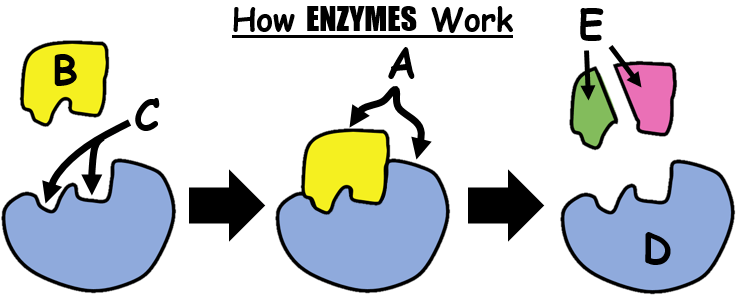
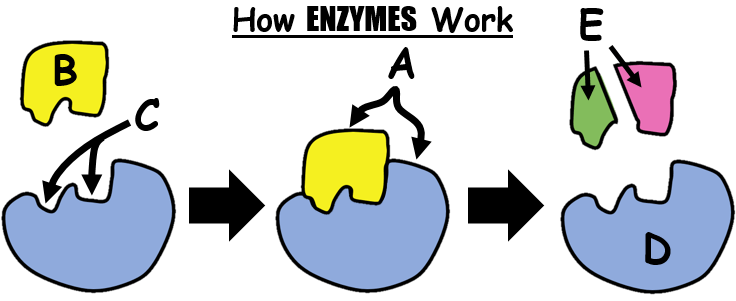
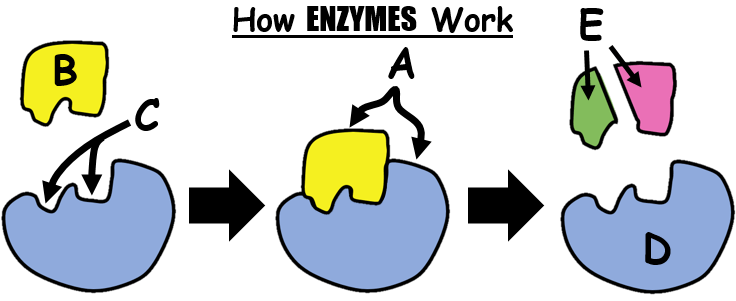
What is structure C?
a)
Substrate
b)
Active site
c)
Enzyme
d)
Products
28.
The graph shows how enzymes affect reactions in cells. Which statement best summarizes the information shown in the graph?
a)
Enzymes increase the energy of the reactants.
b)
Enzymes decrease the energy level of the products.
c)
Enzyme decrease the activation energy of the reaction.
d)
Enzymes reverse the direction of the reaction.
29.
Which of the following is the correct equation for PHOTOSYNTHESIS?
a)
6CO2 + 6H2O --> 6O+ C6H12O6
b)
6CO+ C6H12O6 + 6H2O --> O
c)
6O2 + 6H2O --> 6CO+ C6H12O6
d)
C6H12O6 + 6O2 ---> 6H2O + 6CO2 
30.
Which sequence of DNA bases would pair with this partial strand
ATG TGA CAG
a)
ATG TGA CAG
b)
TAC ACT GTC
c)
GTA AGT GAC
d)
CAT TCA CTG
31.
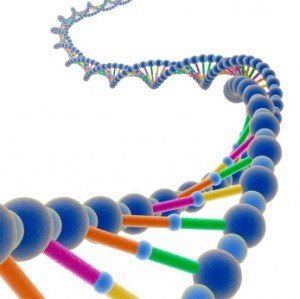
What process is going on in this photo? 
a)
Transcription 
b)
Translation 
c)
Replication 
d)
All the above 
32.
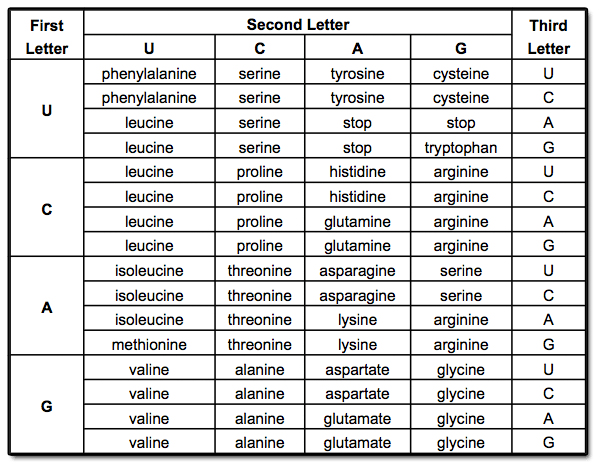
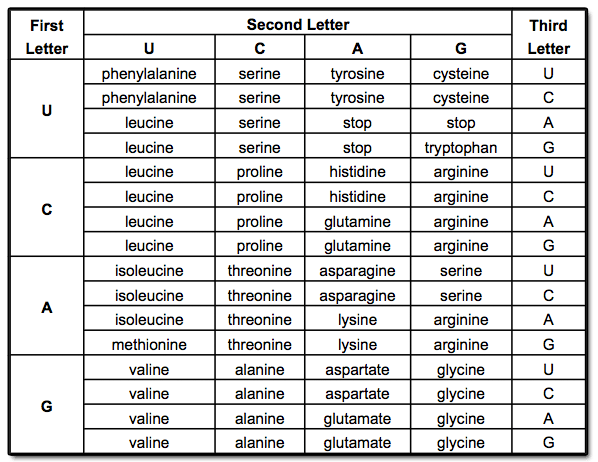
What amino acid is represented by the codon UUA?
a)
Phenylalanine
b)
Tyrosine
c)
Leucine
d)
Stop codon
33.
Which process and type of resulting cells are represented?
a)
mitosis, gametes
b)
mitosis, body cells
c)
meiosis, gametes
d)
meiosis, body cells
34.
DNA molecule segment is : TTACGCAAG
The mutated DNA segment is TTCGCAAG. This is an example of ______ mutation.
a)
Substitution
b)
Deletion
c)
Insertion
d)
Inversion
35.
What is the main source of energy on Earth?
a)
stars
b)
moon
c)
water
d)
sun
36.
The building blocks of nucleic acids are called ...
a)
amino acids
b)
nucleotides
c)
carbohydrates
d)
proteins
37.
ATP is...
a)
a unit of energy in the cell
b)
a type of lipid
c)
a molecule of DNA
38.
Nucleotides are made up of three parts. The three parts are...
a)
DNA, RNA, and a sugar
b)
a lipid, a fat, and an oil
c)
a carbohydrate, a protein, and a fat
d)
a sugar, a phosphate, and a base
39.
Carbohydrates are made up of...
a)
monosaccharides
b)
lipids
c)
oils
d)
proteins
40.
___________ are the main source of energy for cells.
a)
Proteins
b)
Lipids
c)
Nucleic acids
d)
Carbohydrates
41.
What are the products of photosynthesis?
a)
Carbon dioxide and water
b)
Carbon dioxide and oxygen
c)
Glucose and oxygen
d)
Glucose and water
42.
What pigment absorbs sunlight for photosynthesis?
a)
chloroplast
b)
thylakoid
c)
grana
d)
chlorophyll
43.
In which  organelle does photosynthesis occur?
a)
mitochondria
b)
stomata
c)
xylem
d)
chloroplast
44.
How can photosynthesis be related to cellular respiration?
a)
What's produced (made) by one is needed (the reactants) for the other
b)
They both produce the same products
c)
They both have the same reactants (need the same things)
d)
These 2 processes have nothing in common
45.
Which statement best describes the roles of photosynthesis and respiration in the carbon cycle?
a)
Respiration and photosynthesis both add carbon to the atmosphere.
b)
Respiration and photosynthesis both remove carbon from the atmosphere
c)
Respiration adds carbon to the atmosphere, while photosynthesis removes carbon from the
  atmosphere.
d)
Photosynthesis adds carbon to the atmosphere, while respiration removes carbon from the
  atmosphere.
46.
Cellular respiration takes place in the
a)
nucleus
b)
cytoplasm
c)
ribosomes
d)
mitochondria
47.
This process releases chemical energy from sugars and other carbon-based molecules to make ATP when oxygen is present.
a)
photosynthesis
b)
light-independent reaction
c)
cellular respiration
d)
light-dependent reaction
48.
What is one of the reactants of cellular respiration?
a)
energy
b)
glucose
c)
carbon dioxide
d)
water
49.
Which of the following best describes a DNA molecule?
a)
double helix
b)
contains ribose
c)
made of amino acids
d)
contains Uracil
50.
Which of the following units are repeatedly joined together to form a strand of DNA?
a)
amino acids
b)
nucleotides
c)
fatty acids
d)
polysaccharides
51.
Guanine bonds with ______________.
a)
Adenine
b)
Guanine
c)
Cytosine
d)
Thymine
52.
Why is DNA important?
a)
it is very small and very complicated
b)
it's in everything
c)
it serves as the blueprint for traits of all living things
d)
because we eat it every day for energy
53.
Which 2 molecules form the sides (backbone) of the DNA ladder?
a)
deoxyribose sugar and adenine
b)
deoxyribose sugar and a hydrogen bond
c)
deoxyribose sugar and the nucleus
d)
deoxyribose sugar and phosphate
54.
Which organelle is DNA usually found in?
a)
cell membrane
b)
vacuole
c)
chloroplast
d)
nucleus
55.
DNA replication results in two DNA molecules,
a)
each one with two original strands
b)
each one with two new strands
c)
each one with one new strand and one original strand
d)
one with two new strands and the other with two original strands
56.
Before cells can divide, what must be copied?
a)
mitochondria
b)
cytoplasm
c)
DNA
d)
Cell Wall
57.
Eukaryotic cells store their genetic information(DNA) in __________.
a)
Chromosomes
b)
Centromeres
c)
karyotypes
d)
Proteins
58.
A human cell has 46 chromosomes before mitotic division.  How many chromosomes will the daughter cells after mitosis.
a)
12
b)
23
c)
46
d)
92
59.
Cells of organism must replicate for ?
a)
growth
b)
repair of damaged cells
c)
replacement of dying cells.
d)
All of the above
60.
Which bases are complementary in RNA?
a)
A-T
b)
A-U
c)
T-C
d)
G-A
61.
What is the location in the cell for transcription?
a)
nucleus
b)
cytoplasm
c)
ribosome
d)
mitochondria
62.
What is the location in the cell for translation?
a)
nucleus
b)
mitochondria
c)
ribosome
d)
chloroplast
63.
Choose the nucleotide sequence of the RNA strand that would be complementary to the following strand: 
GTAGTCA
a)
UATUAGA
b)
ACGACTG
c)
CAUCAGU
d)
CATCAGT
64.
The main function of tRNA is to...
a)
carry a message that, when translated, forms proteins
b)
form a portion of ribosomes
c)
string together complementary RNA and DNA strands
d)
bring amino acids from the cytoplasm to the ribosomes
65.
What is the three base sequence of mRNA that codes for a single amino acid?
a)
Anticodon
b)
Codon
c)
Protein
66.
Which is the mRNA molecule that would be transcribed from this DNA template:
TGGCAAGTACGT
a)
ACCGTTCATGCA
b)
UGGCAAGUACGU
c)
UCCGUUCUUGCU
d)
ACCGUUCAUGCA
67.
What is the correct amino acid sequence for the mRNA code AUGCCAGUAUGA
a)
Met-Pro-Ala-Val
b)
Met-Pro-Val-Stop
c)
Tyr-Gly-His
d)
Tyr-Gly-Arg-His
68.
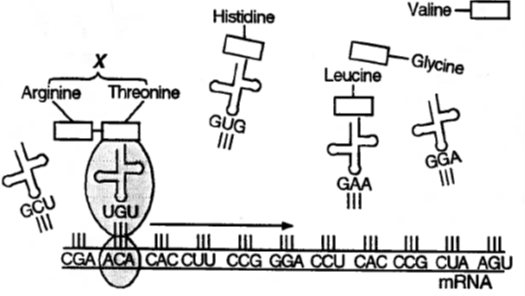
What is occurring in this picture?
a)
Translation
b)
Replication
c)
Translocation
d)
Transcription
69.
A characteristic that an organism can pass on to its offspring through its genes is ___________
a)
Trait
b)
Gene
c)
Allele
d)
Dominant
70.
An allele that is masked when a dominant allele is present. The "weaker" gene. 
a)
Dominant Allele
b)
Recessive Allele
71.
An allele whose trait always shows up in the organism when the allele is present. The "stronger" gene. 
a)
Dominant Allele
b)
Recessive Allele
72.
An organism’s genetic makeup or allele combination.
a)
Genotype
b)
Phenotype
c)
Beanotype
d)
Notype
73.
An organism’s physical appearance, or visible traits. 
a)
Genotype
b)
Phenotype
c)
Beanotype
d)
Notype
74.
What is called when a organism has  two different alleles for a trait. Tt or Rr
a)
Heterozygous
b)
Homozygous
c)
Domozygous
d)
Thermozygous
75.
What is called when a organism has two identical alleles for a trait. TT or tt. RR or rr
a)
Heterozygous
b)
Homozygous
c)
Domozygous
d)
Thermozygous
76.
Punnett squares can be used to predict the probability of:
a)
being exposed to a contagious disease and contracting it
b)
having an inherited disease or a genetically determined physical trait
c)
Both
77.
In a certain species of plant, the color purple (P) is dominant to the color white (p).
According to the Punnett Square, what is the probability of an offspring being purple?
a)
25%
b)
0%
c)
100%
d)
50%
78.
In a certain species of plant, the color purple (P) is dominant to the color white (p).
According to the Punnett Square, what is the probability of an offspring being white?
a)
25%
b)
0%
c)
100%
d)
50%
79.

Each one of the boxes on the Punnett square represents what probability of an offspring's genotype?

a)

25%

b)

1%

c)

10%

d)

0%

80.

Brown eyes are dominant over blue eyes. What is the probability that the offspring will have brown eyes in this cross?

a)

25%

b)

50%

c)

75%

d)

100%

81.

Black fur(B) in guinea pigs is dominant over white fur(b). Find the probability of an offspring with the same phenotype as its parents in a cross between a homozygous black and a heterozygous black guinea pig.

a)

0%

b)

25%

c)

50%

d)

75%

e)

100%

82.

Black fur(B) in guinea pigs is dominant over white fur(b). Find the probability of a hybrid offspring in the cross: BB x Bb.

a)

0%

b)

25%

c)

50%

d)

75%

e)

100%

83.

Black fur(B) in guinea pigs is dominant over white fur(b). Find the probability of a white offspring in a cross between two heterozygous guinea pigs.

a)

0%

b)

25%

c)

50%

d)

75%

e)

100%

84.

If the dominant trait is having freckles (F) and the recessive trait is no freckles (f), which allele combination(s) below would represent a person who has freckles? (select all that apply)

a)

FF

b)

Ff

c)

ff

85.
What is the missing allele?
a)
a
b)
A
c)
AA
d)
aa
86.
This is an example of ___________?
a)
Incomplete dominance
b)
Co-Dominance
87.
This is an example of ___________.
a)
 Incomplete Dominance
b)
 Codominance
88.
What type of inheritance do two alleles have if their traits blend together? 
a)
Incomplete Dominance
b)
Co-Dominance
89.
A calico cat shows both the traits for orange fur and black fur. What kind of allele expression is this?
a)
Incomplete Dominance
b)
Co dominance
90.
This is an example of ___________.
a)
Incomplete Dominance
b)
Codominance
91.
A tall plant (TT) is crossed with a short plant (SS) and a medium plant (TS) results. This is what type of inheritance pattern?
a)
Incomplete Dominance
b)
Codominance
92.
How are Incomplete Dominance and Co Dominance different than a normal Mendelian cross?
a)
There is no difference
b)
The heterozygous genotype has a unique phenotype
c)
There is no heterozygous genotype
d)
There is only one phenotype regardless of genotype.
93.
If you cross a black chicken with a white chicken, only checkered chickens would be produced.  What kind of inheritance pattern does this follow?
a)
incomplete Dominance
b)
Co-Dominance
94.

Codominance occurs in calico cats, which allows for the Black and Tan colors to show. What percentage of the offspring will be calico (black and tan spotted)?

a)

25

b)

50

c)

75

d)

100

95.

Incomplete dominance occurs in cats, which allows them to be Black, White, or gray as shown on this Punnett square. What percentage of the offspring will be black?

a)

25

b)

50

c)

75

d)

100

96.

A pink flower and a white flower produced this offspring:

a)

Incomplete dominance

b)

Codominance

c)

Complete dominance

97.

A woman with curly hair and a man with straight hair produced a child with wavy hair:

a)

Incomplete dominance

b)

Codominance

c)

Complete dominance

98.

An organism is a hybrid genotype (Tt) but is appears tall instead of short.

a)

Law of Dominance

b)

Law of Segregation

c)

Law of Independent Assortment

99.

If your genotype is Bb, then you can only pass a B or b to your child but you can't pass both.

a)

Law of Dominance

b)

Law of Segregation

c)

Law of Independent Assortment

100.

Person A is smart and has brown hair while Person B is also smart but has blonde hair.

a)

Law of Dominance

b)

Law of Segregation

c)

Law of Independent Assortment

101.

Which of Mendel's laws states that alleles are separated during meiosis?

a)

Law of Dominance

b)

Law of Segregation

c)

Law of Independent Assortment

102.

If a dominant allele is present, the trait will always appear in the organism.

a)

Law of Segregation

b)

Law of Dominance

c)

Law of Independent Assortment

103.

Law of Independent Assortment

a)

every organism has two alleles which separate when gametes are produced

b)

alleles for traits are the same

c)

genes from different traits are inherited independently of one another

d)

the allele combination of an organism

104.
Fruit fly body cells have 8 chromosomes. After mitosis, you would expect a resulting fruit fly daughter cell to have ...
a)
16 chromosomes.
b)
46 chromosomes.
c)
8 chromosomes.
d)
4 chromosomes.
105.
In which type of cells will mitosis occur?
a)
egg cells
b)
sperm cells
c)
jail cells
d)
Body cells except the sperm and egg cells
106.
How many daughter cells are produced from meiosis ?
a)
10
b)
6
c)
4
d)
2
107.
Most of the cells in the human body are produced by
a)
mitosis
b)
meiosis
108.
Humans have how may chromosomes ?
a)
112
b)
46
c)
8
d)
67
109.
Why do we need meiosis?
a)
To double the number of chromosomes going into sex cells
b)
To halve the number of chromosomes going into sex cells
c)
To triple the number of chromosomes going into sex cells
d)
To not change the number of chromosomes going into sex cells
110.
Name that process
a)
Mitosis
b)
Meiosis
c)
Mutation
d)
Cell Cycle
111.
In Meiosis if the parent cells has 40 chromosomes, then how many will the daughter cells have 
a)
40
b)
10
c)
20
d)
18
112.
A cat has a total of 38 chromosomes in its body cells.  How many in its gametes?
a)
38
b)
19
c)
76
d)
10
113.

Human cells have _____ pairs of chromosomes- ____ chromosomes in total

a)

23, 46

b)

23, 23

c)

46, 46

d)

1, 2

114.
The process on the left is:
The process on the right is:
a)
Left: meiosis
Right: meiosis
b)
Left: meiosis
Right: cloning
c)
Left: mitosis
Right: meiosis
d)
Left: mitosis
Right: mitosis
115.
What scientific process is being shown?
a)
Mixing
b)
Crossing under
c)
Crossing over
d)
square dancing
116.
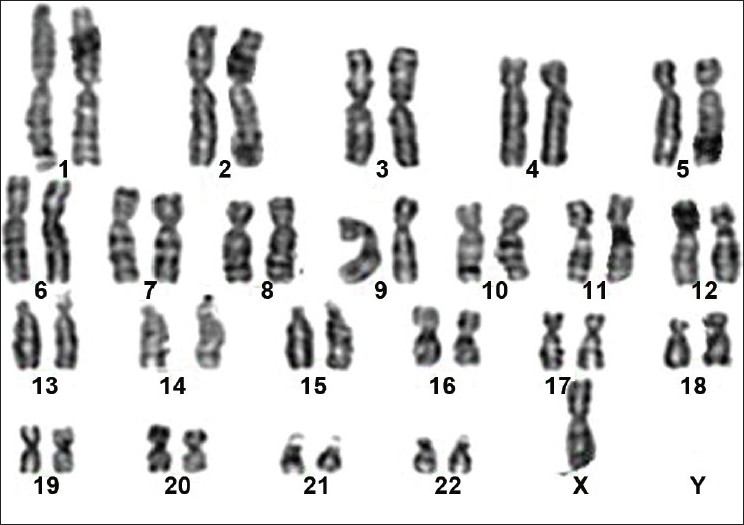
a)
This karyotype shows Trisomy 21
b)
This karyotype has no abnormality
c)
This karyotype is missing a sex chromosome (monosomy x)
d)
This karyotype is from a gamete
117.
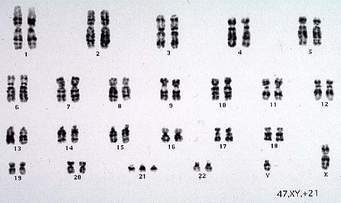
Based on the Karyotype shown, at which chromosome pair can we identify a genetic disorder? 
a)
Chromosome pair 5
b)
sex chromosomes
c)
Chromosome pair 21
d)
There are no chromosomal disorders
118.
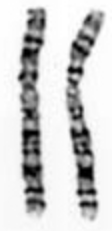
A pair of identical chromosomes shown in a karyotype, one inherited from mom, and one inherited from dad are called
a)
sister chromotids
b)
centromeres
c)
homologous chromosomes
d)
autosomes
119.
Nondisjunction can result in 
a)
trisomy conditions
b)
monosomy conditions
c)
additional sex chromosomes
d)
all of these
120.

What would you call the failure of one or more pairs of homologous chromosomes or sister chromatids to separate normally during meiosis?

a)

nondisjunction

b)

anaphase I

c)

nondiploidy

d)

karyotype

121.

What is the primary cause of genetic variation during meiosis?

a)

chromosomes lining up

b)

"crossing over" of chromosomes

c)

separation of chromosomes

d)

chromosomes pulling apart

122.

What kind of cells are made in MEIOSIS?

a)

Haploid Gametes

b)

Diploid Somatic Cells

c)

Skin Cells

d)

Liver Cells

123.
If the Diploid number of Carrots is 18, the haploid number is
a)
18
b)
9
c)
27
d)
36
124.
Meiosis makes sperm and egg cells. In humans, sperm and egg cells each have _____ chromosomes. Therefore a fertilized human egg cell (sperm and egg cell combined) would create a cell with _____ chromosomes.
a)
23, 46
b)
46, 23
c)
2, 4
d)
50, 100
125.
A male shark has 40 chromosomes in each of its sex cells. How many would be present in its body cells?
a)
20
b)
40
c)
80
d)
160
126.
Define Surface area
a)
The total area on the surface of an object
b)
Length X Width 
c)
6 X (length X width)
d)
Add up the sides and divide by 4
127.
The amount of space something takes up is called the.... 
a)
Surface area
b)
Perimeter 
c)
Volume
d)
Weight
128.
For cells to stay alive they require what type of SA:V?
a)
Large SA, Large V
b)
Small SA, Large V
c)
Large SA, Small V
d)
Small SA, Small V
129.
High Surface area to volume ratio allows cells to do what quickly?
a)
Move materials around inside the cell
b)
Move materials in and out of the cell 
c)
Communicate to other cells
d)
Divide
130.
Microvilli are tiny projections that extend off the cell to increase the Surface Area.  What purpose might that serve? 
a)
Increased absorption
b)
Better communication among cells
c)
Maintain homeostasis 
d)
Decreased oxygen use
131.

Enzymes are an example of

a)

Lipids

b)

Carbohydrate

c)

Protein

d)

Nucleic Acid

132.
What is the purpose  of an enzyme?
a)
give permission for the reaction
b)
raise activation energy
c)
speed up reactions
d)
control how many reactions occur
133.
Enzymes are capable of increasing the rate of a chemical reaction within a living cell.  Enzymes accomplish this through which of the following means?
a)
reducing the number of products   
b)
reducing the activation energy
c)
increasing the temperature of the cell
d)
increasing the concentration of reactants 
134.
Each enzyme only has 1 substrate that will fit its active site.  What is this called?
a)
reusable
b)
catalyst
c)
specific
d)
fragile
135.
What 3 letters do enzymes typically end in?
a)
-ose
b)
-ase
c)
-ese
d)
-tic
136.
Any substance that is acted upon by an enzyme is called a(n)?
a)
Coenzyme
b)
Substrate
c)
Vitamin
d)
Polypeptide
137.
Letter D...
a)
active site
b)
enzyme
c)
substrate
d)
products
138.
Letter B...
a)
active site
b)
enzyme
c)
substrate
d)
products
139.
Letter C...
a)
active site
b)
enzymes
c)
substrate
d)
products
140.
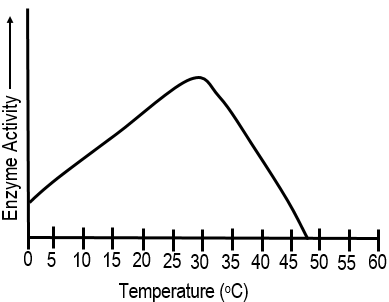
Based on the graph, what is the optimal temperature for this enzyme? 
a)
15oC
b)
40oC
c)
30oC
d)
35oC
141.
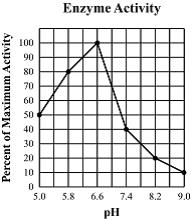
Which of the following conclusions can be drawn from this graph?
a)
The optimum pH of the enzyme is 6.6.
b)
The optimum pH of the enzyme is 5.8
c)
The enzyme’s activity increases as pH increases 5.0 to 9.0
d)
The enzyme’s activity is greater around pH of 8.0 .
142.

A student is investigating how reaction rate changes over a range of enzyme concentration. The student uses excess reactants. Which of the following graphs best represents the relationship between enzyme concentration and reaction rate?

a)

a.

b)

b.

c)

c.

d)

d.

143.

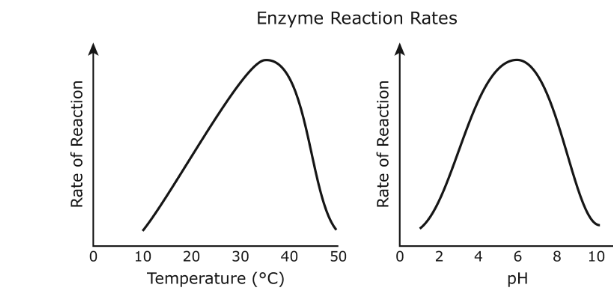
The graphs show the reaction rate for an enzyme across a range of temperatures and pH.


Based on these data, this enzyme functions best as what temperature and pH?

a)

Temperature of 27oC and a pH of 4

b)

Temperature of 37oC and a pH of 6

c)

Temperature of 40oC and a pH of 8

d)

Temperature of 50oC and a pH of 10

144.
Significantly changing the pH the enzyme is exposed to will cause the enzyme to _____________.
a)
increase enzymatic action 
b)
fit better with the substrate 
c)
denature 
d)
evaporate