
 Worksheets
Physical Science Reviewer
Total questions: 140
Worksheet time: 3hrs 5mins

Stars can take different paths due to their initial . . .
temperature
mass
brightness
color
Hubble observed that galaxies are
which of the following are stages in the life cycle of a medium mass star (mark all the apply)
main sequence
super nova
red giant
neutron star
What causes stars to exit the main sequence?
when they get too old
when gravity causes the core to collapse
when the star begins to exhaust all of its hydrogen and run out of fuel
when the star begins to burn too hot and go into supernova
How long ago did the solar system begin to form?
4.6 billion years ago
50 million years ago
4.6 million years ago
13 billion years ago
What is the main source of fuel when a star is in the main sequence?
oxygen-burning
hydrogen-burning
electromagnetic radiation
helium burning
When is a star born?
when the nebula starts spinning
when nuclear fusion starts
when gas and dust starts to contract
when x rays get emitted
Which is not true about the Big Bang Theory?
It explains the evolution of the universe
It was a big explosion
It explains the creation and origin of the universe
It is supported by scientific data and evidence
Hubble's Law shows mathematically that more distant galaxies are
moving away at a slower rate
moving away at a faster rate
not moving at all
move away slowly at first and then speed up
Which is true of electromagnetic waves with low frequencies? Choose all correct answers.
They have short wavelengths
They have lower energy
They have long wavelengths
They have higher energy
Arno Pensiaz and Robert Wilson discovered
redshift
big bang theory
nebular theory
Cosmic microwave background radiation

What is represented by letter A in the image?
amplitude
frequency
wavelength
velocity
What is the main factor that determines how a star will end it's life?
temperature
mass
luminosity
distance from Earth
Step 1 of the proton-proton chain reaction results in
Helium 3 atom
Helium 4 aton
Hydrogen 1 atom
Hydrogen 2 atom
Which of the following is true of step 2 of the proton-proton chain reaction?
a neutrino is given off
a positron is given off
gamma radiation is released
2 single protons are released
Which is an input of step 4 of the proton-proton chain reaction?
Hydrogen 1 atom
Hydrogen 2 atom
Helium 3 atom
Helium 4 atom
The next evolutionary stage for our sun is?
white dwarf
red giant
supernova
black hole
According to the nebular theory, what is the next step in the sequence of events after the immediate collapse of the interstellar cloud due to gravity?
A flat, rotating protoplanetary disc is formed
Planetismals collide with each other to create larger bodies
Solar wind pushes debris to the outer regions of the universe
Nuclear fusion begins and a star is born
covalent bond
London forces
hydrogen bond
dipole-dipole attraction
Which substance has the weakest intermolecular forces?
Substance A, boiling point of 75 °C
Substance B, boiling point of 105 °C
Substance C, boiling point of 25 °C
Substance d, boiling point of 45 °C

Intermolecular forces for: CO2
Dispersion Force
Dipole dipole
Hydrogen bonding
What explains the high boiling point of water?
hydrogen bonding
ion-ion attractions
a high density
a large gram formula mass
The polarity of a bond is determined by...
The sum of the electronegativities of the two atoms
The difference in the electronegativities of the two atoms
The charges of the atoms
The number of electrons shared in the bond
In a polar covalent bond, the electrons gather around...
Mostly the atom with the greatest electronegativity
The atom with the lowest electronegativity
Each atom equally
Only the atom with the greatest electronegativity
In a nonpolar covalent bond, the electrons gather around...
Mostly the atom with the greatest electronegativity
The atom with the lowest electronegativity
Each atom Equally
Only the atom with the greatest electronegativity
Which of the following molecules would dissolve in oil?
CHCl3
NH3
CCl4
HBr

View Figure 1 (if not visible)

It was a motion where we see the sun rises at the east horizon and sets down at the west horizon. The Greeks explained this phenomenon by introducing the concept of celestial spheres. What motion was explaining the occurrence of day and night?
Annual Motion
Diurnal Motion
Precession of Equinoxes
None of the Above
What does the word HELIOCENTRIC mean?
earth - center
sun- center
moon - center
planet- center
According to Copernican Model, the epicycle moves in what type of motion?
Vertical Motion
Circular Motion
Elliptical Motion
Horizontal Motion
Where does the Greek word Geocentric came from?
sun - center
earth - center
moon - center
planet- center
This explains that the planets of the Solar System revolve around the Sun but the Earth is the center of the universe.
Aristotelian Model
Copernican Model
Tychonic Model
Ptolemaic Model
The apparent daily motion of the stars as a result of Earth's rotation about its axis is called __________.
Annual motion
Diurnal motion
Retrograde motion
Precession of the equinoxes
The apparent motion of the sun caused by Earth's revolution around it is called _______________.
Annual Motion
Diurnal Motion
Retrograde Motion
Precession of the Equinoxes
How long is a sidereal day?
exactly 24 hours
23 hours 56 minutes
23 hours 56 minutes and 4 seconds
23 hours 56 minutes and 30 seconds
How many years does Earth require to complete a cycle of precession?
10,000
15,000
21,000
26,000
The two points where the ecliptic intersects the celestial equator are known as ________________.
Solstice
Equinoxes
Summer Solstice
Autumnal Equinoxes
Which two astronomers believed in geocentric model?
Aristotle and Copernicus
Aristotle and Ptolemy
Copernicus and Galileo
Galileo and Aristotle
Who was the first astronomer to see craters on the moon and rings of Saturn.
Galileo
Copernicus
Aristotle
Ptolomy
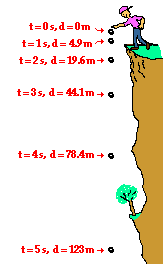


Which form of motion always follows a curved path and requires an initial launch force that is greater than the force of gravity?
Centripetal Motion
Projectile Motion
Free Fall Motion
None of the Above
This form of motion can only occur in outer space or in a vacuum. It is solely dependent on the force of gravity.
Free Fall Motion
Centripetal Motion
Projectile Motion
None of the Above

A leaping frog is an example of which type of motion.
Projectile Motion
Free Fall Motion
Centripetal Motion
None of the Above
This is the idea used by Aristotle to explain how objects sustain their horizontal motion.
large amount of force applied
violent motion
antiperistasis
projectile motion
Aristotle explained that the object moves depending on the natural motion of the dominant element of that object. Which among the following element-motion pairs is CORRECTLY matched?
earth - circular
fire - fall
water - fall
celestial - retrograde
Based from Aristotelian Physics, what was natural for planets to do in terms of their type of motion?
They orbit in elliptical motion
They orbit in triangular motion
They orbit in no particular consistent shape
They orbit in circular motion
Aristotle proposed that all falling objects _______
fall at the same speed
fall at the same acceleration
fall at the same distance
fall at the same time
Based from Galileo, force is needed to ___________
sustain the motion of the object
change the direction of the object
change the speed of the object
oppose the motion of the object
Aristotle stated that:
GREATER FORCE APPLIED = ___________
greater distance covered
greater speed
greater acceleration
greater free falling
If you are Galileo answer the ff question:
"Why does a bowling ball and feather hit the ground at different times when dropped from the same height?"
They don't; they hit the ground at the same time.
One is more dense than the other.
One is heavier than the other.
Air resistance

The more mass an object has, the faster it will fall.
True
False
Aristotle - TRUE; Galileo - FALSE
Aristotle - FALSE; Galileo - TRUE
Compare the angle of incidence from angle of reflection in a regular reflection.
The angle of incidence is equal to the angle of reflection.
The angle of incidence is less than the angle of reflection.
The angle of incidence is greater than the angle of reflection.
The angle of incidence is never equal to the angle of reflection.
Why does light bend (refracts) when it enters from air to water?
Light has a tendency to go in all direction.
It enters a material with different optical density.
Light changes its direction due to the resistivity of the material.
The bending of light is dependent upon the conductivity of the material.
How does the light bends as it enters from air to glass?


White light is separated into spectrum of colors by a prism. What does this mean?
White light has no color.
Prism emits different colors.
Prism absorbs the white light.
Component colors of light are refracted at different angles
Upon exiting a glass prism, white light is dispersed. Which color bends the most?
Red
Blue
Violet
Orange
How will the velocity of light change, as it enters a denser medium?
Light will slow down.
There will be an increase in its speed.
The speed of light will change in unknown value.
The light will change its direction and bend toward the normal.
If you were to fish by bow and arrow technique, where would you aim to actually strike a fish?
Strike exactly where you see the fish.
Aim below the fish; it is actually deeper than you think.
Shoot a little above its head; refraction causes a different perception of its depth.
In the morning, hit it above, but in the afternoon, aim it below because the light is dimmer.
How does the photoelectric effect demonstrate the particle characteristics of light?
Light bounces off like a wave, as it shines on the metal surface.
Light may knock the electrons out of the metal surface as if light were made of particles.
Intense radiation may (large-amplitude waves) may cause emitted electrons to have more energy.
The Energy of the electron emitted from metal surface is dependent on the speed of the light that shined on it.
What does the theories of modern physics tells us about light?
Demonstrate wave property only
Exclusively shows particle property
It combines wave and particle properties
It has neither wave nor particle properties
What color of light do photographers usually use in dark rooms? Why?
Yellow light since paper is not sensitive to this color.
Regular light may be used since it won’t affect the printing.
Red light does not cause the film to be exposed since it has low energy.
Violet light has the highest energy which is used to give color to the pictures.
Explain how you we see colors.
The color we see are the colors absorbed by the object.
The energy with wavelengths that are too short to see is "bluer than blue".
When light hits an object, the wavelengths change and are reflected in different direction.
When light hits an object, some wavelengths are absorbed by that object and the color we see are those that are reflected.
How come we cannot see other EM waves such as infrared, microwave and UV?
Other lights are invisible and has no color.
Our eyes are only sensitive and can only detect visible light spectrum.
Temperature of the surrounding interacts with these lights and makes it difficult for us to notice.
Ozone layer absorbs most of the energies of these lights thus making it colorless when it reaches the land.
Identify which property of light best explain the light phenomenon below.
Rainbow is separated into component colors upon passage through water droplets.
Scattering
Refraction
Diffraction
Dispersion
Identify which property of light best explain the light phenomenon below.
Mirage is formed by warm air near the road surface.
Scattering
Refraction
Diffraction
Dispersion
Identify which property of light best explain the light phenomenon below.
Brilliant colors in soap bubbles
Reflection
Refraction
Diffraction
Interference
Identify which property of light best explain the light phenomenon below.
Twinkling of the stars
Reflection
Refraction
Diffraction
Dispersion
Identify which property of light best explain the light phenomenon below.
Sky appears blue in a clear cloudless day-time.
Scattering
Diffraction
Dispersion
Interference
Choose which statement/s are true.
Ampere demonstrated that parallel wires carrying currents may attract and repel each other. Which wires will most likely attract?
I. Wires carrying current moving in the same direction.
II. Wires carrying current moving in opposite directions.
I only
II only
both I and II
neither I and II
Choose which statement/s are true.
When electrons are made to move through a conductor,
I. An electric current is produced
II. A magnetic field around the conductor develops
I only
II only
both I and II
neither I and II
Who demonstrated that the effect of a changing magnetic field on a conductor can induce electric current and vice versa?
Hertz
Faraday
Oersted
Maxwell
Mass energy relation is
E=mc2
E=T+V
E=T-V
M=Ec2
1.If you were in spaceship traveling at the speed close to the speed of light (with respect to the earth) you would notice that___________
your pulse rate is different than normal
your mass is different than normal
some of your physical dimensions were smaller than the normal
none of these effects occur

The speed of light (c) =
186,282 miles per second
300,000,000 meters per second
3.0 x 10⁵ km/sec (kilometers per second)
All answers are correct and equal to one another
In what year did Einstein develop his theory of relativity?
1880
1905
1914
1921
What astronomer was the firs to nail down a concrete measure of the speed of light?
Newton
Galileo
Romer
Plato
What was the historical takeaway from the Michelson & Morley experiment?
It demonstrated there was no luminiferous aether.
It demonstrated light must move at the same speed regardless of reference frame.
It demonstrated light was a wave phenomena.
It demonstrated that the speed of light was relative.
What is your position in your own reference frame?
x=ct
x=vt
x=0
x=tcv
In a spacetime diagram, suppose you have a worldline for some object moving relative to your frame of reference. If the object were moving twice as fast, what would happen to its worldline?
It'd have a slope twice as large as before.
It's have the same slope as before.
It'd have a slope half as much as before.
It'd have no slope and be a flat worldline.

