wayground logo

Free Printable Worksheets

Font size

S
M
L
XL
Worksheets

A&P SPRING FINAL REVIEW DAY 1 2022/23

Total questions: 147

Worksheet time: 2hrs 47mins

Name
Class
Date
1.

Reorder the following steps (1-5) of a muscle contraction

a)

Nerve Impulse reaches Neuromuscular Junction

b)

Acetylcholine (ACH) Released by Motor Neuron

c)

ACH binds to Muscle Receptor Sites

d)

Action Potential charge travels down muscle cell

e)

Impulses reaches the SR and Ca+ channels open

1)
2)
3)
4)
5)
2.

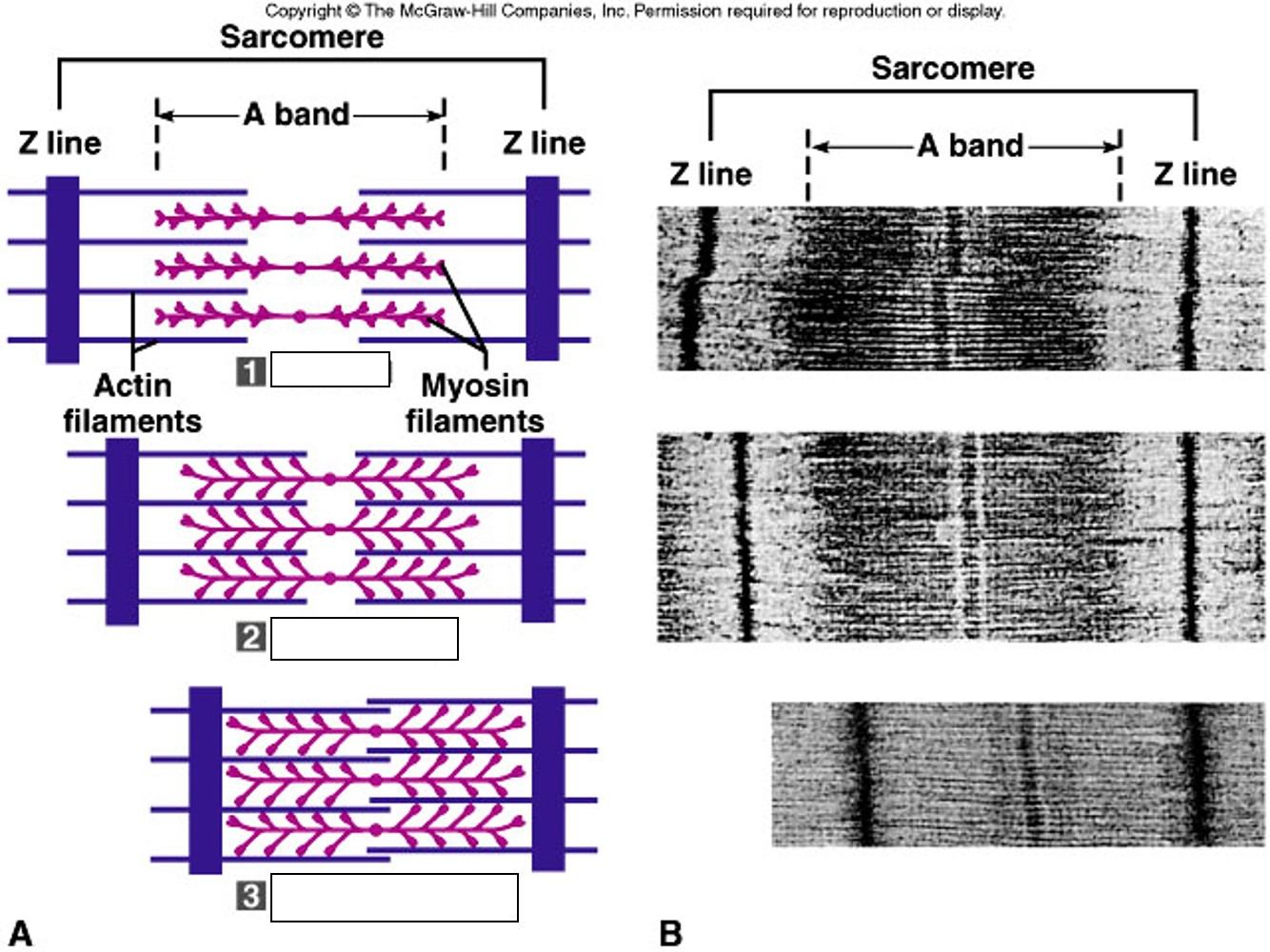
The part of the sarcomere that C (Blue) refers to is the...

a)

Actin

b)

Myosin

c)

Troponin

d)

Tropomyosin

3.
The part of the sarcomere that D (Red) refers to is the?
a)

Actin

b)

Myosin

c)

Troponin

d)

Tropomyosin

4.
What state is the sarcomere in #1
a)

Relaxed

b)

Contracting

c)

Fully Contracted

d)

None of the above

5.

What state is the sarcomere in #2

a)

Relaxed

b)

Partially Contracted

c)

Fully Contracted

d)

None of the above

6.
What state is the sarcomere in #3
a)

Relaxed

b)

Contracting

c)

Fully Contracted

d)

None of the above

7.
What happens to the Z lines during a sarcomere contraction?
a)

It disappears

b)

gets closer together

c)

It gets bigger

d)

None of these

8.
The functional unit of the muscle cell is the: 
a)

Sarcomere

b)

Osteon

c)

Myofilament

d)

Muscle fiber

9.
Thin filaments in a myofibril are
a)

Sarcomeres

b)

Sarcoplasm

c)

Actin

d)

Myosin

10.
Thick filaments are in a myofibril are
a)

ATPase

b)

Sarcoplasmic reticulum

c)

Actin

d)

Myosin

11.

How may sarcomeres are shown above?

a)

6

b)

5

c)

4

d)

3

12.

Reorder the following (6-10) of the muscle contraction

a)

Ca+ ions diffuse from the SR and bind to troponin molecules

b)

Tropomyosin molecules move and expose specific sites on actin where myosin heads can bind

c)

Cross-bridges form, linking actin and myosin

d)

Actin filaments are pulled toward the center of the sarcomere by pulling of the cross-bridges, increasing the overlap of the thin and thick filaments

e)

The muscle fiber shortens as contractions occurs

1)
2)
3)
4)
5)
13.
Which ion below IS NOT critical to muscle contraction?
a)
Sodium Ion
b)
Calcium Ion
c)
Potassium Ion
d)
Phosphorus Ion
14.
Which of the Proteins listed below IS NOT a myofibril protein?
A.  Actin
B.  Troponin
C.  Trypsin
D.  Tropomyosin
E.  Myosin
F.  Titin
a)
All of these listed are myofibril proteins
b)
Troponin is not a myofibril protein.
c)
Trypsin is not a myofibril protein.
d)
Titin is not a myofibril protein.
15.
Which is more true to cause muscle contraction?
a)
Actin Pulls on the myosin
b)
Myosin Pulls on the Titin
c)
Myosin Pulls on Actin
d)
Actin Pulls on Titin
16.
Which ion, when present, changes the conformation of tropomyosin?
a)
Calcium
b)
Sodium
c)
Potassium
d)
Lithium
17.
In order for tropomyosin to change conformation, calcium has to bind with...
a)
Voltage Gated Ion Channel
b)
Ligand Gated Ion Channel
c)
Troponin Protein
d)
Actin Protein
18.
What opens the Calcium Ion Transport Channel embedded in the pre-synaptic terminal?
a)
Binding of Acetylcholine
b)
Binding of Calcium Ion
c)
An Action Potential
d)
Binding of Sodium Ion
19.
Calcium that will eventually enter the muscle cell to bind with troponin is stored in the...
a)
T-Tubule of the Muscle Cell
b)
Sarcoplasmic Reticulum of the Muscle Cell
c)
The Sarcolemma of the Muscle Cell
d)
The interstitial space outside the muscle cell near the pre-synaptic terminal.
20.
Which of the following occurs first in muscle contraction?
a)
Calcium Ion Enters the Pre-synaptic Terminal
b)
Acetylcholine Enters the Synaptic Cleft
c)
Sodium Ion Enters the Sarcolemma
d)
Calcium Ion Enters the Sarcoplasm (Cytoplasm).
21.
Which of the following occurs first in muscle contraction?
a)
Myosin /Actin Cross bridge shifts to move actin.
b)
Phosphate is released form the myosin globular head
c)
Calcium Enters the Sarcoplasm (Cytoplasm) of the muscle cell.
d)
ADP is released form the myosin globular head.
22.
Which of the following occurs first in muscle contraction?
a)
Myosin globular head 'uncoils' releasing stored energy.
b)
Cross Bridges are formed between actin and myosin
c)
Tropomyosin changes shape (conformation) to expose myosin binding sites.
d)
Calcium Binds with Troponin
23.
During muscle contraction the 'Z' Lines will...
a)
Disappear
b)
Get Farther apart
c)
Get Closer Together
d)
Appear Thicker
24.
a neurotransmitter that stimulates skeletal muscles
a)
acetylcholine (Ach)
b)
ATP
c)
cross bridges
d)
neuromuscular junction
25.
the only energy source that can be used to directly power muscle activity
a)
acetylcholine (Ach)
b)
ATP
c)
cross bridges
d)
neuromuscular junction
26.
the heads of the myosin myofilaments are called __ when they link the thick and the thin filament together 
a)
acetylcholine (Ach)
b)
ATP
c)
cross bridges
d)
neuromuscular junction
27.
point where an axon terminals of a nerve cell and the sarcolemma of a skeletal muscle join
a)
acetylcholine (Ach)
b)
ATP
c)
cross bridges
d)
neuromuscular junction
28.
specialized smooth endoplasmic reticulum that surrounds each myofibril, it stores calcium and releases on demand
a)
sarcolemma
b)
sarcoplasmic reticulum
c)
thick filament
d)
thin filament
29.
myosin protein
a)
sarcolemma
b)
sarcoplasmic reticulum
c)
thick filament
d)
thin filament
30.
actin, contractile protein
a)
sarcolemma
b)
sarcoplasmic reticulum
c)
thick filament
d)
thin filament
31.

Put steps of contraction in order.

a)

rest, nerve action, ACh released, transmitted, Ca released

b)

ACh released, Ca released, nerve action, transmitted, rest

c)

rest, nerve action, Ca released, ACh released, transmitted

d)

ACh released, Ca released, transmitted, nerve action, rest

32.

Put steps of Contraction in order

a)

Ca bound, activated, shift, cross bridge, repeat

b)

Cross bridge, Ca bound, shift, activate, repeat

c)

Activate, cross bridge, Ca bound, shift, repeat

d)

Shift, activate, cross bridge, Ca bound, repeat

33.

Where a nerve and muscle fiber come together is called a...

a)

Synaptic Cleft

b)

Neurotransmitter

c)

Neuromuscular Junction

d)

Action Potential

34.

The neurotransmitter stored in the axon terminal identified as ...

a)

Acetylcholine

b)

Serotonin

c)

Adrenaline

d)

Dopamine

35.

Where is calcium stored in the muscle cell?

a)

T Tubules

b)

Sarcoplasmic Reticulum (SR)

c)

Sarcolemma

d)

Sarcomere

36.

When the action reaches the muscle cell, it travels down the....

a)

Sarcolemma

b)

T Tubules

c)

Sarcoplasmic Reticulum

d)

Calcium Channel

37.

The action potential releases (a)   from the Sarcoplasmic Reticulum (SR)

38.

After calcium is released from the SR, it binds to _________

a)

troponin

b)

tropomyosin

c)

actin

d)

myosin

39.

Troponin moves the ____________ uncovering binding sites.

a)

actin

b)

troponin

c)

tropomyosin

d)

myosin

40.

A calcium deficiency would

a)

create uncoordinated muscle contractions

b)

allow muscle contraction, but not relaxation

c)

prevent contraction by preventing myosin from binding to actin

d)

have no effect on contraction

41.

What would be the correct order of the steps?


  1. Action potential travels down T-tubules.
  2. Nerve impulse reaches the muscle.
  3. Calcium binds to troponin.
  4. Tropomyosin moves.
a)

1, 2, 3, 4

b)

4, 3, 2, 1

c)

3, 4, 1, 2

d)

2, 1, 3, 4

42.

Another name for the prime mover is

a)

antagonist

b)

agonist

c)

synergist

d)

fixator

43.

A muscle that helps the agonist is called a

a)

antagonist

b)

agonist

c)

synergist

d)

fixator

44.

What is the opposing muscle group for the quadriceps?

a)

biceps

b)

lower back

c)

hamstrings

d)

obliques

45.

In knee flexion, which is the agonist? (the one contracting or getting shorter)

a)

hamstrings

b)

quadriceps

46.

What is the agonist and what is the antagonist in a bicep curl?

a)

biceps are the agonist, triceps are the antagonist

b)

triceps are the agonist, biceps are the antagonist

47.

The muscle that causes the action and does the majority of the work

a)

agonist

b)

antagonist

c)

synergist

d)

fixator

48.

A muscle can be a agonist for one movement and an antagonist for a different movement

a)

true

b)

false

49.

The agonist and antagonist work in __________ to create movement

a)

tandem

b)

random

c)

opposition

d)

synchronization

50.

Identify the quadriceps

a)

5

b)

8

c)

6

d)

13

51.

Identify the hamstrings

a)

5

b)

8

c)

6

d)

13

52.

Identify the tibialis anterior

a)

5

b)

8

c)

6

d)

13

53.

Identify the gastrocnemius

a)

5

b)

8

c)

6

d)

13

54.

Identify the sternocleidomastoid

a)

1

b)

9

c)

7

d)

10

55.

Identify the trapezius

a)

1

b)

9

c)

7

d)

10

56.

Identify the deltoid

a)

3

b)

2

c)

11

d)

8

57.

Identify the pectorals

a)

3

b)

4

c)

7

d)

12

58.

Identify the biceps

a)

3

b)

4

c)

11

d)

12

59.

Identify the triceps

a)

3

b)

4

c)

11

d)

12

60.

Identify the abdominals

a)

3

b)

4

c)

11

d)

12

61.

Identify the latissimus dorsi

a)

3

b)

4

c)

11

d)

12

62.

This muscle group rotates the head and flexes the neck

a)

Trapezius

b)

Pectorals

c)

Sternocleidomastoid

d)

Latissimus dorsi

63.

This muscle group elevates, depresses, and retracts the scapula

a)

Trapezius

b)

Pectorals

c)

Sternocleidomastoid

d)

Latissimus dorsi

64.

This muscle group abducts the arms

a)

deltoid

b)

biceps

c)

triceps

d)

pectorals

65.

This muscle group flexes the shoulder (arms forward)

a)

deltoid

b)

biceps

c)

triceps

d)

pectorals

66.

This muscle group flexes the elbow

a)

deltoid

b)

biceps

c)

triceps

d)

pectorals

67.

This muscle group extends the elbow

a)

deltoid

b)

biceps

c)

triceps

d)

pectorals

68.

This muscle group bends the torso in a forward direction (think crunches), balance

a)

abdominals

b)

latissimus dorsi

c)

trapezius

d)

sternocleidomastoid

69.

This muscle group adducts the arms

a)

abdominals

b)

latissimus dorsi

c)

trapezius

d)

sternocleidomastoid

70.

This muscle group flexes the hip (legs forward)

a)

quadriceps

b)

hamstrings

c)

tibialis anterior

d)

gastrocnemius

71.

This muscle group extends the hip (legs back)

a)

quadriceps

b)

hamstrings

c)

tibialis anterior

d)

gastrocnemius

72.

This muscle group moves in a dorsiflexion motion

a)

quadriceps

b)

hamstrings

c)

tibialis anterior

d)

gastrocnemius

73.

This muscle group moves in a plantar flexion motion

a)

quadriceps

b)

hamstrings

c)

tibialis anterior

d)

gastrocnemius

74.
The type of muscle contraction where the muscle tenses but does not shorten.  
a)
Isometric
b)
Isotonic
c)
Contraction
d)
relaxation
75.
When a muscle shortens under tension, it is called_______
a)
isotonic eccentric contraction
b)
isotonic concentric contraction
c)
isometric concentric contraction
d)
isometric eccentric contraction
76.
As the athlete lowers the weights, his biceps undergo-
a)
isometric concentric contraction
b)
isotonic eccentric contraction
c)
isometric contraction
77.

What type of contraction is happening here??

a)

isostabilize

b)

isokinetic

c)

isotonic

d)

isometric

78.
During the downward phase of this squat, what muscles are undergoing isometric contractions?
a)
quadriceps
b)
hamstrings
c)
abdominals
d)
calves
79.

Muscle fatigue is...

a)

when the muscle is unable to contract

b)

when you are too tired to exercise

c)

when the muscle is contracted more than 30 secondsd

d)

when O2 comes from direct phosphorylation

80.

What is the correlation between muscle fatigue and oxygen debt?

a)

When O2 decreases, muscle fatigue increases

b)

When O2 increases, muscle fatigue decreases

c)

When O2 is obtained, muscle fatigue decreases

d)

The lesser the oxygen debt, the lesser the muscle fatige

81.

What is the correlation between lactic acid, ATP, and muscle contractions?

a)

increase in lactic acid, decrease ATP, decrease in muscle contraction

b)

increase in lactic acid, decrease ATP, increase in muscle contraction

c)

increase in lactic acid, increase in ATP, decrease in muscle contraction

d)

increase in lactic acid, increase in ATP, increase in muscle contraction

82.

which of the following is true regarding aerobic activity and muscle growth?

a)

increase in mitochondria

b)

increase in vasculature

c)

muscle fiber size DOES NOT increase

d)

Muscle fiber diameter decreases

83.

which of the following is true regarding aerobic activity and muscle growth?

a)

mitochondria number stays the same

b)

decrease in vasculature

c)

muscle fiber size DOES increase

d)

Muscle fiber diameter increases

84.
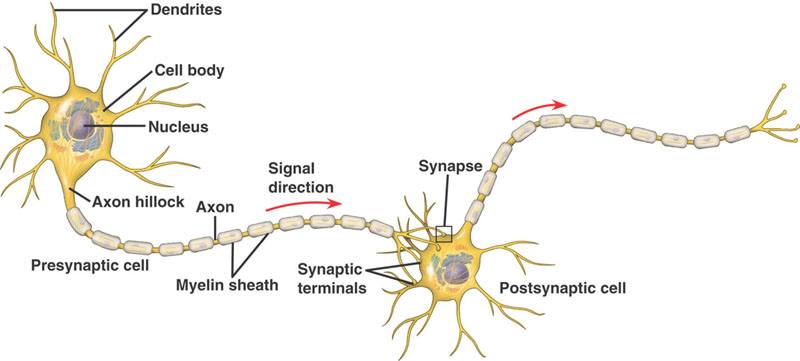
Label the Neuron-What does the letter "A" represent?
a)
Axon
b)
Dendrite
c)
Axon Terminal
d)
Cell Body
85.

Label the Neuron-What does the letter "D" represent?

a)

Dendrite

b)

Axon

c)

Myelin Sheath

d)

Axon Hillock

86.
Label the Neuron-What does the letter "E" represent?
a)
Schwann Cell
b)
Node of Ranvier
c)
Axon Terminal
d)
Myelin Sheath
87.
The part of the neuron that receives messages from other neurons
a)
axon
b)
dendrite
c)
cell body
d)
Schwann cell
88.
Identify the part of the neuron
a)
axon
b)
axon terminal
c)
dendrite
d)
Node of Ranvier
89.
Identify the part of the neuron
a)
axon
b)
axon terminal
c)
dendrite
d)
Node of Ranvier
90.

Sends impulses AWAY from CNS to muscle and glands.

a)

Motor Neuron

b)

Sensory Neuron

c)

Interneuron

91.

What direction does an electrical signal move?

a)

Dendrite, Cell body, Axon

b)

Cell body, Axon, Dendrite

c)

Cell body, Dendrite, Axon

d)

Axon, Cell Body, Dendrite

92.

Label the Neuron-What does the letter "H" represent?

a)

Axon

b)

Dendrite

c)

Axon Terminal

d)

Synaptic Bulb/Knob

93.
The skeletal muscles are controlled by this part of the nervous system.
a)
Somatic Nervous system
b)
Autonomic Nervous system
c)
astrocytes
d)
glial cells
94.
The smooth muscles and glands are controlled by this part of the nervous system.
a)
Somatic Nervous system
b)
Autonomic Nervous system
c)
astrocytes
d)
glial cells
95.
Consists of the brain and spinal cord.
a)
Autonomic Nervous System
b)
Somatic Nervous System
c)
Peripheral Nervous System
d)
Central Nervous system
96.
Nerves throughout the body other than the brain and spinal cord.
a)
Autonomic Nervous System
b)
Somatic Nervous system
c)
Peripheral Nervous System
d)
Central Nervous System
97.
Cells that are found between neurons and blood vessels.
a)
oligodendrocyte
b)
microglial cell
c)
astrocyte
d)
ependymal cell
98.
Neurons that have a single process extending from the cell body.
a)
unipolar
b)
bipolar
c)
dipolar
d)
multipolar
99.
White matter has this insulating covering that increases the rate at which an impulse can be carried.
a)
Schwann Cell
b)
axon membrane
c)
Neurilemma
d)
Myelin Sheath
100.
Neurons that have two processes extending from the cell body
a)
unpolar
b)
bipolar
c)
polar
d)
multipolar
101.
The junction between two communicating neurons.
a)
synapse
b)
neuromuscular junction
c)
dendrite
d)
axon
102.
Chemical messengers that move across the synapse.
a)
vesicles
b)
sodium
c)
potassium
d)
neurotransmitters
103.
Align along axons and provide insulating layers of myelin in the brain and spinal cord.
a)
microglia 
b)
astrocytes
c)
ependymal cells
d)
oligodendrocytes
104.
Gaps in the myelin sheath.
a)
nodes of Ranvier
b)
axon endings 
c)
synapse
d)
neurotransmitters
105.
conduct impulses from peripheral body parts to the brain or spinal cord.
a)
motor neurons
b)
sensory neurons
c)
interneurons
d)
microglia
106.
Conduct impulses from one part of the brain or spinal cord to another part of the brain or spinal cord.
a)
motor neurons
b)
sensory neurons
c)
interneurons
d)
microglia
107.
are multipolar and conduct impulses out of the brain or spinal cord to effectors.
a)
motor neurons
b)
sensory neurons
c)
interneurons
d)
microglia
108.
These cells have the same function as oligodendrocytes but are found in the peripheral nervous system (PNS).
a)
microglia
b)
astrocytes
c)
ependymal cells
d)
Schwann cells
109.
When a neuron is depolarized, what are the first channels to open?
a)
Sodium
b)
Potassium
c)
Calcium
d)
ACTH
110.
When a neuron is resting, the inside of the axon has a ____________ charge.
a)
positive
b)
negative
111.
Which ions are involved in the electrical nerve impulse?
a)
Iodine and Sodium
b)
Potassium and Sodium
c)
Iron and Sodium
d)
Calcium and Iodine
112.

When a neuron is at REST,

a)

the inside of the neuron is negatively charged compared to the outside.

b)

the inside of the neuron is positively charged compared to the outside.

c)

there is no charge difference established

d)

none of these is true

113.

Depolarization occurs when

a)

sodium channels open

b)

potassium channels open

c)

sodium channels close

d)

potassium channels close

114.
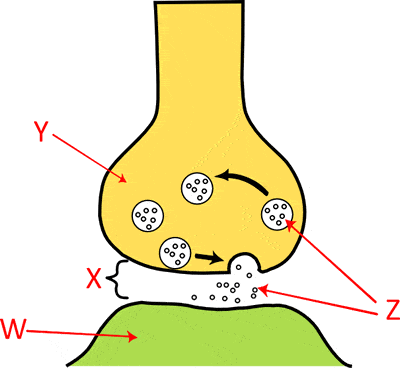
Z
a)
Dendrite
b)
Axon Terminal
c)
Neurotransmitters
d)
Synapse
115.
W
a)
Axon Terminal Button
b)
Neurotransmitters
c)
Dendrite
d)
Synapse
116.
X
a)
Axon Terminal Button
b)
Neurotransmitters
c)
Dendrite
d)
Synapse
117.

calcium is responsible for

a)

signaling the release of the neurotransmitter

b)

signaling Na to be released into the membrane

c)

signaling the release of K out of the membrane

d)

serving as the neurotransmitter

118.
What is the normal resting potential of a neuron cell membrane?
a)
+40mV
b)
-30mV
c)
+55mV
d)
-70mV
119.
When a neuron is not engaged in an impulse.
a)
Resting potential
b)
Action potential
c)
Neural potential
d)
Synaptic potential
120.
In resting potential, neurons have more _________ on the outside of the cell membrane.
a)
K+
b)
NaCl
c)
Na+
d)
Cl-
121.
The sodium-potassium pump....
a)
Sends (Na+) into the cell
b)
Sends (K+) into the cell
c)
Exchanges (K+) & (Na+) during depolarization
d)
Exchanges (K+) & (Na+) during hyperpolarization
122.
At what stage are both ions present in large concentrations INSIDE the neuron?
a)
Depolarizarion
b)
Repolarization
c)
Hyperpolarization
d)
Resting Potential
123.

When is the potassium channel open?

a)

during rest only

b)

during repolarization only

c)

during depolarization only

d)

all the time

124.

Action potentials run along the ______ from ______ to ________.

a)

axon, dendrites, axon terminals

b)

axon, axon terminals, dendrites

c)

dendrites, axon, axon terminals

d)

axon terminals, axon, dendrites

125.

An action potential is __________ in nature, with the inside of the neuron being more ________.

a)

chemical, negative

b)

electrical, negative

c)

chemical, positive

d)

electrical, positive

126.

As the neuron fires, there's a reversal in _____ as the axon undergoes ________.

a)

direction, depolarization

b)

charge, depolarization

c)

direction, repolarization

d)

charge, repolarization

127.

Occurs when sodium voltage-gated channels open and sodium rushes into the axon changing the membrane potential from -55mV to +40mV.

a)

Depolarization

b)

Hyperpolarization

c)

Repolarization

d)

Summation

e)

Resting-State

128.

Occurs when sodium voltage-gated channels close and potassium voltage-gated channels open. Potassium rushes out of the axon changing the membrane potential from +40mV to -70mV.

a)

Depolarization

b)

Hyperpolarization

c)

Repolarization

d)

Summation

e)

Resting-State

129.

Occurs when both voltage-gated channels remain closed and the sodium-potassium pump moves 3Na out and 2K in maintaining a membrane potential of -70mV.

a)

Depolarization

b)

Hyperpolarization

c)

Repolarization

d)

Summation

e)

Resting-State

130.

What maintains the resting membrane potential in a neuron?

a)

sodium-potassium pumps

b)

sodium channels

c)

potassium channels

d)

gravity

131.

An electrical impulse within a single neuron is called a

a)

synapse

b)

membrane potential

c)

action potential

d)

cell body

132.

Depolarization is occuring at number

a)

1

b)

2

c)

4

d)

5

133.
What number(s) on the graph represents the Resting Potential?
a)
1 and 2
b)
1 and 5
c)
2 and 3
d)
3 and 4
134.
When a membrane potential reaches +30mV, ________ channels open, ________ occurs, and ________ channels close.
a)
Sodium, depolarization, potassium
b)
Potassium, depoloarization, sodium
c)
sodium, repolarization, potassium
d)
postassium, repolarization, sodium
135.
What number on the graph represents the Hyperpolarization phase?
a)
1
b)
2
c)
3
d)
4
136.
Why is -55 mV a significant number?
a)
This is the largest charge achieved during an action potential
b)
This is the threshold required to complete an action potential
c)
This is the resting charge of a neuron
d)
This is the charge when all the sodium is inside the cell
137.
What is the normal resting potential of a neuron cell membrane?
a)
+40mV
b)
-30mV
c)
+55mV
d)
-70mV
138.
Which ions are involved in an action potential?
a)
Na; Cl
b)
Na; K
c)
K; Cl
d)
Na; Ca
139.
At which point on the diagram does depolarisation of the axon occur? 
a)
A
b)
B
c)
C
d)
D
140.
When a neuron is not engaged in an impulse.
a)
Resting potential
b)
Action potential
c)
Neural potential
d)
Synaptic potential
141.

What number(s) on the graph represents the THRESHOLD level of stimulus?

a)

1 and 5

b)

2

c)

3

d)

6

142.
The sodium-potassium pump....
a)
Sends (Na+) into the cell
b)
Sends (K+) into the cell
c)
Exchanges (K+) & (Na+) during depolarization
d)
Exchanges (K+) & (Na+) during hyperpolarization
143.
When a neuron is resting, the inside of the axon has a ____________ charge.
a)
positive
b)
negative
144.
In resting potential, neurons have more _________ on the outside of the cell membrane.
a)
K+
b)
NaCl
c)
Na+
d)
Cl-
145.
In resting potential, neurons have more ____________ on the inside of the cell membrane.
a)
NaCl
b)
Na+
c)
K+
d)
Cl-
146.
At what stages do Sodium/Potassium Channels open?
a)
Repolarization/ Repolarization
b)
Depolarization/ Hyperpolarization
c)
Hyperpolarization/ Repolarization
d)
Depolarization/ Repolarization
147.

Which one of the following is involved in maintaining a resting membrane potential?

a)

Na+/K+ ATPase pump moves 3Na+ in for every 2K+ out

b)

Na+/K+ ATPase pump moves 3K+ in for every 2Na+ out

c)

Na+/K+ ATPase pump moves 3Na+ out for every 2K+ in

d)

Na+/K+ ATPase pump moves 3K+ out for every 2Na+ in