wayground logo

Free Printable Worksheets

Font size

S
M
L
XL
Worksheets

EOC Review Physics Part1

Total questions: 143

Worksheet time: 8hrs 20mins

Name
Class
Date
1.
A series of steps used by scientists to solve a problem or answer a question. 
a)
scientific method
b)
recipe
c)
data collection
d)
metric system
2.
Testing a hypothesis often involves a(n):
a)
answer
b)
experiment
c)
problem
d)
safety check
3.
This variable in an experiment is the one being changed by the scientist. 
a)
dependent variable
b)
independent variable
c)
data
d)
control group
4.
An experiment is performed on plants to see how different liquids affect plant growth. Each plant in the experiment is given a different liquid; water, apple juice, or milk. Each plant has the same amount of soil, sunlight, and listens to the same music. In this investigation, the independent variable is ...
a)
The type of plant
b)
The amount of sunlight
c)
The type of music
d)
The type of liquid
5.
If you increase the amount of spinach you eat, then you will increase the iron in your blood. 
What's the dependent variable?
a)
increase the amount of iron in your blood
b)
spinach you eat
6.
If I ride my bike to school instead of walking, then I will get to school faster. What is the dependent variable?
a)
True
b)
How fast you get to school
c)
Riding a bike or walking
d)
False
7.
How do you calculate average speed?
a)
divide total time by total distance
b)
multiply total time by total distance
c)
divide total distance by total time
d)
subtract total time from total distance
8.
An 8th grade class traveled 110 km and the bus was going 55 km/hr. How long did it take?
a)
0.5 hr
b)
2.0 hr
c)
55 hr
d)
6050 hr
9.

If you travel 50 km/hr for 2 hours, how far will you get? d=sxt

a)

25 km

b)

50 km

c)

100 km

d)

200 km

10.
The rate at which velocity changes is called
a)
acceleration
b)
constant speed
c)
average speed
d)
displacement
11.
2 objects traveling at the same speed have different velocities if they....
a)
start at different times
b)
travel different distances
c)
have different masses
d)
move in different directions
12.
Which best describes Alex's data?
a)
Alex reached his greatest speed in the last 20 sec
b)
Alex was stopped in the first 60 sec
c)
Alex was stopped in the last 40 sec
d)
Alex's greatest speed was between 60-120 sec
13.
Who had the greatest average speed after 100 seconds?
a)
Mike
b)
Katelyn
c)
Alex
d)
They had the same average speed
14.
Which of the following represents a velocity?
a)
40 m
b)
40 m north
c)
40 m/s
d)
40 m/s north
15.
What is the formula to calculate speed?
a)
Speed = time/distance
b)
Speed = distance/time
c)
Speed = distance x time
d)
Speed = time x distance
16.
A runner races in the 100 meter dash.  It takes her 10 seconds to finish.  What is her average speed?
a)
10 m/s
b)
1000 m/s
c)
100 seconds
d)
10 seconds
17.
According to the graph how far does the person travel in the first 5 seconds?
a)
2 m
b)
10 m
c)
0 m
d)
5 m
18.
What is the person doing from 5 seconds to 10 seconds?
a)
Walking 
b)
Running
c)
Standing Still 
d)
Walking Fast
19.
At 60 seconds, how far had this object traveled? 
a)
0 m
b)
10 m
c)
20 m
d)
40 m
20.
What does this graph represent?
a)
Constant Speed
b)
Acceleration
c)
Not moving
21.
What is happening at D?
a)
Stationary
b)
Accelerating
c)
Fast steady speed; moving away from the starting position
d)
Slower steady speed; moving away from the starting position
22.
What is happening at E?
a)
Stationary
b)
Accelerating
c)
Fast steady speed; moving away from the starting position
d)
Steady speed; returning to start position
23.

Speed = 0.5m/s , Time = 30 seconds, find the distance. d=sxt

a)

10m

b)

15m

c)

20m

24.

Find the acceleration

a)

5m/s squared

b)

10m/s squared

c)

15m/s squared

25.

What is the speed at point B?

a)

0.2km/m

b)

0.4km/min

c)

0.6km/min

26.

Which graph shows an object that is not moving?

a)

A

b)

B

c)

C

d)

D

e)

E

27.

Which graph sows an object that is moving at a steady rate of speed?

a)

A

b)

B

c)

C

d)

D

e)

E

28.

Which graph shows an object that is slowing down?

a)

A

b)

B

c)

C

d)

D

e)

E

29.

Which car is moving slowest?

a)

#1

b)

#2

c)

#3

d)

#4

30.

A runners accelerates to a speed of 12 m/s in 3 seconds. What is her acceleration? a = Vf-Vi/t

a)

12 m/s2

b)

4 m/s2

c)

9 m/s2

31.

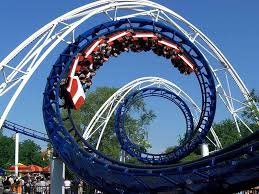
A roller coasters accelerates from an initial velocity of of 6.0 m/s to a final velocity of 70 m/s over 4 seconds. What's the acceleration? a = Vf-Vi/t

a)

24 m/s2

b)

18 m/s2

c)

16 m/s2

d)

16 m/s

32.
Why does a car accelerate as it round a corner at a constant speed?
a)
Its direction changes
b)
It doesn't
c)
It slows down
d)
Its speeds up  
33.

A car travels 30 miles/hr for 3 hours, calculate the distance it will travel. d=sxt

a)

90 miles

b)

10 miles

c)

600 miles

d)

90 km

34.
The rate at which velocity changes is called
a)
speed
b)
direction
c)
acceleration
d)
motion
35.

Which of these is an example of negative acceleration (or deceleration)?

a)

a bird taking off for flight

b)

a baseball released by a pitcher

c)

a car approaching a red light

d)

an airplane following a straight flight path

36.
A car accelerates from 15 m/s to 60 m/s in 30 seconds.  What is its acceleration?
a)
2 m/s2
b)
3 m/s2
c)
1.5 m/s2
d)
0.75 m/s2
37.
The Law of Inertia
a)
Newton's
1st
Law of Motion
b)
Newton's
2nd
Law of Motion
c)
Newton's
3rd
Law of Motion
38.
F=ma
a)
Newton's
1st
Law of Motion
b)
Newton's
2nd
Law of Motion
c)
Newton's
3rd
Law of Motion
39.
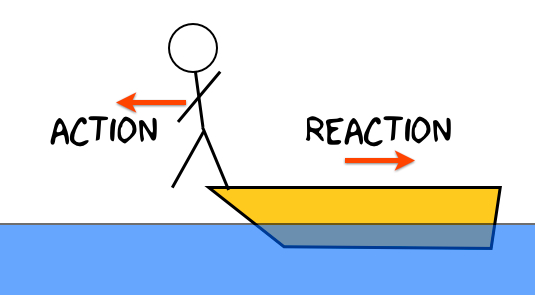
For every action, there is an equal and opposite reaction.
a)
Newton's
1st
Law of Motion
b)
Newton's
2nd
Law of Motion
c)
Newton's
3rd
Law of Motion
40.
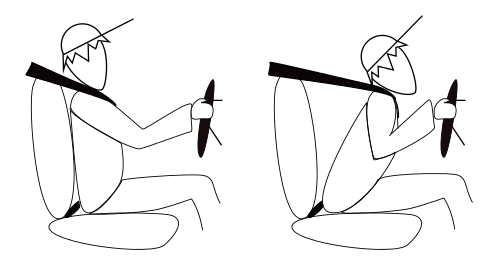
An automobile you are riding in suddenly stops, but you continue to go forward.
a)
Newton's
1st
Law of Motion
b)
Newton's
2nd
Law of Motion
c)
Newton's
3rd
Law of Motion
41.
A magician pulls a table cloth from under a table of dishes.
a)
Newton's
1st
Law of Motion
b)
Newton's
2nd
Law of Motion
c)
Newton's
3rd
Law of Motion
42.
A skater pushes another skater forward, but the one pushing moves backwards.
a)
Newton's
1st
Law of Motion
b)
Newton's
2nd
Law of Motion
c)
Newton's
3rd
Law of Motion
43.
The harder you hit a baseball, the faster it accelerates.
a)
Newton's
1st
Law of Motion
b)
Newton's
2nd
Law of Motion
c)
Newton's
3rd
Law of Motion
44.
As the fuel in a rocket ignites, the force of gas expansion and explosion pushes out the back of the rocket and pushes the rocket forward.
a)
Newton's
1st
Law of Motion
b)
Newton's
2nd
Law of Motion
c)
Newton's
3rd
Law of Motion
45.
You slide towards the window when a car makes a sudden turn.
a)
Newton's
1st
Law of Motion
b)
Newton's
2nd
Law of Motion
c)
Newton's
3rd
Law of Motion
46.

Determine the accelerations that result when a 12-N net force is applied to a 3-kg object. a=f/m

a)

3 m/s

b)

4 ft/s

c)

13 m/s

d)

4 m/s

47.

Which has more Inertia? (need more force to move)

a)

Truck

b)

Ant

c)

A cat

d)

A skateboard

48.
According to Newton's second law, if you increase the force applied to an object :
a)
it accelerates more
b)
it doesn't move
c)
you get more inertia
d)
it decelerates
49.
What law of motion does this picture represent?
a)
Newtons 1st law
b)
Newtons 4th law 
c)
Newtons 3rd law 
d)
Newtons 2nd law
50.
What Newtons law does this picture represent
a)
Newtons 2nd law 
b)
Law of gravity 
c)
Newtons 1st law
d)
Newtons 5th law
51.
Which of the following energy transformations occur when a lamp that is plugged into a wall socket is functioning correctly?
a)
Chemical to light
b)
Electrical to chemical
c)
Electrical to light
d)
Chemical to electrical
52.
Which of the following shows an energy transformation from chemical energy to electrical to light energy?
a)
A bolt of lightning lights the night sky.
b)
A candle glows brightly in the dark.
c)
A fire in a fireplace lights up a room.
d)
A battery causes a flashlight to shine.
53.
What energy transformations take place when a battery-operated radio is in use?
a)
Electrical to chemical to light
b)
Sound to chemical to mechanical
c)
Chemical to electrical to sound
d)
Light to electrical to thermal
54.
People get energy from the food that they eat and transform that energy as they move. Which energy transformations occur as a student rapidly rubs the palms of his hands together?
a)
mechanical to thermal to electrical
b)
chemical to mechanical to thermal
c)
mechanical to chemical to sound
d)
chemical to sound to electrical
55.
Which of the following devices transforms electrical energy into mechanical energy?
a)
An e-reader
b)
a fan
c)
a manual pencil sharpener
d)
ipod
56.
The diagram shows a complete circuit with a battery and a buzzer making noise. This circuit works by transforming -
a)
chemical energy to electrical to sound.
b)
electrical energy to thermal to light.
c)
sound energy to electrical to chemical.
d)
mechanical energy to electrical to sound.
57.
Hot coffee is stirred with a spoon; the spoon gets hot due to
a)
conduction
b)
convection
c)
radiation
58.
A chair is several feet from a fireplace. The side of the chair facing the fireplace gets warm due to
a)
conduction
b)
convection
c)
radiation
59.
"Lava lamps" contain colored liquids. These liquids form globs that rise to the top due to
a)
conduction
b)
convection
c)
radiation
60.
Near the ceiling of a room the air is warmer; the warm air rises because of
a)
conduction
b)
convection
c)
radiation
61.
Warm air over the beach rises while cooler, dense air from the ocean rushes in due to
a)
conduction
b)
convection
c)
radiation
62.
A huge rock at the state park gets hot during the day. The rock was warmed from the Sun by
a)
conduction
b)
convection
c)
radiation
63.

Some cook pans have copper on the bottom to heat evenly.

Copper transfers heat to the pan by

a)

conduction

b)

convection

c)

radiation

64.
In heat transfer, heat always flows from the _______________ substance to the _______________ substance.
a)
Hotter to colder
b)
Colder to hotter
c)
Hotter to hotter
d)
Colder to colder
65.
The type of heat transfer that happens through direct contact of molecules or particles with each other is ___________________.
a)
Convection
b)
Conduction
c)
Radiation
d)
insulation.
66.
The kind of heat transfer that travels through space in electromagnetic waves is ______________________.
a)
insulation.
b)
Radiation
c)
Conduction
d)
Convection
67.
___________________ is the type of heat transfer that occurs in fluids, such as warm air rising and cold air sinking; creating wind.
a)
Convection
b)
Conduction
c)
Radiation
d)
insulation.
68.
Warm air rises and the cool air sinks demonstrates this type of heat transfer. 
a)
conduction
b)
convection
c)
radiation
d)
Insolation 
69.
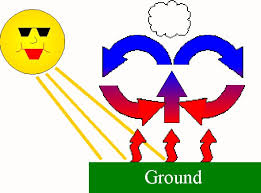
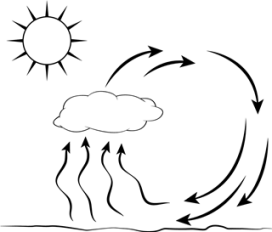
What causes the circulation of air in the atmosphere?
a)
Air in the atmosphere is heated by the sun and sinks to the ground.
b)
The ground is heated by the sun and then heats the air, causing the air to rise.
c)
Air loses heat to the ground and then rises upward to obtain more energy.
d)
The sun heats the clouds which forces the cooler air to move away and sink.
70.
A high specific heat means...
a)
It heats up quickly with energy added
b)
It requires more energy to change temperature
71.
The amount of energy required to raise the temperature 1ºC for every kilogram is called____?
a)
Thermal Energy
b)
Specific Heat
c)
Temperature
d)
Kinetic Energy
72.

Which will heat up faster?

a)

copper

b)

granite

c)

iron

d)

basalt

73.

Which will heat up slower?

a)

water

b)

lead

c)

granite

d)

iron

74.

Which will cool down slower?

a)

granite

b)

basalt

c)

water

d)

iron

75.

How much energy is needed to raise the temperature of 5.0 grams of lead from 25°C to 35°C? [specific heat (c) = 0.129 J/(g•°C)] Q=mcΔt

a)

6.45 J/(g•°C)

b)

6.45 J

c)

16.1 J/(g•°C)

d)

d.16.1 J

76.

Which of the following best explains why the sand at the beach is hotter than the water?

a)

Sand has a higher specific heat than water.

b)

Sand has a lower specific heat than water.

c)

There is more water than sand at the beach.

d)

There is more sand than water at the beach.

77.

The temperature of a 6.0 g sample of glass changed from 20.0°C to 45.0°C when it absorbed 550 J of heat. What is the specific heat of this glass?

a)

0.27 J/g °C

b)

3.7 J/g °C

c)

130 J/g °C

d)

12 J/g °C

78.

If the battery produced 12.6 Volts and what would be the current flow be for a 6 Ohm resistor? I=V/R

a)

2.1 Amps

b)

2.4 Amps

c)

1.71 Amps

d)

15 Amps

79.
What types of charges attract?
a)
Positive and Positive
b)
Positive and Neutral
c)
Negative and Neutral
d)
Positive and Negative
80.
The mathematical relationship among Voltage, Current, and Resistance
a)
Faraday's Law
b)
Tesla's Law
c)
Edison's Law
d)
Ohm's Law
81.

What is the Voltage of a circuit that has a resistance of 5 Ω and a current of 2 A? V=IxR

a)

25 V

b)

10 V

c)

2.5 V

d)

0.4 V

82.
What size resistor would produce a current flow of 5 Amps with a battery voltage of 12.6 volts
a)
60 Ohms
b)
2.52 Ohms
c)
1.71 ohms
d)
5.04 Ohms
83.
This is an example of a _______ circuit
a)
open
b)
series
c)
parallel
d)
square
84.
This is an example of a ______ circuit
a)
Series
b)
Parallel
c)
Open
d)
Dihexihedral
85.
DC stands for ____ and is used in batteries.
a)
Distant Current
b)
Don't Current
c)
Direct Current
d)
Distributed current
86.
AC stands for ___.
a)
Alternating Current
b)
Attraction Connections
c)
Actual Current
d)
Action Curcuit
87.
To complete a circuit the switch must be
a)
unattached
b)
open
c)
closed
d)
It depends
88.
If the lights are off, the circuit is
a)
closed
b)
open
c)
electrified
d)
in trouble
89.
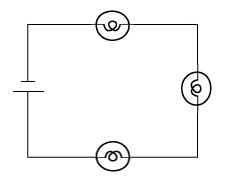
The picture shows an electrical circuit. This circuit is a series circuit because: 
a)
It has 3 light bulbs.
b)
The same current flows through all three light bulbs.
c)
It uses a single battery.
d)
The electrical current is divided between the three light bulbs.
90.

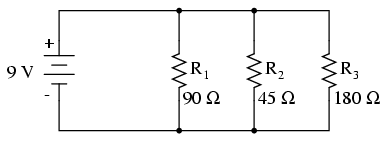
The current going through the 180 ohm resistor is ____ I=V/R

a)

0.05 amps

b)

0.2 amps

c)

0.1 amps

d)

20 amps

91.
The voltage drop across the 180 ohm resistor is 
a)
9 V
b)
6 V
c)
2 V
d)
12 V
92.

The current going through the 45 ohm resistor is ______ I=V/R

a)

0.05 amps

b)

0.2 amps

c)

0.1 amps

d)

5 amps

93.

What is electricity?

a)

Flow of Protons

b)

Flow of Atoms

c)

Flow of Electrons

d)

Flow of Neutrons

94.
In a parallel circuit which of the following is the same value throughout the circuit?
a)
Voltage
b)
Current
c)
Resistance
d)
Charge
95.
What is one benefits of using a parallel circuit?  
a)
It gets confusing.
b)
There are no problems.
c)
If one goes down, it does not affect the others. 
d)
Porque es para llelio. 
96.

What will happen if one light bulb is removed from this circuit?

a)

The other bulbs will go out.

b)

The other bulbs will continue to shine.

c)

The other bulbs will get dimmer.

d)

The battery will become stronger.

97.
What is one problem with using a series circuit? 
a)
It has a lot of series. 
b)
If one goes down, they all go down! 
c)
It doesn't work properly.
d)
There are no problems. 
98.
Which of the two circuits would have the brightest bulbs? 
a)
A
b)
B
99.

What is the current through R1? I=V/R

a)

10 A

b)

5 A

c)

7 A

d)

2 A

100.
What happens when you add a second bulb to a series circuit?
a)
The first bulb gets brighter
b)
The second bulb will be as bright as the first because they both get full power
c)
The circuit will no longer work
d)
Both bulbs will be half as bright because the voltage is divided by two now
101.
The coil of current-carrying wire with an iron core is called a(n)
a)
ferromagnet
b)
electromagnet
c)
compass
d)
maglev
102.
An electromagnet is a solenoid with an __________ core.
a)
copper
b)
wire
c)
iron
103.

_____________________ coils make a stronger electromagnet,

a)

Thicker

b)

Tighter

c)

Less

d)

Crazier

104.

_________________ wire makes a stronger electromagnet.

a)

Tighter

b)

Thicker

c)

Smaller

d)

Weirder

105.

How does the number of winds around the iron core affect the STRENGTH of the electromagnet?

a)

The less winds, the stronger the electromagnet

b)

The more winds, the stronger the electromagnet

c)

It doesn't matter how many times you wind it

d)

Wind it all over the rivet

106.

The strength of an electromagnet can be affected by

a)

changing the current in the wire

b)

changing the number of loops in the solenoid

c)

changing the size of the iron core

d)

all of the above

107.

A motor will make electrical energy change into

a)

nuclear energy

b)

chemical energy

c)

mechanical energy

d)

nothing

108.
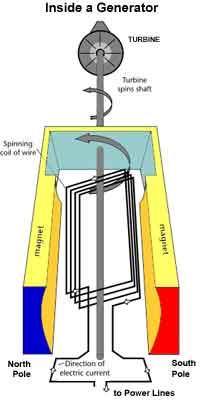
Generators are devices that convert _____ energy into _____ energy.
a)
chemical; mechanical
b)
mechanical; electrical
c)
electrical; mechanical
d)
potential; kinetic
109.
In large generators in power plants, ___________ rotate inside a coil of wire to produce an electric current.
a)
Wind
b)
Water
c)
Magnets
d)
Circuits
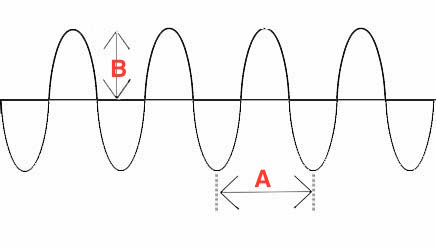
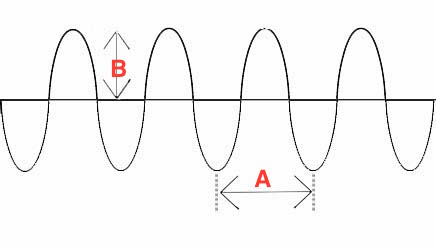
110.

What property of this wave is represented by the letter "A"

a)

amplitude

b)

crest

c)

trough

d)

wavelength

111.
What property of the wave is represented by the letter "B"?
a)
amplitude
b)
crest
c)
trough
d)
wavelength
112.
The highest point on a wave is:
a)
the crest
b)
the trough
c)
the top
d)
the coast 
113.
The lowest point on a wave is the:
a)
Amplitude
b)
Crest
c)
Trough
d)
Wavelength
114.
When the frequency of a wave increases, what happens to the wavelength?
a)
The wavelength is not directly affected by the frequency of a wave.
b)
The wavelength increases.
c)
The wavelength decreases.
d)
More specific information is needed to form a conclusion about the wavelength.
115.
A mechanical wave cannot travel through...
a)
a vacuum(empty space).
b)
water.
c)
air. 
d)
glass.
116.
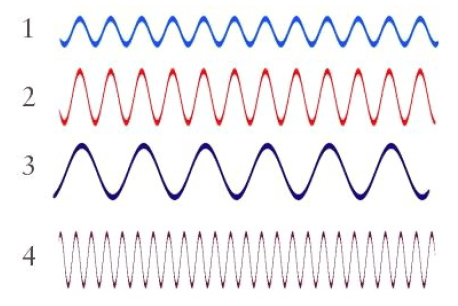
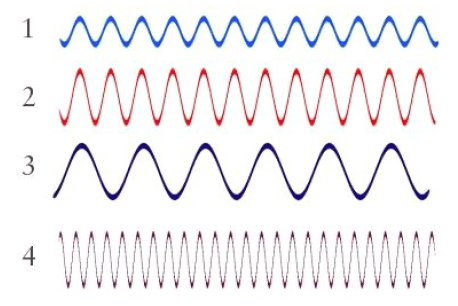
Which wave in the diagram has the greatest frequency?
a)
1
b)
2
c)
3
d)
4
117.
Which wave in the diagram has the greatest wavelength?
a)
1
b)
2
c)
3
d)
4
118.
Which of the following can sound travel through?
a)
solid
b)
liquid
c)
gas
d)
all of the above
119.

Electromagnetic waves include the following except

a)

radio waves

b)

X-rays

c)

seismic waves

d)

microwaves

120.
regular disturbances that carry energy through matter or space
a)
crest
b)
energy
c)
wave
d)
trough
121.
which material does sound travel the fastest?
a)
solid 
b)
liquid 
c)
gases
122.
When a wave strikes and object and bounces off. (example echo)
a)
medium
b)
refraction
c)
reflection
d)
interference
123.
When a wave bends as it passes through at an angle from one medium to another.(example: pencil in a glass of water-)
a)
medium
b)
refraction
c)
reflection
d)
interference
124.
What kind of waves can travel through space?
a)
electromagnetic waves
b)
compressional waves
c)
longitudinal waves
d)
sound waves
125.
What is the measure of how many waves pass a point in a second?
a)
frequency
b)
wavelength
c)
midpoint
d)
crest and trough
126.
A compressional wave is another name for a 
a)
longitudinal wave
b)
electromagnetic wave
c)
radio wave
d)
hair wave
127.
In a longitudinal wave, the particles move...?
a)
back and forth
b)
up and down
c)
not at all
d)
at a 90 degree angle
128.
The longer the _____________  the ______________ the frequency.
a)
wavelength, lower
b)
wavelength, higher
c)
amplitude, lower
d)
amplitude, higher
129.
You can't hear sounds in outer space because there is no
a)
matter
b)
light
c)
energy
d)
heat
130.
What do seismic waves and sound waves have in common?
a)
they're mechanical waves
b)
they're electromagnetic waves
c)
they're transverse waves
d)
they're permanent waves
131.
When a wave's amplitude increases it means
a)
it's carrying more energy
b)
its wavelength gets longer
c)
its frequency increases
d)
its wavelength decreases
132.
Which is an example of a longitudinal wave?
a)
light wave
b)
sound wave
c)
visible wave
d)
radio wave
133.
Of the following, ________ have the greatest frequency of the electromagnetic spectrum.
a)
ultraviolet rays
b)
gamma rays
c)
radio
d)
visible waves
134.
All waves carry ________ as they travel from one place to another.
a)
matter
b)
space
c)
energy
d)
water
135.
This type of Electromagnetic wave shows a break in bones.
a)
gamma ray
b)
x-ray
c)
brokenometer
d)
radio wave
136.

Earthquakes produce

a)

Electromagnetic waves

b)

Thermal Energy Waves

c)

Seismic Waves

d)

None of the above

137.

The bending of waves around a barrier.

a)

refraction

b)

diffraction

c)

resonance

138.

Which one has the longest wavelength

a)

Radio

b)

Micro

c)

Gamma

d)

X-ray

139.

What are microwaves mostly used for

a)

To warm people up

b)

Rainbows

c)

Radars

d)

To find broken bones

140.

What is the best example of infared rays

a)

Heat lamp

b)

A pool

c)

Blond hair

d)

A mirror

141.

What color reflects all visible light

a)

white

b)

Red

c)

Blue

d)

Black

142.

____________ warms up food

a)

Microwaves

b)

Gamma

c)

Radio

d)

X-ray

143.

____________ warms up food

a)

Microwaves

b)

Gamma

c)

Radio

d)

X-ray