
 Worksheets
SECOND 2025/26 Benchmark 1 Prep
Total questions: 139
Worksheet time: 1hrs 12mins
Emma is studying how plants store energy and build their structures. She wants to know which macromolecule provides short-term energy and structural support in plants. What should she focus on?
Proteins
Lipids
Carbohydrates
Nucleic acids
Samuel is learning about nutrients in his biology class. His teacher asks him: Which of the following is NOT a function of lipids?
Long-term energy storage
Speed up reactions
Form cell membranes
Insulation
Grace is preparing a meal and wants to include a carbohydrate in her diet. Which of the following should she choose?
Starch
Lactase
Triglyceride
DNA
Olivia is preparing a meal and wants to include a source of lipids for a balanced diet. Which of the following ingredients should she choose?
Cellulose
Antibody
Triglyceride
RNA
Nora is studying for her biology exam and comes across a question asking her to identify a nucleic acid. Which of the following should she choose?
Starch
Steroid
DNA
Lactase
Charlotte is preparing a healthy meal and wants to include foods that contain glucose and cellulose. Which macromolecule should she focus on?
Proteins
Lipids
Carbohydrates
Nucleic acids
Elijah is learning about how the body fights off infections. He discovers that antibodies play a key role in this process. Antibodies are an example of which type of macromolecule?
Carbohydrates
Proteins
Lipids
Nucleic acids
Grace is preparing for a marathon and needs to choose foods that will give her quick energy during the race. Which of the following is a function of carbohydrates?
Long-term energy storage
Short-term energy
Immunity
Transport
Grace is studying how plants make their own food. She wants to know: where does photosynthesis primarily occur in plant cells?
Mitochondria
Chloroplasts
Nucleus
Ribosomes
Jackson is studying how plants convert sunlight into energy. He wants to know which stage of photosynthesis captures light energy and produces ATP and NADPH. Can you help him identify the correct stage?
Calvin Cycle
Light Reactions
Krebs Cycle
Electron Transport Chain
Maya is conducting an experiment to observe the process of photosynthesis in a plant. After a few hours, she wants to know what substances are produced by the plant during photosynthesis. What are the outputs of photosynthesis?
Glucose and oxygen
ATP and NADPH
Water and carbon dioxide
Pyruvate and ATP
Michael is training for a marathon and wants to understand how his body gets energy from the food he eats. What is the main purpose of cellular respiration in helping Michael during his run?
Convert chemical energy (glucose) into usable energy (ATP)
Convert light energy into glucose
Produce oxygen
Break down ATP into glucose
Hannah is learning about how her body produces energy from food. She wonders where cellular respiration primarily occurs in her cells. Can you help her find the answer?
Chloroplasts
Mitochondria
Nucleus
Ribosomes
Elijah is setting up an experiment to observe how living cells produce energy. What are the inputs he needs to provide for cellular respiration?
Glucose and oxygen
Carbon dioxide and water
ATP and NADPH
Pyruvate and oxygen
Charlotte is studying how our bodies get energy from food. She wants to know: What are the outputs of cellular respiration?
Carbon dioxide, water, and ATP
Glucose and oxygen
NADPH and ATP
Pyruvate and water
Mia is studying how our bodies generate energy from food. She wants to know: approximately how many ATP molecules are produced per glucose molecule in cellular respiration?
12
24
36
48
Emma is planting a garden and wants her plants to grow healthy and strong. Which process in the plants requires sunlight as an input?
Photosynthesis
Cellular respiration
Fermentation
Digestion
Jackson is observing animals in a forest. He notices some animals eat only plants, some eat other animals, and some eat both plants and animals. Which group do these animals belong to in a food chain?
Producers
Consumers
Decomposers
Keystone species
Samuel is studying a food chain in a forest. He notices that as energy moves from plants to herbivores and then to carnivores, something happens to the amount of energy available at each level. What happens to energy as you move up trophic levels in a food chain?
It increases by 10%
It stays the same
It decreases by 10%
It decreases by 90%
David and Avery work together to plant a garden. David waters the plants while Avery pulls out weeds, and both enjoy fresh vegetables from the garden. Which of the following best describes their relationship?
One organism benefits, the other is harmed
Both organisms benefit
One organism benefits, the other is unaffected
Both organisms are harmed
Sophia is planning a research trip to study a biome with the coldest climate and the least biodiversity. Which biome should she choose?
Tropical rainforest
Desert
Tundra
Grassland
Kai is planning a trip and is deciding between visiting the tundra or the tropical rainforest. He wants to know how these two biomes differ in terms of climate and biodiversity. Which statement best compares the characteristics of the tundra and tropical rainforest?
Both have high biodiversity and warm climates
Tundra is cold with low biodiversity; tropical rainforest is warm with high biodiversity
Both are deserts with little vegetation
Tundra is warm with high biodiversity; tropical rainforest is cold with low biodiversity
In a forest where many animals live close together, which of the following is an example of a density-dependent factor affecting their population?
Competition
Natural disasters
Climate change
Sunlight
Daniel is tracking the population growth of bacteria in a petri dish. He notices that the number of bacteria doubles at regular intervals. What shape does the curve of exponential growth take?
J-shaped
S-shaped
U-shaped
L-shaped
During a severe drought, Oliver notices that all the plants in his garden are affected, no matter how many of each type he has. Which of the following factors can affect all populations regardless of their density?
Density-Independent Factors
Density-Dependent Factors
Exponential Factors
Logistic Factors
In a city, the population size changes due to factors that affect birth and death rates. Which of the following is a factor that influences population size by affecting birth and death rates?
Density-Dependent Factor
Density-Independent Factor
Exponential Factor
Logistic Factor
During a severe drought, a forest experiences a significant decrease in water availability, affecting all plants and animals regardless of how many live there. Which of the following best describes this type of factor?
Factors not influenced by population density
Factors influenced by population density
Factors that cause exponential growth
Factors that cause logistic growth
Daniel is studying a local animal population and wants to understand what affects its size. Which of the following is NOT a factor affecting populations?
Exponential growth
Density-dependent factors
Density-independent factors
Logistic growth
After a hurricane hits a coastal town, which of the following is a result for the local population?
All populations are impacted regardless of density
Only dense populations are impacted
Resources become unlimited
Growth becomes exponential
Henry starts a business selling handmade candles. In the first few months, his sales double each month without any restrictions. Which of the following is true about the growth of Henry's business?
Growth is unrestricted
Growth slows as resources become limited
It is represented by an S-shaped curve
It is only affected by density-independent factors

Anika is studying nutrition labels and comes across a diagram showing a macromolecule made up mostly of carbon, hydrogen, and oxygen atoms. Which macromolecule is shown below?
Carbohydrate
Lipid
Protein
Nucleic Acid

Wax is used on surfboards to repeal water. In humans, wax can be used to cover skin and keep the skin from drying.
What macromolecule is wax?
carbohydrate
lipid
protein
nucleic acid
Maya is studying for her biology exam and comes across a chapter about nucleic acids. She wonders, what is the main function of nucleic acids in living organisms?
store genetic information
store energy (long-term)
store energy (short-term)
build skin, hair, nails, muscles
Samuel is learning about how our bodies build and break down important molecules. Which of the following best summarizes the relationship between dehydration reactions and hydrolysis in this process?
Hydrolysis only occurs in the urinary system, and dehydration reactions only occur in the digestive tract.
Hydrolysis creates monomers, and dehydration reactions break down polymers.
Dehydration reactions can occur only after hydrolysis.
Dehydration reactions assemble polymers, and hydrolysis breaks down polymers.
Which of the following is an example of mutualism in nature?
A lion hunting a zebra
Bees pollinating flowers while collecting nectar
Moss growing on a tree without affecting it
A tick feeding on a dog
In a symbiotic relationship known as parasitism, which statement is true?
Both organisms benefit equally
Both organisms are harmed
One organism benefits while the other is harmed
Neither organism is affected
Clownfish live among the tentacles of sea anemones. The clownfish get protection, and the anemone gets food scraps. What type of symbiotic relationship is this?
Mutualism
Commensalism
Competition
Parasitism
Olivia is learning about how carbon moves through the environment. Which process releases carbon dioxide into the atmosphere?
Photosynthesis
Respiration
Nitrogen fixation
Precipitation
Liam is studying the nitrogen cycle in his biology class. What is the role of bacteria in the nitrogen cycle?
They release carbon dioxide
They absorb water from the soil
They convert nitrogen gas into usable forms for plants
They produce oxygen
Sophia is observing how water moves through the environment. Which process in the water cycle involves water vapor turning into liquid water?
Transpiration
Precipitation
Condensation
Evaporation
Which of the following best describes a population pyramid for a rapidly growing country?
Irregular shape with no pattern
Equal width at all levels
Narrow base and wide top
Wide base and narrow top
What information can you determine from an age-structure diagram of a population?
The amount of rainfall in the region
The distribution of individuals among different age groups
The migration patterns of the population
The genetic diversity of the population
In an ecological pyramid, which level typically contains the least amount of energy?
Tertiary consumers
Primary consumers
Secondary consumers
Producers


What happens if a population grows past its carrying capacity?
The population keeps growing
The population reduces untl it is below carrying capacity again
The entire species will go extinct
The carrying capacity just increases

If the secondary consumer level has 20,000 kcal available to it, how much energy was captured by the producers during photosynthesis?
2 kcal
200 kcal
200,000 kcal
2,000 kcal
Which of the following is a density-dependent limiting factor that can affect a population?
Temperature extremes
Earthquake
Flood
Competition for resources
What is an example of a density-independent limiting factor?
Predation
Disease
Natural disaster
Food availability
How do density-dependent limiting factors typically affect populations as their size increases?
They have no effect/impact
They only affect/impact small populations
They become less effective/impactful
They become more effective/impactful
Which stage of the demographic transition model is characterized by high birth rates and high death rates, resulting in a stable population size?
Stage 4
Stage 1
Stage 2
Stage 3
During which stage of demographic transition does a country typically experience a rapid population increase due to declining death rates while birth rates remain high?
Stage 4
Stage 3
Stage 2
Stage 1
What is a common characteristic of countries in the final stage of the demographic transition model?
High birth and death rates
High birth rates and low death rates
Low birth and death rates
Rapid population growth

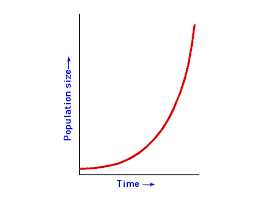
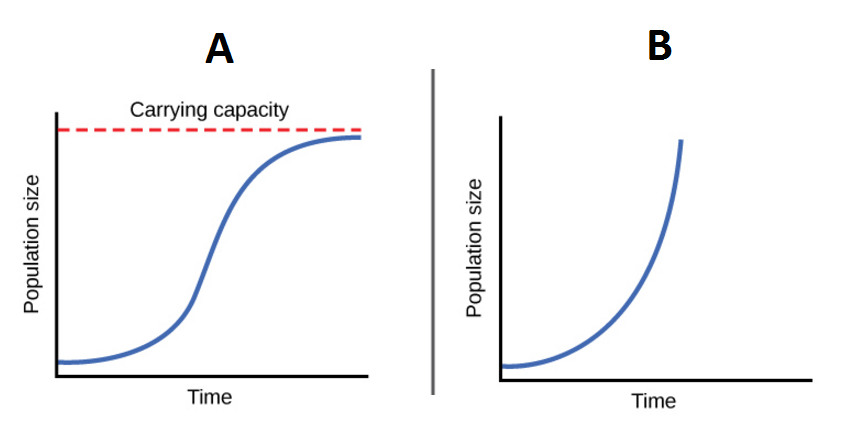
What type of growth model is shown in image A?
Exponential
Logistic
Which of the following best describes an invasive species?
A species that is endangered in its natural habitat
A species that is native to an ecosystem and helps maintain balance
A species that only lives in one specific habitat
A species introduced to a new environment that causes harm to native species
What is one common impact of invasive species on native ecosystems?
They help native predators survive
They often outcompete native species for resources
They always improve soil quality
They increase biodiversity by creating new habitats
Which of the following is an example of an invasive species in North America?
Zebra mussel
Eastern gray squirrel
Monarch butterfly
Bald eagle
Which of the following is a common impact of invasive species on native ecosystems?
Increase biodiversity and stability
Improve soil fertility for all plants
Cause extinction of native species
Reduce competition among native species
What is one method used to control the spread of invasive species?
Physical removal and habitat restoration
Introducing more invasive species
Increasing food supply for invasive species
Reducing native species populations
Why are invasive species often successful in new environments?
They require very specific conditions to survive
They are always larger than native species
They have no natural predators
They only reproduce once in their lifetime
Which of the following human activities is most responsible for habitat loss and a decline in biodiversity?
Ecotourism
Urbanization and deforestation
Recycling programs
Wildlife photography
How does pollution from industrial waste impact biodiversity in aquatic ecosystems?
It increases the number of species
It can cause the death of sensitive species and disrupt food chains
It always improves water quality
It has no effect on aquatic life
Which of the following is a way humans can help protect biodiversity?
Overharvesting natural resources
Establishing protected areas and wildlife reserves
Introducing invasive species
Expanding urban development
Which of the following best describes biodiversity?
The amount of rainfall in a habitat
The variety of ecosystems in a region
The number of individuals in a population
The variety of life forms, including plants, animals, and microorganisms, in a given area
Why is biodiversity important for ecosystem stability?
It reduces the number of species in an ecosystem
It helps ecosystems recover from disturbances and maintain balance
It increases the risk of disease outbreaks
It makes ecosystems more vulnerable to changes
Which human activity is most likely to decrease biodiversity in a forest ecosystem?
Deforestation and habitat destruction
Protecting endangered species
Creating wildlife corridors
Planting native trees
Which of the following best describes a keystone species in an ecosystem?
A species that is the most abundant in the ecosystem
A species that is always a top predator
A species whose removal would cause major changes in the ecosystem
A species that only lives in one specific habitat
What is one possible consequence of removing a keystone species from an ecosystem?
All other species become keystone species
Biodiversity may decrease and ecosystem balance may be disrupted
The ecosystem remains unchanged
Only the keystone species is affected
Which of the following is an example of a keystone species?
Earthworms in soil
Butterflies in a garden
Grass in a meadow
Sea otters in kelp forests

How do biodiversity and stability work together?
The lower the biodiversity the greater the stability of an ecosystem.
The higher the biodiversity, the less stable the ecosystem
The higher the biodiversity, the greater the stability of the ecosystem.
Biodiversity has nothing to do with ecosystem stability.

Which of the following best describes the relationship between biodiversity
and stability of ecosystem?
Increased biodiversity increases the stability of an ecosystem.
As biodiversity increases, stability of the ecosystem decreases.
A less diverse ecosystem keeps more resources in the ecosytem.
An ecosystem with low biodiversity is better able to recover from natural disasters.
Which statement best describes the competitive exclusion principle?
Two species can coexist indefinitely if they occupy the same niche
No two species can occupy the same niche in the same habitat for a long time
Species always share resources equally
Competition always leads to increased biodiversity
What is a likely outcome when two species compete for exactly the same resources in an ecosystem?
The resources will increase to support both species
Both species will become extinct
One species will outcompete and exclude the other
Both species will thrive equally
Which of the following scenarios illustrates the competitive exclusion principle?
Two insect species pollinate different flowers
Two plant species grow in different soil types
Two fish species occupy the same niche and one disappears over time
Two bird species feed on different types of seeds in the same forest
Which statement best explains the 10% rule in energy transfer within a food chain?
10% of the population migrates to a new habitat each year.
10% of the biomass is lost at each level.
10% of organisms survive at each trophic level.
Only 10% of the energy at each trophic level is passed to the next level.
What does a pyramid of numbers illustrate in an ecosystem?
The number of individual organisms at each trophic level
The flow of water through the ecosystem
The diversity of species in a food web
The amount of energy at each trophic level
In a biomass pyramid, which trophic level typically has the greatest total biomass?
Tertiary consumers
Primary consumers
Producers
Secondary consumers
In a food chain, only a small fraction of energy is transferred from one trophic level to the next. What is the approximate percentage of energy that is passed on?
50%
10%
1%
25%
Which of the following best describes a pyramid of numbers in an ecosystem?
Illustrates the amount of sunlight received by producers
Displays the flow of water in an ecosystem
Represents the number of organisms at each trophic level
Shows the total energy at each trophic level
Why are food webs considered more realistic than food chains in representing feeding relationships in nature?
Food chains are always longer than food webs
Food webs show only producers and consumers
Food chains show all possible energy transfers
Food webs include multiple interconnected food chains
Which of the following best describes bioaccumulation?
The buildup of a substance in an organism over time
The movement of nutrients through the food chain
The breakdown of pollutants by bacteria
The increase in concentration of a substance in organisms at higher trophic levels
What is a major consequence of biomagnification in aquatic food chains?
Faster growth of algae
Increased oxygen levels in water
Higher concentrations of toxins in top predators
Decrease in water temperature
Which pollutant is most commonly associated with biomagnification in birds of prey?
Carbon dioxide
DDT
Ozone
Nitrogen
Which of the following best describes bioaccumulation?
The movement of nutrients through the food chain
The increase in concentration of a substance in organisms at higher trophic levels
The buildup of a substance in an organism over time
The breakdown of pollutants by bacteria
What is a major consequence of biomagnification in aquatic food chains?
Decreased oxygen levels in water
Higher concentrations of toxins in top predators
Increased biodiversity
Faster decomposition rates
Which of the following substances is most likely to biomagnify in a food web?
Simple sugars
Heavy metals like mercury
Proteins
Water-soluble vitamins
What type of consumer feeds on both plants and animals?
Decomposer
Carnivore
Herbivore
Omnivore
Which group of consumers is responsible for breaking down dead organic matter in an ecosystem?
Producers
Decomposers
Primary consumers
Secondary consumers
Which of the following is a direct product of the light-dependent reactions of photosynthesis?
Oxygen
Glucose
ATP
Carbon dioxide
Where in the chloroplast do the light-independent reactions (Calvin cycle) take place?
Thylakoid membrane
Stroma
Grana
Outer membrane
What is the main purpose of the light-dependent reactions in photosynthesis?
To produce glucose directly
To convert carbon dioxide into oxygen
To break down water into glucose
To capture energy from sunlight and produce ATP and NADPH
Which organelle is primarily responsible for carrying out aerobic cellular respiration in eukaryotic cells?
Mitochondrion
Chloroplast
Ribosome
Nucleus
During aerobic cellular respiration, which molecule acts as the final electron acceptor in the electron transport chain?
Carbon dioxide
Water
Glucose
Oxygen
What are the main products of aerobic cellular respiration?
Lactic acid and ATP
Glucose and oxygen
ATP, carbon dioxide, and water
Pyruvate and NADH
Which of the following is produced as a result of aerobic cellular respiration?
Lactic acid
Glucose
Oxygen
Carbon dioxide
Which stage of aerobic cellular respiration generates the most ATP?
Glycolysis
Krebs cycle
Electron transport chain
Fermentation
What is the main purpose of oxygen in aerobic cellular respiration?
To break down glucose directly
To act as the final electron acceptor in the electron transport chain
To produce lactic acid
To initiate glycolysis
Which of the following is a common product of alcoholic fermentation?
Carbon dioxide
Oxygen
Glucose
Lactic acid
What is the main purpose of fermentation in cells?
To store energy as fat
To break down proteins
To generate ATP in the absence of oxygen
To produce oxygen
Which organism is most commonly used in the fermentation of bread and alcoholic beverages?
Lactobacillus
Yeast
Mold
Algae

Which statement best describes cellular respiration?
It converts energy in food into a more usable form.
It stores energy in food molecules
It occurs in animal cells, but not in plant cells.

Whish habitat has the highest biodiversity?
Area A
Area B
Area C
Area D

The variety of life within an area.
biodiversity
biotic factor
abiotic factor

Image "B" shows more biodiversity than image "A". Why?
Because "B" shows more different species than image "A"
Because image "B" has less different species than "A"
"A" has a greater number of same species plants so this statement is wrong.
Both images show the same biodiversity

What does biodiversity mean?
Only one species in an area.
The different amount of species in an area
All abiotic life
Nitrogen fixation
Which of the following best describes the importance of biodiversity in an ecosystem?
It reduces the number of available habitats
It helps maintain ecosystem stability and resilience
It causes food chains to collapse
It increases the risk of disease outbreaks
Why is biodiversity important for human survival?
It provides resources such as food, medicine, and clean water
It makes ecosystems less productive
It decreases the variety of crops available
It increases pollution in the environment
What can happen to an ecosystem if biodiversity is lost?
The ecosystem becomes more resilient to change
There is no impact on ecosystem services
The ecosystem may become unstable and collapse
All species will thrive equally
Which of the following biomes is characterized by permafrost, low temperatures, and limited vegetation?
Desert
Tundra
Grassland
Tropical rainforest
What is the primary factor that determines the type of plants and animals found in a particular biome?
Climate
Soil color
Altitude
Longitude
Which biome is known for having the highest biodiversity and dense, multi-layered vegetation?
Temperate forest
Taiga
Savanna
Tropical rainforest
Which biome is characterized by permafrost and very low temperatures for most of the year?
Taiga
Deciduous forest
Tundra
Tropical rainforest
Which of the following is a key difference between taiga and deciduous forest biomes?
Deciduous forest has permafrost, while taiga does not
Taiga is found near the equator, while deciduous forest is found at the poles
Taiga has mostly coniferous trees, while deciduous forest has trees that lose their leaves seasonally
Taiga receives more rainfall than deciduous forest
Which animal is most likely to be found in the tundra biome?
Polar bear
Chimpanzee
Jaguar
Red fox
Which of the following biomes is characterized by hot days, cold nights, and very little rainfall?
Tundra
Desert
Grassland
Deciduous forest
What is a common adaptation of plants found in grasslands?
Epiphytic growth on trees
Broad leaves to capture sunlight
Deep root systems to access water
Thick, waxy leaves to reduce water loss
Which of the following best describes the seasonal changes in a deciduous forest?
Leaves remain green all year
Leaves change color and fall off in autumn
Temperatures stay constant throughout the year
Rainfall is extremely low year-round
Which layer of the leaf contains tightly packed cells that are rich in chloroplasts and are primarily responsible for photosynthesis?
Stomata
Epidermis
Palisade mesophyll
Spongy mesophyll
What is the main function of the spongy mesophyll in a leaf?
To protect the leaf from water loss
To absorb sunlight for photosynthesis
To allow gas exchange by providing air spaces
To transport water and nutrients
Which structure in the leaf opens and closes to regulate the exchange of gases such as oxygen and carbon dioxide?
Palisade mesophyll
Cuticle
Spongy mesophyll
Stomata
Which of the following best describes a species' niche in an ecosystem?
The role a species plays, including its use of resources and interactions with other organisms
The physical space a species occupies
The genetic diversity within a species
The number of individuals in a population
According to the competitive exclusion principle, what is most likely to happen if two species occupy the exact same niche?
They will both thrive and increase in number
One species will outcompete the other, leading to the exclusion or extinction of the less competitive species
They will merge to form a new species
They will both adapt to use identical resources
Which scenario illustrates resource partitioning as a way to avoid competitive exclusion?
Two bird species feed on the same seeds at the same time of day
Two lizard species hunt insects, but one hunts during the day and the other at night
Two fish species live in the same part of a lake and eat the same food
Two plant species compete for sunlight and one is eliminated
Which of the following best describes resource partitioning among species in an ecosystem?
Different species use the same resources in exactly the same way
Species divide resources to reduce competition and coexist
All species compete until only one survives
Resources are unlimited so partitioning is unnecessary
What is a niche in ecological terms?
The number of individuals in a population
The role and position a species has in its environment, including how it obtains resources
The amount of sunlight an organism receives
The physical location where an organism lives
According to the competitive exclusion principle, what happens when two species attempt to occupy the same niche?
They will both adapt to use identical resources
They will merge to form a new species
They will both thrive equally
One species will outcompete the other, leading to the exclusion of the less competitive species
Which of the following best describes an r-strategist species?
Is typically found in stable environments
Has a long lifespan and slow maturation
Produces few offspring and invests heavily in parental care
Produces many offspring with little parental care
What is a key characteristic of k-strategist organisms?
Rapid population growth and short lifespan
High reproductive rate and minimal competition
Ability to colonize disturbed habitats quickly
Stable population size near carrying capacity
Which of the following organisms is most likely to be classified as an r-strategist?
Oak tree
Elephant
Whale
Mouse
Which of the following is a characteristic of r-strategist species?
Produce few offspring with high parental care
Produce many offspring with little parental care
Long lifespan and slow maturation
Stable population size near carrying capacity
Which type of strategist is more likely to thrive in unpredictable or rapidly changing environments?
k-strategist
r-strategist
Both equally
Neither
Which of the following organisms is an example of a k-strategist?
Mouse
Elephant
Rabbit
Fruit fly
Which of the following best describes an r-strategist species?
Has a Type I survivorship curve
Lives long lives with stable population sizes
Produces many offspring with little parental care
Produces few offspring with high parental care
Which survivorship curve is most commonly associated with k-strategists?
Type I
Type II
Type III
Type IV
What does a Type III survivorship curve indicate about a population?
High mortality rate early in life
Low reproductive rate
Mortality is constant throughout life
Most individuals survive to old age

