
 Worksheets
Plate Tectonics
Total questions: 57
Worksheet time: 1hrs 13mins
The North American plate and Pacific plates meet at the San Andres Fault in California causing frequent earthquakes. This fault is located at a _____ boundary.
Ridge
Divergent
Convergent
Transform
Which TWO landforms occur when a continental plate and an oceanic plate hit each other?
Volcanoes on land and Volcanic Islands
Volcanoes on land and Deep Sea Trench
Volcanoes on land and Mountains
Rift Valley and Mid Ocean Ridge
How do most mountains form?
Continents collide and fold up on each other
Earth is shrinking and the crust wrinkles up
Ocean plates diverge and fold up on each other
Gravity from the moon pulls sections of the Earth up

What kind of landform is created when a continent starts to get torn apart?
Volcanic Island
Deep Sea Trench
Mid-ocean Ridge
Rift Valley
Mountains
Plates are not created or destroyed: They just pass by each other.
Converge
Diverge
Transform
This is where new material is added on to plates.
Converge
Diverge
Transform
This is where plate material may be destroyed (or recycled) and returned to the mantle.
Converge
Diverge
Transform

What are these plates doing?
Diverging
Converging
Forming a transform boundary

Study this diagram carefully, noticing the direction of the arrows.The green bars are tectonic plates.What will happen at the place where the star is drawn on this diagram?
The plates will slide past each other (causing a major earthquake)
The plates will hit each other (one will subduct)
The plates will diverge (spread apart)

What are these plates doing?
Converging
Diverging
Forming a transform boundary

What are these plates doing?
Converging
Diverging
Forming a transform boundary

What type of event will occur at this boundary?
Earthquake
Volcano Eruption
Tornado
Mountain Building
A divergent boundary occurs when plates ....
Pull apart
Come together
Slide past each other
subducting
The Great Rift Valley in Africa and the Mid-Ocean Ridge were all created by this boundary
Divergent
Convergent
Reform
Transform
The type of plate boundary where two plates come together is a .....
Convergent Boundary
Divergent Boundary
Transform Boundary
Plate Boundary
A place where two plates slip past each other, moving in opposite directions, is known as a _______
transform boundary
divergent boundary.
convergent boundary.
rift valley.

Identify this type of plate movement
Divergent Boundary
Convergent Boundary
Transform Boundary
None
Tectonic plates can be made of continental crust or oceanic crust, or a combination of the two. Besides their locations, how else are these two kinds of crust different?
Continental crust is thinner than oceanic crust.
Continental crust is thicker than oceanic crust.
Tectonic plates made of continental crust are larger than plates made of oceanic crust.
Tectonic plates made of continental crust are smaller than plates made of oceanic crust.
__________ describes the large scale movement of the Earth’s lithosphere.
Crust Displacement
Mantle Movement
Plate Tectonic
None
This scientist was the first to develop the idea of continental drift.
Wegener
Einstein
Copernicus
Hawking

Identify this type of plate movement
Divergent Boundary
Convergent Boundary
Transform Boundary
None
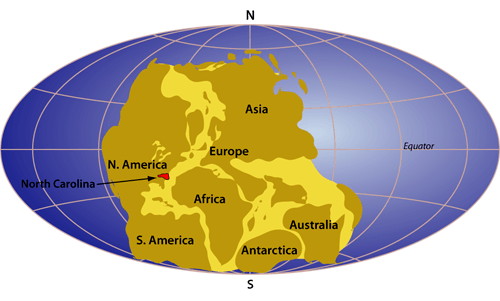
Around 200 – 250 million years ago ______ started to break into separate plates.
Oceans
China
Pangea
None
Two plates moving or sliding by each other.
Divergent Boundary
Convergent Boundary
Transform Boundary
None
Two plates collide
Divergent Boundary
Convergent Boundary
Transform Boundary
None
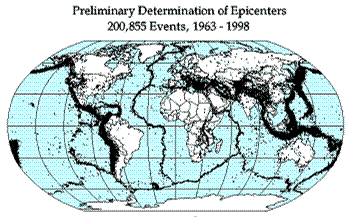
Earthquake epicenters (center of where the earthquakes started) were mapped for a 35 year period in the diagram above. The black dots indicate these epicenters. The black dots appear along what feature on Earth?
hot spots
plate boundaries
rift zones
sea floor spreading
The San Andreas Fault in California is known as an active earthquake area. What type of
boundary is it?
Converging
Diverging
Transform
Sea Floor Spreading
The Mid-Atlantic Ridge, the Great African Rift Valley and Iceland were formed as a result of what boundary interaction?
Continental-Continental Convergent
Continental-Oceanic Convergent
Divergent
Transform
Is the Lithosphere Rigid?
True
False
What is below the Lithosphere ?
Crust
Core
Mantle
Asthenosphere
What are the plates made out of?
Lithosphere
Asthenosphere
Crust
Mantle

What causes convection currents?
Hot magma rises while cool magma sinks
The rotation of the Earth
Ocean currents pulling plates apart
The spinning of the Earth's core

Why does oceanic crust subduct under continental crust?
Oceanic crust is thin
Oceanic crust is dense
Continental crust is thin
Continental crust is dense

How is it possible for new crust to be formed without increasing the surface area of the Earth?
Crust is destroyed at the same time it is created
New crust is underwater where it sinks
New crust breaks more easily than old crust

Islands can from from magma which is pushed up at a __________ plate boundary
Divergent
Convergent
Transform
The San Andreas Fault in California is known as an active earthquake area. What type of
boundary is it?
Converging
Diverging
Transform
Sea Floor Spreading
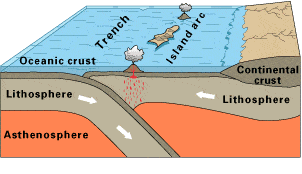
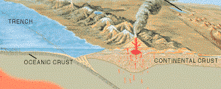
Observe this diagram of a plate boundary. One statement BEST describes what is happening. It is that
the oceanic crust is melting.
the denser ceanic crust is subducting under the less dense oceanic crust
volcanic islands are forming.
the tectonic plates are moving away from each other.

What Theory states Earth's Lithospheric plates are in constant motion due to convection currents in the mantle.
Theory of Continental Drift
Theory of Plate Tectonics
Theory of Relativity
Theory of Plates and Table
Scientists believe Earth's Plate move due to
The Crust
The Sun
The Convection currents in the mantle
The ice age

The lithosphere is made up of
The crust and outer core
The crust and Inner Core
The crust and Upper core
The crust and upper mantle

A divergent boundary is when two plate divide. This is under water or on land. The landforms created on land include
Mid- Ocean Ridge
Mountains
Rift Valleys
Tornadoes
Subduction of a plate boundary means one plate sinks toward the Earth's Mantle. Which plate would sink toward the mantle?
The less dense continental plate
The less dense oceanic plate
The more dense oceanic plate
The more dense continental plate

A trench is formed at which type of boundary?
Convergent
Divergent
Transform
Sliding
What is the process by which the ocean floor sinks beneath a deep-ocean trench and back into the mantle?
Subduction
Convection
Plate Tectonics
Continental Drift
Fossils provide evidence to support the theory of plate tectonics. Why?
Fossils of the same animals have been found on different continents.
Fossils are always found on plate boundaries
Fossils of each type of animal are always found only on one continent
Fossils are never found near divergent boundaries.
A mid-ocean ridge forms when seafloor spreading occurs.
What causes the mid-ocean ridge to form?
New magma is added to the mantle
Earthquakes
Magma rises to the surface when plates pull apart
Volcanoes ruin everything

Who is the scientist who proposed Continental Drift Theory?

Alfred Wegener named his single supercontinent ____________, which means "all Earth" in ancient Greek.
Pandora
Gandowandaland
Pangea
Percia

What type of fossils were noticed by Wegener to be found on two different continents?

Most geologists think that the movement of Earth's tectonic plates is caused by
the rotation of the Earth.
the Earth's magnetic field.
subduction.
convection currents.

Sea-floor spreading explains how.....
new crust is created at a divergent boundary
volcanoes are formed on continents
deep sea trenches are formed

