
 Worksheets
Y11 Jan Review Quiz
Total questions: 100
Worksheet time: 56mins
Subatomic particles with a negative charge
Electrons
Neutrons
Protons
Quarks
What is this subatomic particle that has negative charge?
Electron
Neutron
Proton
Megatron
What is this subatomic particle that has no charge?
Electron
Neutron
Proton
Megatron
What is the smallest particle of an ELEMENT, and it has also all the properties of it?
Molecules
Nucleus
Subatomic particle
Atoms
What is the small, DENSE REGION consisting of protons and neutrons at the CENTER of an atom?
Molecules
Nucleus
Subatomic particle
Atoms
It is consisting of two or more atoms combined together in a specific arrangement. It is the smallest particle of compound that can exist independently. What is this?
Molecules
Nucleus
Subatomic particle
Atoms
Where can we find the location of the Atomic Nucleus?
Center
Left Side
Right Side
Above
What is the atomic model proposed by J.J Thompson, and suggest that negatively-charged electrons were embedded in a kind of cloud or soup of positive charge?
Asia's Next Top Model
Quantum Atomic Model
Plum Pudding Model
Nuclear Model
What is the name of experiment conducted by Ernest Rutherford's Team, in testing the validity of Plum Pudding Model, which then resulted to introducing of the NUCLEAR MODEL of an Atom?
Planetary Model Experiment
Alpha particle scattering Experiment
Paro-Paro G Experiment
Quantum Particle Experiment

A horizontal row of elements in the periodic table
Molecule
Period
Family
Atom

The smallest particle of an element.
Element
Molecule
Atom
A combination of two or more atoms
Period
Molecule
Atom
Family
Used the word "atomos" to decsribe the uncuttable (indivisible) atom.
Democritus
Thomson
Bohr
Dalton

Proposed that electrons move around the nucleus in specific layers, or shells.
Bohr
Rutherford
Chadwick
Thomson

This picture best represents ___________________ atomic model.
Thomson's
Dalton's
Bohr's
Chadwick's
Which of the following is/are conclusions based on Rutherford’s gold foil experiment?
Atom is mostly empty space
The nucleus is positively charged
The atom has a small dense nucleus
All answers are correct
If an atom has an extra neutron, it is _____.
a positive ion
a neutral atom
an isotope
a negative ion
If an atom gains an electron, it is _____.
a positive ion
a negative ion
a neutral atom
an isotope
An atom's atomic mass comes from its _____.
nucleus
electron cloud
electrons
protons
If an atom loses an electron, it is _____.
A positive ion
a negative ion
a neutral atom
an isotope
Carbon-14 is an example of _____.
a positive ion
a negative ion
an isotope
a neutral atom
Ca+ is an example of _____.
a positive ion
a negative ion
an isotope
a neutral atom

Can an atom of Hydrogen have 2 protons?
Yes, because it can be an ion.
No, because protons identify the atom
Yes, because it can be an isotope
No, because only neutral atoms exist.

Can an atom of Helium have 3 electrons?
Yes, because it can be an ion
No, because protons identify the atom
Yes, because it can be an isotope
No, because only neutral atoms exist

Can an atom of Helium have 3 neutrons?
Yes, because it can be an ion
No, because protons identify the atom
Yes, because it can be an isotope
No, because only neutral atom exist
A neutral atom of Lithium has 3p+, 4n, and 3e-. It would be ______.
a positive ion
a negative ion
an isotope
a neutral atom
An atom of Boron has 5p+, 5n, and 6e-. It would be _____.
a positive ion
a negative ion
an isotope

Which type of model is pictured?
Bohr model
electron cloud
plum pudding
billiard ball

Which type of model is pictured?
Bohr model
electron cloud
plum pudding
billiard ball
If an atom has more protons than electrons, it is _____.
a positive ion
a negative ion
an isotope
a neutral atom
If an atom has more electrons than protons, it is _____
a positive ion
a negative ion
an isotope
a neutral atom
If an atom has an equal number of protons and electrons, it is _____.
a positive ion
a negative ion
an isotope
a neutral atom
Which answer choice correctly describes the subatomic particles and their respective charges?
p+, e-, n
p-, e+, n
p-, e, n-
p+, e, n-
A negative ion is called _______.
an anion
a neutron
an isotope
valence
A positive ion is called _______.
a cation
an anion
a metalloid
a neutron

How many protons are in the pictured element?
197
79
967
What is an ionic lattice?
A structure with random arrangement of ions.
A regular arrangement of alternating positive and negative ions.
A structure with only positive ions.
A structure with only negative ions.
Why do ionic compounds conduct electricity when dissolved in water?
Because the ions are free to move and carry charge.
Because water is a good conductor of electricity.
Because the ions are fixed in place.
Because the water molecules become charged.
Name two ionic compounds.
Sodium chloride and magnesium oxide.
Water and carbon dioxide.
Methane and ethane.
Oxygen and nitrogen.
Explain why ionic compounds have high melting points.
Because they have weak forces between molecules.
Because they have strong ionic bonds that require substantial energy to break.
Because they are made of small molecules.
Because they are gases at room temperature.
What type of bonding is present in ionic compounds?
Covalent bonding.
Metallic bonding.
Ionic bonding.
Hydrogen bonding.
Which of the following is a property of ionic compounds?
Low melting point.
High electrical conductivity in solid state.
Solubility in water.
Poor thermal conductivity.
What happens to the ions in an ionic lattice when it is heated to its melting point?
They become fixed in place.
They start to vibrate more vigorously and eventually break free from the lattice.
They lose their charge.
They form covalent bonds.
Which of the following best describes the electrical conductivity of solid ionic compounds?
They conduct electricity well.
They do not conduct electricity.
They conduct electricity only at high temperatures.
They conduct electricity only when mixed with metals.
What is the main reason for the high boiling points of ionic compounds?
The presence of free electrons.
The strong electrostatic forces between oppositely charged ions.
The weak van der Waals forces.
The presence of hydrogen bonds.
Which of the following is NOT a characteristic of ionic compounds?
High melting and boiling points.
Conduct electricity when molten or dissolved in water.
Generally soluble in water.
Low density.
What happens to the ionic bonds in a compound when it is dissolved in water?
They become stronger.
They are broken, allowing ions to move freely.
They form covalent bonds.
They remain unchanged.
Which of the following statements is true about the structure of sodium chloride?
It consists of molecules.
It is a giant covalent structure.
It is a giant ionic lattice.
It is a simple molecular structure.
Why are ionic compounds generally brittle?
Because the ions are tightly packed.
Because the layers of ions can slide over each other easily.
Because when a force is applied, like charges are brought together, causing repulsion.
Because they have a high density.
Which of the following is a common use of ionic compounds?
As insulators in electrical circuits.
As conductors in electrical circuits.
As solvents for organic compounds.
As fuels for combustion engines.
What is the effect of temperature on the solubility of most ionic compounds in water?
Solubility decreases with increasing temperature.
Solubility remains constant with increasing temperature.
Solubility increases with increasing temperature.
Solubility is unaffected by temperature.
Why does graphite conduct electricity?
Because it is a metal
Because it has delocalised electrons
Because the layers can move over each other
What is the arrangement of atoms in diamond called?
Tetrahedral
ionic lattice
diatomic
Pentahedral
What kind of bonds are there between atoms in diamond?
Ionic
Covalent
Van der Waals
What bonding holds the layers together in graphite?
Ionic
Covalent
Van Der Waals
Complete the sentence:
Diamond and Graphite are both __________ of carbon
mixtures
ionic bonds
allotropes
Why is graphite soft and slippery?
because it has delocalised electrons
Because it is a metal
Because it has covalent bonds
Because the layers can move over each other
What do we call large structures that contain only covalent bonds?
Giant covalent molecule
Ionic lattice
Simple molecular structure
What is a covalent bond?
electrons lost to form a positive ion
electrons gained to form a negative ion
pair of electrons shared between tow atoms
Between what ions are ionic bonds formed?
metal ions
non-metal ions
metal and non-metal ions
Between what atoms are covalent bonds formed?
metal ions
non-metal ions
metal and non-metal ions
What is the size range of a nanoparticle?
1-100 nm
100-1000 nm
1-10 nm
10-1000 nm
What is the approximate size of one nanometer in meters?
0.000 000 001 m
0.000 000 01 m
0.000 000 1 m
0.000 001 m
What is a key difference between bulk materials and nanoparticles?
Bulk materials consist of a few hundred atoms, while nanoparticles consist of huge numbers of atoms.
Bulk materials consist of huge numbers of atoms, while nanoparticles consist of only a few hundred atoms.
Bulk materials are smaller in size compared to nanoparticles.
Bulk materials have a higher surface area to volume ratio compared to nanoparticles.
What is the surface area of one side of a larger cube with dimensions 100 cm × 100 cm × 100 cm?
1000 cm²
10000 cm²
60000 cm²
100000 cm²
What is the surface area to volume ratio of a smaller cube with dimensions 10 cm × 10 cm × 10 cm?
0.06 : 1
0.6 : 1
6 : 10
60 : 1
Which of the following is a benefit of using nanoparticles of zinc oxide in sun creams?
They are difficult to rub in.
They are visible on the skin.
They do not degrade on exposure to the sun.
They provide less effective protection from UV rays.
What is a potential risk of using nanoparticles in sun creams?
They are too large to penetrate cell membranes.
They are less reactive than bulk material.
They may cause cell damage in the body.
They have no harmful effects on the environment.
How does the surface area to volume ratio change when the sides of a cube decrease by a factor of 10?
It decreases by a factor of ten.
It increases by a factor of ten.
It remains the same.
It decreases by a factor of one hundred.
Which of the following is NOT a benefit of using nanoparticles in sun creams?
Better skin coverage
Clear and colourless appearance
Effective protection from UV rays
Harmful effects on the environment
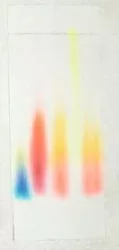
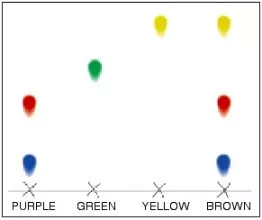


Filtering is
Separating a soluble solid and solvent
When one liquid is changed to another liquid
Separating solids from liquids
Separating an insoluble solid from a liquid

The separation technique being used is
Decanting
Filtering
Evaporation
Distillation
When a solid is mixed into a liquid, it has...
Condensed
Dissolved
Evaporated
Diluted
Dyes in ink may be separated by using...
crystallization
sublimation
chromatography
sedimentation

The separation technique being used is
Filtering
Distillation
Evaporation
Decanting

When mixing sugar into tea, the sugar is the...
Insoluble
Solute
Solvent
Solution

After sugar is mixed into the tea, the whole thing is now called a...
Solution
Condensate
Sublimate
Evaporate

When a liquid gains energy and becomes a gas, this is called...
(a)

I have brewed some loose tea, how can I remove them before drinking?
Evaporation
Chromatography
Filtration
Dissolving
Which of the following is an example of dissolving?
Adding a lemon slice to Coke
Adding Cheerio's to milk
Mixing sugar into milk
Dipping a McVitie's Digestive into milk
Which technique is used to separate insoluble solids from liquids?
Filtration
Distillation
Evaporation
Decantation

