
Font size
 Worksheets
APUSH Unit 6 Test
Total questions: 129
Worksheet time: 3hrs 8mins
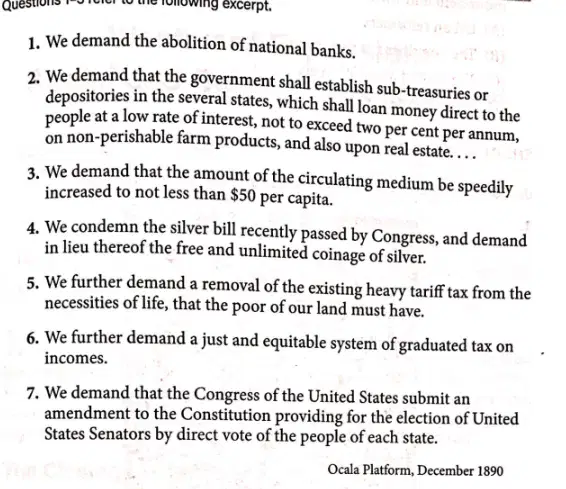
The Ocala Platform was primarily based on the belief that
federal income taxes fell mainly on average working Americans.
large banks had worked together to reduce interest rates on loans.
higher tariffs would help farmers prosper.
increasing the money supply would help farmers who were in debt.
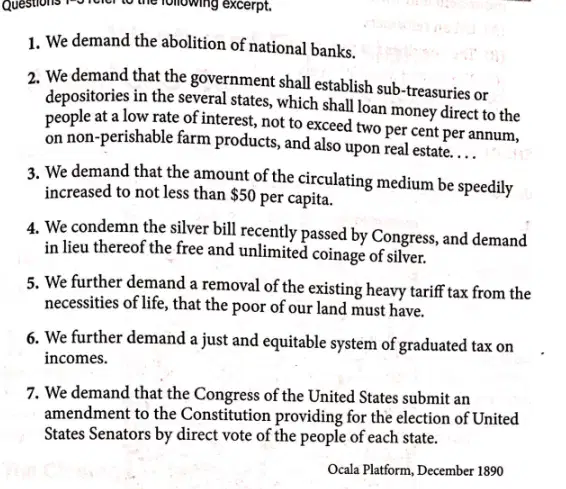
Which statement best explains the reason for the demand for “election of United States Senators by direct vote”?
Labor unions resented how the Senate often supported efforts to break strikes.
Reformers hoped that reforming the U.S. Senate would lead to similar reforms by states.
Residents of states with large populations argued that the Senate did not represent all people equally.
Many voters felt that the Senate had become dominated by powerful business interests.
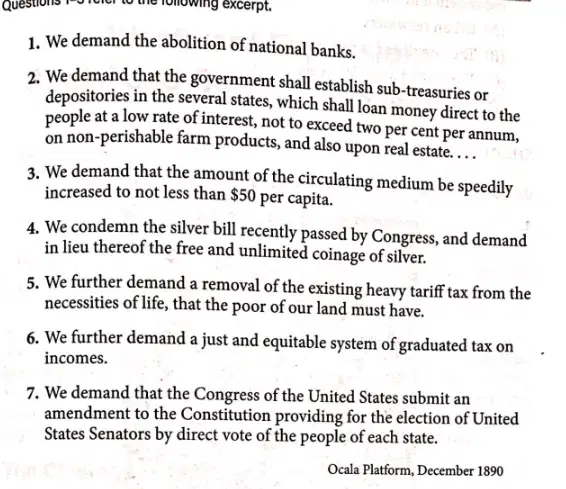
The Ocala Platform proved an important link between the alliance movement and which of the following later groups?
Urban reformers
The Populists
The United Mine Workers
Factory workers
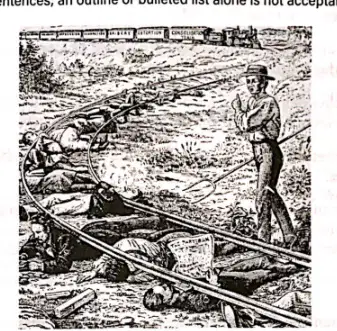
Briefly explain ONE specific historical development that led to the perspective expressed in the image.
Answer (a), (b), and (c). (a) Briefly describe ONE way the mining frontier changed in the period from 1865 to 1898.
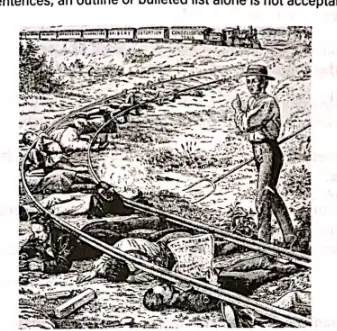
Briefly explain ONE specific example of how farmer movements challenged railroads in the period from 1865 to 1898.
Answer (a), (b), and (c). (b) Briefly describe ONE way the cattle frontier changed in the period from 1865 to 1898.
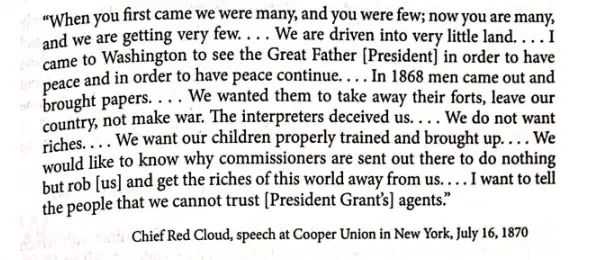
The excerpt best illustrates which of the following issues of that time?
President Grant had instituted policies that protected tribal lands.
Migrants and Native Americans were clashing over tribal lands.
Tribal leaders believed that their growing population would give them more power to negotiate favorable treaties.
Tribal leaders wanted to end the conflicts with White Americans through assimilation.
Answer (a), (b), and (c). (c) Briefly describe ONE way the economics of western farming changed in the period from 1865 to 1898.
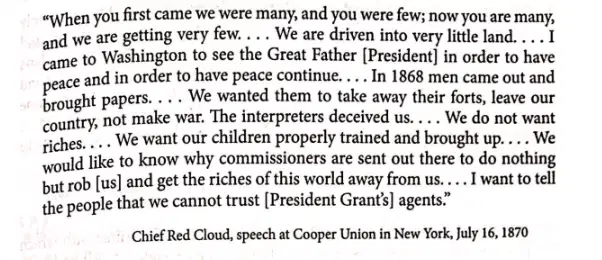
Which of the following best explains the relationship of the United States government and Native American tribes before 1871?
Native tribes were recognized as “nations” within the United States.
Individual Native Americans enjoyed the same equal rights as White U.S. citizens.
Native Americans had no legal status and were treated as foreigners.
The federal government left agreements and treaties up to the states.
Explain three factors that contributed to continuity or change in the "New South" from 1877 to 1898.
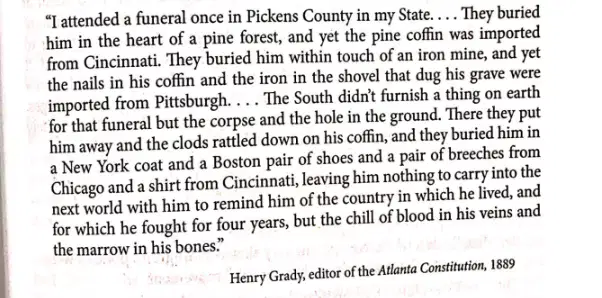
The key idea in the excerpt is that Grady believes
The Civil War damaged the Southern economy
Former Confederate soldiers deserved better treatment
The secession of the Confederacy was justified
The South needed to industrialize
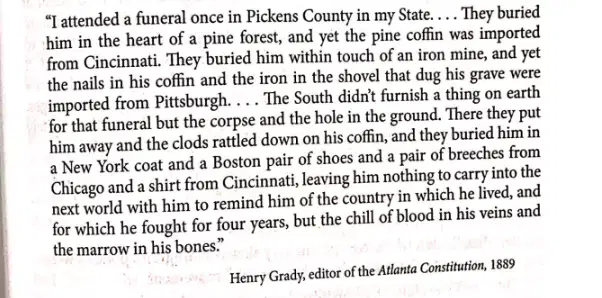
Which of the following best demonstrates a change or condition that reflected Grady’s hopes for the South?
Railroads, textile mills, and steel factories developed.
Formerly enslaved people often became tenant farmers.
Northern investors controlled three-quarters of Southern railroads.
The Southern economy remained mainly tied to agriculture.
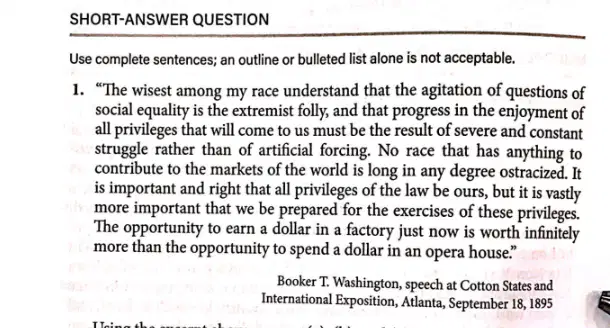
Using the excerpt from Booker T. Washington's speech, answer the following: (a) Briefly describe ONE specific way that Washington’s policies were similar to the goals of the “New South” movement. (b) Briefly explain ONE historical development that resulted from the perspectives presented by Washington. (c) Briefly explain ONE historical development that contributed to the perspective presented by Washington.
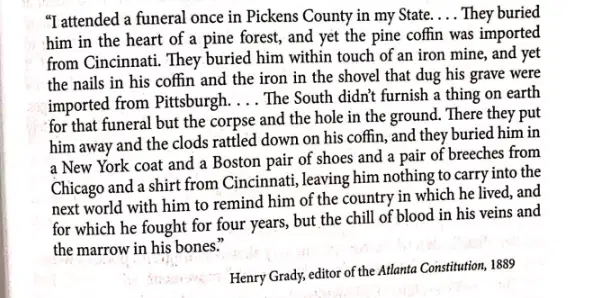
Grady’s comments best express the viewpoint of which group of people?
Southerners who advocated developing a “New South”
Populists who wanted a coalition between White and Black Southerners
Redeemers who wanted to restore pre-Civil War Southern culture
Political leaders who agreed with the decision in Plessy v. Ferguson
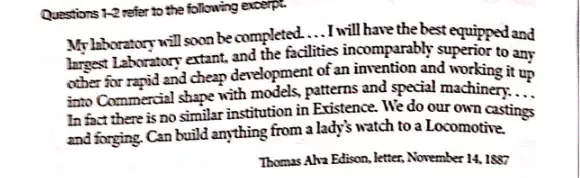
What did Edison mean with the claim that “there is no similar institution in Existence”?
He had created the first factory to mass-produce commercial products.
He had created the first laboratory dedicated to producing inventions.
He had developed the designs for electric-powered streetcars and locomotives.
He had developed marketing practices that promoted a consumer economy.
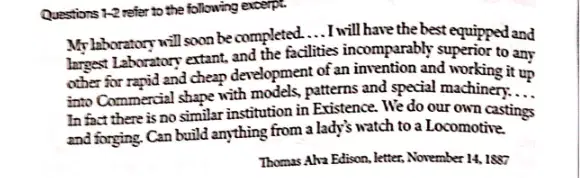
How did the development described in the excerpt cause a lasting change in how science and industry operated?
It showed that large corporations would need to invent new products in order to survive.
It marked the first time an inventor became famous for developing something new.
It started the tradition of individual inventors working on their own.
It promoted the idea that teams of people working together could invent new products profitably.
Briefly explain how ONE innovation caused changes in communications during the period from 1865 to 1898.
Briefly explain how ONE innovation caused changes in the marketing of consumer goods during the period from 1865 to 1898.
Briefly explain how ONE innovation caused changes in the development of cities during the period from 1865 to 1898.
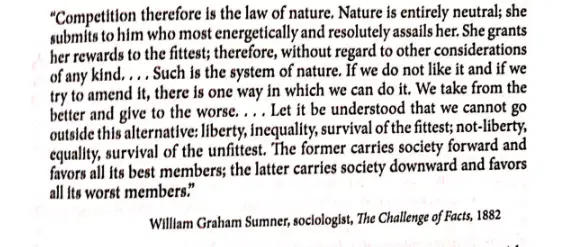
Sumner most clearly expresses ideas associated in the 19th century with
John Locke's description of the social contract in the Second Treatise of Government
Thomas Jefferson's belief about human equality in the Declaration of Independence
Charles Darwin's explanation on why some species survive and others do not in On the Origins of Species
J. Pierpont Morgan's use of interlocking directorates to consolidate ownership among railroads
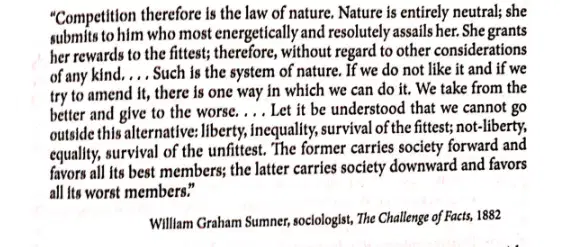
Supporters of the position expressed by Sumner would likely defend
monopolies because they reduced destructive economic competition
laissez-faire capitalism because it reduced business regulations
socialism because it emphasized equality among people
populism because it helped farmers who were poor
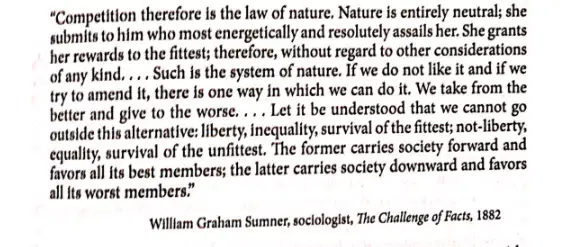
Which of the following developments would be most consistent with the beliefs expressed in the excerpt?
Consolidation of wealth by an elite
Expansion of rights for women
Passage of antitrust legislation
Spread of organized labor
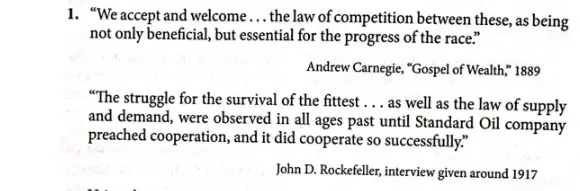
Using the excerpts above, answer (a), (b), and (c). (a) Briefly explain ONE significant difference between Carnegie’s perspective and Rockefeller’s perspective on the role of competition in industrial development. (b) Briefly explain ONE historical event or development from Carnegie’s career that supports his view on competition. (c) Briefly explain ONE historical event or development from Rockefeller’s career that supports his view on competition.
Explain three changes for workers during the period associated with the growth of industrial capitalism from 1865 to 1898.
Answer (a), (b), and (c). (a) Briefly explain ONE specific example of how government promoted the growth of railroads in the United States before 1900. (b) Briefly explain ONE specific example of how the rise of large corporations influenced the U.S. economy from 1865 to 1900. (c) Briefly explain ONE specific text or belief that influenced the United States to follow laissez-faire policies.
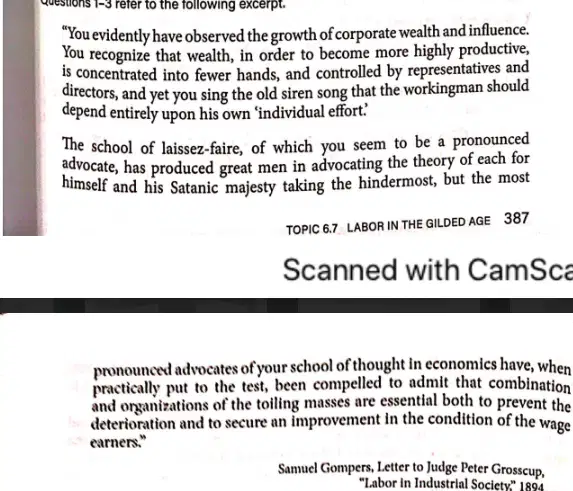
What does the excerpt suggest about the growth of corporate wealth and influence?
It is beneficial for all workers.
It is concentrated into fewer hands.
It is evenly distributed among workers.
It is controlled by the government.
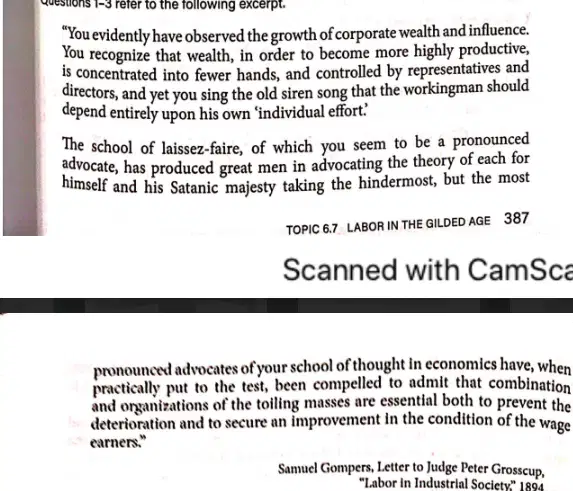
According to the excerpt, what is the role of the workingman in the growth of corporate wealth?
To depend entirely on his own 'individual effort.'
To rely on government support.
To collaborate with corporate directors.
To form unions for better wages.
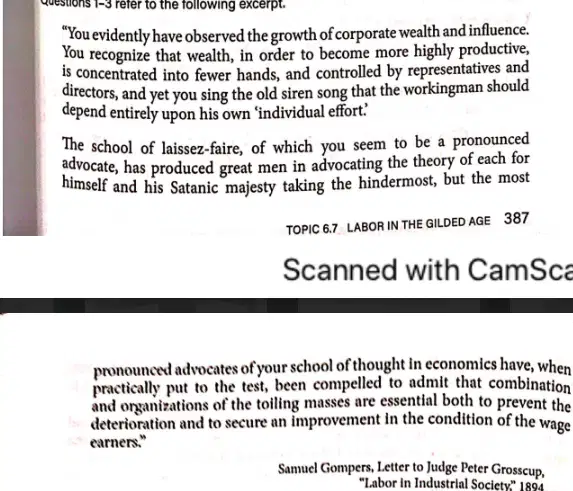
What does the school of laissez-faire advocate according to the excerpt?
Government intervention in the economy.
Each individual for himself.
Corporate control over all industries.
Equal distribution of wealth.
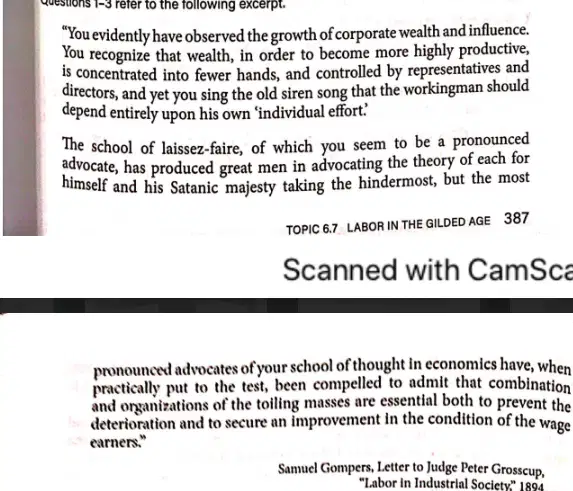
This excerpt was written to most directly support which of the following?
Formation of trusts
The right to organize and bargain collectively
The antitrust movement
Employee ownership of business
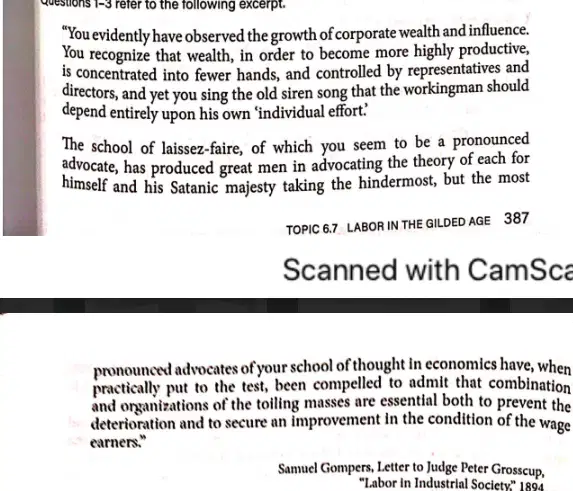
Which of the following best explains why Gompers thought that "organizations of the toiling masses are essential both to prevent the deterioration and to secure an improvement in the condition of the wage earners"?
The school of laissez-faire economics
The rise of the captains of industry
The concentration of corporate wealth and power
The belief in individualism and self-reliance
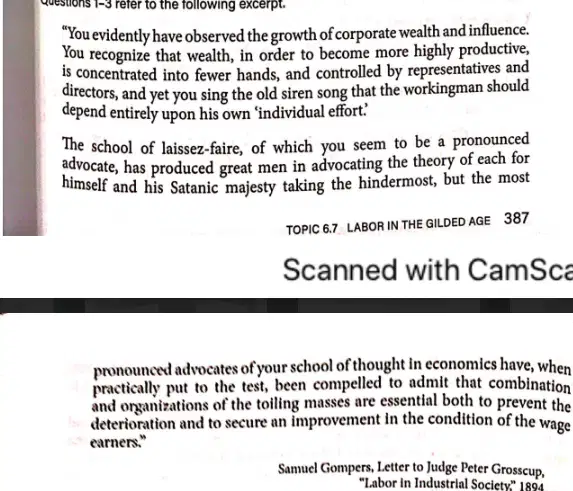
The ideas expressed in this excerpt are most closely allied with
the theory of wages by David Ricardo
the practice of horizontal integration
the establishment of Pullman's company town for workers
the rise of the American Federation of Labor
Briefly explain ONE specific example of the impact of a labor organization during the period from 1865 to 1900.
Briefly explain ONE specific example of a tactic used by employers to defeat the organization of labor unions.
Briefly explain ONE specific example of the role of government in a labor conflict during the period from 1865 to 1900.
Explain how three cultural and economic factors affected migration patterns during the Gilded Age.

In the graph above, the group of immigrants who would be considered "new" immigrants were those from
northern and western Europe
southern and eastern Europe
Latin America
Asia
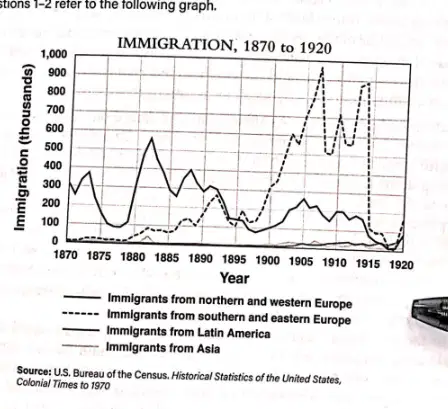
Which of the following best explains why immigration declined in some years between 1870 and 1900?
Increased religious persecution in Europe
Military conflicts in Europe
Economic depressions in the United States
Restrictions on Europeans entering the United States
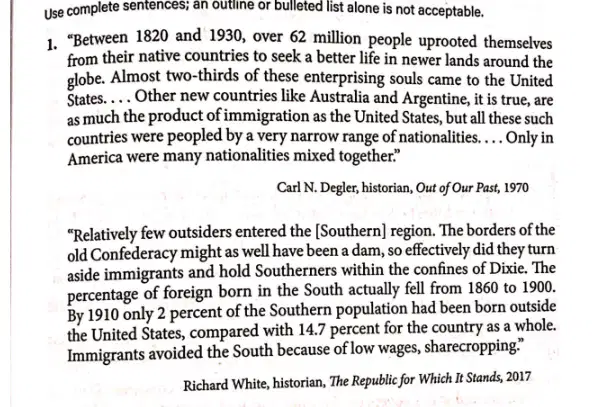
Using the excerpts above, answer (a), (b), and (c). (a) Briefly describe ONE major difference between Degler’s and White’s historical interpretations of immigration to the United States.
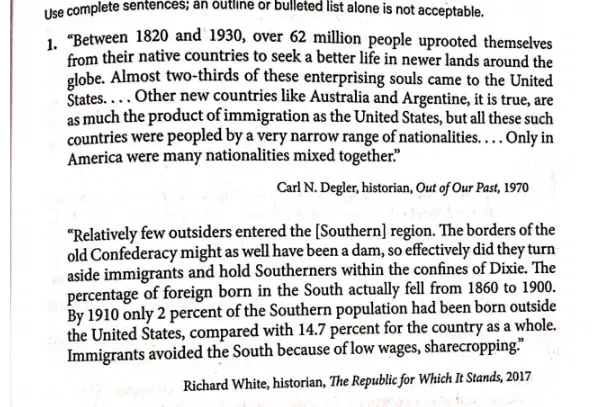
(b) Briefly explain how ONE specific historical event or development in the period 1865 to 1900 that is not explicitly mentioned in the excerpts could be used to support Degler’s interpretation.
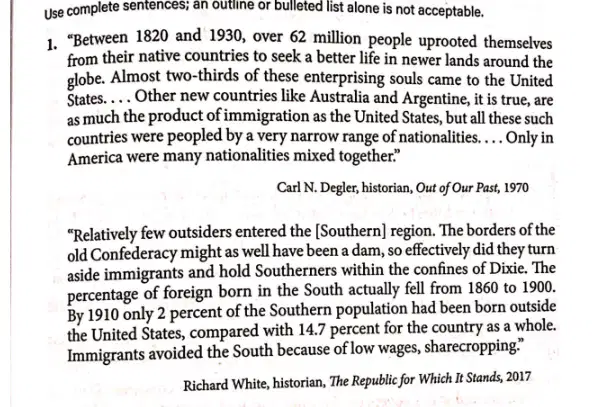
(c) Briefly explain how ONE specific historical event or development in the period 1865 to 1900 that is not explicitly mentioned in the excerpts could be used to support White’s interpretation.
Explain two perspectives on the assimilation of immigrants.
Explain three responses to immigration during the period from 1865 to 1898.
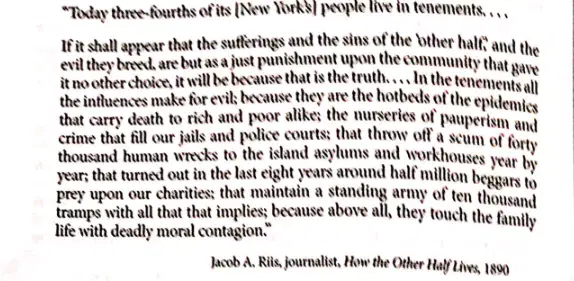
Which phrase best summarizes what Riis considers the cause of the problems he sees?
are but as a just punishment upon the community
In the tenements all the influences make for evil
throw off a scum of forty thousand human wrecks
touch the family life with deadly moral contagion
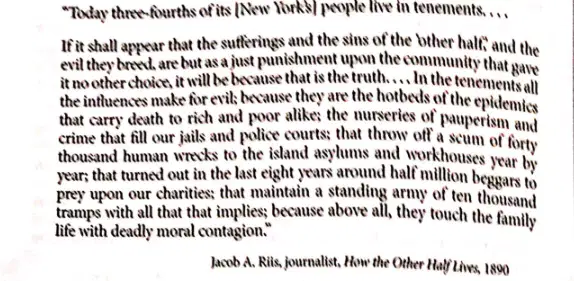
During the late 19th century, which of the following groups used the conditions described by Riis to become powerful?
Religious organizations such as churches and synagogues
Political machines that operated in big cities
Social Darwinists who were influenced by Herbert Spencer
Residents who lived in tenements
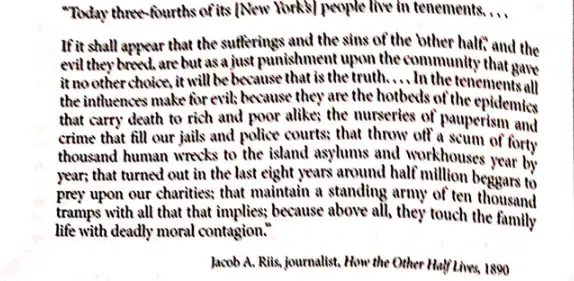
Which group would be most likely to support government intervention to change the housing conditions described by Riis?
Opponents of raising taxes
Advocates of laissez-faire policies
Members of nativist organizations
Workers in the settlement house movement
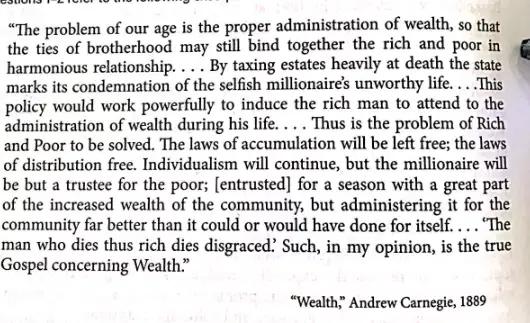
Carnegie’s remarks in the excerpt were most likely in response to
the development of the social sciences
the spread of racial theories about the survival of the fittest
the rise of monopolies in major industries, such as oil and steel
the discontent in society over the increase in economic inequality
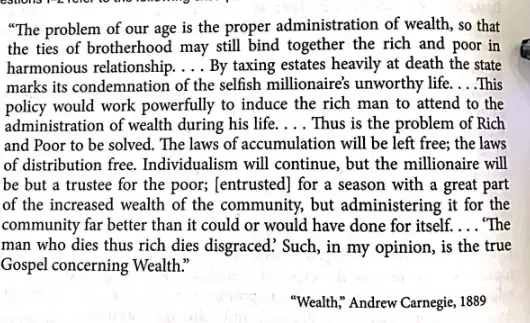
Carnegie was most likely hoping his comments would promote
the passage of a graduated income tax by the government
the religious values that could reform greedy behavior
an increase in large-scale philanthropy to fund civic institutions
an increase in contributions by working people to religious institutions
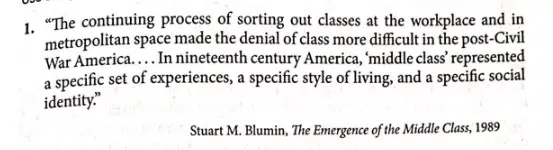
Using the excerpt above, briefly explain ONE specific cause of the process of “sorting out classes at the workplace” that Blumin referred to during the period from 1865 to 1900.
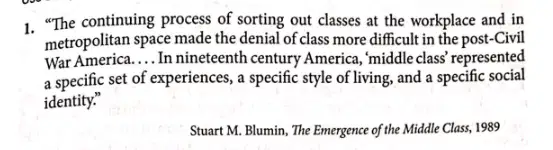
Using the excerpt above, briefly explain ONE specific cause of the development of what Blumin called a “specific social identity” during the period from 1865 to 1900.
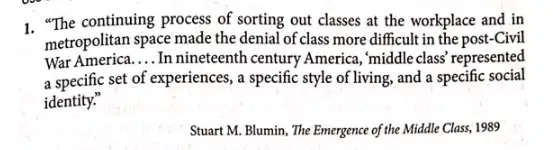
Using the excerpt above, briefly explain ONE specific example of how the changes described by Blumin affected working women during the period from 1865 to 1900.
Briefly explain ONE historical development in education that was influenced by the economic or cultural changes from 1865 to 1898.
Briefly explain ONE way in which urban development was affected by the growth of the middle class during the period from 1865 to 1898.
Briefly explain ONE way in which popular culture was affected by the growth of the middle class during the period from 1865 to 1898.
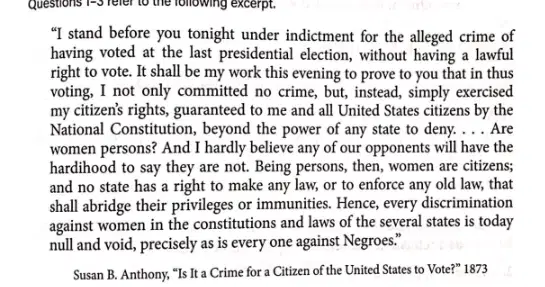
Susan B. Anthony was arrested and fined $100 for casting an illegal vote in the presidential election of 1872. She refused to pay the fine. Her protest was most similar to which of the following?
The dumping of chests of British tea into the Boston Harbor by colonists disguised as American Indians
The jailing of Henry David Thoreau for not paying taxes for what he considered an immoral war
The federal suit to free the enslaved Dred Scott after he resided in a free state
The raid of abolitionists led by John Brown on the federal arsenal at Harpers Ferry
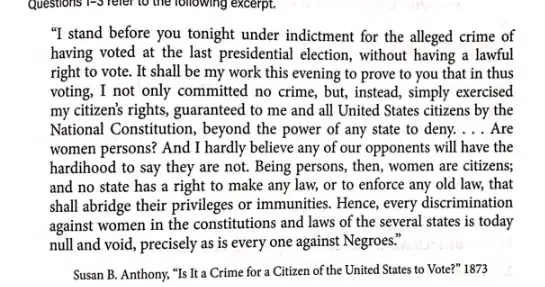
Anthony’s arguments expressed in the excerpt above can best be understood in the context of
The Supreme Court decision in Marbury v. Madison
The proclamation of the Monroe Doctrine
The ratification of the three Reconstruction-era amendments
The strength of the American Protective Association
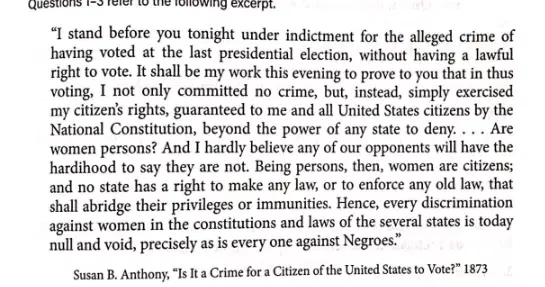
Which of the following best describes why Anthony targeted states in this excerpt?
The United States Constitution generally left the power to states to determine who could vote.
The states kept women in an inferior legal position to men through marriage laws.
The president had vowed to veto any laws passed by Congress designed to protect suffrage for women.
Congress was already shown strong support for a suffrage amendment that included women.
Briefly explain ONE specific response of religious institutions to the urban problems of the Gilded Age.
Briefly explain ONE impact that the urban experience had on family life during the Gilded Age.
Briefly explain ONE reason why temperance gained such strength as a reform movement during the Gilded Age.
Briefly explain ONE effect that social and cultural changes had on American literature in the period from 1865 to 1898.
Briefly explain ONE effect that social and cultural changes had on the visual arts in the period from 1865 to 1898.
Briefly explain ONE effect that economic and urban developments had on architecture in the period from 1865 to 1898.
Explain three examples of changes in the role of the government in the U.S. economy from 1865 to 1898.
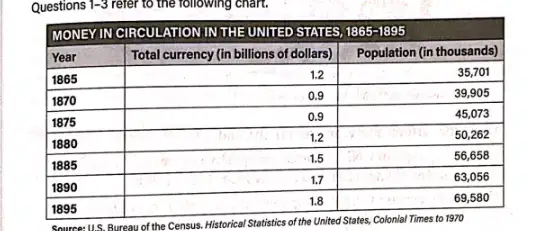
Which of the following most likely explains the change in the amount of currency in circulation between 1865 and 1870?
The decline of gold mining in the United States
The withdrawal of “greenbacks” from circulation
The refusal of Congress to purchase silver for coinage
The increasing poverty of most Americans
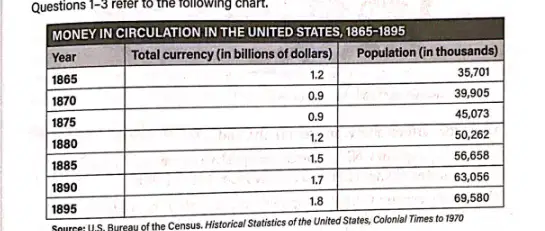
Which group supported the change in the total money supply between 1875 and 1895 but wanted the change to be larger than it was?
Many farmers who were in debt
Many bankers who had loaned money to individuals
Many merchants who had sold goods on credit
Many state governments that were trying to reduce taxes
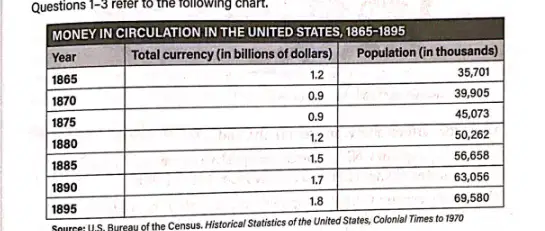
The change in the amount of money in circulation in the 1890s would most likely have made
wages for most workers decrease slightly
prices for most goods decrease slightly
loans slightly easier to repay
tariffs slightly harder to pay
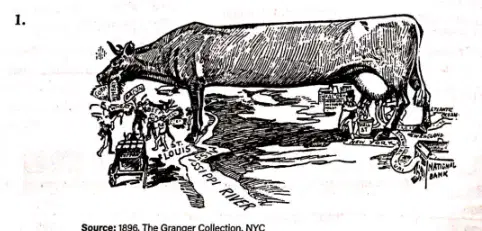
Using the cartoon above, briefly explain ONE historical perspective expressed by the artist about the changes in the economy from 1865 to 1900.
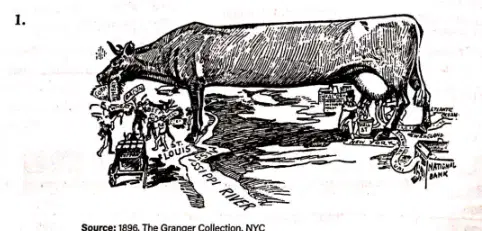
Using the cartoon above, briefly explain ONE development in the period from 1865 to 1900 that supported the perspective expressed by the artist.
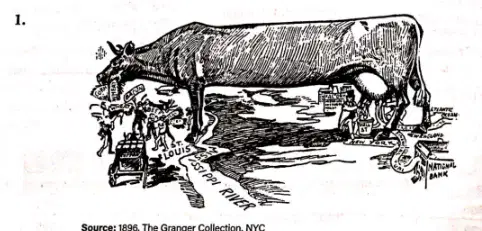
Using the cartoon above, briefly explain ONE development in the period from 1865 to 1900 that challenged the perspective expressed by the artist.
Briefly explain ONE example of a federal government action to promote economic development from 1865 to 1900.
Briefly explain ONE example of a federal government action to regulate business practices from 1865 to 1900.
Briefly explain ONE reason that caused tariff policies to become an important political issue during the period from 1877 to 1900.
Which of the following was the MAIN purpose for cattle drives in the United States during the 19th century?
to bring cattle to markets
to take cattle to safer ranch land
to exchange cattle with other owners
to move cattle away from harsh weather
The major factor in drawing country people off the farms and into the big cities was (LT 6.6)
the development of the skyscraper.
the availability of industrial jobs.
the compact nature of those large communities.
the advent of new housing structures known as dumbbell tenements.
What was one effect of economic growth on cities during the 1800s?
Decrease in city size
Increase in the construction of public parks
Expansion of city infrastructure and housing
Reduction in trade and commerce
How did the layout and infrastructure of cities change as a result of urbanization?
Cities became more spread out with larger agricultural areas
Cities developed more parks and recreational areas
Cities saw the development of dense industrial and residential areas
There was a decrease in the construction of roads and bridges
The Pullman Strike (1894) resulted in the first instance of… (LT 6.9)
A) management recognition of the right of workers to organize and strike.
B) violence during a labor strike.
C) a united front between urban workers and agrarian Populists.
D) government use of a federal court injunction to break a strike.
1. The Homestead Act (1862) assumed that public land should be administered in such a way as to... (LT 6.1)
A) raise government revenue.
B) promote frontier settlement.
C) conserve natural resources.
D) favor large-scale “bonanza” farms.
2. The national government helped to finance transcontinental railroad construction in the late nineteenth century by providing
railroad corporations with (LT 6.1)
A) cash grants from new taxes.
B) land grants.
C) reduced prices for iron and steel.
D) aid for construction of railroad stations.
3. The Morrill Act of 1862 (LT 6.1)
A) granted public lands to states to support higher education.
B) required compulsory school attendance through high school.
C) established the modern American research university.
D) mandated racial integration in public schools.
4. The Dawes Severalty Act (1887) did all of the following EXCEPT (LT 6.2)
A) dissolved many tribes as legal entities.
B) tried to make rugged individualists of the Indians.
C) promoted Americanization of Native Americans.
D) increased tribal ownership of land.
In the 1896 case Plessy v. Ferguson, the Supreme Court ruled that (LT 6.3)
A) African Americans could be denied the right to vote.
B) segregation was unconstitutional.
C) “separate but equal” facilities were legally permissible
D) the 14th Amendment did not apply to African Americans
At the end of Reconstruction, Southern whites disenfranchised African Americans using all the following EXCEPT: (LT 6.3)
A) literacy requirements.
B) poll taxes.
C) grandfather clauses.
D) the use of federal troops
As a leader of the African American community, Booker T. Washington… (LT 6.4)
A) helped to found the National Association for the Advancement of Colored People.
B) advocated social equality.
C) discovered hundreds of uses for the peanut.
D) promoted black self-help but did not challenge segregation.
That a “talented tenth” should lead the race to full social and political equality with whites was the view of ...? (LT 6.4)
Eugene Debs
Booker T. Washington
W.E.B. DuBois
Andrew Carnegie
The first great industrial trusts, the ____________ was organized through a principle of “horizontal integration” that ruthlessly incorporated or destroyed competitors. (LT 6.5)
American Railway Trust
American Steel Company
Standard Oil Company
Unified Meat Industry Trust
All the following are true of the developments of the Gilded Age EXCEPT: (LT 6.5)
patents and corporations allowed businesses to expand by offering legal protections to business owners
the invention of Thomas Edison replaced gas lights and kerosene lamps
the invention of Alexander Graham Bell made it possible to communicate without knowledge of mores code
the government attempted to regulate monopolies to facilitate economic growth
The major factor in drawing country people off the farms and into the big cities was (LT 6.6)
the development of the skyscraper.
the availability of industrial jobs.
the compact nature of those large communities.
the advent of new housing structures known as dumbbell tenements.
Name the businessman who bought out Andrew Carnegie and organized the United States Steel Corporation.(LT 6.7)
JP Morgan
John Rockefeller
Leland Stanford
Cornelius Vanderbilt
The American Protective Association... (LT 6.8)
A) preached the social gospel that churches were obligated to protect New Immigrants.
B) was led for many years by Florence Kelley and Jane Addams.
C) supported immigration restrictions.
D) established settlement houses in several major cities in order to aid New Immigrants.
Most “new” immigrants in the late 19th century... (LT 6.8)
A) eventually returned to their country of origin.
B) tried to preserve their Old Country culture in America.
C) were subjected to stringent immigration restrictions.
D) quickly assimilated into the mainstream of American life.
The Sherman Anti-Trust Act, although aimed at monopolies, was at first primarily used to curb the power of whom? (LT 6.9)
A) manufacturing corporations
B) State legislatures
C) labor unions
D) railroad corporations
Labor unrest in the 1870s and 1880s resulted in... (LT 6.9)
A) Congress passing legislation supporting the formation of unions.
B) a ban on Irish immigration.
C) the use of federal troops to keep peace during strikes.
D) many associating labor unions with radicalism.
All of the following are true about the Homestead Strike (1892) EXCEPT: (LT 6.9)
A) Company official Henry Frick negotiated with the strikers to get them back to work.
B) Company officials called in armed Pinkerton detectives to crush the strike.
C) The state militia sent troops to break up the strike.
D) Workers were angry over pay cuts.
The Pullman Strike (1894) resulted in the first instance of… (LT 6.9)
A) management recognition of the right of workers to organize and strike.
B) violence during a labor strike.
C) a united front between urban workers and agrarian Populists.
D) government use of a federal court injunction to break a strike.
During the 19th century, the National American Woman Suffrage Association (NAWSA)... (LT 6.10)
A) limited its membership to whites.
B) conducted an integrated campaign for equal rights.
C) abandoned the goals of Susan Anthony and Elizabeth Cady Stanton
D) elected Ida B. Wells as its president.
The Farmers' Alliance was formed to... (LT 6.12)
A) provide help to northern farmers.
B) provide opportunities for higher education.
C) end the rise of tenant farming.
D) take action to break the strangling grip of the railroads.
Who invented the telegraph, which significantly impacted communication in the 19th century?
Alexander Graham Bell
Thomas Edison
Samuel Morse
Nikola Tesla
How were indigenous people of the Great Plain affected by the Transcontinental Railroad?
Indigenous culture was further protected by American expansion
The population of Buffalo thrived and grew
The cross cultural exchange left Native people in a better condition
The Railroad brought conflict and cultural changes to the indigenous people
Which group would be involved in the herding of cattle within the Great Plains?
New England Farmers
Vaqueros / Cowboys
The Lakota
Mining town residents
Which law encouraged farming and settlement of the Great Plains?
The Treaty of Fort Laramie
The Civil Rights Act of 1866
Homestead Act of 1862
Anti-Trust Laws
What was the purpose of the Granger Oragnization?
To protect farmers from Trust & Railroad companies
To help Trust Companies build wealth
To give Plains Native Americans assistance
To help labor unions organize themselves
Select all the statements that are true about The People's Party
Called for political reform
Also known as the Populist Party
Created to limit the growth of corporate power
Worked to gain rights for the people
Select the statement that best describes the Dawes Act
It allowed whites and blacks to remain separate but equal
It sought to assimilate Native Americans to American culture
It gave more power to women in the workforce
The act was created with the purpose of welcoming immigrants to America
Select the statement that best describes the Dawes Act
It allowed whites and blacks to remain separate but equal
It sought to assimilate Native Americans to American culture
It gave more power to women in the workforce
The act was created with the purpose of welcoming immigrants to America
The Party that attempted to create a coalition alongside democrats that also were strong advocates for workers' rights went by what name?
Know-Nothings
Redeemers
Populists
Dixiecrats
Which court case established the legal precent of "separate but equal?"
Worcester v. Georgia
Lochner v. New York
Plessy v. Ferguson
McCulloch v. Maryland
What was the term commonly used to describe Capitalists like Andrew Carnegie and John D. Rockefeller?
Nativists
Muckrakers
Benevolent barons
Robber barons
At the end of the nineteenth century, the desire of American business to control supplies and processes of raw materials and shipping led to
The 1896 Supreme Court decision Plessy v. Ferguson did which of the following?
Upheld segregated railroad facilities.
Declared civil rights legislation unconstitutional.
Upheld literacy testing as a condition of voting in federal elections.
Outlawed segregation in public schools.
Select the statements that describe the Gospel of Wealth
A way for wealthy people to justify their wealth
Urged wealthy people to donate money and give back to the community
Promoted fair wages for everyone
Urged wealthy Americans to hoard their wealth
All the following are true of the developments of the Gilded Age EXCEPT: (LT 6.5)
patents and corporations allowed businesses to expand by offering legal protections to business owners
the invention of Thomas Edison replaced gas lights and kerosene lamps
the invention of Alexander Graham Bell made it possible to communicate without knowledge of mores code
the government attempted to regulate monopolies to facilitate economic growth

Thomas Nast’s political cartoon against Boos William Marcy Tweed was a forerunner of which journalistic movement that exposed the abuses and corruption of both the politics and industrialists of the Gilded Age?
Anti-Masonic
Mugwuumps
Social Darwinism
Muckrakers
Women working in settlement houses such as Hull House initially sought to help
formerly enslaved men and women adjust to life after slavery.
immigrants adapt to American customs and language.
farmers fight unfair banking practices.
Native Americans resist encroachment on their lands.
Which of the following was a difference between the immigration from 1865 to 1895 and
immigration in the 1840s and 1850s?
More immigrants in the 1840s and 1850s sought factory work than did the immigrants who arrived
between 1865 and 1895.
More immigrants in the 1840s and 1850s arrived with cultural practices similar to those of Americans
than did the immigrants who arrived between 1865 and 1985.
Immigration was a main source of agricultural labor in the Southern states during the 1840s and 1850s,
but it was not between 1865 and 1895.
Immigration from China was greater than immigration from central Europe in the 1840s and 1850s as
compared to the period between 1865 and 1895.
The greatest economic consequence of the transcontinental railroad network was that it
enabled farmers to make a highly profitable living by shipping their goods across the nation.
enabled people from farms and small towns to visit the big cities.
united the nation into a single integrated national market.
developed a skilled industrial workforce.
What does the Wabash, St. Louis & Pacific Railroad Company v. Illinois case relate to?
Labor laws
State taxation powers
Environmental regulations
Interstate commerce
What does Vertical Integration refer to?
A company spreading out its investments among various sectors
A company controlling all phases of production from raw materials to finished goods
A merger between companies in different industries
A partnership between companies for a specific project
What is Horizontal Integration?
Acquiring a company in the same industry
Diversifying a company's product line
Splitting a company into smaller units
Expanding a company's production to different geographical locations
What is a Business Trust?
A form of business organization
A type of investment fund
A government grant
A charity organization
Which company was famously broken up due to the Sherman Anti-Trust Act?
Microsoft
U.S. Steel Corporation
Standard Oil Company
General Electric
What did the Bessemer Process significantly improve?
The production of cotton
The efficiency of steam engines
The extraction of oil
The manufacturing of steel
Why were some farmers forced into tenant farming in the late nineteenth century?
A. The supply of cotton exceeded demand, causing prices to fall.
B. The U.S. required farmers to grow the same types of cotton.
C. The demand for cotton exceeded supply, causing prices to increase.
D. The Texas Congress began regulating cotton farms.

