wayground logo

Free Printable Worksheets

Font size

S
M
L
XL
Worksheets

Final Review Study guide- unit 1-3

Total questions: 130

Worksheet time: 1hrs 18mins

Name
Class
Date
1.
People who lived in the New England colonies most likely had which of the following jobs?
a)
Farmin
b)
Raising livestock
c)
Ship building and fishing
2.
What was the climate like for the people of the New England colonies?
a)
Harsh winters and mild summers
b)
Warm, humid summers and mild winters.
c)
Cold winters and hot summers
3.
Which colonial region was settled by Puritans and Pilgrims seeking religious freedom?
a)
New England
b)
Southern
c)
Mid-Atlantic
4.
Which colonial region was settled by people with many different cultural and religious backgrounds?
a)
New England
b)
Mid-Atlantic
c)
Southern
5.
Which colonial region contained rocky soil and a jagged coastline?
a)
New England
b)
Mid-Atlantic
c)
Southern
6.
Which colonists were farmers and plantation owners who grew cotton and tobacco?
a)
New England
b)
Southern
c)
Mid-Atlantic
7.
Why were the Mid-Atlantic colonies nicknamed "The Bread Basket?"
a)
They grew many types of grain.
b)
Making bread was a great economic opportunity.
c)
They ate bread with every meal.
8.
The soil in the Mid-Atlantic colonies was _____
a)
rocky and not good for farming
b)
fertile and perfect for farming
c)
dry and sandy
9.
Which colonists were farmers and plantation owners who grew cotton and tobacco?
a)
New England
b)
Southern
c)
Middle
d)
Backcountry
10.
The people who settled in the New England colonies were looking for religious freedom
a)
True
b)
False
11.
Which region relied mostly on cash crops to make their money?
a)
New England
b)
Middle Colonies
c)
Southern Colonies
d)
Backcountry
12.
The first permanent English settlement in North America was
a)
Werowocomoco
b)
Yorktown
c)
Richmond
d)
Jamestown
13.
How was the agreement which bonded Pilgrims called?
a)
Mayflower Compact
b)
Declaration of Independence
c)
Napoleonic Code
d)
Geneva Conventions
14.
1st representative governing body in the American colonies.
a)
English Bill of Rights
b)
Articles of Confederation
c)
Virginia House of Burgesses
d)
Congress
15.
Because I was born into _______, I was scared I might be sold and never see my family again.
a)
artisan
b)
slavery
c)
merchant
16.
At my store, colonists could buy items such as tea, spices, and candy.  I am a ______.
a)
geography
b)
merchant
c)
artisan
17.
An area of land that is ruled by another country such as Jamestown is called a _____.
a)
indentured servant
b)
slavery
c)
colony
18.
I worked for many years to learn how to make shoes and boots for the colonists.  I am an ________.
a)
artisian
b)
georgraphy
c)
slave
19.
Jack was a shipbuilder living in Massachusetts.  He lived in a _______ colony.
a)
New England
b)
Royal
c)
Southern 
20.
Which of the following choices was not a reason that England started a colony in Jamestown?
a)
Increase wealth and power
b)
Find raw materials
c)
Trade with other countries
d)
To get a new King
21.
Which of the following is not a reason that the settlers chose the site for the Jamestown settlement?
a)
It had swamps
b)
Fresh supply of water
c)
Deep harbor to dock ships
d)
Easy to defend against attack
22.
Which of the following was not a hardship the settlers faced?
a)
Not enough safe drinking water
b)
Not enough survival skills
c)
The indians were nice to them.
d)
A harsh winter with little food
23.
What was the name of the indian girl who told the indians they should get along with settlers and help them survive?
a)
Belle
b)
Ariel
c)
Pocahontas
d)
Rapunzel
24.
Jamestown was located on a peninsula in ...
a)
Virginia
b)
North Carolina
c)
Florida
d)
New York
25.

What is the Mayflower Compact?

a)

person who immigrates because of religious reasons

b)

An English ship that brought the first pilgrims to America

c)

a document signed in 1620 that made the rules of Plymouth

d)

a person who is owned by another person and is forced to do whatever their owner tells them

26.

How long did indentured servants usually work for?

a)

5-9 years

b)

2-6 months

c)

4-7 months

d)

4-7 years

27.

_________ was an English solider who helped establish Jamestown

a)

John White

b)

William Bradford

c)

John Smith

d)

Pocahontas

28.

_______was an English ship that brought the first pilgrims to America

a)

The Pilgrim's Ship

b)

The Mayflower

c)

Puritans Boat

d)

None of the Above

29.

The first representative assembly in the European colonies was called The House of______.

a)

Slaves

b)

Jamestown

c)

Burgess

d)

Europe

30.

______is a_______who cultivated his own farm

a)

Yeoman,Farmer

b)

Martyr,Farmer

c)

Tenet,Farmer

d)

Massacre,Farmer

31.

When did the French and Indian War begin?

a)

1754

b)

1762

c)

1776

d)

1750

32.

Which is not another name for the French and Indian War

a)

The war of Conquest

b)

The Revolutionary War

c)

The Seven Years War

33.

Which two countries thought that they had control over the ohio river?

a)

Britain and Spain

b)

France and Portugal

c)

America and Britain

d)

France and Britain

34.

What was the name of Benjamin Franklins proposed plan to unite the colonies?

a)

Albany Plan

b)

Charleston Plan

c)

Virginia Plan

d)

Pennsylvania Plan

35.

which Country had to give up most of their land after losing the French and Indian War?

a)

Britain

b)

France

c)

America

36.

What announcement made by George the III, stated that all lands west of the Appalachian mountains belonged to the Native Americans?

a)

Stamp Act

b)

Treaty of Paris

c)

Sugar Act

d)

Proclamation of 1763

37.

What act, passed in 1764, was supposed to raise money for the British that were in debt?

a)

The Stamp Act

b)

The Sugar Act

c)

Treaty of Paris

d)

Proclamation of 1763

38.

What did Great Britain gain in the Treaty of Paris?

a)

Land East of the Mississippi River, Florida and Canada

b)

Land West of the Mississippi River but not Florida or Canada

c)

Just Florida

d)

New Orleans

39.
Who was Jonathan Edwards?
a)
a former actor who would shout the word of God
b)
a minister who wrote "Sinners in the Hands of an Angry God" 
c)
a minister who criticized the Great Awakening
d)
A minister who was shunned from town for his beliefs
40.
Who was George Whitfield?
a)
a minitser who as shunned from town for his beliefs
b)
a minister who wrote "Sinners in the Hands of an Angry God"
c)
a former actor who would shout the word of God
d)
A minister who critized the Great Awakening
41.
How did the Great Awakening lead up to the Revolutionary War?
a)
people revolted against Whitfield and Edwards, leading to the Revolution
b)
the Great Awakening convinced people that they should go to war
c)
people started to communicate their beliefs and defend them
d)
people in the colonies began taxing one another, rather than being taxed by Britain
42.
How did the Great Awakening unify people in the colonies?
a)
It was the first event that all the colonies could share
b)
it created tension between Britain and the coloines
c)
it showed the differences in social class in the colonies
43.
What were two results of the Great Awakening?
a)
religious tolerance and acceptance
b)
better jobs and trade routes
c)
better trade routes and acceptance
d)
religious tollerance and better jobs
44.
Followers of Whitfield and Edwards became known as _____________.
a)
Old Dawn preachers
b)
New Light preachers
c)
New Dawn preachers
45.
George Whitefield and Jonathan Edwards gave sermons about
a)
the existence of many gods.
b)
helplessness and sinfulness of humankind.
c)
importance of government.
d)
importance of other religions.
46.
Montesquieu believed in
a)
limiting natural laws
b)
separation of powers
c)
absolute monarchies
d)
freedom of speech
47.
"...all men are created equal, they are endowed by their Creator with certain unalienable rights, among these are life, liberty, and the pursuit of happiness
These ideas are based mostly on the ideas of
a)
George Washington
b)
John Locke
c)
George Whitefield
d)
John Smith
48.
What was the name of the British king during the American Revolution?
a)
Charles III
b)
George III
c)
William III
d)
James III
49.
Who was the major author of the Declaration of Independence?
a)
Benjamin Franklin
b)
John Adams
c)
Thomas Jefferson
d)
Patrick Henry
50.
This American victory was the turning point in the war.
a)
Saratoga
b)
Yorktown
c)
Bunker Hill
d)
Lexington and Concord
51.
Surrounded by French and Continental armies, a large British army surrendered here.
a)
Saratoga
b)
Yorktown
c)
Bunker Hill
d)
Lexington and Concord
52.
This member of the Continental Congress helped gain French support for American independence.
a)
Thomas Jefferson
b)
Benjamin Franklin
c)
Patrick Henry
d)
John Adams
53.
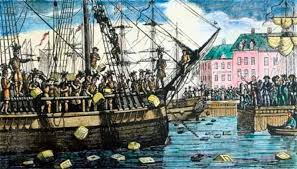
What event is depicted in this image?
a)
Boston Massacre
b)
Boston Tea Party
c)
Battle of Bunker Hill
d)
Lexington and Concord
54.
This patriot made a daring ride to warn colonists that British soldiers were approaching.
a)
Patrick Henry
b)
Paul Revere
c)
Phillis Wheatley
d)
Samuel Adams
55.
Samuel Adams and Paul Revere led members of the Sons of Liberty in this protest against taxes.
a)
First Continental Congress
b)
Boston Massacre
c)
Boston Tea Party
d)
Stamp Act Congress
56.
Of the following events, which happened first? 
a)
Saratoga
b)
Yorktown
c)
Declaration of Independence
d)
Treaty of Paris of 1783
57.
Of the following events, which happened last?
a)
First Continental Congress
b)
Boston Massacre
c)
Boston Tea Party
d)
Stamp Act
58.
What event is depicted in this image?
a)
Boston Massacre
b)
Saratoga
c)
Lexington and Concord
d)
Yorktown
59.
Which one of these is not an advantage that helped the American patriots defeat Great Britain.
a)
defense of their own land, principles and beliefs
b)
support from France
c)
superior numbers of soldiers and greater experience
d)
strong leadership from men like George Washington
60.
The U.S. was founded on July 4, 1776, by the approval of this document.
a)
the Treaty of Paris
b)
the Constitution
c)
the Declaration of Independence
d)
the Virginia Charter
61.
The event illustrated happened before which of the following?
a)
First Continental Congress
b)
Lexington and Concord
c)
Saratoga
d)
Boston Tea Party
62.
Which of the following events occurred before the event illustrated?
a)
First Continental Congress
b)
Stamp Act
c)
Declaration of Independence
d)
Boston Tea Party
63.
The location of what event is shown on this map?
a)
Lexington and Concord
b)
First Continental Congress
c)
Saratoga
d)
Yorktown
64.
This was a tax on molasses and sugar to reduce smuggling.
a)
Stamp Act
b)
Sugar Act
c)
Townshend Act
d)
Tea Act
65.
This was a tax on all printed materials in the 13 Colonies.
a)
Stamp Act
b)
Sugar Act
c)
Tea Act
d)
Townshend Act
66.
Finish this American Colonist Motto, "No Taxation without..."
a)
Transportation
b)
Relaxation
c)
Representation
d)
Sensation
67.
What was this poster's meaning?
a)
The Colonies needed to be united
b)
Serpents can grow back together
c)
Colonies need to be independent
d)
Ben Franklin didn't know why he made this
68.
Why were the American Colonist taxed after the French and Indian War?
a)
Britain was in debt and needed money
b)
That was the agreement with the Native Americans
c)
They made too much money
d)
Townshend Acts
69.
This event broke tensions between the colonist and the British troops where shots were fired. Crispus Attucks was the first to be killed.
a)
Lexington and Concord
b)
Boston Tea Party
c)
Boston Massacre
d)
Bloody Valentine
70.
How did the colonist protest against the tea tax?
a)
Dressed up like Native Americans
b)
Boston Massacre
c)
Dumped tea into Boston harbor
d)
Didn't pay the tax on the East India Tea
71.
Which was the punishment for the Boston Tea Party?
a)
Intolerable Acts
b)
Sugar Acts
c)
Quartering Acts
d)
Stamp Acts
72.
The First Continental Congress produced...
a)
plantation systems
b)
colonial militias
c)
Continental Army
d)
Declaration of Independence
73.
This type of American Colonist was in support of the British parliament.
a)
Patriot
b)
Loyalist
c)
Yes man
d)
Neutral
74.
Early revolutionary battle where 1,000 British troops died and realized the American Colonists were tougher than they though.
a)
Battle of Bunker Hill
b)
Lexington and Concord
c)
Battle of Saratoga
d)
Battle of Yorktown
75.
The Second Continental Congress addressed the steps to the colonies governing themselves and the creation of what military group?
a)
Colonial militias
b)
Marines
c)
Continental Army
d)
Navy
76.
Who was the first choice to command the Continental Army?
a)
Thomas Jefferson
b)
Benjamin Franklin
c)
Thomas Paine
d)
George Washington
77.
This type of colonist was ready for rebellion and the fight for independence.
a)
Loyalist
b)
Patriot
c)
Neutral
d)
British 
78.
Colonists were forbidden to settle west of the Appalachian Mountains.
a)
Proclamation line of 1763
b)
Proclamation boundary
c)
Manifest Destiny
d)
Borderlands
79.
Which phrase became popular after passage of the Stamp Act?
a)
“The rights of Englishmen”
b)
“Give me liberty or give me death”
c)
“Life, liberty, and the pursuit of happiness”
d)
“No taxation without representation“
80.
Which act was passed as a result of the Boston Tea Party?
a)
Stamp Act
b)
Quartering Act
c)
Intolerable Acts
d)
Outrageous Acts
81.
What does Quartering mean?
a)
To allow troops to stay in your home
b)
Hitting someone with a quarter
c)
To give someone a quarter
d)
Giving a quarter of your earnings to Britain
82.
To refuse to buy goods from someone as a form of protest . . .
a)
occupy
b)
boycott
c)
damage
d)
repeal
83.
Given that only 5 people died in the Boston Massacre, why was it labeled a massacre?
a)
 British commanders ordered troops to shoot into a rioting crowd in effort to restore order
b)
the victims were innocent bystanders who were caught in the barrage of gunfire
c)
 the victims had done little to provoke the confrontational and hostile British troops
d)
Boston radicals used it as propaganda to take advantage of the heightened tensions 
84.
What group was created as a response to the Stamp Act?
a)
Sons of Liberty
b)
The Patriots
c)
The Red Coats
d)
The Loyalists
85.
Why did King George III tax the colonists so heavily?
a)
He hated the colonist
b)
He wanted more money for himself
c)
The national debt increase from the French and Indian War
d)
To make money for the colonies
86.
The Olive Branch Petition was written as a last attempt at …
a)
Freedom 
b)
Peace 
c)
Loyalty 
d)
Rebellion 
87.
All colonies were represented at the First Continental Congress EXCEPT -
a)
Pennsylvania
b)
North Carolina
c)
Georgia
d)
South Carolina
88.

Which man's "discovery" of Central America in 1492 led to an increase in European exploration of the world?

a)

Marco Polo

b)

Hernando Cortes

c)

Christopher Columbus

d)

Juan Ponce de Leon

89.

In the American Revolution, the American colonists were at odds with which country?

a)

France

b)

Britain

c)

Spain

d)

Portugal

90.

Which two countries stepped in towards the end of the American Revolution to assist the colonists in defeating the British?

a)

Portugal and Italy

b)

France and Spain

c)

Scotland and Australia

91.
Under the Articles of Confederation, the government consisted of _______________ branch of government.
a)
3
b)
2
c)
1
d)
4
92.
Under the Articles of Confederation Congress could only pass a law if ____________ out 13 states agreed. 
a)
13
b)
8
c)
9
d)
10
93.
In order to change (amend) the Articles of Confederation,  __________ out of 13 states had to agree. 
a)
9
b)
10
c)
13
d)
15
94.
Under the Articles of Confederation, America used a national currency (money)
a)
True
b)
False
95.
Under the Articles of Confederation, Congress could regulate trade between the states.
a)
true
b)
false
96.
The Supreme Court under the Articles of Confederation was made up of 9 Justices.
a)
True
b)
False
97.
Under the Articles of Confederation, each state got __________ vote. 
a)
b)
2
c)
1
d)
5
98.
The Articles of Confederation created a _________________ type of government.
a)
strong
b)
average
c)
weak
d)
federal
99.
One weakness of the Articles Of Confederation was that it lacked which 2 branches of government?
a)
Legislative & Executive
b)
Executive & Judicial
c)
Judicial & Legislative
d)
Executive & Oak
100.

Which strong feature of the Articles of Confederation created a method for western territories to become states?

a)

The ability to sign peace treaties

b)

Shays' Rebellion

c)

Northwest Ordinance

d)

60,000 Ordinance

101.
In the Articles of Confederation, where was most of the government power placed?
a)
The States
b)
The National Government
c)
The Continental Congress
d)
The Legislative Branch
102.
Why was the U.S. Army so weak under the Articles of Confederation?
a)
There was only 1 branch of government
b)
States could refuse to provide soldiers
c)
The nation had no common currency
d)
All of the above
103.
What did Shays' Rebellion help Americans realize they needed?
a)
A strong national government
b)
A stronger militia
c)
A common currency
d)
The ability to sign peace treaties
104.
Which of the following demonstrated 1 of the strengths of the Articles of Confederation?
a)
Shays' Rebellion
b)
The establishment of the U.S. dollar
c)
The signing of the Treaty of Paris (1783)
d)
A system of taxation
105.
How many states needed to agree to revise the Articles of Confederation?
a)
3/4
b)
13
c)
2/3
d)
12
106.
Which of the following BEST describes the Articles of Confederation?
a)
A Constitution established after the American Revolution
b)
A Declaration of Independence
c)
The 1st Constitution of the U.S.
d)
A strong form of government
107.
Which of the following BEST describes the Articles of Confederation?
a)
A Constitution established after the American Revolution
b)
A Declaration of Independence
c)
The 1st Constitution of the U.S.
d)
A strong form of government
108.

What was the job of the 1 branch of government in the Articles Of Confederation?

a)

Enforce laws

b)

Make laws

c)

Interpret whether a law is Constitutional

d)

Promote westward expansion

109.

Who participated in Shays' Rebellion?

a)

Poor farmers who were Continental Army soldiers

b)

A group of brothers named Shays

c)

Massachusetts militia men

d)

Loyalists

110.
What is the name of the first written plan of government in America?
a)
Constitution
b)
Treaty of Paris
c)
Declaration of Independence
d)
Articles of Confederation
111.
Americans were afraid that a __?__ would lead to tyranny, or oppressive rule.
a)
strong state government
b)
weak government
c)
strong central government
d)
legslature
112.
Under the Articles of Confederation, most of the power was where?
a)
Legislative branch
b)
the president
c)
the states
d)
national government
113.
Under the Articles of Confederation, how many votes did each state get when voting on a new law?
a)
Zero
b)
One
c)
Two 
d)
Three
114.
Anti-Federalists preferred a strong ____________ government.
a)
National
b)
State
c)
Central
d)
Republican
115.
Which is a weakness of the Articles of Confederation?
a)
Congress couldn't collect taxes
b)
Weak central government
c)
Provided for no common currency
d)
All of the these
116.
What was the position of the group known as the Federalists?
a)
they supported a new Constitution
b)
they questioned the justice of slavery
c)
the feared the power of the national government
d)
the believed that states should have equal representation
117.
The Great Compromise was a compromise between--
a)
Mass. Plan and New Jersey Plan
b)
Virginia Plan and New Jersey Plan
c)
Virginia Plan and New York Plan
d)
Virginia Plan and Delaware Plan
118.
The Virginia Plan wanted representation based on--
a)
population
b)
equality for every state
c)
state size
d)
money
119.
The New Jersey Plan wanted representation in government based on--
a)
population
b)
equality for every state
c)
state size
d)
money
120.
What kind of congress did the Great Compromise establish?
a)
1 House that controls everything
b)
2 Houses that have no power
c)
2 Houses that both vote on laws
d)
2 Houses that take turns being in charge
121.
Congress is made up of two houses, which one is based on population?
a)
House of Burgesses
b)
Senate
c)
House of Representatives
d)
Continental Congress
122.
Congress is made up of two houses, which one has equal representation of 2 representatives per state?
a)
House of Burgesses
b)
Senate
c)
House of Representatives
d)
Continental Congress
123.
The Great Compromise and the 3/5 Compromise were both resolved by the Delegates of the--
a)
House of Burgesses
b)
Continental Congress
c)
Parliament
d)
Constitutional Convention
124.
Which term means 'system where the national government shares power with state governments'?
a)
propose
b)
republican
c)
federalism
d)
execute
125.
Which term means 'introduce a new amendment'?
a)
propose
b)
republican
c)
federalism
d)
execute
126.
Which term means 'a representative form of government'?
a)
propose
b)
republican
c)
federalism
d)
execute
127.
Which term means 'approve or pass an amendment'?
a)
republican
b)
federalism
c)
execute
d)
ratify
128.
Which terms means 'carry out a law'?
a)
republican
b)
federalism
c)
execute
d)
ratify
129.
Which branch of government writes the bills that become laws?
a)
judicial
b)
legislative
c)
executive
130.
Which branch of government makes sure the laws are carried out and enforced?
a)
judicial
b)
legislative
c)
executive