wayground logo

Free Printable Worksheets

Font size

S
M
L
XL
Worksheets

XYZ#1

Total questions: 140

Worksheet time: 1hrs 10mins

Name
Class
Date
1.

Section 1: LISTENING COMPREHENSION

In this section of the test, you will have an opportunity to demonstrate your ability to understand conversations and talks in English. There are three parts to this section. Answer all the questions on the basis of what is stated or implied by the speakers you hear. Do not take notes or write in your test book at any time. Do not turn the pages until you are told to do so.

Part A

Directions: In Part A you will hear short conversations between two people. After each conversation, you will hear a question about the conversation. The conversations and questions will not be repeated. After you hear a question, read the four possible answers in your test book and choose the best answer. Then, on your answer sheet, find the number of the question and fill in the space that corresponds to the letter of the answer you have chosen.

Listen to an example.

On the recording, you hear:

(man) That exam was just awful.

(woman) Oh, it could have been worse.

(narrator) What does the woman mean?

In your test book, you read:

(A) The exam was really awful.

(B) It was the worst exam she had ever seen.

(C) It couldn't have been more difficult.

(D) It wasn't that hard.

You learn from the conversation that the man thought the exam was very difficult and that the woman disagreed with the man. The best answer to the question, "What does the woman mean?" is (D), "It wasn't that hard." Therefore, the correct choice is (D).

Now let us begin part A with question number one. Question number one.

  1. 1.  

a)
  1. He'll correct the exams this afternoon.

b)
  1. The exam will be at noon.

c)
  1. He will collect the exams at 12:00.

d)
  1. The tests will be graded by noon.

2.
  1. 2.

a)
  1. Martha applied for a visa last month.

b)
  1. Martha's visa will last for only a month.

c)
  1. Martha arrived last month without her visa.

d)
  1. Last Month Martha got her visa.

3.
  1. 3.

a)
  1. The professor described what the students should do.

b)
  1. There was a long line to register for the required class.

c)
  1. It is a requirement for each professor to teach at least one course.

d)
  1. The professor required the class to prepare an outline.

4.
  1. 4.

a)
  1. Chuck had improved.

b)
  1. This visit was better than the last.

c)
  1. Chuck looked at him in the hospital.

d)
  1. Chuck didn't seem to be doing very well.

5.
  1. 5.

a)
  1. She thinks the tuition should be raised.

b)
  1. The semester's tuition is quite affordable.

c)
  1. She doesn't have enough money for her school fees.

d)
  1. She has more than enough for tuition.

6.
  1. 6.

a)
  1. He thinks he got a good grade.

b)
  1. The history grades were all C or above.

c)
  1. No one got history grades.

d)
  1. There were no high scores.

7.
  1. 7.

a)
  1. The parking lots were full before 10:00.

b)
  1. It was impossible to start class by 10:00.

c)
  1. He parked the car before class at 10:00.

d)
  1. The possibility of finding a place to park increased.

8.
  1. 8.

a)
  1. She's found a new ring.

b)
  1. She needs to help him find something.

c)
  1. She's shopping for a carpet.

d)
  1. She's thankful she has a rag.

9.
  1. 9.

a)
  1. In a department store

b)
  1. In a bank

c)
  1. In an accounting firm

d)
  1. In a checkout line

10.
  1. 10.

a)
  1. Jane usually visits San Francisco for her vacations.

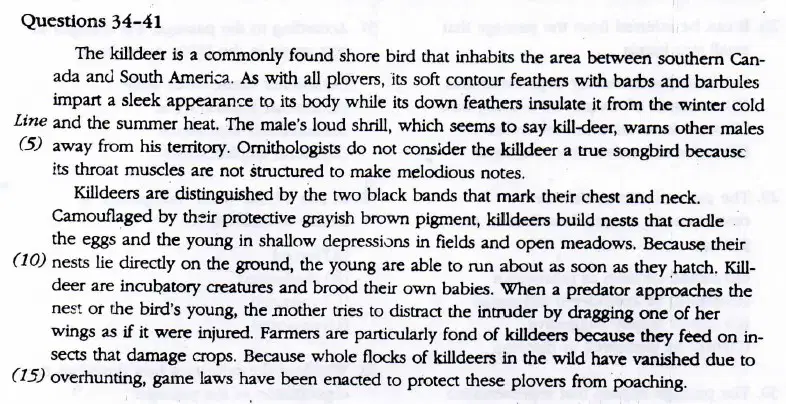
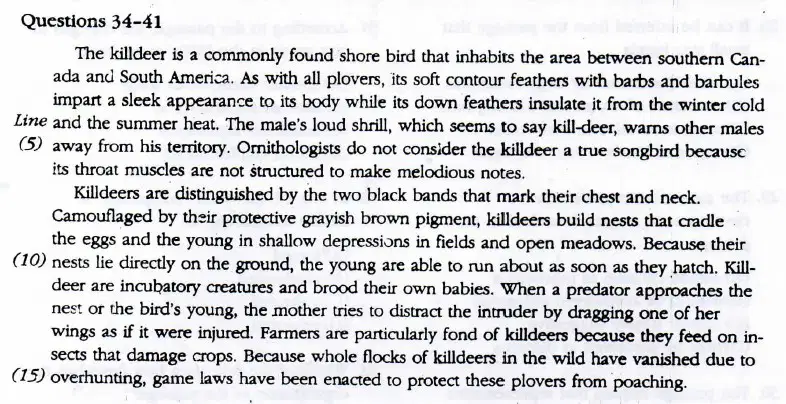
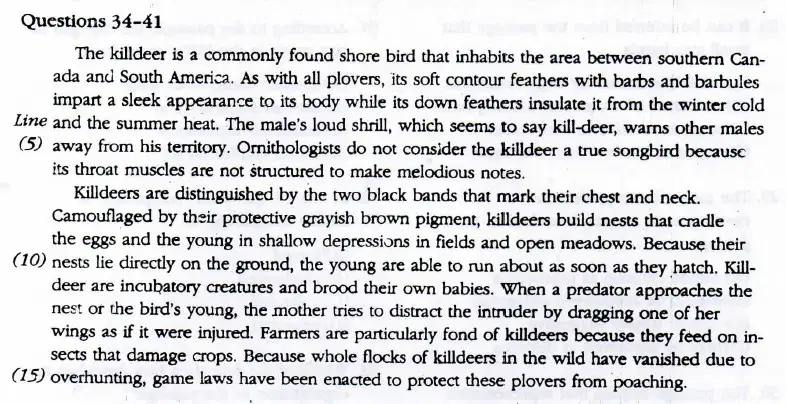
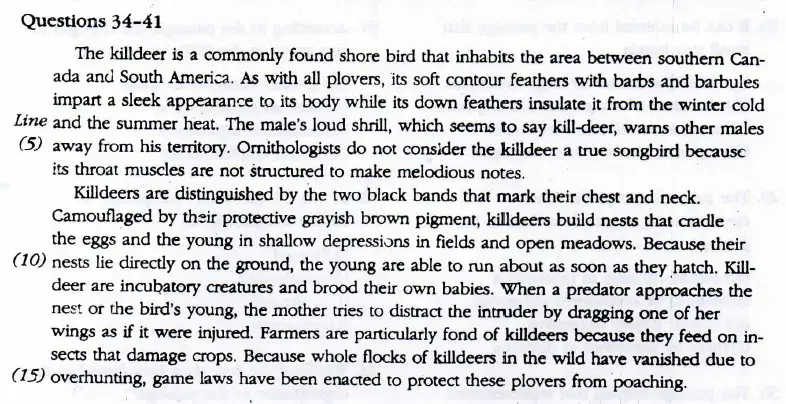
b)
  1. Jane's cousin often visits San Francisco.

c)
  1. Whenever there's a holiday, Jane's cousin goes to San Francisco.

d)
  1. Whenever there's a holiday, Jane leaves San Francisco.

11.
  1. 11.

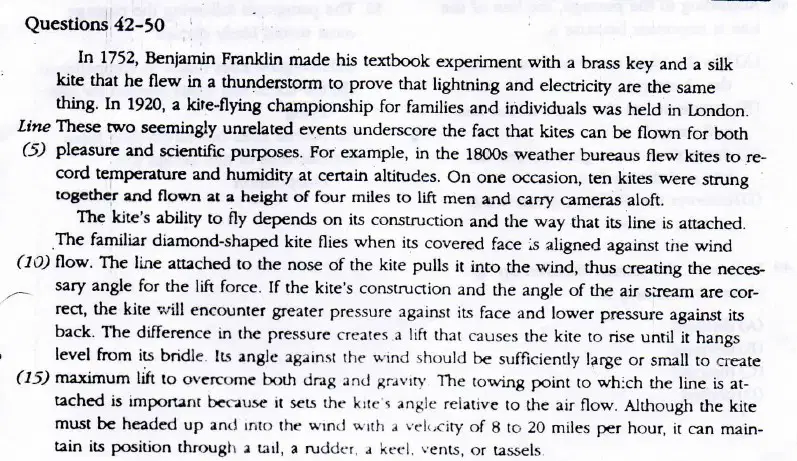
a)
  1. sorry that Andrew can’t go to the concert

b)
  1. She feels bad that Andrew still has to pay for the tickets

c)
  1. She only cares about Andrew paying her back

d)
  1. She insists that Andrew come to the concert

12.
  1. 12.

a)
  1.     The systems isn’t convenient for users

b)
  1.   He’s not familiar with the systems

c)
  1.   He likes the earlier version better

d)
  1. Using the systems is simple

13.
  1. 13.

a)
  1. He couldn’t let his friend into the dorm

b)
  1. He wasn’t suspended even though he let his friend into the dorm

c)
  1. He can’t be suspended if he let his friend into the dorm

d)
  1. He was suspended for letting his friend into the dorm

14.
  1. 14.

a)
  1.   He’s afraid he’ll be late to arrive.

b)
  1. He’s not ready for the last stop.

c)
  1. He had to wait a long time to arrive.

d)
  1. He got on the wrong train.

15.
  1. 15.

a)
  1. Some people are unable to attend the regular meeting

b)
  1. No one attends the meeting every day

c)
  1.    Everyone does not come to every meeting

d)
  1. Someone never come to any meeting

16.
  1. 16.

a)
  1. He doesn’t like that the club meets so often.

b)
  1. He is not sure when the club meets.

c)
  1. He hopes the meeting times can be changed.

d)
  1. He isn’t likely to attend all the meetings.

17.
  1. 17. 

a)
  1. She likes the design Rosita creates.

b)
  1. She’s not sure who else likes the design.

c)
  1. She recommends Rosita as his designer.

d)
  1. She doesn’t think the design is attractive.

18.
  1. 18.

a)
  1. She bought 3 cans for $20

b)
  1. She bought 3 cans to get discount

c)
  1. She spent $40

d)
  1. She saved $20

19.
  1. 19. 

a)
  1. Furniture store.

b)
  1. Hotel.

c)
  1. School.

d)
  1. Bank.

20.
  1. 20.

a)
  1. It must be looking good with the added space.

b)
  1. It must be needing more money.

c)
  1. It must be gaining a lot of profit.

d)
  1. It will be adding even more space.

21.
  1. 21.

a)
She approves
b)
He is good at tennis
c)
He was nice to clean the house
d)
She wants to come, too
22.

22.

a)
He is going out of town
b)
He is expecting guests
c)
He is changing companies
d)
He is moving to another town
23.

23.

a)
At an amusement park
b)
In a restaurant
c)
On the sidewalk
d)
Near a parking meter
24.

24.

a)
Buying vegetables
b)
Planting a garden
c)
Cooking a meal
d)
Loading a truck
25.

25.

a)
Can you hear this noise?
b)
Do you know this sound?
c)
Where would you prefer?
d)
Where is this sound coming from?
26.

26.

a)
At a craft show
b)
At a bookstore
c)
At a hardware store
d)
At a video rental shop
27.

27.

a)
a gas station attendant
b)
A university course grader
c)
An income tax accountant
d)
A technical team leader
28.

28.

a)
She is upset that she forgot to send the card
b)
She thinks the man should share responsibility
c)
She has been forgetting a lot of things lately
d)
She is asking whether the man sent his own card
29.

29.

a)
Go for dinner
b)
Order Italian food
c)
Mail her report
d)
Finish her report
30.

30.

a)
She believes her services should be noticed
b)
She is taking a two week leave
c)
She was promoted to the position of a manager
d)
She is planning to take another job
31.

Part B.

Directions. In this part of the test, you will hear longer conversations. After each conversation, you will hear several questions. The conversations and questions will not be repeated. After you hear a question, read the four possible answers in your test book and choose the best answer. Then on your answer sheet, find the number of the question and fill in the space that corresponds to the letter of the answer you have chosen. Remember, you are not allowed to take notes or write in your test book.

  1. 31.

a)
  1. Attend a football game alone.

b)
  1. Go to a sporting event.

c)
  1. Eat in the cafeteria and study.

d)
  1. See a play.

32.

32.

a)

It's the final game of the season.

b)

It's better than the drama department's play.

c)

It's a very important game.

d)

It's close to the cafeteria.

33.

33.

a)

A play.

b)

A game.

c)

A study group meeting.

d)

Dinner in the cafeteria.

34.

34.

a)

Saturday night.

b)

After dinner in the cafeteria.

c)

Sunday afternoon.

d)

Maybe next weekend.

35.

35.

a)

Trash orbiting Earth.

b)

A trip by an astronaut to the Moon.

c)

The overabundance of garbage on Earth.

d)

Becoming space scientists.

36.

36.

a)

From a lecture.

b)

In a magazine article.

c)

In a book.

d)

On a television program.

37.

37.

a)

17,000 pounds

b)

3,000 tons

c)

3,000 pounds

d)

300 tons

38.

38

a)

She will be able to travel in space.

b)

The problem will take care of itself.

c)

Scientists will find solutions to the problem.

d)

The junk will fall to Earth.

39.

Part C

Directions. In Part C, you will hear short talks. At the end of each, you will be asked several questions. Each talk and each question will be spoken only one time. For this reason, you must listen carefully to understand what the speaker says. After you hear a question, read the four selections and choose the one that is the best answer to the question the speaker asked. Then, on your answer sheet, find the number of the question and blacken the space that corresponds to the letter for the answer you have chosen.

Listen to this sample talk. You will hear...

Before people used automobiles, they walked or rode bicycles for short distances and took trained streetcars or horse-drawn carriages for long-distance travel. When automobiles were first produced, only the rich could afford them. Today, almost every household in the United States owns at least one car and 90% of American adults have driver's licenses. According to the yearly value of its output, the U.S. automobile industry exceeds all other manufacturing industries in the country. As a consumer, this industry also supports other major industries such as steel, glass, and rubber. Furthermore, approximately 12 million Americans are employed in the auxiliary service industries consisting of repair shops and service stations.

Now listen to the following question. You will hear...

According to the speaker, how did people travel before the invention of the automobile?

You will read...

A. By cars and carriages. B. By bicycles, trains, and carriages. C. On foot and by boat. D. On board ships and trains.

The best answer to the question, according to the speaker, how did people travel before the invention of the automobile, is B. By bicycles, trains, and carriages.

Therefore, the correct answer is B.

Now listen to another sample question. Approximately how many people are employed in the automobile service industry?

You will read A. One million. B. Ten million. C. Twelve million. D. Ninety million.

The best answer to the question, approximately how many people are employed in the automobile service industry, is C. Twelve million. Therefore the correct answer is C.

39.

a)
It changes climatic conditions
b)
It controls the indoor environment
c)
It circulates water particles in the air
d)
It reduces overhead expenditures
40.

40.

a)
By cleaning off dirt and dust
b)
By modifying the temperature
c)
By removing and adding moisture
d)
By bringing in and taking out air
41.

41.

a)
To replace it with
b)
To create a breeze
c)
To retard heat
d)
To remove local moisture
42.

42.

a)
Hardly ever in cold regions
b)
Exclusively in business settings
c)
Basically as it does in summer
d)
Mainly as needed for repairs
43.

43.

a)
They can dress comfortably
b)
They become tired
c)
They feel alert
d)
They stay healthy
44.

44.

a)
Business and finance
b)
Law and science
c)
Sports
d)
Chief editors
45.

45.

a)
Copy editing
b)
Approaching people
c)
Writing
d)
Typing
46.

46.

a)
Many reports have been filed
b)
Many reporters have been laid off
c)
Many publications have closed
d)
Many are hiring new specialists
47.

47.

a)
They will stay sluggish
b)
They may continue to decrease
c)
They are likely to expand
d)
They may be difficult to break into
48.

48.

a)
It represents an essential supply of water
b)
Its sources can be renewed indefinitely
c)
It always provides a usable source of water
d)
Its development is important in the United States
49.

49.

a)
Increased rain and agricultural irrigation
b)
Increased use and contamination
c)
airborne bacteria and atmospheric oxygen
d)
Surface runoff turbulence
50.

50.

a)
Several years
b)
Centuries
c)
Dozens of years
d)
Thousands of years
51.

Section 2: STRUCTURE and WRITTEN EXPRESSIONS

A. STRUCTURE

DIRECTIONS : Questions 1-15 are incomplete sentences. Beneath each sentence you will see four words or phrases, marked (A), (B), (C), and (D). Choose the one word or phrase that best completes the sentence. Then, on your answer sheet, find the number of the question and fill in the space that corresponds to the letter of the answer you have chosen. Fill in the space so that the letter inside the oval cannot be seen.

1. The Upper branches of the tallest trees produce more leaves ............................other

a)
than do
b)
than does
c)
than they do
d)
than it does
52.
2. No one...............projections of demographic shifts are reliable and will prove to be valid in the future
a)
know how
b)
knows whether
c)
knows even
d)
know who
53.
3. Senior executives often receive bonuses when their profit targets are reached or.....
a)
surpass
b)
surpasses
c)
surpasse
d)
surpassing
54.

4. Since the 1970s, riding bicycle...... in the United States.

a)
becomes increasingly widespread
b)
become increasingly widely spread
c)
has become increasingly widespread
d)
has increased and becomes spread widely
55.
5. Horseradish has extended stems and a large root that is grated...... a spicy food sauce
a)
to making
b)

to make

c)
to be made
d)
to the making
56.
6. Vitamin A maintains the sharpness of human vision....... and promotes healthy bones
a)
at night
b)
of the night
c)
for the night
d)
nighttime
57.
7. ........., often used in children’s poetry and rhymes, are a result of words used in ambiguous contexts.
a)
Humorous and misunderstood
b)
Misunderstand humorously
c)
Humorous misunderstandings
d)
Misunderstanding its humor
58.

8. X: “You look so unhappy, Mary. What’s the matter?”
    Y: “My father ... his job.”

a)

had just lost

b)

is lost

c)

to lost

d)

losing

59.

9. X: “What are the workmen doing in your garden?”
Y: “Oh I ...”

a)

have build gazebo

b)

has build gazebo

c)

am having a gazebo built

d)

have been build gazebo

60.

10. Mercy: “Why do you have to stay at home tomorrow?”
Nancy: “... my little sister.”

a)

take care

b)

to take care of

c)

of take care

d)

do take care

61.

11. Geothermal energy is a potentially inexhaustible energy source ... been tapped by humans for centuries but until recent years, only on a small scale.

a)

that has

b)

has it

c)

has

d)

that

62.

12. Astronomers estimate ... called the Pleiades in the constellation Taurus is 415 light-years away from Earth.

a)

that a loose cluster of stars

b)

lost of start

c)

that is lost

d)

there is lost

63.

13. Pearl Sydenstricker Buck, ... the Nobel Prize for literature in 1938, is best known for her novels about China.

a)

winning

b)

win

c)
needed for
d)

won

64.

14. Stage producers Klaw and Erlanger were the first to eliminate arguments among leading performers ... in order of appearance, instead of prominence.

a)

of the program

b)

by listing them on the program

c)

for them

d)

the program listing

65.

15. The province of Alberta lies along three of the major North American flyways used by birds ... between their winter and summer homes.

a)

migrate

b)

migrating

c)

and migrate

d)

to migrate

66.

B. WRITTEN EXPRESSIONS

DIRECTIONS : In questions 16- 40 each sentence has four underlined words or phrases. The four underlined parts of the sentence are marked (A), (B), (C), and (D). Identify the one underlined word or phrase that must be changed in order for the sentence to be correct. Then, on your answer sheet, find the number of the question and fill in the space that corresponds to the letter of the answer you have chosen.

16.

a)
A
b)
B
c)
C
d)
D
67.
17.
a)
A
b)
B
c)
C
d)
D
68.
18.
a)
A
b)
B
c)
C
d)
D
69.
19.
a)
A
b)
B
c)
C
d)
D
70.
20.
a)
A
b)
B
c)
C
d)
D
71.
21.
a)
A
b)
B
c)
C
d)
D
72.
22.
a)
A
b)
B
c)
C
d)
D
73.
23.
a)
A
b)
B
c)
C
d)
D
74.
24.
a)
A
b)
B
c)
C
d)
D
75.
25.
a)
A
b)
B
c)
C
d)
D
76.
26.
a)
A
b)
B
c)
C
d)
D
77.
27.
a)
A
b)
B
c)
C
d)
D
78.
28.
a)
A
b)
B
c)
C
d)
D
79.
29.
a)
A
b)
B
c)
C
d)
D
80.
30.
a)
A
b)
B
c)
C
d)
D
81.
31.
a)
A
b)
B
c)
C
d)
D
82.
32.
a)
A
b)
B
c)
C
d)
D
83.
33.
a)
A
b)
B
c)
C
d)
D
84.
34.
a)
A
b)
B
c)
C
d)
D
85.
35.
a)
A
b)
B
c)
C
d)
D
86.
36.
a)
A
b)
B
c)
C
d)
D
87.
37.
a)
A
b)
B
c)
C
d)
D
88.
38.
a)
A
b)
B
c)
C
d)
D
89.
39.
a)
A
b)
B
c)
C
d)
D
90.
40.
a)
A
b)
B
c)
C
d)
D
91.

Section 3: READING COMPREHENSION

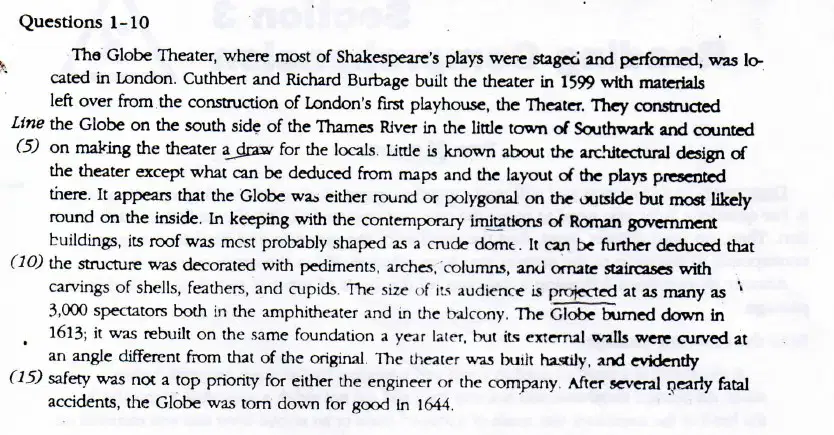
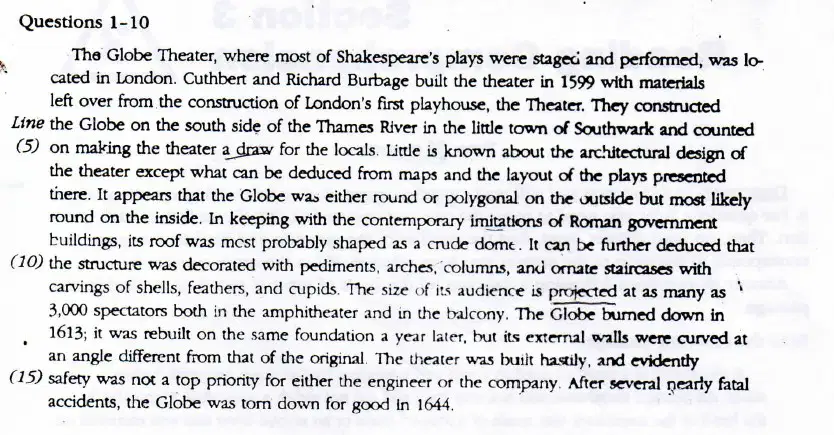
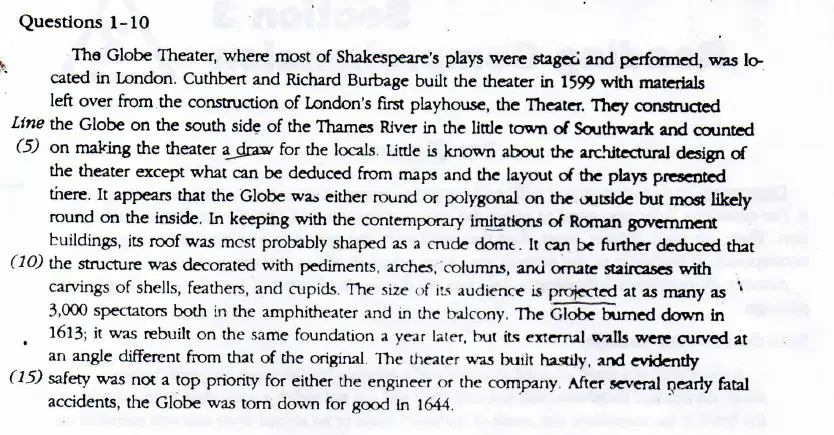
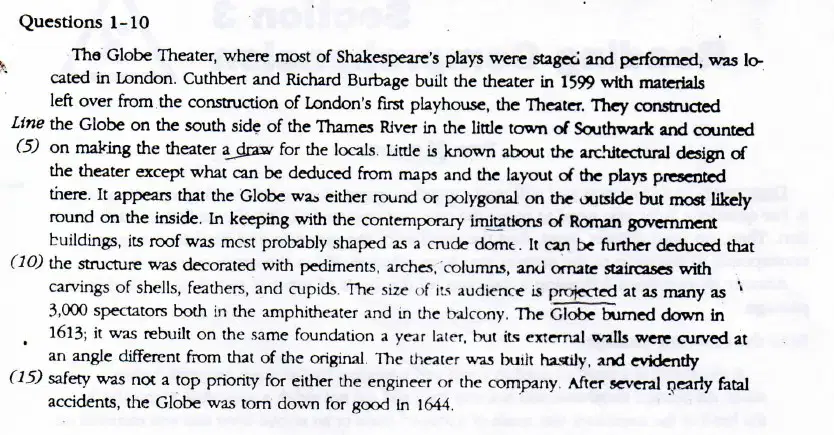
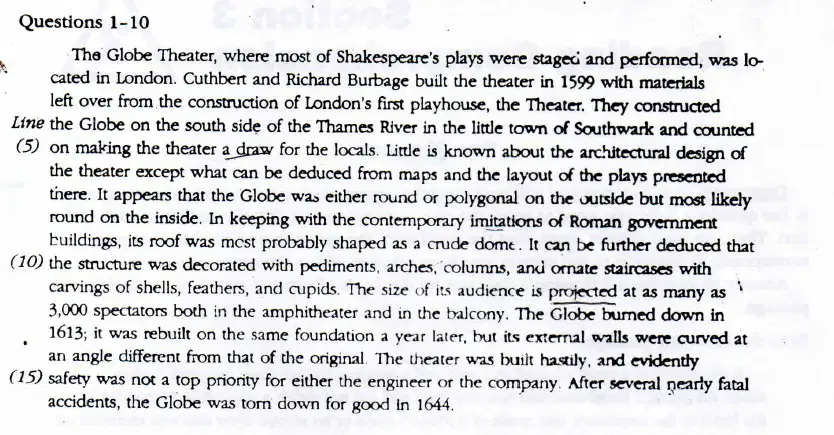
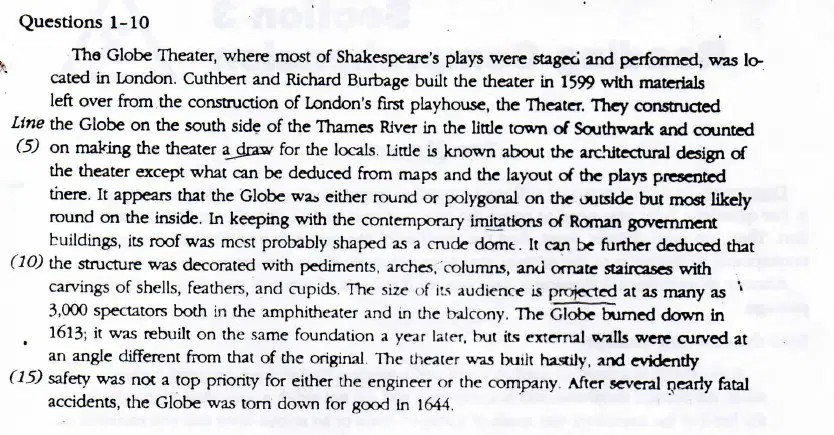
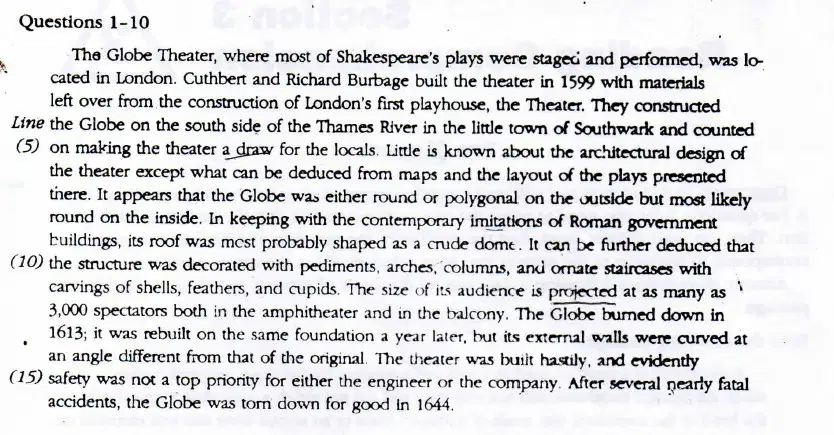
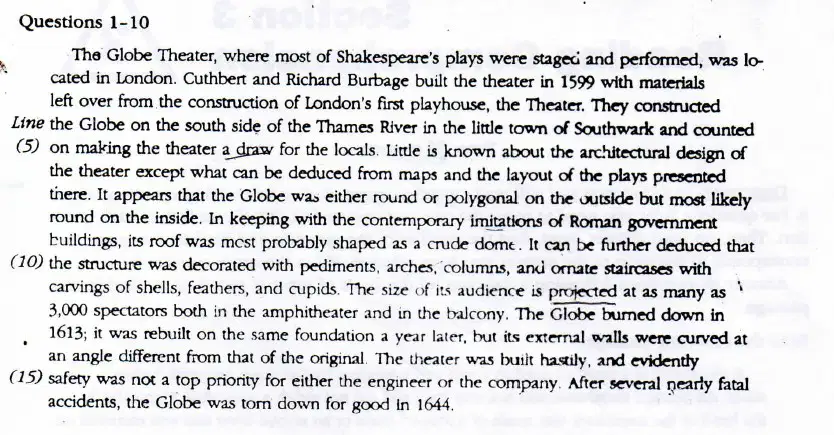
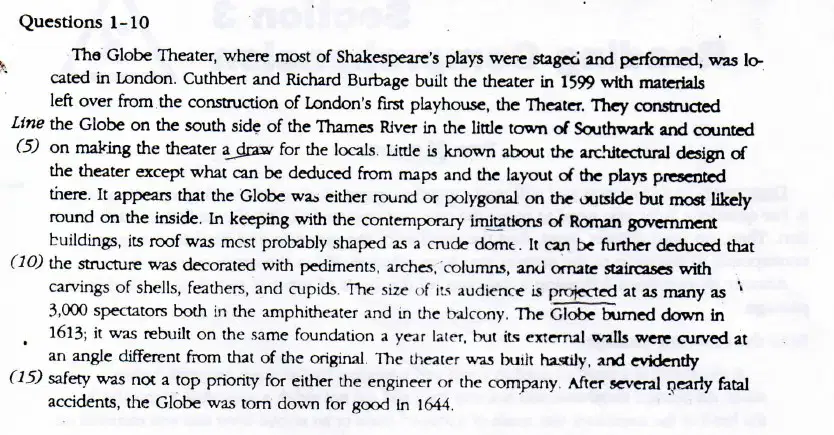
DIRECTIONS: In this section you will read several passages. Each one is followed by several questions about it, For this section, you are to choose the one best answer, (A), (B), (C), or (0), to each question. Then, on your answer sheet, fi nd the number of the question and fi ll in the space that corresponds to the Letter of the answer you have chosen. Now begin work on the questions. Questions 1-10

1. This passage most likely came from a longer work on
a)
English deductive trivia
b)
English monumental constructions
c)
the history of the English theater
d)
notable English disasters
92.
2. According to the passage, the Globe Theater was built
a)
from available contemporary
b)
from materials remaining from another project
c)
on a foundation designed to meet a temporary need
d)
with ornaments intended to fool the spectators
93.
3. in line 5, the phrase "a draw" is closest in meaning to
a)
an option
b)
an attraction
c)
a drawing
d)
a donation
94.
4. It can be inferred from the passage that the Globe's exact architectural design
a)
should be reconstituted
b)
should be obliterated
c)
cannot be determined
d)
cannot be disregarded
95.
5. In line 8, the word "imitations" is closest in meaning to
a)
enumeration
b)
elimination
c)
elaborations
d)
emulation
96.
6. in line 11, the word “ projected “ is closest in meaning to
a)
caiculated
b)
confirmed
c)
embellished
d)
entrenched
97.
7. The passage suggests that, for its time, the Globe Theater was
a)
humble
b)
harsh
c)
austere
d)
large
98.
8. According to the passage, in how many building was the Globe Theater housed during Its operation
a)
One
b)
Two
c)
Three
d)
four
99.
9. The author implies the last building housing the Globe was
a)
dignified
b)
unmistakabie
c)
hazardous
d)
haunted
100.
10. With which of the following statements is the author most likely to agree?
a)
The arhitecurral design of the theater was exemplary in the 1600s
b)
The builders did not invest a great deal of thought into the theaterdesign
c)
The theater audience enjoyed plays as well as the building design
d)
The theater location contributed to the opulence of its design and decorations
101.

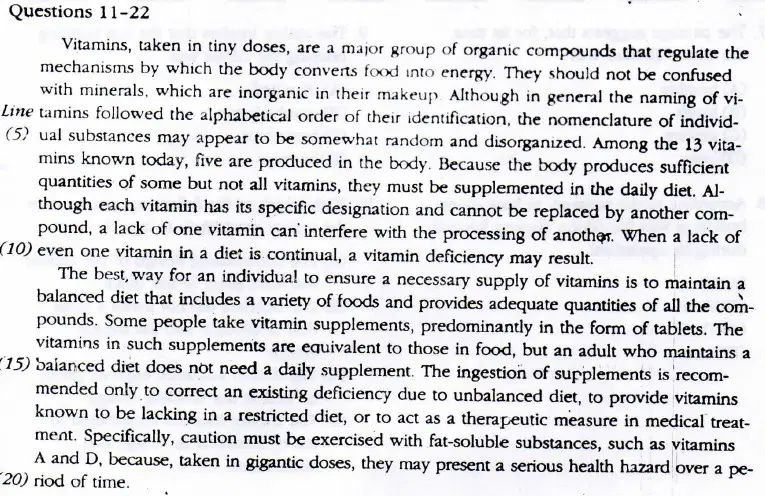
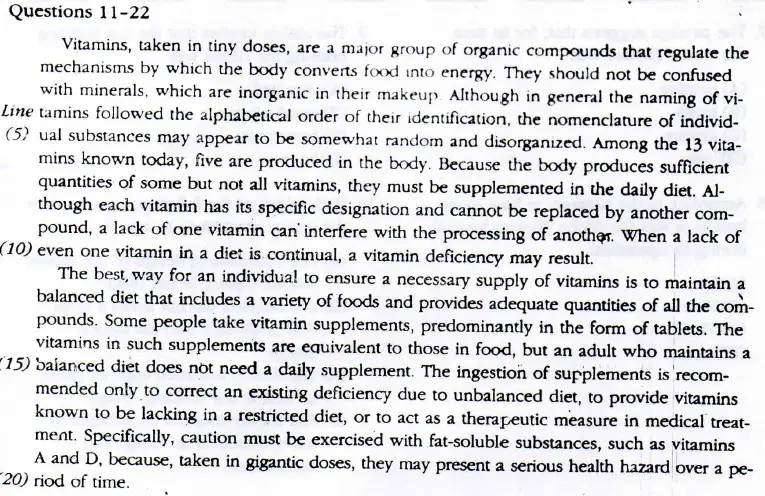
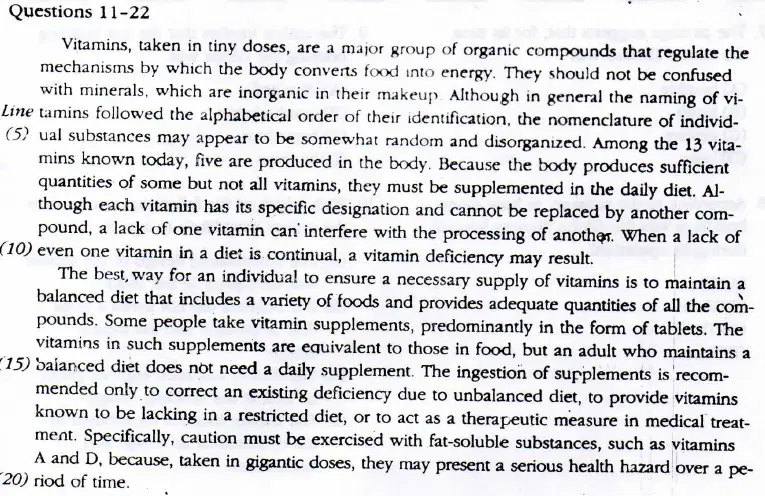
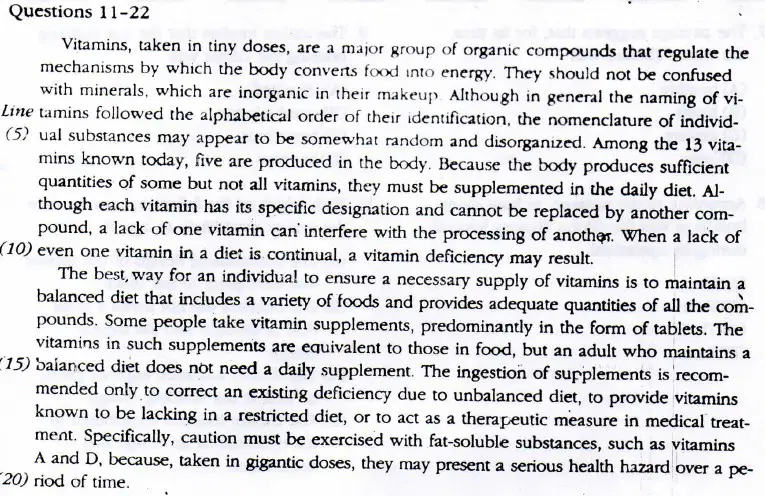
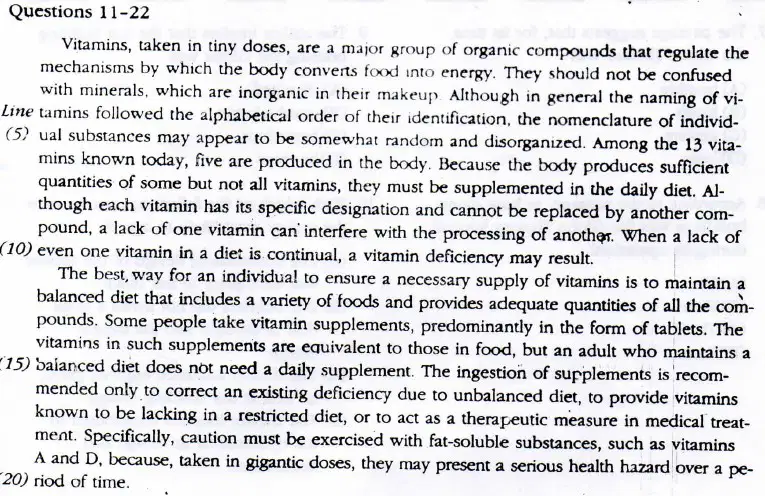
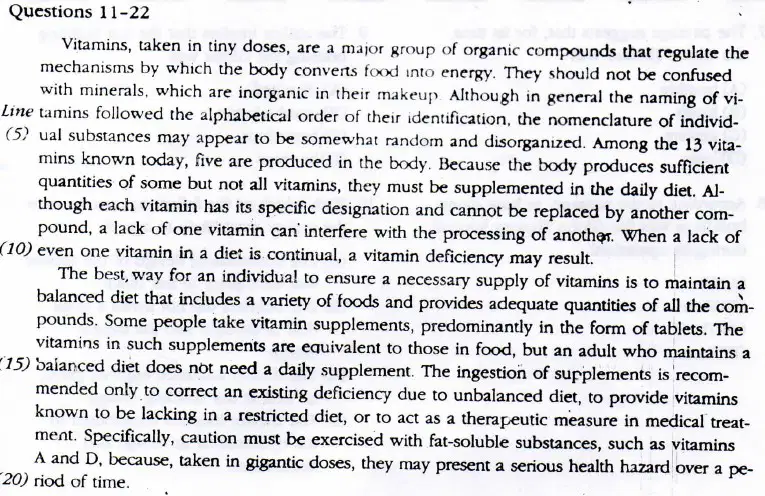
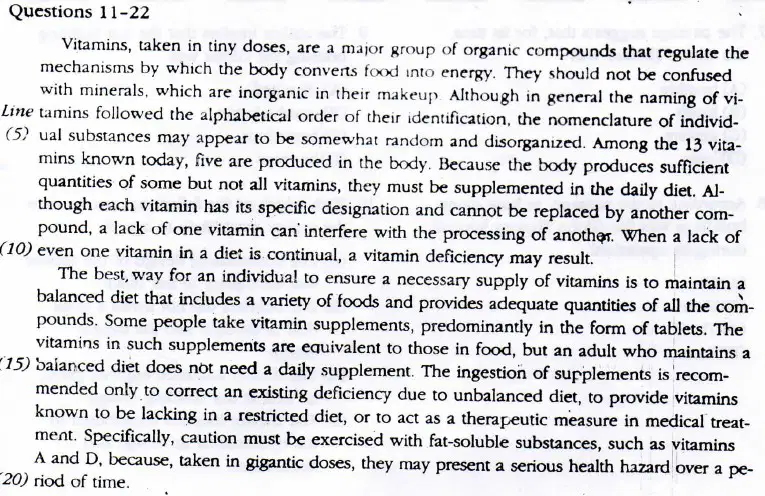
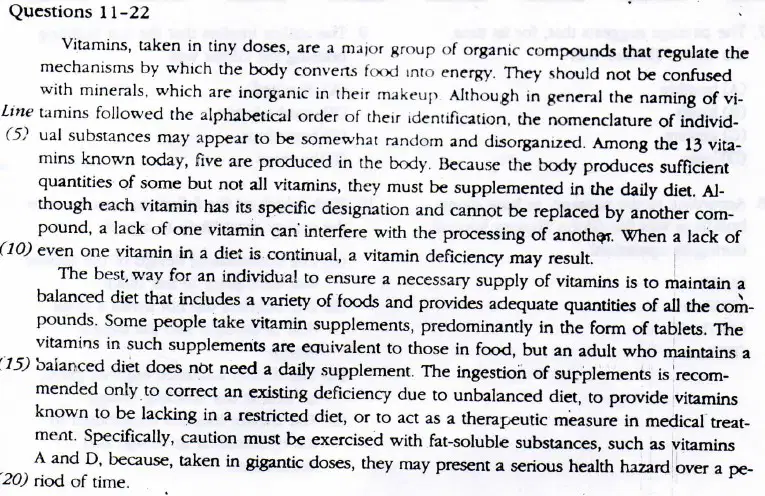
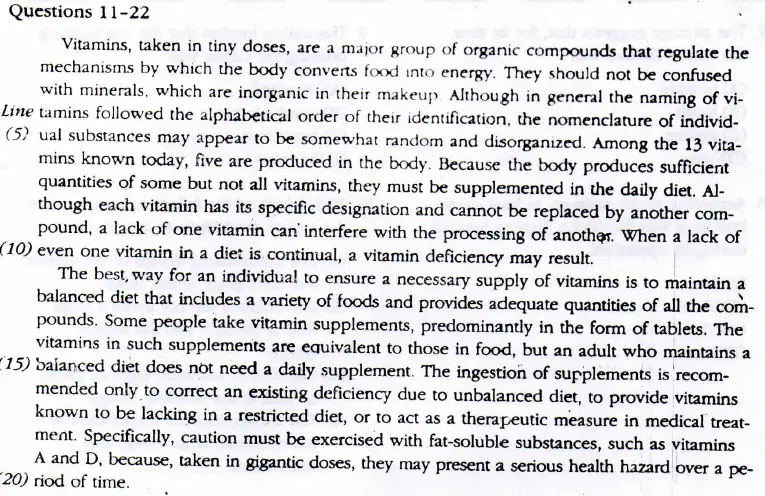
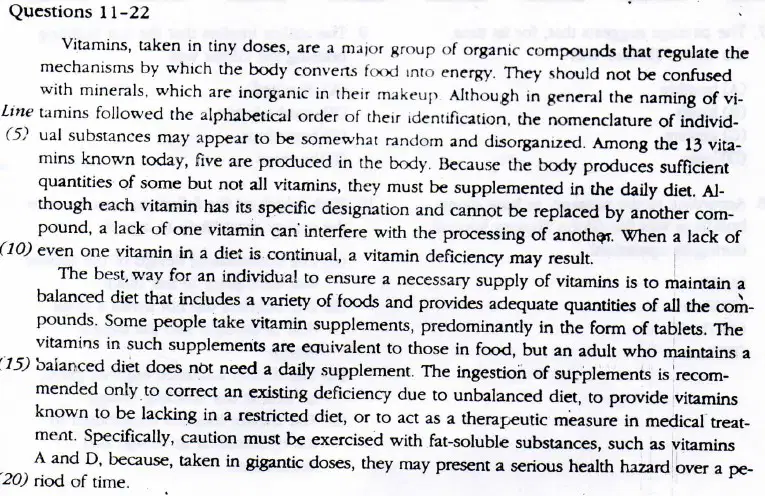
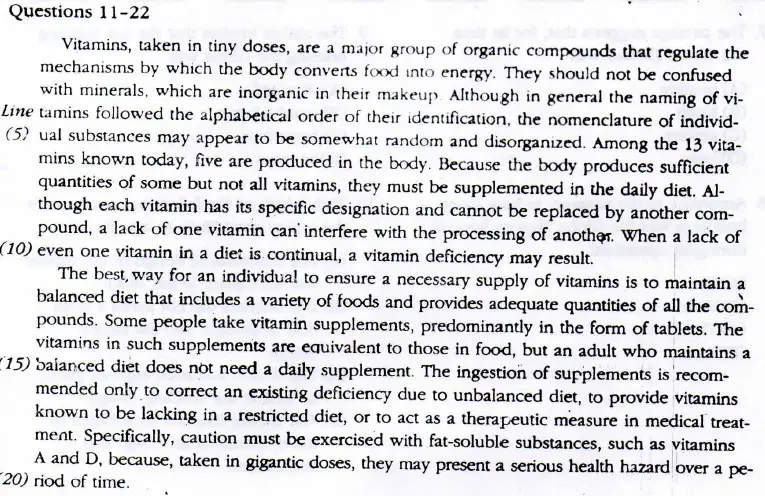
(Questions 11 - 22)

11. in line 1 the word "regulate is closest in meaning to
a)
control
b)
refine
c)
refresh
d)
confine
102.
12. According to the passage, vitamins are
a)
food particles
b)
essential nutrients
c)
miscellaneous substances
d)
major food groups
103.
13. In line 4, the word “ nomenclature” is closest in meaning to
a)
conservation
b)
classification
c)
concentration
d)
clarification
104.
14. How many vitamins must be derived from nourishment?
a)
5
b)
7
c)
8
d)
13
105.
15. The author some implies that foods
a)
supply some but not all necessary vitamins
b)
should be fortified with all vitamins
c)
are equivalent in vitamin content
d)
supplement some but not all necessary
106.
16. In line 7, the phrase” daily diet “ is closest in meaning to
a)
weight loss or gain
b)
sufficient quantities
c)
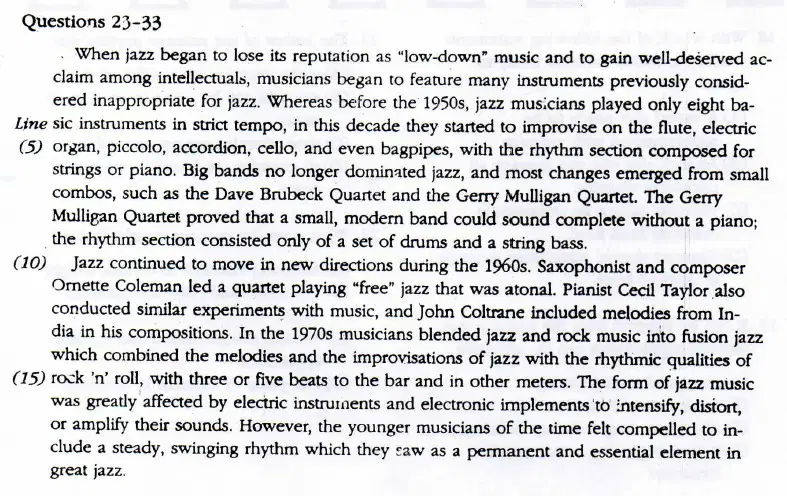
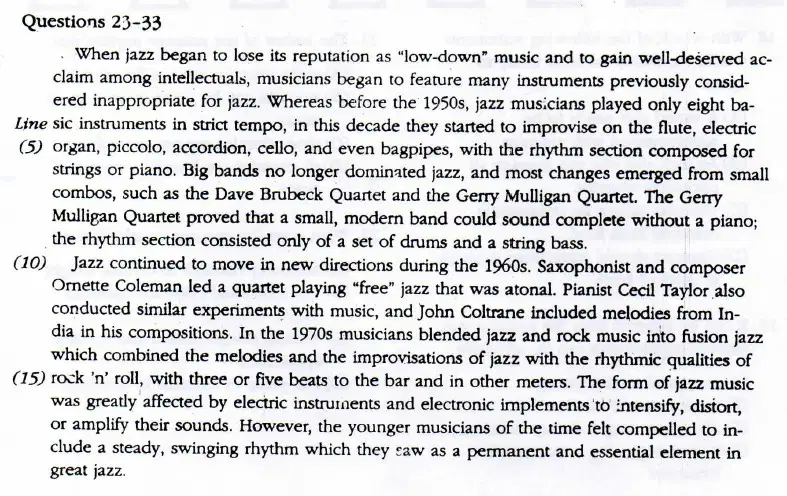
nourishment intake
d)
vitamin tablets
107.
17. A continual lack of one vitamin in a person’s diet is
a)
contaglous
b)
desirable
c)
preposterous
d)
dangerous
108.
18. With which of the following statements would the author be most likely to agree
a)
A varied diet needs to be supplemented with vitans
b)
An invlusive diet can provide all necessary vitamins
c)
Vitamins cannot be consistenly obtained from food
d)
Vitamins should come from capsules in purified form
109.
19. It can be inferred from the passage that vitamin supplements can be advisable
a)
in special medical cases
b)
in most restricted diets
c)
after correcting a dietary deficiency
d)
before beginning a therapeutic treatment
110.
20. In line 17, the phrase “ act as” is closest in meaning to
a)
Play the role of
b)
pretend to be
c)
fight for
d)
attest to the fact that
111.
21. The author of the passage implies that
a)
some vitamins are not fat-soluble
b)
vitamin can be taken in very small doses
c)
most vitamins are water-soluble
d)
all vitamins are found in measured doses
112.
22. What does the passage mainly discuss?
a)
Adopting vitamins to control weight
b)
The individual’s diet for optimum health
c)
Vitamin categorization and medical application
d)
The place of vitamins in nutrition
113.

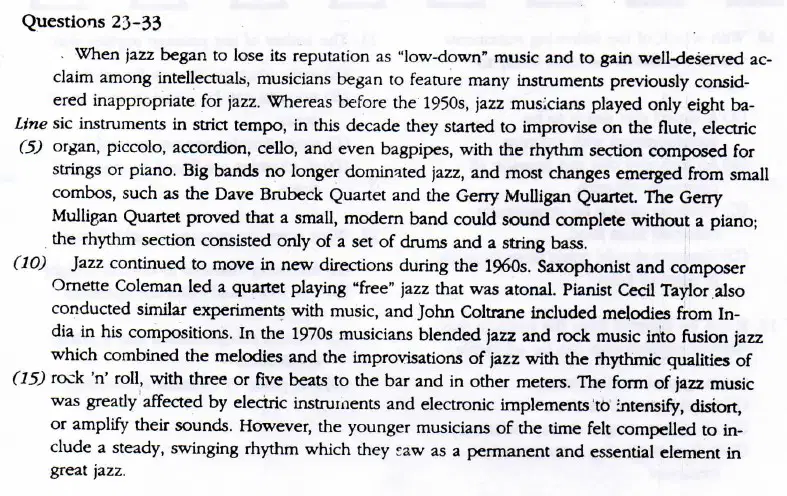
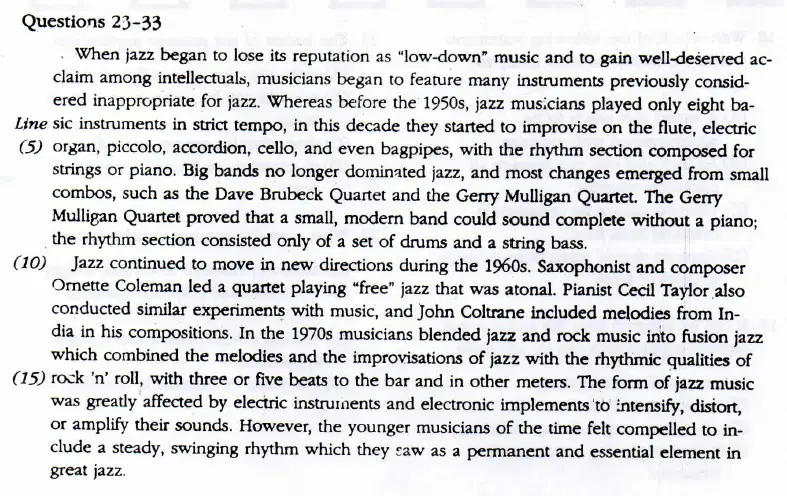
(Questions 23 - 33)

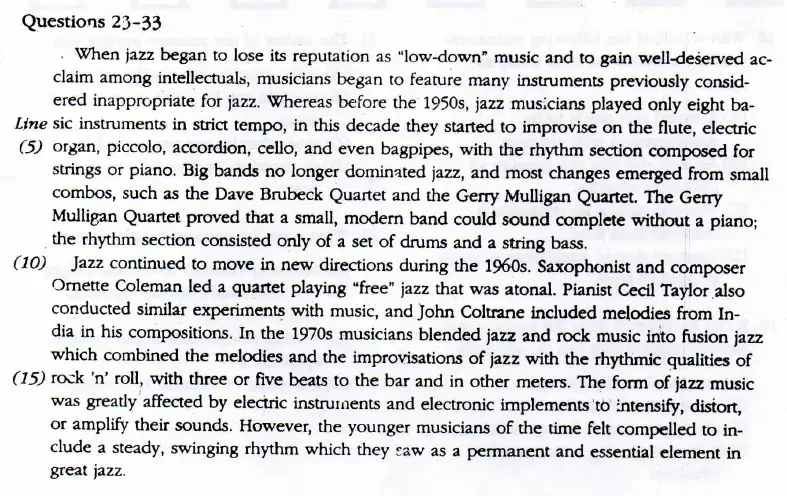
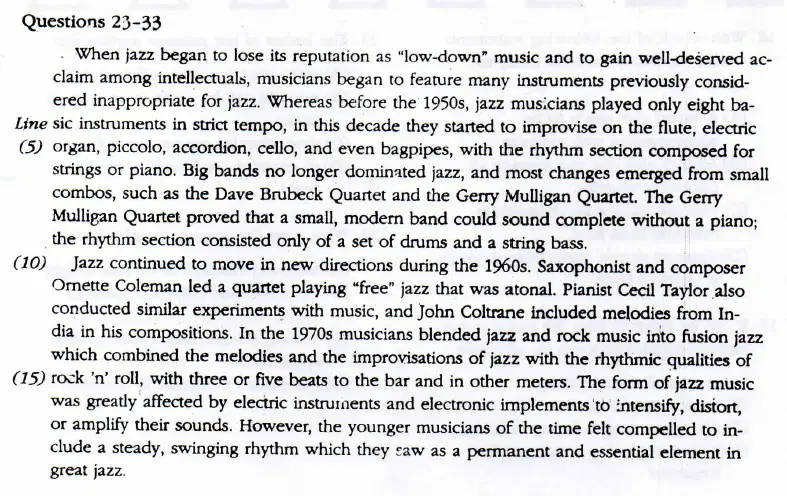
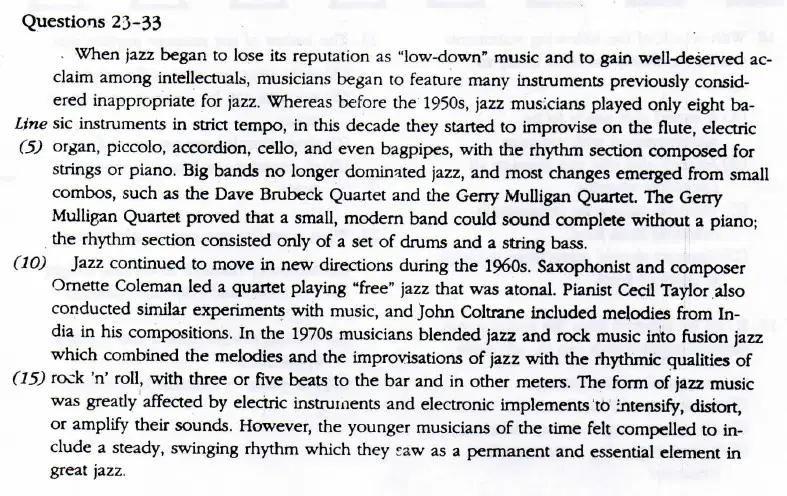
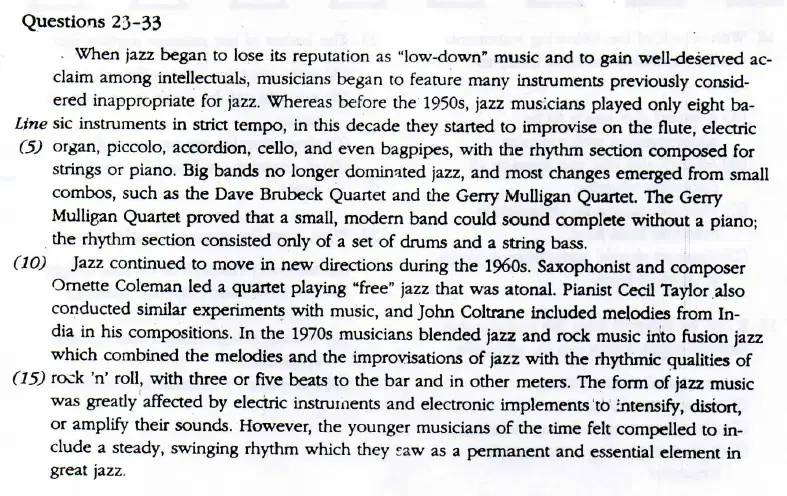
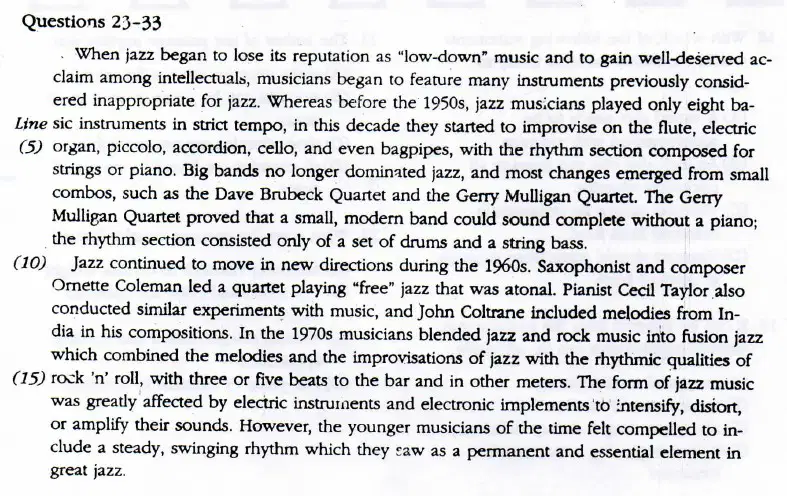
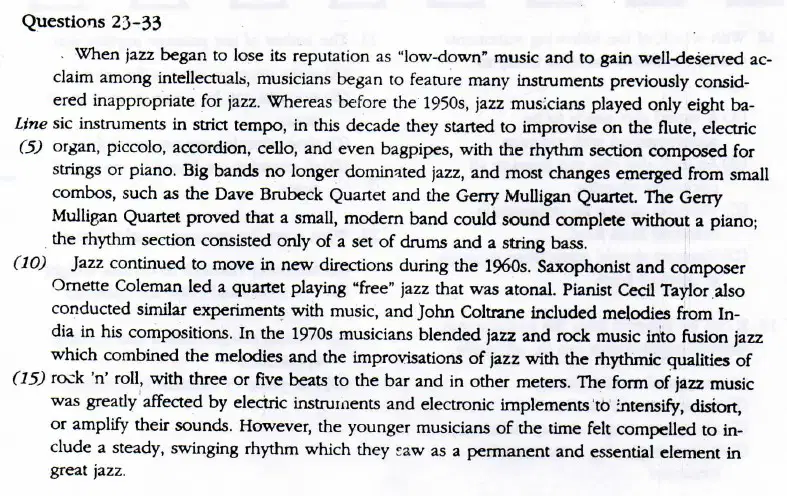
23. Which of the following would be the best title for the passage?
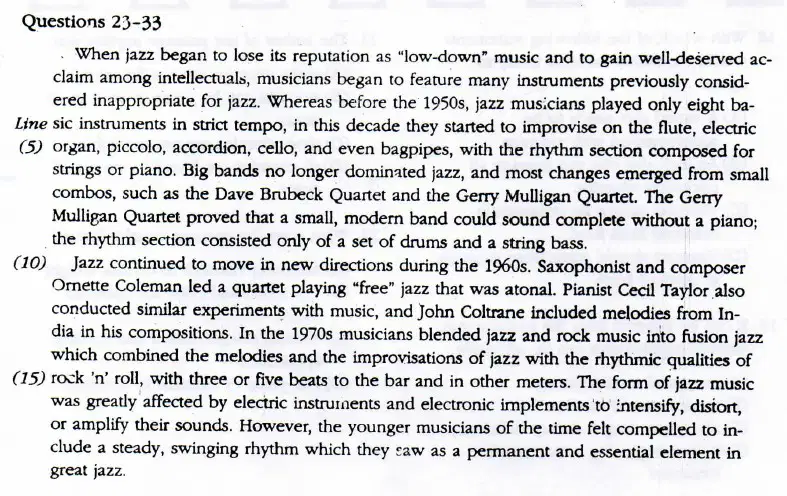
a)
popular Beast in Classical and Modern Jazz
b)
Quintessential moments in Jazz Music
c)
The Achievements of Famous Jazz Musicians
d)
The Rising prestige and diversity of Jazz
114.
24. In line 2, the word "feature" is closest in meaning to
a)
profess
b)
prohibit
c)
protest
d)
promote
115.
25. The paragraph preceding this passage would most likely describe
a)
instruments used in jazz
b)
instrumental pieces in jazz
c)
jazz in the 1940's
d)
the origins of jazz
116.
26. The author of the passage implies that in the 1950's, jazz musicians
a)
strictly adhered to its traditions and compositions
b)
probably continued with its tempo and instrumentation
c)
experimented with rhythm and instruments
d)
increased the tempo to keep up with the changes
117.
27. The author of the passage mentions all of the following EXCEPT
a)
bagpipes
b)
percussion
c)
string bass
d)
harpsichord
118.
28. it can be inferred from the passage that small jazz bands
a)
were dominated by large orchestras
b)
consisted of drums and a string bass
c)
were innovative in their music
d)
included modern sound systems
119.
29. The author believes that the developments in jazz described in the passage
a)
should be seen as precocious
b)
should be considered influential
c)
appear largely suggestive
d)
may be perceived as discrete
120.
30. The passage implies that representative jazz musicians
a)
concentrated on melodious combinations of sounds
b)
blended improvisations and sheet music together
c)
created and modernized sophisticated devices
d)
sought novel techniques in form and content
121.
31. According to the passage, the change in jazz music in the 1970's came from
a)
another harmonious scale
b)
another musical trend
c)
ambitious aspirations
d)
sound amplifications
122.
32. In line 17, the word"compelled" is closest in meaning to
a)
forced
b)
challenged
c)
obligated
d)
censored
123.
33. Which of the following best describes the organization of the passage
a)
Chronological innovations in jazz music
b)
Definitions of diverse jazz styles
c)
A classification of prominent jazz musicians
d)
Descriptions and examples to illustrate jazz rhythms
124.

(Questions 34 - 41)

34. It can be inferred from the passage that killdeer usually live
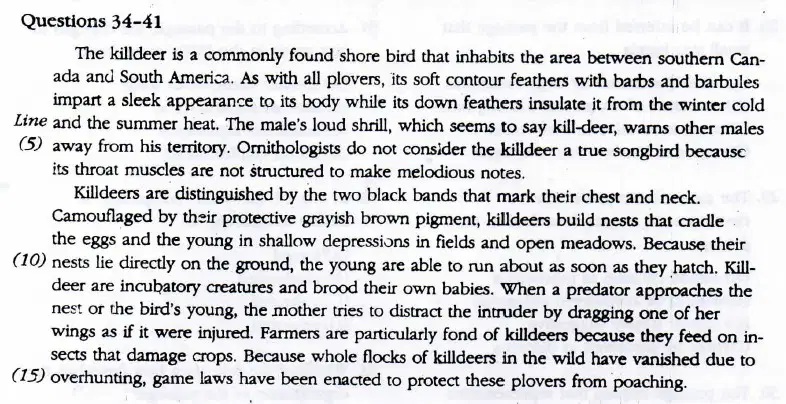
a)
in the brush
b)
in mountains
c)
near oceans
d)
near cities
125.
35. In line 3, the word "impart" is closest in meaning to
a)
give
b)
import
c)
link
d)
imprint
126.
36. What is the reason given for the bird's name?
a)
it has distinctive bands
b)
it has a peculiar song
c)
it kills young deer
d)
it eats deer fodder
127.
37. In line 6, the word "melodious" is closest in meaning to
a)
memorable
b)
musical
c)
mellow
d)
marvelous
128.
38. It can be inferred from the passage that killdeers are
a)
inarticulate
b)
inconspicuous
c)
irreverent
d)
irresolute
129.
39. How does the mother bird mislead its enemies?
a)
By pretending to be vulnerable
b)
By blending in with the background
c)
By building low-lying nests
d)
By scaring them away with her cry
130.
40. According to the passage, farmers
a)
form foundations to protect killdeers
b)
appreciate the effects of killdeers
c)
camouflage killdeer nests and eggs
d)
provide killdeers with food and insects
131.
41. Which of the following best describes the author's attitude toward the killdeer?
a)
Menacing
b)
Warm
c)
Detached
d)
Humorous
132.

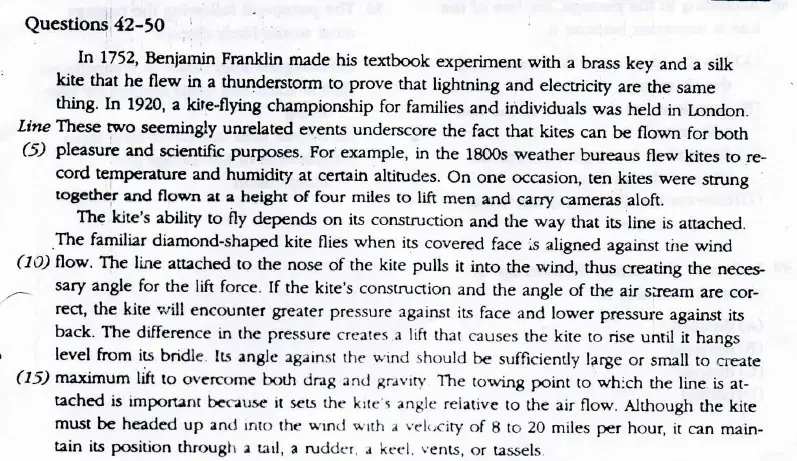
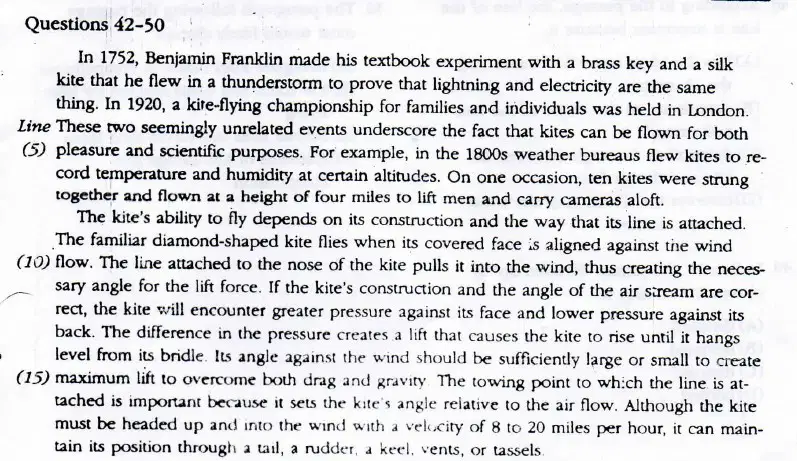
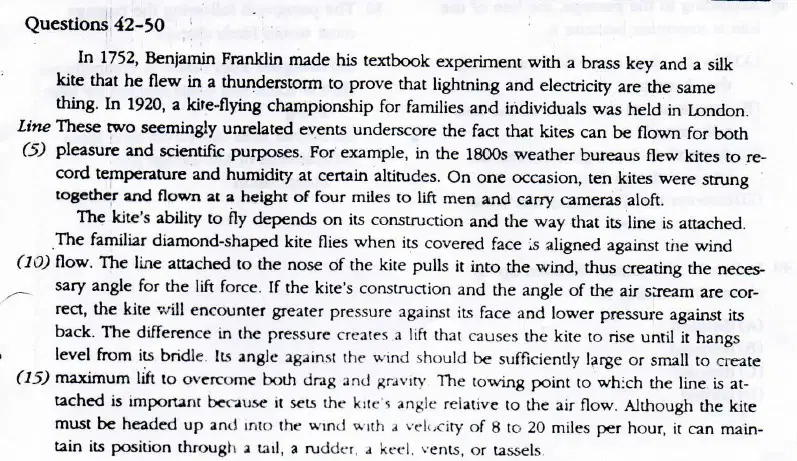
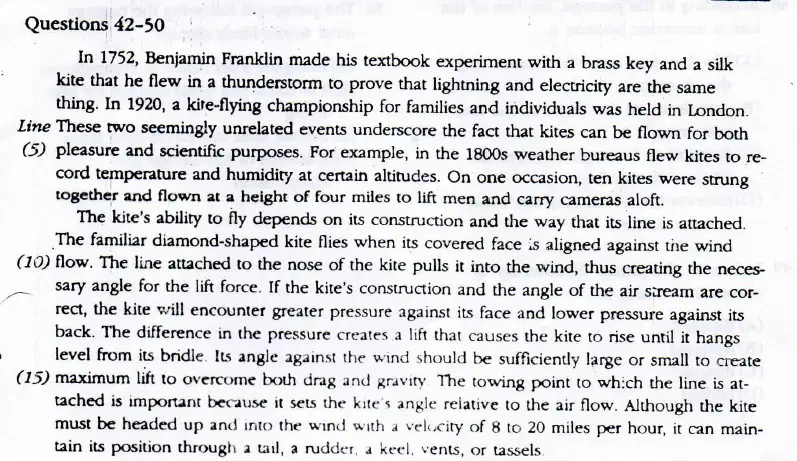
(Questions 42 - 50)

42. What is the main topic of the passage
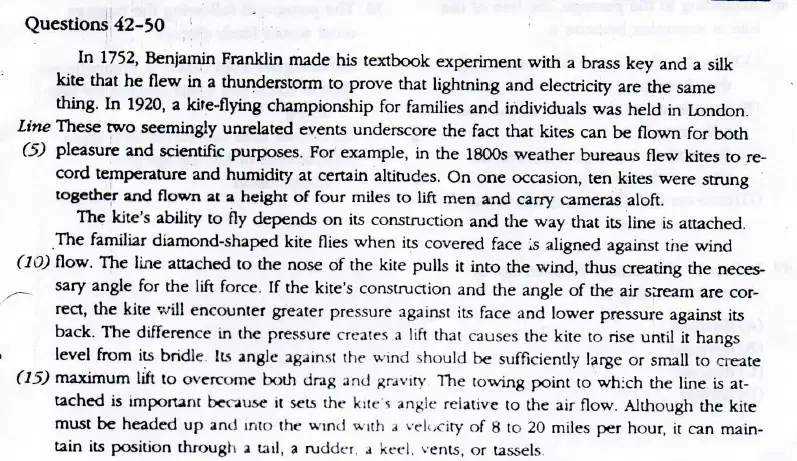
a)
How kites can be untilized
b)
Why kites were spurned
c)
What parts kites consist of
d)
What makes kites stay aloft
133.
43. In line 1, the word "textbook" is closest in meaning to
a)
textual
b)
tentative
c)
classic
d)
outrageous
134.
44. In line 4, the word "seemingly" is closest in meaning to
a)
ostensibly
b)
oncoming
c)
optimistic
d)
opposite
135.
45. In line 7, the word "aloft" is closest in meaning to
a)
in flight
b)
in the flood
c)
for the analysis
d)
for amusement
136.
46. According to the passage, the kite flies when its nose is
a)
pointed away from the ground
b)
pointed into the wind flow
c)
balanced with the tail
d)
aligned parallel to the wind flow
137.
47. What is the necessary condition for the kite to fly?
a)
The kite must be sufficiently strong to withstand great pressure
b)
The kite must be diamond-shaped and the wind of a certain velocity
c)
The pressure against its back must be lower than the pressure against its face
d)
The pressure of the air flow must be lower than the weight of the kite
138.
48. According to the passage, the line of the kite is important because
a)
lifts the kite's cover and frame into the air space
b)
contributes to the shape of the kite and extends it
c)
determines the angle between the kite and the air flow
d)
conveys the direction of the wind and the air flow
139.
49. In line 17, the phrase "head up" is closest in meaning to
a)
diverted
b)
deviated
c)
directed
d)
drafted
140.
50. The paragraph following the passage most would likely discuss
a)
fiberglass kites flown in competitions
b)
the cords and wires needed for kite flying
c)
bowed kites curved on their faces
d)
elements of kite design and composition