
 Worksheets
AdvanceWorldSr&En2024
Total questions: 35
Worksheet time: 18mins
Name
Class
Date
1.
The Scientific Revolution of the seventeenth century
a)
was stimulated by a revived interest in ancient authorities from the medieval period
b)
directly resulted from reaction and revolt against the social and historical condition of the Middle ages
c)
was largely due to a monastic revolution in education
d)
an innovative phase in western thinking, was based upon the intellectual and scientific accomplishments of previous centuries
2.
The heliocentric theory is
a)
sun centered
b)
earth centered
3.
Enlightenment thinkers contributed to the development of democratic government through their belief that -
a)
most changes in government are dangerous
b)
absolute monarchy is the most effective form of government
c)
governments are instituted to protect citizens' rights
d)
popular liberties should be limited by the need for social order
4.
In Two Treatises of Government, John Locke wrote that the purpose of government was to --
a)
keep kings in power
b)
regulate the economy
c)
expand territory
d)
protect natural rights
5.
The political philosopher, Baron Charles de Montesquieu published Spirit of the Laws in the 18th century. His model of government resulted in the development of -
a)
constitutions including a bill of rights
b)
three branches of government with shared power
c)
nation-states ruled by a few wealthy men
d)
voting rights being extended to all landowners
6.
Which of the following was a significant effect of the European Enlightenment period?
a)
It provided the intellectual spark for the American and French Revolutions
b)
It marked an end to the humanism that had developed during the Renaissance
c)
It forced the individual to recognize that God is supremely powerful
d)
It led to a revival of feudalism in northern Europe
7.
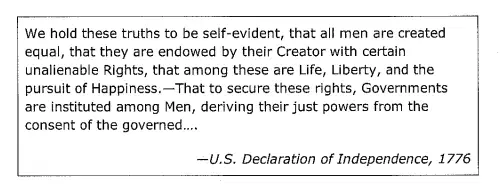
The greatest influence on these political ideas came from the
a)
Justinian Code
b)
Theories of Jean-Jacques Rousseau
c)
Philosophy of Machiavelli
d)
Writings of John Locke
8.

Which statement best reflects the ideas of the Enlightenment?
a)
Statement 1
b)
Statement 2
c)
Statement 3
d)
Statement 4
9.
The geocentric theory is
a)
sun centered
b)
earth centered
10.
The cosmological views of the later Middle Ages held that which of the following was the center of the universe.
a)
the sun
b)
the earth
c)
the heavens
d)
the moon
11.
Organized religions in the seventeenth century rejected scientific discoveries that conflicted with the Christian view of the world
a)
true
b)
False
12.
The cosmological views of the Later Middle Ages held that which of the following was the center of the universe (Geocentric)?
a)
The sun.
b)
The earth.
c)
Heaven.
d)
The epicycles.
e)
The moon.
13.
Which theory of the Universe did the Catholic church validate
a)
Geocentric theory
b)
Heliocentric theory
14.
The Scientific Revolution was a new way of thinking about the natural world that was based upon careful observation and a willingness to question accepted beliefs.
a)
True
b)
False
15.
The geocentric theory originated with Aristotle in 300 BC. The Catholic church continued to teach this theory and the idea that God placed earth at the center of the universe.
a)
True
b)
False
16.
The first major challenge to accepted scientific thinking came in the field of
a)
medicine
b)
psychology
c)
history
d)
astronomy
17.
Nicolaus Copernicus, a Polish astronomer, studied the planetary movements for twenty five years. On his death bed to avoid retaliation from the Catholic church he published his findings. His theory is referred to as
a)
Geocentric Theory
b)
Heliocentric Theory
c)
Polyatomic Theory
18.
Which scientist concluded that certain laws of math governed planetary motion and that planets revolved in elliptical orbits. He used math to show that Copernicus's ideas were true.
a)
Thomas Hobbes
b)
John Locke
c)
Johannes Kepler
d)
Galileo Galilei
19.
Which scientist's findings frightened Catholic leaders because it went against church's teaching and its authority. Tried by the Inquisition and torture until he publicly confessed Copernicus ideas were false.
a)
Thomas Hobbes
b)
John Locke
c)
Johannes Kepler
d)
Galileo Galilei
20.
What was Newton's main contribution to the scientific world
a)
social contract theory
b)
laws of gas and temperature
c)
laws of gravity
21.
Which philosopher believed in natural rights, life, liberty and property. His ideas are the fundamental to the United States Declaration of Independence/
a)
Locke
b)
Hobbes
c)
Jefferson
22.
Which philosopher believed that the state of nature was good and everyone born had the right to equality
a)
Hobbes
b)
Locke
23.
Which philosopher believed that mankind was good and rational and capable of self rule. The role of government was to ensure these natural rights and if they did not under the social contract theory the people had the right to revolt against the government
a)
Hobbes
b)
Locke
24.
Which philosopher believed that peoples state of nature was evil. His social contract theory was that the role of government was to preserve peace and stability at all cost.
a)
Hobbes
b)
Locke
25.
Medieval science was primarily based on
a)
close observation of nature
b)
pure superstition
c)
the experimental method
d)
a blending of Christian theology and the writings of classical authors
26.
In Leviathan, Thomas Hobbes became an advocate for which of the following types of government
a)
Absolute monarchy
b)
Parliamentary government
c)
Divine right monarchy
d)
Constitutional monarchy
27.
Mary Wollstonecraft's Vindication of the Rights of Women
a)
focused primarily on economic issues such as property rights
b)
served as the inspiration for a small group of eighteenth-century women who formed the first female suffrage organization
c)
was the first work in English to openly advocated for full political equality for women
d)
failed to find a publisher during her lifetime
28.
What made the spread of ideas possible during this time was not only new urban institutions where people could meet and discuss ideas, but a revolution in
a)
Academics
b)
Women's equality
c)
Print culture
d)
abolition of torture
29.
The Declaration of Independence contractual view of the political structure in which the government drew its authority from the consent of the governed was influenced by
a)
Thomas Jefferson
b)
John Locke
c)
Voltaire
d)
John Hobbes
30.
“I asked him to tell me in what true religion consisted.‘ Have I not told you?’ [he answered] ‘Love God and your neighbor as yourself. ’”Voltaire, Philosophical Dictionary In the excerpt above, Voltaire was supporting
a)
religious toleration
b)
papal authority
c)
unification of all Christian churches
d)
Protestantism
e)
the monastic life
31.
In the Spirit of the Laws, Montesquieu argued that the best political system in modern society is one where
a)
the legislature exercises absolute and unlimited power
b)
the king exercises absolute and unlimited power
c)
power is divided between the three branches of government
d)
all government should be controlled by the military
32.
According to the social contract theory, the general will was
a)
a meaningless abstraction and impediment to reason
b)
deprived from the law of supply and demand
c)
a social consensus to which the individual must yield
33.
Deductive and inductive reasoning, experimentation, scientific method and mathematical proof were promoted by
a)
Locke and Hobbes
b)
Copernicus, Galileo and Newton
c)
Descartes and Bacon
d)
Descartes and Newton
34.
Is the statement below true or false- "Initially scientific discoveries were censored by both religious and secular authorities, but gradually rulers came to see the advantages of using science to enhance their power"
a)
True
b)
False
35.
Which of the following is NOT one of John Locke's main ideas
a)
that governments were a result of a social contract between rulers and ruled
b)
that subjects had the right to remove their ruler
c)
the rulers derived their authority from the consent of those they governed
d)
although kings did have divine sanction their subjects maintained personal rights
100 %

