
 Worksheets
Review Weather, Heat Transfer, Matter
Total questions: 57
Worksheet time: 36mins
What is the definition of CONVECTION
When heat transfers through waves.
When heat transfers from objects that are touching.
warm fluid rises; cool fluid sinks
Heat traveling from the sun
When would an object left in a room temperature room stop transferring heat?
When it has reached the same temperature as the room temperature air
When it has lost all of its thermal energy
When it has gained all of the air's thermal energy
When it has gained or lost all of it's coldness to the air

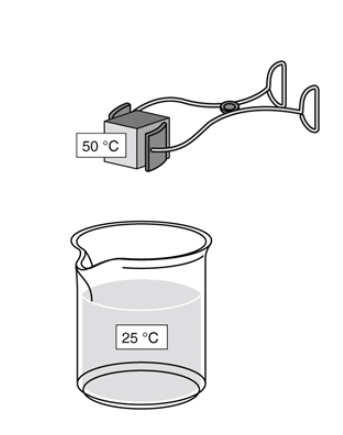
As part of a lab experiment, Tasha drops a metal cube into a beaker of water, as shown in the figure below.
After energy in the form of heat transfers between the substances, what is the final temperature of the water?
The final temperature is 25 °C because there is more water than metal.
The final temperature is 50 °C because the metal warms the water to the temperature of the metal.
The final temperature is between 25 °C and 50 °C because energy is transferred from the metal to the water.
The final temperature is between 25 °C and 50 °C because most of the thermal energy is lost to the air around the substances.

The water in Mario’s swimming pool absorbs energy as heat during the day. Which of the following would the water in the pool be most likely to do?
condense
evaporate
freeze
melt
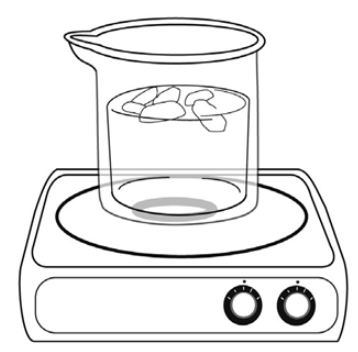
Emerson places a beaker of water on a hotplate and turns the hotplate on. The temperature in the room is 25 ºC. After the water heats to 75 ºC, she adds pieces of ice to the beaker.
Which of the following describes a transfer of heat energy that occurs during this experiment?
from the air to the water
from the ice to the beaker
from the water to the ice
from the water to the hotplate

How does the thermal energy of the liquid in the larger beaker compare to the thermal energy of the liquid in the smaller beaker?
The liquid in the larger beaker has less thermal energy than the liquid in the smaller beaker.
The liquid in the larger beaker has more thermal energy than the liquid in the smaller beaker.
The liquid in the larger beaker has the same amount of thermal energy as the liquid in the smaller beaker.
The exact volume of the liquid in each beaker must be known to compare the thermal energy of the liquids.
Which description defines heat?
total thermal energy of an object or substance
change in the temperature of a substance in degrees Celsius
energy transferred between objects at different temperatures
average kinetic energy of the particles that make up a substance

The pan is made of iron. The handle is NOT too hot to touch. What might the pan's handle be made of?
copper
aluminum
wood
iron

Rahma got an ice cream from her mom. The ice cream melts under the sun because the ice cream ___________.
gains heat from the sun
loses heat to the sun
cannot withstand the heat from the sun
produce too much heat
Heat loss causes matter to ________. Heat gain causes matter to ________.
contract ; expand
expand ; contract
stay ; change
change ; stay

A device that measures temperature.

A temperature scale that is used mostly in United States.
According to it, water freezes at 32 degrees and boils at 212 degrees.
Celsius
Fahrenheit
Kelvin
All of them

Mariana is at the beach with her parents so she see on a clock that the temperature is 104 ºF, she asks his father what is the temperature in celsius. He father says:
279,5 ºC
40 ºC
55,5 ºC
104 ºC

Juanita tells to his mother that she wants to go some day to iceland to see beautiful landscape, but his mother says that the temperatures there are around 280 K on may, Juanita convert to Celsius and get:
44.33 ºC
280 ºC
7 ºC
89 ºC

Warm day at the beach. Which temperature represents the situation?
30⁰F
25⁰C
37⁰F
0⁰C

What is a suitable temperature for the top of Mt. Everest?
22⁰C
40⁰F
-20⁰F
10⁰C

Which temperature is the coldest?
-10⁰F
-40⁰C
-50⁰C
-40⁰F
Temperature is a measure of
how much liquid something contains
how much a liquid spreads out
how warm something is
how much space something takes up

Which is TRUE about the liquids shown?
Liquid (a) has the highest temperature.
Liquid (b) has the highest temperature.
Liquid (c) has the highest temperature.
All three temperatures have the same temperature.

Select the temperature in °C
30°C
100°C
90°C
35°C

what is the normal temperature of the human body?
30°C
35°C
38°C
37°C
what temperature does water boil at?
110°C
80°C
100°C
98°C
what temperature does water freeze at?
100°C
0°C
30°C
-20°C
What are the states of matter?
solid, liquid, and juice
solid and liquid
solid and gas
solid, liquid, and gas
Which form of matter does not take the shape of its container?
liquid
gas
solid
air

A gas
has a definite shape but no definite volume
has a definite volume but no definite shape
has fast-moving particles
none of the above

At higher temperatures
particles in an object have less energy
particles in an object move faster
a gas contracts
none of the above

Which of the following occurs when a liquid becomes a gas?
the particles slow down
the particles break away from one another
the particles move closer together
none of the above

Which state of matter has molecules that slide past each other but stay close together?
They do not form a regular pattern.
solid
liquid
gas
semi-solid

In the above diagram, "State of Matter B" is a liquid. This means that it has:
definite shape and volume.
no definite shape or volume.
definite volume, but changing shape.
definite shape, but changing volume.
What is happening when my water bottle in the freezer goes from a liquid state to a solid state?
melting
evaporating
freezing
cutting
What happens when my glass of water is sitting in the sun and disappears into a gas?
evaporation
burning
melting
freezing
My glass of ice water is sitting in the sun and has droplets of water on the outside of the glass. What is happening?
condensation
evaporating
melting
freezing
Forces that hold particles together in liquids and gases are...
weak
strong
tall
short

