
 Worksheets
Speed & Newton's Laws of Motion
Total questions: 52
Worksheet time: 1hrs 8mins
Because of inertia, a resting object ________.
will remain at rest
will move at a constant speed
will eventually move
is unbalanced
The first law of motion states that objects in motion will:
stop
accelerate
stay in motion
rest
The first law of motion states that objects at rest will stay at rest unless acted upon by an unbalanced:
motion
force
inertia
acceleration
Newton's second law of motion states that an unbalanced force is equal to mass times:
acceleration
force
motion
inertia
As more unbalanced force is applied to an object, its acceleration:
stays the same
decreases
increases
Newton's third law of motion states that for every action there is:
an opposite, but equal reaction.
an opposite and equal reaction.
a reaction.
Friction and air resistance are forces that:
can make an object slow down or stop
pulls an object toward the center of Earth
changes an object's position
can't be described
A force is:
a push
a pull
both
neither

Which law is this picture illustrating?
Law 1
Law 2
Law 3
A book sitting on the table does not move.
Law 1
Law 2
Law 3
A 20 kg bike accelerates at 10 m/s2. What was the force?
25 Newtons
20 Newtons
200 Newtons
10 Newtons
Which of the following statements is false?
Friction can only slow things down
Friction is never useful
Friction can stop things from moving
Which of the following is an example of balancing forces?
A Book resting on the table.
A pencil is knocked off the desk.
What is Newton's 1st Law?
For every action there is an equal and opposite reaction.
An object at rest will stay at rest, an object in motion will stay in motion, unless an unbalanced force acts upon it.
What is Newton's 2nd Law?
For every action there is an equal and opposite reaction.
Acceleration depends on two variables, the mass of the object and the amount of force.
What is Newton's 3rd Law?
For every action there is an equal and opposite reaction.
Acceleration depends on two variables, the mass of the object and the amount of force.
What explains why objects resist changes in their state of motion?
gravity
inertia
force
friction
What explains a quantity that has BOTH speed and direction?
Inertia
Force
Speed
Velocity
Newton's first law states that an object must travel at a constant speed and in ___________, unless an unbalanced force acts on it.
in a circle
a wave like manner
the same direction

Looking at the image. Decide if this is balanced or unbalanced.
Unbalanced
Balanced

Looking at the image. Decide if this is balanced or unbalanced.
Unbalanced
Balanced
The force that prevents a ball rolling on the ground from continuing on it's path forever is...
Friction
Gravity
Inertia


Total distance divided by total time, for an object shows:
acceleration
the size of one's toupee
absolute speed
average speed
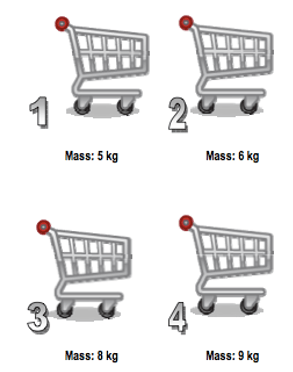
What does the first part of Newton’s first law say about objects in motion?
Objects in motion speed will increase.
Objects in motion speed will decrease.
Objects will move at the same speed and direction unless force changes their motion.
Force does not affect the change in an objects motion.
What does the second part of Newton’s first law say about objects at rest?
They cannot move unless they have a lot of friction.
If they are heavy, they will stay at rest, but if they are light, they will move.
They will stay at rest unless an outside force makes them move.
They have more inertia than objects in motion.
Force=Mass x Acceleration
Newton's First Law
Newton's Second Law
Newton's Third Law
Isaac Newton stated for every action there is an
_________ and _________ reaction.
equal and same
equal and opposite
unequal and same
unequal and opposite
What determines an object’s mass?
amount of matter
amount of friction
amount of force
amount of gravity
What is inertia?
Only how things move
Only how things do not move
How things move and don't move
All of the above
While you’re ice-skating with your friends, you push off from one end of the rink and slide forward. Based on Newton’s first law of motion, what is true?
You will lose your balance and fall over before your reach the middle of the ice rink.
You will continue to slide across the ice until a force makes you stop or change direction.
The force of gravity will make you keep your velocity until your friends make you stop.
The size of your ice skates will determine how quickly or slowly you travel across the ice.
Your friend kicks a soccer ball, and it stops a few feet from you. What needs to happen to it in order for it to return to your friend?
Friction has to be applied to the ball.
Force has to be applied to the ball.
Speed has to be applied to the ball.
Inertia has to be applied to the ball.
What does friction do to a moving object?
Makes it rise
Slows it down
Speeds it up
All of the above
How is velocity different from speed?
Velocity is when an object goes in reverse.
Velocity is the direction an object moves in, and it has nothing to do with speed.
Velocity is speed and direction together.
Velocity is not at all different from speed.
You are riding in the car with your grandfather, and he turns left. Why do you shift to the right?
It takes you a moment to catch up with the new velocity of the car.
You have more inertia than the car, so it take longer for you to turn left.
You had been sitting at rest until the force of the turn set you in motion.
The car continued in the same velocity, but you had a different inertia.
The rate at which an object’s velocity changes is called what?
inertia
actualization
acceleration
completion
Your neighbor is riding her bike around the block. When she slows down and turns a corner, what changes about her?
velocity
friction
speed only
balance
Every time your cat’s paw hits her toy string, it swings away from her. How does this demonstrate Newton’s third law of motion?
Objects with mass, such as your cat's paw and toy string, will require inertia.
Objects in action, such as the string toy, will experience force.
For every motion from your cat's paw, there is unbalanced inertia from the string.
For every action your cat makes, there is an equal and opposite reaction from the string.
A softball and a volleyball collide with equal speed, and then they accelerate at the same rate. What must be true about the masses of the objects?
The softball has more mass than the volleyball.
The softball and the volleyball have equal mass.
The volleyball has more mass than the softball.
It is impossible to compare the mass of the softball and the volleyball
___ refers to how fast an object is moving.
Speed
Velocity
Acceleration
Motion

