wayground logo

Free Printable Worksheets

Font size

S
M
L
XL
Worksheets

Forces and Motion 5

Total questions: 84

Worksheet time: 1hrs 29mins

Name
Class
Date
1.

The formula for Speed is...

a)

Speed = distance/ time

b)

Speed = time/ distance

2.

If you are solving for the distance, you would calculate the...

a)

time divided by speed

b)

speed divided by time

c)

speed multiplied by time

d)

distance multiplied by speed

3.

Based on the UNITS given, which of the following would be a correct answer for finding the SPEED.

a)

S = 4 miles

b)

S = 4 minutes

c)

S = 4 min/miles

d)

S = 4 miles/min

4.

Which of the following could be a correct answer for solving for the time?

a)

t= 4 kilometers

b)

t = 4 km/hr

c)

t = 4 hr

d)

t = 4hr/km

5.

Which of the following could be an answer if solving for the distance?

a)

d = 4 seconds

b)

d = 4 meters/second

c)

d = 4 seconds/meters

d)

d = 4 meters

6.

If Sally is speeding through the parking lot at 18m/hr, and she travels 9 m, how long did it take her?

a)

2 m/hr

b)

0.5 hr

c)

2 m

d)

0.5 m

7.

What is missing in the triangle of knowledge?

a)

speed

b)

distance

c)

time

d)

minutes

8.

In order to find the Time, you must

a)

divide the distance by the speed (distance/speed)

b)

multiply the distance by the speed (distance/speed)

c)

Neither of the Above

9.

How do we find speed?

a)

time x distance

b)

time - distance

c)

distance + time

d)

distance ÷ time

10.

A toy car moved along a 1.2 km track in 6 min. Find the speed of the toy car.

a)

0.2 km/h

b)

1.2 m/min

c)

12 km/h

d)

200 m/h

11.

A car travelled 52 km in  ½h. Find the speed of the car.

a)

104 km/h

b)

85 km/h

c)

26 km/h

d)

17 km/h

12.

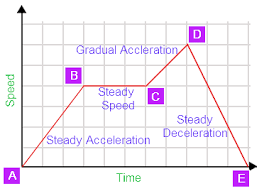
When was the object sitting still?

a)

between 5 and 6 seconds

b)

between 2 and 5 seconds

c)

between 1 and 2 seconds

d)

between 0 and 1 second

13.

At what point is the object moving back to the starting point?

(a)  

14.

A car covers 450 m in 1 minute. A train covers 6900 m in 15 minutes. Which one is travelling faster?

a)

The car

b)

The train

15.

At what point is the speed the greatest?

a)

C-D

b)

B-C

c)

A-B

d)

D-E

16.

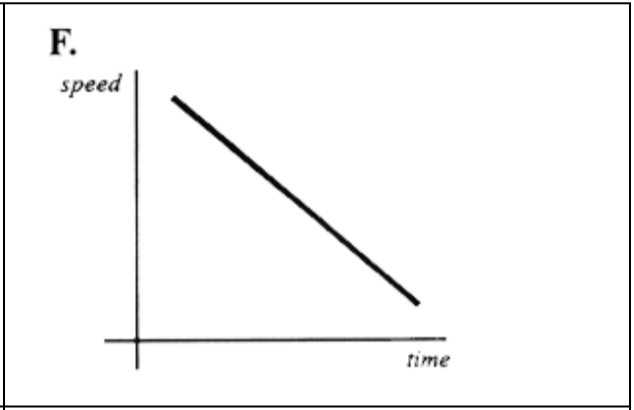
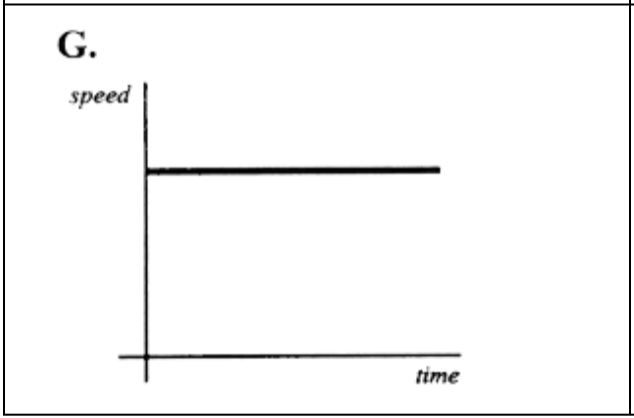
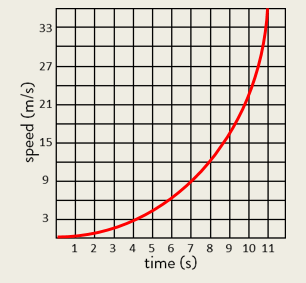
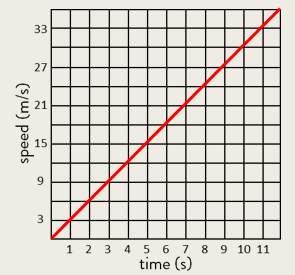
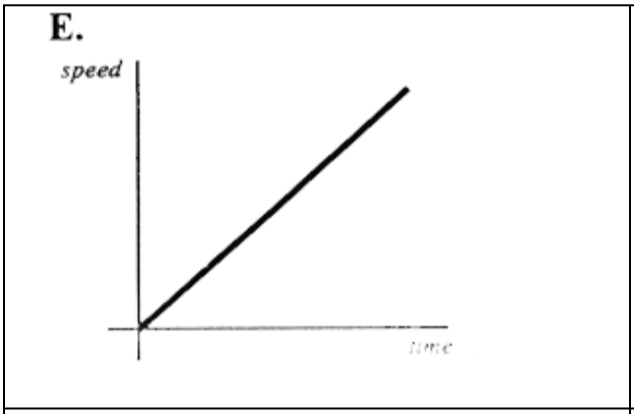
Match the graph to the description:

"The car is slowing down."
a)
b)
c)
d)
17.

What is this graph showing?

a)

Gradually slowing down

b)

Gradually speeding up

c)

Constant speed

d)

Stopped

18.
a)

Accelerating gradually

b)

Stopping

c)

Slowing down constantly

d)

Speeding up constantly

19.

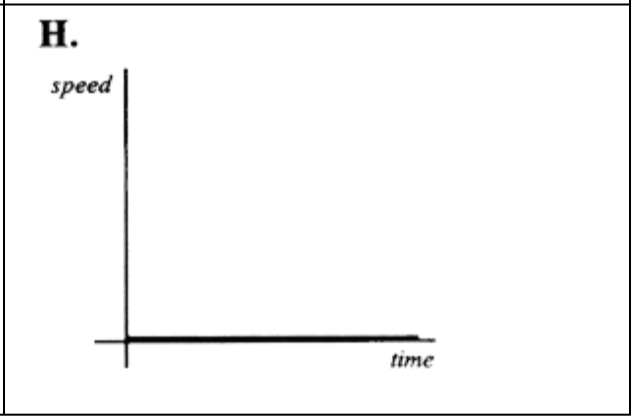
Match the graph to the description:

"The car is stopped."
a)
b)
c)
d)
20.

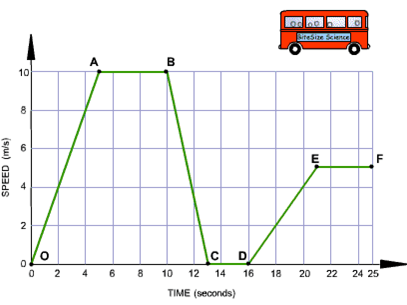
How many seconds did it take for the bus to travel from O to C?

a)

4 sec.

b)

10 sec.

c)

13 sec.

d)

14 sec.

21.

What line has the greatest speed?

a)

Line A

b)

Line B

c)

Both

d)

Neither

22.

What is this graph showing?

a)

Acceleration (Speeding up)

b)

Acceleration (Slowing down)

c)

An object moving at a constant speed

d)

Object at rest

23.

Same distance each second (always the same speed) is what?

a)

Constant Speed

b)

Instantaneous speed

c)

Average Speed

24.

Total distance divided by total time is what?

a)

Constant Speed

b)

Instantaneous speed

c)

Average Speed

25.
Which graph shows: a car slowing down and coming to a stop.
a)
A
b)
B
c)
C
d)
D
26.

What is the acceleration during the first 5 seconds?

a)

2 m/s2

b)

4 m/s2

c)

5 m/s2

d)

10 m/s2

27.

speed of an object in a particular direction

a)

motion

b)

velocity

c)

speed

d)

acceleration

28.

when an object changes its position compared to a reference point.

a)

acceleration

b)

speed

c)

motion

d)

reference point

29.

total distance traveled divided by total time taken to travel that distance

a)

velocity

b)

motion

c)

acceleration

d)

average speed

30.

the rate at which speed or velocity changes

a)

acceleration

b)

average speed

c)

motion

d)

reference point

31.

an object that appears to stay in place and that helps you detect motion in another object

a)

acceleration

b)

average speed

c)

motion

d)

reference point

32.

Is this a speed or acceleration graph?

a)

speed

b)

acceleration

33.

Is this a speed or acceleration graph?

a)

speed

b)

acceleration

34.

What is happening at segment A?

a)

no motion/object at rest

b)

constant speed

c)

deceleration

35.

A runner crossed the 1 mile marker of a race running at a speed of 9 miles per hour. She crossed the finish line running at a speed of 9.8 miles per hour. Did the runner change her velocity?

a)

Yes

b)

No

36.

The formula for calculating speed is...(x means multiply; / means divide)

a)

time x distance

b)

distance x speed

c)

distance / time

d)

time / distance

37.

Speed = _______________

a)

Distance + time

b)

Distance – time

c)

Distance x time

d)

Distance / time

38.

Velocity = _______________

a)

Speed – direction

b)

Speed + direction

c)

Speed x direction

d)

Speed / direction

39.

At what speed would a car have to move in order to travel 20 kilometers in 2 hours.

a)

5 km/hr

b)

10 km/hr

c)

20 km/hr

d)

40 km/hr

40.
What is the definition of velocity?
a)
A force that opposes motion
b)
Uniform circular motion
c)
The speed of an object in a particular direction
41.

What is this?

"This airplane is traveling at 500 mph, West"

a)

Speed

b)

Velocity

c)

Acceleration

42.

A helicopter flies west 200 miles in 2 hours. What is its velocity?

a)

99 mph

b)

100 mph south

c)

400 mph south

d)

297 mph south

43.

What two things must you know to determine speed?

a)

distance and direction

b)

direction and time

c)

speed and direction

d)

time and distance

44.

What is Newtons 1st law

a)

Inertia

b)

F=m*a

c)

Mass and acceleration

d)

force

45.

Mr. Haughey crashed his car. When he crashed, the car stops but he keeps going forward. Which one of newtons laws is this.

a)

2nd law

b)

1st law

c)

3rd law

d)

4th law

46.

Which one of these is the 2nd law

a)

The harder I push this, the faster it will go

b)

If I am in a car crash, and the car stops, why do I keep going forward?

c)

When I push on my desk, it pushes back at me

d)

When i drop a feather and a brick and there is no air resistance, they will land the same time

47.

The harder I push Andrew on the cart, the faster he will go. Which one of Newtons laws is this?

a)

2nd law

b)

1st law

c)

3rd law

d)

4th law

48.

Which one of Newtons laws does this equation belong to. F=m*a

a)

1st law

b)

2nd law

c)

3rd law

d)

4th law

49.

What happens if I push someone harder

a)

The will go upwards

b)

They will move forward slower

c)

They won't move at all

d)

They will move forward faster

50.
What law is best described by inertia?
a)
1st
b)
2nd
c)
3rd
d)
law of conservation of mass
51.
a)
1st
b)
2nd
c)
3rd
d)
law of motion
52.
Equal and Opposite
a)
1st
b)
2nd
c)
3rd
d)
speed 
53.
A magician pulls a tablecloth out from under dishes and glasses on a table without disturbing them.
a)
Newton's 1st Law
b)
Newton's 2nd Law
c)
Newton's 3rd Law
54.
A person not paying attention while skateboarding hits a rock. The skateboard stops...they don't.
a)
The Law of Inertia (1st law)
b)
The Law of Acceleration (2nd law)
c)
The Law of Conservation of Momentum
d)
Action Reaction Law (3rd law)
55.
What Unit do we Measure Force in? 
a)
Newtons
b)
Joules
c)
Force
d)
Kilograms
56.
With unbalanced forces, the object will move in the direction that the _______ force is being applied.
a)
larger 
b)
smaller 
c)
equal 
d)
less
57.
What is Newton's First Law
a)
F=ma
b)
Every action has an equal and opposite reaction
c)
An object at rest stays at rest, an object in motion stays in motion. 
d)
Friction 
58.
A person is pushed forward into their seatbelt when a car stops
a)
1st
b)
 2nd
c)
2 and 3
d)
3rd 
59.
Which type of force(s) will cause a change in an object's motion?
a)
gravity
b)
zero net force
c)
balanced forces
d)
unbalanced forces
60.
A 20 kg bike accelerates at 10 m/s2.  what was the force
a)
25 Newtons
b)
20 Newtons
c)
200 Newtons
d)
10 Newtons
61.
Newton's third law states that any action will have a(n) _______ and ______ reaction
a)
Equal and similar
b)
Equal and opposite
c)
Equal and different
d)
Greater and opposite
62.
8 N to the left , and 4 N to the right. Find the net force. Is this balanced 
a)
12 N Right  No
b)
4 N Left  No
c)
12 N Right  Yes
d)
4 N Left  Yes
63.
You hit a wall with a stick.  The equal but opposite reaction is _____
a)
the wall pushes against you
b)
the stick pushes against you
c)
you push against the stick
d)
the wall pushes against the stick
64.
What is Newton's First Law known as? The Law of
a)
Friction
b)
Mass
c)
Inertia
d)
Gravity
65.
What is the acceleration of an object traveling at a constant velocity?
a)
10 m/s2
b)
0 m/s2
c)
250 m/s2
d)
20 m/s2
66.
What are the appropriate units to describe acceleration?
a)
m/s
b)
m/s2
c)
cm
d)
there are no units associated with acceleration
67.
What is an example of Newton's first law?
a)
Trying to push a couch that's sitting on a fluffy rug is harder than pushing that same couch on a smooth floor
b)
Jumping on a diving board
c)
A pair of snow skis aren't going to go anywhere without a skier in them forcing them to move
d)
A ball rolling along a level surface will eventually slow down and stop due to friction
68.
What is an example of inertia?
a)
Jumping on a diving board
b)
Trying to push a couch that's sitting on a fluffy rug is harder than pushing that same couch on a smooth floor
c)
A book on a table remaining at a rest
d)
A ball rolling along a level surface will eventually slow down and stop due to friction
69.
What is an example of air resistance?
a)
A ball rolling along a level surface will eventually slow down and stop due to friction
b)
Jumping on a diving board
c)
Trying to push a couch that's sitting on a fluffy rug is harder than pushing that same couch on a smooth floor
d)
A paper airplane slowing down a in the wind
70.

What type of force is a contact force?

a)

magnetism

b)

friction

c)

gravity

71.
What is velocity?
a)
Movement with speed and direction
b)
The resistance that one surface or an object encounters when moving against another
c)
A tendency to do nothing or to remain unchanged
d)
The amount of stuff that makes up something
72.
What is an example of Newton's third law?
a)
a car moving forward when being pushed forward
b)
A ball rolling along a level surface will eventually slow down and stop
c)
Jumping on a diving board
d)
The resistance that one surface or an object encounters when moving against another
73.
What is the concept of air resistance?
a)
A force that affects speed of moving objects
b)
A change in speed or direction of something
c)
A tendency to do nothing or to remain unchanged
d)
The amount of stuff that makes up something
74.
Which of Newtons laws  best explains why football teams have big, large, fast athletes.
a)
Gravity
b)
second law
c)
first law
d)
Third law
75.
It takes more force to accelerate the iron man on the left than the iron man on the right because the iron man on the left has more mass. This best describes
a)
Newton's first law, the law of inertia
b)
Newton's second law, the law of acceleration
c)
Newton's third law, the law of action reaction 
d)
The law of universal gravitation
76.
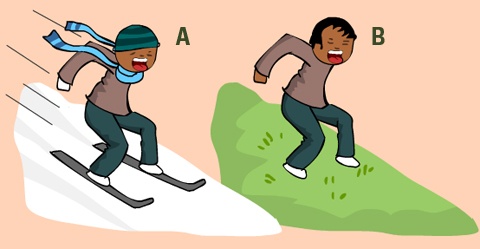
Why is it harder for the boy in Image B to get down the hill?
a)
Motion
b)
Friction
c)
Work
d)
Displacement
77.
Newton's third law states that any action will have a(n) _______ and ______ reaction
a)
Equal and similar
b)
Equal and opposite
c)
Equal and different
d)
Greater and opposite
78.

What law is best described

A person not paying attention while skateboarding hits a rock. The skateboard stops...they don't.

a)

The Law of Inertia (1st law)

b)

The Law of Acceleration (2nd law)

c)

The Law of Conservation of Momentum

d)

Action Reaction Law (3rd law)

79.

Your car has a mass of 2500 kg and a force of 5000 N. How fast will it accelerate?

a)

1 m/s2

b)

2 m/s2

c)

3 m/s2

d)

4 m/s2

80.

What is the force of a baseball that has a mass of 142 kg and has an acceleration of 30 m/s2?

a)

1 N

b)

2 N

c)

4260 N

d)

3 N

81.
What do each of the letters correctly represent?
a)
Funny, Monkeys, Arrive
b)
Force, Mass, Acceleration
c)
Free, Mass, Access
d)
Force, Magnesium, Arsenic
82.
A change in velocity over time is called ___________.
a)
speed
b)
force
c)
acceleration
d)
direction
83.
A 20 kg bike accelerates at 10 m/s2.  what was the force
a)
25 N
b)
200 N
c)
20 N
d)
10 N
84.

A 20 kg bike has a force of 200 N, what is the bike's acceleration?

a)

25 m/s2

b)

10 m/s2

c)

20 N

d)

10 N