
NEW
Font size
S
M
L
XL
 Worksheets
Seasons Flocabulary
Total questions: 78
Worksheet time: 59mins
Name
Class
Date
1.

What season is it in the Southern Hemisphere when it is fall in the Northern Hemisphere?
a)
winter
b)
spring
c)
summer
d)
fall
2.

Why does the area around the equator stay the same temperature all year?
a)
The equator rotates slower than the poles.
b)
The equator remains the same distance from the sun.
c)
The equator always receives direct sunlight.
d)
The equator has 18 hour days.
3.
In the Northern Hemisphere, on which day will you receive the most daylight?
a)
September 21
b)
December 21
c)
March 21
d)
June 21
4.

Which season is taking place in the Southern Hemisphere in Position 1?
a)
Winter
b)
Spring
c)
Summer
d)
Fall
5.

Which season is taking place in the Northern Hemisphere in Position 2?
a)
Winter
b)
Spring
c)
Summer
d)
Fall
6.

Which season is taking place in the Northern Hemisphere in Position 3?
a)
Winter
b)
Spring
c)
Summer
d)
Fall
7.
One rotation of Earth is equal to
a)
a day.
b)
a year.
8.
Objects in the sky appear to move from _______ to _______.
a)
East to West
b)
West to East
c)
North to South
d)
South to North
9.
Objects appear to move from east to west because Earth turns from _______ to ________.
a)
East to West.
b)
West to East.
c)
North to South.
d)
South to North.
10.
What would seasons be like if Earth's axis were straight up and down?
a)
Seasons would be the same.
b)
Seasons would be more extreme.
c)
There would be no seasons.
11.
If Earth rotated slower, we would have...
a)
shorter days.
b)
longer days.
c)
shorter years.
d)
longer years.
12.
Which seasons have an equal amount of daylight and darkness?
a)
Spring and Fall
b)
Winter and Summer
c)
Winter and Spring
d)
Summer and Fall
13.
Which climate zone experiences 4 seasons?
a)
Polar
b)
Temperate
c)
Tropical
d)
None
14.
Where on Earth can you experience entire days of darkness?
a)
The equator
b)
The poles
c)
The Tropic of Cancer
d)
The Tropic of Capricorn
15.
When will the sun reach the highest altitude at noon?
a)
December
b)
March
c)
September
d)
June
16.
_____________ happens as we begin to turn towards the sun.
a)
Sunset
b)
Sunrise
17.
The Northern Hemisphere gets __________ sunlight in the winter, which leads to _________ temperatures.
a)
less direct, hotter
b)
less direct, colder
c)
more direct, hotter
d)
more direct, colder
18.
Which angle of sunlight produces the most heat?
a)
90 degrees
b)
60 degrees
c)
30 degrees
d)
0 degrees
19.
Which angle of sunlight represents the sunlight that reaches the poles?
a)
90 degrees
b)
60 degrees
c)
30 degrees
d)
0 degrees
20.
Which climate zone receives the most direct sunlight?
a)
Polar
b)
Temperate
c)
Tropical
21.
Which movement of Earth causes day and night?
a)
rotation
b)
revolution
22.

Which season is taking place in the Southern Hemisphere in Position 4?
a)
Winter
b)
Spring
c)
Summer
d)
Fall
23.
What is Earth's annual motion around the sun called?
a)
Rotation
b)
Revolution
24.
How long does Earth take to make a complete rotation?
a)
365 days
b)
24 hours
25.

Why do globes lean sideways?
a)
To allow them to spin easier.
b)
To demonstrate the tilt of Earth's axis.
c)
To demonstrate the effects of gravity.
d)
To demonstrate day and night.
26.
Which season has the least amount of daylight in the Northern Hemisphere?
a)
Winter
b)
Spring
c)
Summer
d)
Fall
27.

In winter, the axis of the earth is pointed away or toward the sun?
a)
towards
b)
up
c)
down
d)
away
28.

In summer, the axis of the earth is pointed away or toward the sun?
a)
towards
b)
up
c)
down
d)
away
29.

Why is it warmer in the summer?
a)
Closer to the sun
b)
More direct light from Earth's tilt
c)
Stronger light from the sun
d)
Earth spins slower
30.

Which season is taking place in the Northern Hemisphere in Position 3?
a)
Winter
b)
Spring
c)
Summer
d)
Fall
31.

Which season is taking place in the Northern Hemisphere in Position 3?
a)
Winter
b)
Spring
c)
Summer
d)
Fall
32.

Which season is taking place in the Northern Hemisphere in Position 4?
a)
Winter
b)
Spring
c)
Summer
d)
Fall
33.
The Earth's axis is tilted _____ degrees.
a)
23.5
b)
25.3
c)
30.2
d)
24
34.

At position A, which hemisphere would have summer?
a)
Northern hemisphere
b)
Southern hemisphere
35.

What happens when the area in which you live tilts away from the sun?
a)
It is summer.
b)
It is spring.
c)
It is winter.
d)
It is fall.
36.
The term equinox means....
a)
equal amount of day light and equal amount of night
b)
Equal amount of winter and summer
c)
Equal amounts of hot dogs for everyone
d)
The longest day of the year
37.
What do June 21 and December 21 have in common?
a)
equinox dates
b)
the moon is full
c)
solstice dates
d)
the cold fronts blow in
38.
What is the longest day of the year?
a)
winter solstice
b)
summer solstice
c)
fall equinox
d)
spring equinox
39.
Why do we experience the changing of the season on the earth?
a)
distance from the sun
b)
rotation of the earth
c)
change in solar output
d)
tilt of the earth's axix
40.

Why is the Equator warmest?
a)
Because it is closest to the sun.
b)
Because it receives the most direct sunlight
c)
Because no clouds form here.
d)
Because it is far from the sun
41.
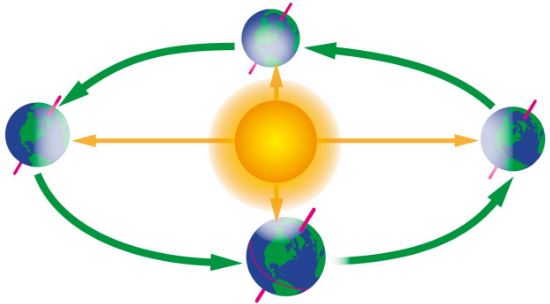
In spring/summer, the axis of the earth is pointed away or toward the sun?
a)
towards
b)
Neither away or toward
c)
away
42.

Which season is taking place in the Southern Hemisphere in Position 1?
a)
Winter
b)
Spring
c)
Summer
d)
Fall
43.

Which season is taking place in the Northern Hemisphere in Position 2?
a)
Winter
b)
Spring
c)
Summer
d)
Fall
44.

Which point is the northern hemisphere experiencing summer?
a)
1
b)
2
c)
3
d)
4
45.

Which point is the northern hemisphere experiencing winter?
a)
1
b)
2
c)
3
d)
4
46.

Which point is the southern hemisphere experiencing summer?
a)
1
b)
2
c)
3
d)
4
47.

Which point is the northern hemisphere experiencing spring?
a)
1
b)
2
c)
3
d)
4
48.

Which points are experiencing equal amount of sunlight?
a)
1 and 2
b)
1 and 3
c)
3 and 4
d)
2 and 4
49.

Which of these locations experiences the least amount of change in daylight hours throughout the year and WHY?
a)
equator, because it is the middle of the earth and receives more light in the summer
b)
equator, because it is the middle of the earth and receives equal light
c)
tropic of cancer, because it is at the top of the earth and is always pointing toward the sun
d)
tropic of capricorn, because it is at the bottom of the earth and sometimes points toward the sun
50.

Which of these locations on Earth experiences the largest change in the number of daylight hours?
a)
Equator only
b)
Tropic of cancer and equator
c)
Tropic of capricorn and equator
d)
Tropic of cancer and tropic of capricorn
51.

What season is the Northern Hemisphere experiencing?
a)
Fall
b)
Winter
c)
Spring
d)
Summer
52.

What season is the Southern Hemisphere experiencing?
a)
Fall
b)
Winter
c)
Spring
d)
Summer
53.

Which location would have the shortest days and longest nights?
a)
South pole
b)
Equator
c)
North pole
d)
south and north poles
54.

Which months are NEITHER of the poles tilted toward or away from the sun?
a)
June and December
b)
September and December
c)
September and March
d)
March and June
55.

Why is it colder in winter than in summer at the poles?
a)
The earth is farther away from the sun in winter.
b)
The pole is tilted away from the sun and receiving less direct sunlight.
c)
The pole is tilted toward the sun and receiving less direct sunlight.
d)
The snow and rain during winter lowers the temperatures.
56.

Why is it warmer in summer than in winter at the poles?
a)
The earth is closer to the sun in the summer.
b)
The pole is tilted away from the sun and receiving more direct sunlight.
c)
The pole is tilted toward the sun and receiving more direct sunlight.
d)
The snow and rain during winter lowers the temperatures.
57.

Which answer choice correctly labels the seasons in the Northern Hemisphere, beginning with position #1?
a)
Winter, fall, summer, spring
b)
Summer, fall, winter, spring
c)
Spring, fall, summer, winter
d)
Fall, winter, spring, summer
58.

Which answer choice correctly labels the seasons in the Northern Hemisphere AND identifies their opposite season?
a)
1 - summer, 3 - winter
b)
1 - fall, 3 - spring
c)
2 - winter, 3 - spring
d)
2 - summer, 4 - winter
59.

The image shows the four positions of Earth as it revolves around the Sun. At which position will the number of hours of daylight be at a minimum in the Northern Hemisphere?
a)
position 4
b)
position 3
c)
position 2
d)
position 1
60.

The image shows the four positions of Earth as it revolves around the Sun. At which position will the number of hours of daylight be at a maximum in the Northern Hemisphere?
a)
position 4
b)
position 3
c)
position 2
d)
position 1
61.

Earth has seasons because its axis is tilted in the same direction as it moves around the Sun. Which position of the Earth corresponds to summer in the Northern Hemisphere?
a)
Position W
b)
Position X
c)
Position Y
d)
Position Z
62.

Earth has seasons because its axis is tilted in the same direction as it moves around the Sun. Which position of the Earth corresponds to fall in the Northern Hemisphere?
a)
Position W
b)
Position X
c)
Position Y
d)
Position Z
63.

Earth has seasons because its axis is tilted in the same direction as it moves around the Sun. Which position of the Earth corresponds to spring in the Northern Hemisphere?
a)
Position W
b)
Position X
c)
Position Y
d)
Position Z
64.

Jaylin draws the orbit of Earth around the Sun. What changes in climate will Earth experience based upon Jaylin's drawing?
a)
The seasons will only occur in regions around the equator.
b)
The seasons will only occur in regions around the poles.
c)
There will only be summer and winter on Earth.
d)
There would be no seasons on Earth.
65.

The diagram shows the three major climate zones on Earth. The average annual temperatures vary across the three zones. Which option correctly determines the reasons for the variations in temperature among the three climate zones?
a)
*changes in the position of the sun in the sky
*Earth's revolution around the Sun
*Earth's revolution around the Sun
b)
*changes in the orbital path of the Earth *Earth's rotation on its tilted axis
c)
*the Sun's rays striking Earth at different angles *the tilt of the Earth's axis
d)
*the increase in distance between the Sun and the Earth *changes in the angle of Earth's tilt
66.

The image shows Earth tilted on its axis and the rays from the Sun falling on it at a particular time of the year. How do the lengths of days in both hemispheres compare on this day?
a)
The length of days and nights will be equal in both hemispheres because the Sun is directly overhead at the equator.
b)
The length of days and nights will be equal in both hemispheres because the Sun is directly overhead at the North Pole.
c)
The days will be longer in the Northern Hemisphere than in the Southern Hemisphere because the Sun is directly above the Tropic of Cancer.
d)
The days will be longer in the Southern Hemisphere than in the Northern Hemisphere because the Sun is directly above the Tropic of Capricor
67.

The image shows the orbit of Earth around the Sun with its axis tilted. In which position will the Northern Hemisphere have the greatest number of daylight hours?
a)
Position 1
b)
Position 2
c)
Position 3
d)
Position 4
68.
The image shows the orbit of Earth around the Sun with its axis tilted. In which position will the Northern Hemisphere have the least number of daylight hours?
a)
Position 1
b)
Position 2
c)
Position 3
d)
Position 4
69.

The diagram represents Earth at four different positions A, B, C, and D in its orbit around the Sun. Between which two positions would the United States be experiencing winter?
a)
positions A and B
b)
positions B and C
c)
positions C and D
d)
positions D and A
70.
The diagram represents Earth at four different positions A, B, C, and D in its orbit around the Sun. Between which two positions would the United States be experiencing summer?
a)
positions A and B
b)
positions B and C
c)
positions C and D
d)
positions D and A
71.
The diagram represents Earth at four different positions A, B, C, and D in its orbit around the Sun. Between which two positions would the United States be experiencing spring?
a)
positions A and B
b)
positions B and C
c)
positions C and D
d)
positions D and A
72.
The diagram represents Earth at four different positions A, B, C, and D in its orbit around the Sun. Between which two positions would the United States be experiencing fall?
a)
positions A and B
b)
positions B and C
c)
positions C and D
d)
positions D and A
73.
Which day has the most sunlight in the United States?
a)
June 18
b)
March 25
c)
September 26
d)
December 19
74.
Which day has the least sunlight in the United States?
a)
June 18
b)
March 25
c)
September 26
d)
December 19
75.
What causes the Earth's seasons?
a)
rotation of the Earth
b)
tilt of the Earth's axis
c)
revolution of the Earth around the Sun
d)
revolution of the Moon around the Earth
76.
Which statement describes the motion of the Earth as related to the Sun?
a)
The Sun rotates around the Earth.
b)
The Sun revolves around the Earth.
c)
The Earth revolves around the Sun.
d)
The Earth rotates around the Sun.
77.

What causes the seasons to change?
a)
The warming and cooling of Earth's core.
b)
The distance from the sun.
c)
Earth's tilt in relation to the sun.
d)
Earth's rotation on its axis.
78.

What happens when the area in which you live tilts away from the sun?
a)
It is summer.
b)
It is spring.
c)
It is winter.
d)
It is fall.
Reset

