wayground logo

Free Printable Worksheets

Font size

S
M
L
XL
Worksheets

Chemistry Spring Benchmark Questions

Total questions: 95

Worksheet time: 5hrs 4mins

Name
Class
Date
1.
Which side of a chemical equation is the reactant side?
a)
Left (before the yields sign)
b)
Right (after the yields sign)
2.
Which side of a chemical equation os the product side?
a)
Left (before the yields sign)
b)
Right (after the yields sign)
3.
Which problem is balanced?
a)
PbO2 + 2H2
b)
SO2 + H20 --> H2SO4
c)
2Na + 2H2O --> 2NaOH + H2
4.
What is a coefficient?
a)
The small number on the right of the chemical symbol.
b)
The large number to the left of a formula.
5.
A replacement occurs when...
a)
Two formulas combine.
b)
A formula breaks apart.
c)
An atom is replaced during a reaction.
6.
Decomposition occurs when...
a)
Two formulas combine.
b)
A formula breaks apart.
c)
An atom is replaced during a reaction.
7.
A synthesis occurs when...
a)
Two formulas combine.
b)
A formula breaks apart.
c)
An atom is replaced during a reaction.
8.
Is the equation balanced?: 2H2O + O2 --> 4MgO + 3Fe
a)
Yes
b)
No
9.
How would this equation be classified?
O2 + 2H2 --> 2H2
a)
Synthesis
b)
Decomposition
c)
Combustion
d)
Single Displacement
10.
Balance this equation:
MgCl2 --> Mg4+ Cl2
a)
It's already balanced.
b)
4MgCl2 --> Mg4+ 4Cl2
c)
4MgCl2 --> Mg4+ 5Cl2
11.
Balance this equation:
FeS + 2HCl -->
FeCl2 + H2O
a)
FeS2 + 2HCl --> FeCl2 + H2O
b)
It's already balanced
c)
FeS2 + 2HCl --> FeCl2 + H4O
d)
None of these
12.
Balance this equation:
 2Li + Cl2 -> LiCl
a)
2Li + Cl2 -> 4LiCl2
b)
2Li + Cl2 -> LiCl2
c)
2Li + Cl2 -> 2LiCl
13.
What is the right ratio of chemicals for the BCE (Balanced Chemical Equation)?__Na + __H2O --> __NaOH + __H2
a)
2,2 --> 2,1
b)
4,4 --> 4,1
c)
1,2 --> 2,4
d)
1,2 --> 2,1
14.

What is the right ratio of chemicals for the BCE (Balanced Chemical Equation)?

__Ca + __H2O --> __Ca(OH)2 + __H2

a)
2,1 --> 2,1
b)
1,2 --> 1,1
c)
1,2 --> 2,4
d)
1,2 --> 2,1
15.
What is the right ratio of chemicals for the BCE (Balanced Chemical Equation)?__CO + __Fe2O3--> __Fe + __CO2
a)
3,1 --> 2,3
b)
3,2 --> 1,1
c)
3,2 --> 2,4
d)
3,2 --> 2,1
16.
What is the right ratio of chemicals for the BCE (Balanced Chemical Equation)?__CH4 + __O2 --> __CO2+ __H2O
a)
2,1 --> 2,1
b)
1,2 --> 1,1
c)
1,2 --> 1,2
d)
1,2 --> 2,1
17.
What is the right ratio of chemicals for the BCE (Balanced Chemical Equation)?__H2 + __S --> __H2S
a)
1,1 --> 1
b)
2,2 --> 2
c)
1,2 --> 1
d)
1,2 --> 2
18.
What is the right ratio of chemicals for the BCE (Balanced Chemical Equation)?__H2SO3 + __KOH--> __H2O+ __K2SO3
a)
2,1 --> 2,1
b)
1,2 --> 1,1
c)
1,2 --> 1,2
d)
1,2 --> 2,1
19.
What is the right ratio of chemicals for the BCE (Balanced Chemical Equation)?__Al + __O2--> __Al2O3
a)
4,1 --> 2
b)
4,3 --> 4
c)
3,4 --> 1
d)
4,3 --> 2
20.
What is the right ratio of chemicals for the BCE (Balanced Chemical Equation)?__FeCl3 + __Ca(OH)2 --> __Fe(OH)3 + __CaCl2
a)
4,3--> 2,1
b)
3,2 --> 3,1
c)
2,3 --> 2,2
d)
2,3 --> 2,3
21.
2 KClO3 → 2 KCl + 3 O2
How many moles of oxygen are produced when 6.7 moles of KClO3 decompose completely?
a)
6.7 mol
b)
1.0 mol
c)
10.1 mol
d)
4.5 mol
22.
2Na + 2H2O → 2NaOH+ H2
How many grams of hydrogen are produced if 120 g of Na are available?
a)
5.2 g
b)
2.6 g
c)
690 g
d)
45 g
23.
What is the measured amount of a product obtained from a chemical reaction?
a)
mole ratio
b)
theoretical yield
c)
percentage yield
d)
actual yield
24.
2 CO (g) + O2(g) → 2 CO2 (g)
In the formation of CO2 from CO and oxygen, how many Liters of CO2 are produced by the reaction of 8 mols of O2 with an excess of carbon monoxide?
a)
0.178 L
b)
358.4 Liters
c)
704 grams
d)
0.36 grams
25.
 SiO2 + 3C → SiC + 2CO
I need to add 8 moles of Carbon to the reaction. How many grams of Carbon should I weigh?
a)
96 g
b)
0.67 g
c)
2.67 g
d)
48 g
26.
Cl2 + 2 KBr → Br2 + 2 KCl
How many grams of potassium chloride can be produced from 356 g of chlorine and 356 g of potassium bromide?
a)
749 g
b)
223 g
c)
479 g
d)
814 g
27.
CH4 + 2 O2 → CO2 + 2 H2O
How many moles of carbon dioxide are produced from the combustion of 110 g of CH4?
a)
13.7 mol
b)
2.75 mol
c)
6.11 mol
d)
6.85 mol
28.
Fe (s) + S (l) --> FeS (s)  

In the experiment above, 7.62 g of Fe are allowed to react with 8.67 g of S.
How much FeS is formed?
a)
14.8 g
b)
12.2 g
c)
13.7 g
d)
19.9 g
29.
Identify the limiting reagent when 6.00 g HCl combines with 5.00 g Mg to form MgCl2.
 
Mg +  2HCl --> MgCl2  +  H2   
 
a)
Mg
b)
H2
c)
MgCl2
d)
HCl
30.
How many particles are in 13.5 grams of Beryllium?
a)
1.5 particles
b)
9 particles
c)
4x10²³ particles
d)
9x10²³ particles
31.
2 NaClO3 (s) --> 2NaCl (s) +3 O2 (g)  
12.00 moles of NaClO3 will produce how many grams of O2?
a)
256 g of O2
b)
576 g of O2
c)
288 g O2
32.
Si + S8 →Si2S4
a)
Synthesis (combination)
b)
Decomposition
c)
Single replacement
d)
Double replacement
33.
Ca + AlCl3→ CaCl2 + Al
a)
Synthesis (combination)
b)
Decomposition
c)
Single replacement
d)
Double replacement
34.
KOH + H3PO4 → K3PO4 + H2O
a)
Synthesis (combination)
b)
Decomposition
c)
Single replacement
d)
Double replacement
35.
Pb(NO3)2 →PbO + NO2 + O2
a)
Synthesis (combination)
b)
Decomposition
c)
Single replacement
d)
Combustion
36.
Mg + N2 →Mg3N2
a)
Synthesis (combination)
b)
Decomposition
c)
Single replacement
d)
Combustion
37.
NO2 →N2 + O2
a)
Synthesis (combination)
b)
Decomposition
c)
Single replacement
d)
Combustion
38.
Fill in the blanks with coefficient:
PCl5+_ H2O→_ HCl+H3PO4
a)
4, 5
b)
1, 6
c)
3, 8
d)
2,2
39.
Balance this equation.
_Mg + _Cl--> _MgCl2
a)
1, 2,1
b)
already balanced
c)
2,1,1
d)
1,1,2
40.
The first energy level can hold up to how many electrons?
a)
8
b)
4
c)
2
d)
5
41.
An atoms overall charge is 
a)
positive 
b)
depends on its mood 
c)
neutral 
d)
negative 
42.
The atoms along the staircase are called 
a)
metals
b)
nonmetals
c)
metalloids
d)
noble gases
43.
Which is a halogen?
a)
Helium
b)
Chlorine
c)
Oxygen
d)
Neptune
44.
A horizontal row of elements in the periodic table.
a)
column
b)
group
c)
period
45.
What is the molar mass of fluorine gas?
(beware!)
a)
18.998 g/mol
b)
38 g/mol
c)
9 g/mol
d)
18 g/mol
46.
Cs2SO4
a)
361.9
b)
361.8
c)
313.9
d)
180
47.
K4Fe(CN)6
a)
368.3
b)
365.3
c)
121.3
d)
726.3
48.
The correct formula for magnesium oxide is 
a)
Mg2O
b)
MgO
c)
MgO2
d)
Mg2O3
49.
What is the mass of one mole of aluminum chloride (remember to determine the correct formula first)?
a)
62.435g
b)
116.399g
c)
133.341g
d)
97.888g
50.
What is the molar mass of (NH4)2O?
a)
34 g/mol
b)
33 g/mol
c)
49 g/mol
d)
50 g/mol
51.
What is the molar mass of Al2(CO3)3
a)
234 g/mol
b)
138 g/mol
c)
210 g/mol
d)
222 g/mol
52.
Find the Molar Mass of:
Ga2(SO3)3
a)
280 g/mol
b)
400 g/mol
c)
380 g/mol
d)
480 g/mol
53.
Find the percent composition of hydrogen in (NH4)2S.
a)
11.8%
b)
41.1%
c)
47.1%
54.
How many moles are in 16.94g of water?
a)
16.94
b)
0.9403
c)
305.2
d)
1.063
55.
What is the molar mass of NaOH?
a)
40 g/mol
b)
38.989 g/mol
c)
23.998 g/mol
d)
57.004 g/mol
56.
The molar mass of an element is equal to its...
a)
Atomic mass
b)
Atomic number
c)
Oxidation number
d)
Valence electrons
57.
What is the mass of one mole of aluminum chloride (remember to determine the correct formula first)?
a)
62.43 g
b)
116.40 g
c)
133.34 g
d)
97.89 g
58.
Find the percent composition of N2S2.
a)
N: 69.6%  S: 30.4%
b)
N:36% S: 75.6%
c)
N: 96.6% S: 3.4%
d)
N: 30.4% S: 69.6%
59.
Which of the following is the correct LD Diagram for Hydrogen Cyanide? HCN?
a)
A
b)
B
c)
C
d)
D
60.
Which LD Diagram is correct for chloromethane (CH3Cl)
a)
A
b)
B
c)
C
d)
D
61.

The substance that dissolves in a solution.

a)

concentration

b)

solute

c)

saturated solution

d)

solvent

62.

A solution that contains the maximum amount of solute.

a)

saturated solution

b)

unsaturated solution

c)

supersaturated solution

d)

pH

63.

A solution that exceeds the maximum amount of solute that should be dissolved in the solvent at that temperature.

a)

saturated solution

b)

unsaturated solution

c)

supersaturated solution

d)

homogeneous

64.

A chemical substance that is slippery, tastes bitter, turns litmus blue, and has pH > 7.

a)

pH

b)

acid

c)

base

d)

metal

65.

In a neutral solution the pH value is always equal to ______.

a)

14

b)

-7

c)

0

d)

7

66.

The solution of known concentration in a titration.

a)

molarity

b)

indicator

c)

saturated

d)

standard

67.

Substances (such as litmus paper, phenolphthalein, cabbage juice) that turn color based on the pH of the solution.

a)

indicators

b)

signals

c)

signs

d)

molarity

68.

The point during a titration when just enough base has been added to completely neutralize the acid.

a)

midpoint

b)

starting point

c)

halfway point

d)

end point

69.

The process in which an acid of known concentration is used to determine the concentration of an unknown base.

a)

saturation

b)

agitation

c)

titration

d)

solution

70.

What is the molarity of a solution that contains 6 moles of solute in 2 liters of solution?

a)

6 M

b)

12 M

c)

7 M

d)

3 M

71.

What is the molarity of 200 mL of solution in which 2.0 moles of sodium bromide is dissolved?

a)

2.0 M

b)

10 M

c)

0.40 M

d)

4.0 M

72.

To 225 mL of a 0.80M solution of KI, a student adds enough water to make 1.0 L of a more dilute KI solution. What is the molarity of the new solution?

a)

180 M

b)

2.8 M

c)

0.35 M

d)

0.18 M

73.

Which of these solutions is the most basic?

a)

[H+] = 1 x 10⁻² M

b)

[OH-] = 1 x 10⁻⁴ M

c)

[H+] = 1 x 10-11 M

d)

[OH-] = 1 x 10-13 M

74.

If the hydrogen ion concentration [H+] is 1 x 10⁻⁷ M, what is the pH of the solution?

a)

1

b)

14

c)

7

d)

0

75.

If the hydrogen ion concentration [H+] is 1 x 10⁻⁷ M, is the solution acidic, basic, or neutral?

a)

acidic

b)

basic

c)

neutral

76.

It takes 83 mL of a 0.45 M NaOH solution to neutralize 235 mL of an HCl solution. What is the concentration of the HCl solution? NaOH + HCl → NaCl + H2O

a)

0.16 M

b)

0.45 M

c)

235 M

d)

83 M

77.

It takes 38 mL of 1.5 M NaOH solution to completely neutralize 55 mL of a sulfuric acid solution (H2SO4). What is the concentration of the H2SO4 solution? H2SO4 + 2 NaOH → Na2SO4 + 2 H2O

a)

0.52 M

b)

38 M

c)

1.5 M

d)

55 M

78.

Which would NOT increase the rate at which a sugar cube dissolves?

a)

Reducing the amount of solvent

b)

Crushing the sugar cube

c)

Stirring the solution

d)

Heating the solvent

79.

The solubility graph below shows the amounts of four substances that will dissolve in 100 grams of water at various water temperatures.


Which substance has 80 grams of solute dissolved in 100 grams of water at 50 C?

a)

Potassium Bromide

b)

Ammonium Chloride

c)

Potassium Chloride

d)

Lithium Hydroxide

80.
How many grams of ammonium chloride are needed to make a saturated solution at 80o C?
a)
50 grams
b)
80 grams
c)
65 grams
d)
75 grams
81.
What is the molarity of  420 mls of a KCl solution that contains 16.0 grams of KCl
a)
625 M
b)
0.51 M
c)
3.19 M
d)
0.00563 M
82.

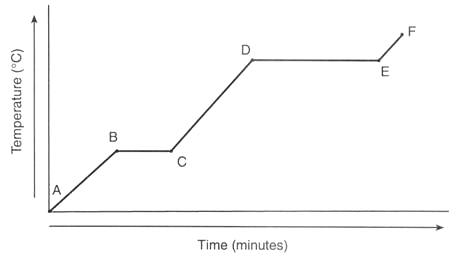
Is the substance gaining or losing energy?

a)

Gaining

b)

Losing

83.

What state/phase is the object likely from points A to B?

a)

Solid

b)

Liquid

c)

Gas

d)

Plasma

84.

Are the particles moving faster or slower as time goes on?

a)

Faster

b)

Slower

85.

Is the substance gaining or losing energy?

a)

Gaining

b)

Losing

86.

What is happening to the particles in the substance between points D and E?

a)

Melting

b)

Freezing

c)

Vaporizing

d)

Sublimating

87.

Where on the graph are phase changes taking place?

a)

1

b)

2

c)

3

d)

4

e)

5

88.
Water exists as a _____________ at 700 mmHg and 50 °C.
a)
solid
b)
liquid
c)
gas
d)
supercritical fluid
89.
What phase change(s) may occur at pressures below 4.58 mmHg?
a)
sublimation/deposition
b)
melting/freezing
c)
all phase changes are possible at these pressures
d)
vaporization/condensation
90.
The pressure is increased on a sample of water at 0 °C from 0 mmHg to 800 mmHg.  In order, what changes occur?
a)
deposition, melting
b)
sublimation, melting
c)
condensation, freezing
d)
deposition, freezing
91.
Based on its phase diagram, which is the most dense state for CO2?
a)
gas
b)
liquid
c)
solid
d)
supercritical fluid
92.
At 10 atm, dry ice is heated from -100 °C to 30 °C.  What changes occur?
a)
freezing, then condensation
b)
melting only
c)
sublimation only
d)
melting, then boiling
93.
What is the normal melting point of CO2?
a)
-78.5 °C
b)
-56.7 °C
c)
31 °C
d)
It doesn't have a normal melting point.
94.
What state of matter is Z?
a)
solid 
b)
liquid
c)
gas
d)
supercritical fluid
95.
What change occurs from E to C?
a)
sublimation
b)
freezing
c)
melting
d)
boiling