
Font size
 Worksheets
Redox Chemistry Review
Total questions: 104
Worksheet time: 5hrs 32mins
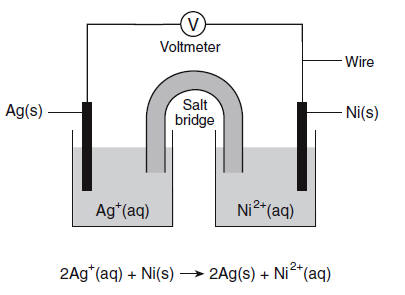

___ Al + ___ Fe+2 → ___ Al+3 + ___ Fe
Is calcium oxidized or reduced in the following reaction? 2CaO ⟶ 2Ca + O2
Oxidized
Reduced
Which energy conversion shown below takes place in a voltaic cell?
Electrical to chemical
Mechanical to chemical
Mechanical to electrical
Chemical to electrical
through the salt bridge
from the cathode to the anode through the wire
from the anode to the cathode through the wire
What is the oxidation number of chlorine in HClO?
0
-1
+1
+5
Oxidation is the _________ of electrons.
loss
gain
sharing
transfer
Reduction is the ___________ of electrons.
loss
gain
sharing
transfer
What is the oxidation number of nitrogen in N2?
-3
0
+4
-1
The sum of the oxidation numbers in SCN- is equivalent to
0
-1
+1
+3
The sum of the oxidation numbers in Na2CO3 is equivalent to
0
-2
+1
-1
What is the oxidation number of iodine in KIO3?
0
-1
+5
+1
Determine the oxidation number of chromate in CrO42-.
+6
0
+2
+3
Which of the following represents oxidation?
C → CH4
Fe3+ → Fe2+
Cl2 → 2Cl-
Zn → ZnO
In the reaction Zn + 2HCl --> ZnCl2 + H2
which element, if any, is oxidized?
Zinc
Hydrogen
Chlorine
None
2Ca(s) + O2(g) --> 2CaO(s), calcium is __________
Mg → Mg2+ + 2e–
4Fe + 3O2 --> 2Fe2O3
2CaO--> 2Ca + O2
What are the oxidation numbers of elements in phosphoric acid, H3PO4?
H = +1, P = +1, O = -2
H = +1, P = +5, O = -2
H = +3, P = +1, O = -4
H = +3, P = +5, O = -8
What are the oxidation numbers of elements in sulfuric acid, H2SO4?
H = +1, S = +6, O = -2
H = +1, S = +4, O = -2
H = +2, S = +1, O = +4
H = +2, S = +6, O = -8
Which of the following reaction types are redox? More than one answer is correct.
Single replacement
Synthesis
Combustion
Double replacement (precipitation)
Double replacement (acid-base)
What element is being reduced?
I2 + H2SO3 + H2O --> 2 HI + H2SO4
I
H
S
O

Which element is oxidized?
H2S + Cl2 → 2HCl + S
H
S
Cl
Not a redox reaction
Defined as the loss of electrons.
oxidation
reduction
redox
OIL RIG
Defined as the gain of electrons.
oxidation
redox
reduction
LEO GER
A redox reaction is NOT:
all reactions
a combustion reaction
a reduction-oxidation reaction
a reaction in which electrons are transferred from one atom to another
These keep track of the movement of electrons.
(+) and (-) signs
oxidation numbers
coefficients
subscripts
Cl2 + 2e- --> 2Cl - is an example of:
a chemical reaction
redox
oxidation
reduction

In a redox reaction, the species that loses electrons
is called the cathode
is oxidized
gains mass at the electrode
decreases in oxidation number

As an element is oxidized, its oxidation number
decreases as electrons are lost
increases as electrons are lost
decreases as electrons are gained
increases as electrons are gained

The reaction 2NaCl → 2Na + Cl2 is an example of
a reduction reaction, only
both an oxidation and reduction reaction
an oxidation reaction, only
neither an oxidation nor a reduction reaction

Oxidation-reduction reactions occur because of the competition between particles for
electrons
positrons
protons
neutrons

Mg + PbCl2 → MgCl2 + Pb
Which statement correctly describes the oxidation and reduction that occur?
Mg is oxidized and Pb+2 is reduced
Mg is oxidized and Cl- is reduced
Mg is reduced and Cl- is oxidized
Mg is reduced and Pb+2 is oxidized

Pb + 2Ag+ → Pb+2 + 2Ag
The chemical species being reduced is
Ag
Pb
Pb+2
Ag+

In electrolysis of copper purification, at cathode
pure copper gets deposited
the object to be electroplated is kept
impure copper gets deposited
CuSO4 gets deposited

An electrolytic cell uses electrical energy to drive
chemical reaction
physical reaction
no reaction
none of above

Voltaic cells convert
mechanical energy in to electrical energy
potential energy in to electrical energy
electrical energy in to chemical energy
chemical energy in to electrical energy

When water is electrolyzed, gas collected at cathode, is
sulphur
oxygen
hydrogen
sulphur dioxide

In electrolysis, particles which move towards cathode are called
anions
cations
photons
positrons
anode
This electrode in a voltaic cell gains mass
Anode
Cathode
This electrode in a voltaic cell loses mass
Anode
Cathode
In a voltaic cell, the half cell that receives anions from the salt bridge is
Cathode
Anode
which element, if any, is oxidized?
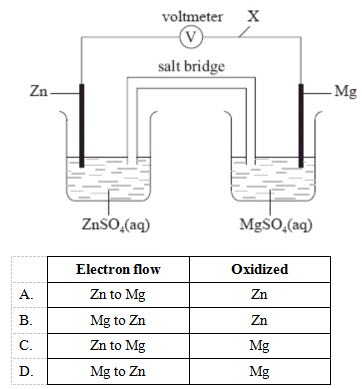
Which statement best describes how a salt bridge maintains electrical neutrality in the half-cells of an electrochemical cell?
It prevents the migration of electrons.
It prevents the reaction from occurring spontaneously.
It permits the migration of ions.
It allows for the reaction from occurring spontaneously.
What is the oxidation state for a lead atom?
2+
4+
0
2-
Which of the following statements refers to an oxidation process?
Hydrogen is added to ethene
Oxygen is removed from carbon dioxide
Chlorine accepts electrons
Increase in the oxidation number of magnesium metal
In a redox reaction, there is a conservation of
mass, only
charge, only
both mass and charge
neither mass nor charge
During an oxidation-reduction reaction, the number of electrons gained is
equal to the number of electrons lost
equal to the number of protons gained
less than the number of electrons lost
less than the number of protons gained
When a lithium atom forms an Li+ ion, the lithium atom
gains a proton
gains an electron
loses a proton
loses an electron


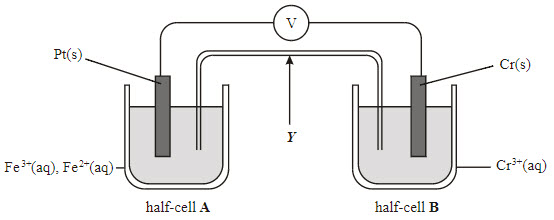
What is the function of Y in cell below?
To complete the circuit
To allow flow of electrons between both cells
To allow flow of ions
To connect both half cells


All chemical reactions must
conserve all 3
conserve mass
conserve charge
conserve energy

What is happening at the Mg electrode/Half Cell 1
Mg atoms are being oxidized to Mg+2 ions
Mg+2 ions are being oxidized to Mg atoms
Mg atoms are being reduced to Mg+2 ions
Mg+2 ions are being reduced to Mg atoms
What is happening at the Fe electrode/Half Cell 2
Fe atoms are being reduced to Fe+2 ions
Fe+2 ions are being oxidized to Fe atoms
Fe+2 ions are being reduced to Fe atoms
Fe atoms are being oxidized to Fe+2 ions
What is happening at the Mg electrode/Half Cell 1
Electrode mass decreases
Electrode mass increases
Ion concentration increases
Ion concentration decreases
What is happening at the Fe electrode/Half Cell 2
Electrode mass decreases
Electrode mass increases
Ion concentration increases
Ion concentration decreases

