
NEW
Font size
 Worksheets
DNA Mutations Transcription Translation
Total questions: 48
Worksheet time: 28mins
Which process is used to make RNA from the DNA in the nucleus?
transcription
translation
replication
ATG GGA ACT CCA
what does RNA do?
it's a working copy of the information in DNA
carry amino acids to ribosomes
help with RNA splicing
make up ribosomes
Which of the following sequences of processes correctly reflects what happens in a cell?
A. protein synthesis, transcription, translation
A. protein synthesis, translation, transcription
A. transcription, translation, protein synthesis
A. translation, transcription, protein synthesis
What is a codon?
A amino acid carrying molecule
3 consecutive nucleotides on a DNA strand
3 consecutive nucleotides on a tRNA strand
3 consecutive RNA bases found on a RNA strand
Codons code for ______
Codons do not code for anything
1 fatty acid in the polypeptide chain
1 nucleotide in a DNA molecule
1 amino acid for the protein
The process to go from RNA to a protein is called ____
transcription
rRNA
replication
translation
Would a mutation that would be bad for the brain in the DNA of a skin cell cause a problem in your body?
Yes, because any change to the DNA is happening in every cell in the whole body.
Maybe. Skin cells only use some of the genetic code but maybe a skin cell on your head could give the mutation to a brain cell.
No. Skin cells are not going to read/access the DNA needed for running brain cells. You lucked out - no brain cancer - yet.
ATTTGAGCC- Original
ATTGAG - Mutated
The example above is an example of a
Addition mutation
Deletion mutation
Both an addition and deletion
ATTTGAGCC- Original
ATTGAGCCTAG - Mutated
The example above is an example of a
Addition mutation
Deletion mutation
Both an addition and deletion
A type of mutation in which the DNA changes but the amino acid does not change
Missense
Nonsense
Silent
Deletion
This type of mutation leading to an early stop codon
Missense
Nonsense
Silent
Deletion
A type of mutation in which the DNA changes and the amino acid changes
Missense
Nonsense
Silent
Deletion
Anything in the environment that can change or damage DNA is called a _________________
Envirogene
Poison
Mutagen
Mutant
Some cancers are the result of...
eating too much healthy food
too many mutations building up in cells over time
breathing too much clean air
a silent mutation
It's possible for a mutation to have no effect at all because more than one codons code for the same _____________
protein
DNA
mutation
amino acid


The purpose of translation is to ____________.
Stop mutations
Make a new strand of DNA
Create a protein that will build cellular structures or run life.
Make a strand of mRNA
This type of mutations occurs when one base is taken out of the sequence, drastically changing the resulting protein.
Point Mutation
Insertion Mutation
Deletion Mutation
Substitution
This type of mutation occurs when a base is added into a sequence and drastically changes the resulting protein.
Point mutation
Addition mutation
Deletion mutation
Substitution
A type ofmutation in which no amino acids change is called
Missense
Nonsense
Silent
Deletion
RNA is translated in groups of three bases, called...
quadralets
anticodons
codons
capsids
A substitution mutation that changes one amino acid in the protein
A missense mutation
A nonsense mutation
A silent mutation
A frameshift mutation
What is the three base sequence of RNA that codes for a single amino acid?
Anticodon
Codon
Protein
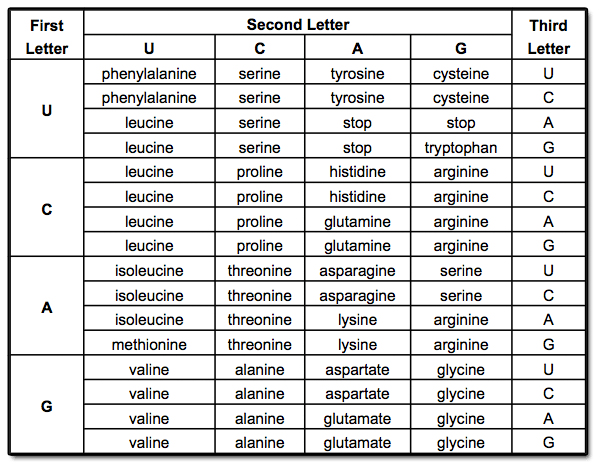
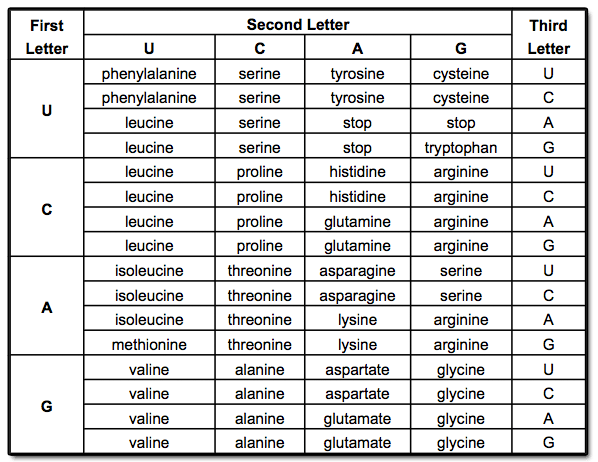
The original codon UAU codes for the amino acid tyrosine. If a mutation in the DNA resulted in a new codon UAA, what would happen in the protein?
No change, UAC also codes for tyrosine
This mutation results in one new amino acid- serine
This mutation results in a stop codon which is called a nonsense mutation and leads to a shorter protein.
This frame shift mutation disrupts all amino acids after this mutation.
True/False: Some mutations can occur spontaneously due to mistakes during mismatch repair.
true
false

