
 Worksheets
Physics Harmonic Motion
Total questions: 40
Worksheet time: 1hrs 19mins
Which of the following is/ are characteristics of simple harmonic motion?
I. The acceleration is constant .
II. The restoring force is proportional to the displacement.
III. The frequency is independent of the amplitude.
II only
I and II only
I and III only
II and III only
I, II, and III
What combination of values will result in a spring - block system with the greatest frequency?
A = 50 cm; k = 80 N/m; m = 2 kg
A = 50 cm; k = 100 N/m; m = 2 kg
A = 50 cm; k = 100 N/m; m = 4 kg
A = 75 cm; k = 80 N/m; m = 2kg
A = 75 cm; k = 100 N/m; m = 4 kg
A block attached to an ideal spring undergoes simple harmonic motion about its equilibrium position (x = 0) with amplitude A. What fraction of the total energy is in the form of kinetic energy when the block is at position
(x =1/2 A)?
1/3
3/8
1/2
2/3
3/4
A linear spring of force constant k is used in physics lab experiment. A block of mass m is attached to the spring and the resulting frequency, f, of the simple harmonic oscillation is measured. Blocks of various masses are used in different trials, and in each case, the corresponding frequency is measured and recorded. If f2 is plotted versus 1/m, the graph will be a straight line with slope
4π2/k2
4π2/k
(4π)(2k)
k/4π2
k2/4π2
A simple pendulum swings about the vertical equilibrium position with a maximum angular displacement of 5o and period T. If the same pendulum is given a maximum angular displacement of 10o, then which of the following best gives the period of the oscillations?
T/2
T/√2
T
T√2
2T

A mass of 200. g stretches a spring 10.0 cm. The spring is then stretched an additional 5.00 cm and released. Determine the max velocity.
0.495 m/s
0.248 m/s
0.371 m/s
0.742 m/s

The period of a simple pendulum is 2.00 sec. Find the length of the pendulum.
1.99 m
0.632 m
0.993 m
1.41 m
A student measures the maximum speed of a block undergoing simple harmonic oscillations of amplitude A on the end of an ideal spring. If the block is replaced by one with twice the mass but the amplitude of its oscillations remains the same, then the maximum speed of the block will
decrease by a factor of 4
decrease by a factor of 2
decrease by a factor of √2
remain the same
increase by a factor of 2
A spring with a natural length 40 cm and a spring constant of 400 N/m is hung vertically with a 10 kg mass attached to the end. Assuming the spring's mass is negligible, what will be the final length of the spring when it reaches equilibrium?
25 cm
35 cm
40 cm
50 cm
65 cm
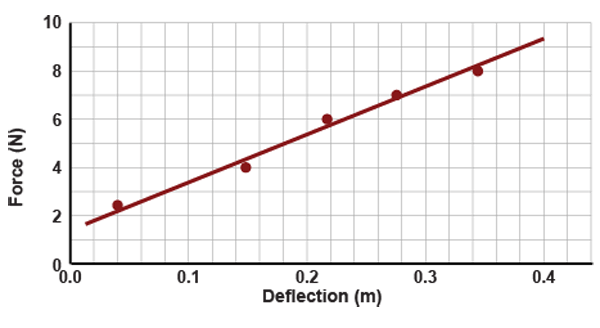
From the graph ,the spring constant is.
4.5 N/m
15 N/m
20 N/m
200 N/m

The variation of the acceleration, a of a particle executing SHM with displacement, x is as shown in figure:


The displacement x, for a particle at time t in simple harmonic motion is given by the equation, x = 10 sin 20t where x is in meters and t is in seconds. Determine the displacement at t=10 s
91.3 m
8.73 m
-91.3 m
-8.73 m

A pendulum swinging with a maximum amplitude of π/6 has a period of T. If the maximum amplitude is increased to π/3, what is the new period of the pendulum?
T/4
T/2
T
2T

A pendulum's period is initially t. Changes are made to the system so that the new period is 2t. What may have been changed?
The length of the pendulum was increased by a factor of 2.
The pendulum was moved to a planet with 2 times the mass of Earth.
The length of the pendulum was increased by a factor of 4.
The pendulum was moved to a planet with 4 times the mass of earth.
The energy contained in a pendulum depends on its
I. period
II. amplitude
III. mass
I only
II only
II and III only
I, II, and III
I. period
II. amplitude
III. mass

The maximum displacement from equilibrium of a particle is 1 m and its maximum acceleration is
1.57 m s-2. The period of the particle will be
1.25 s
0.63 s
0.20 s
5.03 s
The acceleration of a particle in SHM is:
always zero
always constant
maximum at amplitude
maximum at the equilibrium position
The amplitude and period in a SHM is 0.5 m and 0.4 s respectively. The equation of SHM will be:
x=0.5 sin 5πt
x=0.5 sin 4πt
x=0.5 sin 2.5πt
x=0.5 sin 0.8πt

The graph in FIGURE 1 shows the relationship between the acceleration, a and its displacement, x for an object of mass 2 kg which is in simple harmonic motion. Determine the frequency of oscillation.
1.6 Hz
1.26 Hz
0.20 Hz
5.00 Hz
A mass-spring system can oscillate with simple harmonic motion because a compressed or stretched spring can store which kind of energy?
kinetic
mechanical
gravitational potential
elastic potential


Which row, A to D, in the table would give a simple pendulum with a time period twice that of the spring oscillations?

Which row in the table correctly shows the kinetic energy Ek of the mass at maximum displacement and the potential energy Ep of the mass at the equilibrium position?

