Worksheets
Radiation and Radioactivity
Total questions: 110
Worksheet time: 5hrs 52mins
In the equation, 146C --> 147N + 0-1B, the _______ decay of radioactive carbon-14 results in the creation of a new nitrogen-14 atom.
Gamma
Beta
Alpha
23892U-->23490Th + 42He + 200

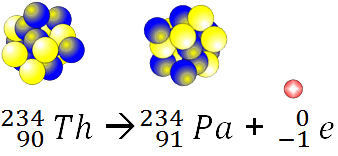

85209At = ___ + 24He
146C --> 0-1e + ________
85209At = ___ + 24He
Gamma rays have
no mass
a huge mass
a small mass
an average mass
614C = ___ + -10e

An isotope that undergoes B- decay has
too few protons
too many protons
too few neutrons
Too many neutrons
Solve this equation for beta decay.
614C = ___ + -10e
410Be
714N
210He
613C


After 22,800 years, approximately what percentage of the original carbon-14 remains?

If the original mass of a radioactive isotope was 24 grams, how many grams would remain after 3 half-lives?


According to the graph, what is the half-life of this isotope?

How long does it take for this radioactive material to decay through 2 half-lives?
occurrence in sediment

The high-energy electrons given off during radioactive decay are called ____________________.
beta-particles
protons
electrons

The nucleus is held together by the ___________________________force.
The Strong Nuclear Force
The Weak Nuclear Force
Electromagnetism
Gravity
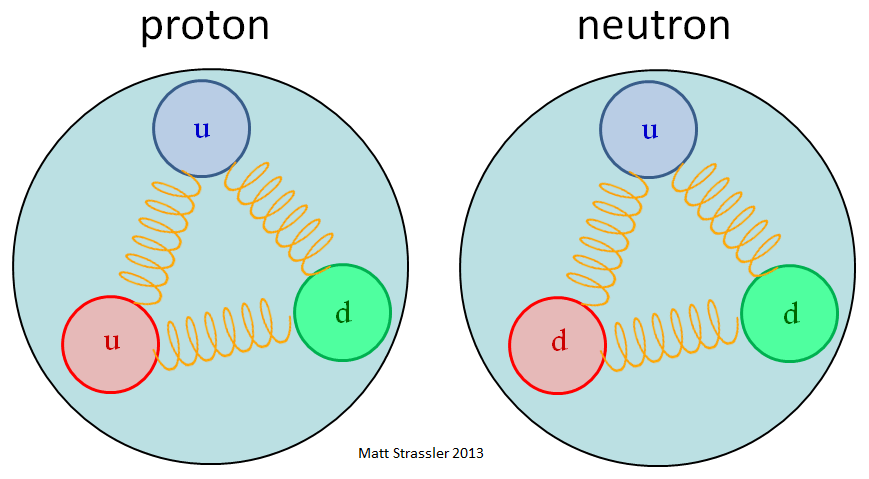
During beta-particle emission, a neutron splits into a____________________.
proton and electron
neutron and electron
neutron and proton
________________________ is used in many smoke detectors.
americium-241
neptunium-237
uranium-235

For a radioactive substance, half-life is determined by the _________________.
decay rate
atomic number
atomic number
______________ is used in the diagnosis of thyroid disease.
iodine-131
phosphorus-32
carbon-14
americium-241

______ is used to determine the age of once-living artifacts.
iodine-131
phosphorus-32
carbon-14
americium-241
A 10-g sample from a healthy 200-year-old redwood would contain _____________________ amount carbon-14 as a 10-g sample from a 20-year-old redwood sapling.
the same
a greater
a lesser
A transmutation involving the release of alpha particles produces atoms whose atomic number has _________________________ .
increased by two
decreased by two
been cut in half
doubled
A transmutation involving the release of beta particles produces atoms whose atomic number has ___________________ .
increased by one
decreased by one
stayed the same

How many grams of Carbon-14 will remain after 17,100 years?
32 g
16 g
8 g
4 g

Which disintigration product is represented on the graph?
206Pb
87Sr
40Ar
14N

How many half-lives have passed if 12.5% 14C remains?
1 Half-life
2 Half-lives
3 Half-lives
4 Half-lives

Which index fossil would Carbon-14 be best for finding the absolute age?
1
2
3
4

What percentage of Rubidium-87 will remain after 4 half-lives?
25%
12.5%
6.25%
3.125%

The shaded boxes represent the undecayed atoms for Isotope "X". If Isotope X has a half-life of 1,000 years, how old is this sample?
1,000 years
2,000 years
3,000 years
4,000 years
A sample of wood that originally contained 100 grams of Carbon-14 now contains 12.5 grams. How old is this sample?
5.7 x 10³
11.4 x 10³
17.1 x 10³
22.8 x 10³
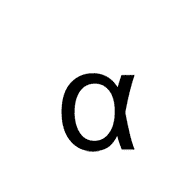
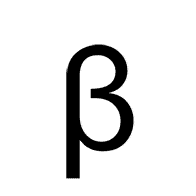
22087Fr —› ____ + 42He
22089Ac
22490Th
21685At
21688Ra
22286Rn —› ____ + 42He
22589Ac
21187Fr
21885At
21884Po
24094Pu —› ____ + 42He
23692U
24796Cm
24493Np
24295Am
13755Cs —› ____ + 0-1e
17872Hf
13753I
14154Xe
13756Ba
3215P—› ____ + 0-1e
3216S
3214Si
1632S
3417Cl
263104Rf —› ____ + 0-1e
268105Db
263105Db
263106Sg
263103Lr
146C —› ____ + 0-1e
126C
147N
148O
145B
18579Au —› ____ + 42He
18580Hg
18775Re
18177Ir
7934Se

What change happens in the nucleus for this radioactive decay example?
loses 2 protons + 2 neutrons
neutron becomes a proton
proton becomes a neutron
no change to nucleus
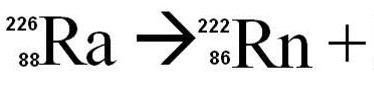
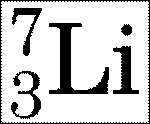
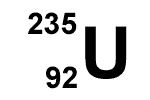
Earth elements decay and change into another element in a process called_____________.
radiation
isotope
radioactive decay
half-life