wayground logo

Free Printable Worksheets

Font size

S
M
L
XL
Worksheets

Radioactivity and Radiation

Total questions: 110

Worksheet time: 5hrs 52mins

Name
Class
Date
1.

In the equation, 146C --> 147N + 0-1B, the _______ decay of radioactive carbon-14 results in the creation of a new nitrogen-14 atom.

a)

Gamma

b)

Beta

c)

Alpha

2.
How is the alpha particle written in a nuclear equation?
a)
42He
b)
24He
3.
In the nuclear equation below, calculate the mass number of the alpha particle. 
23892U-->23490Th + 42He + 200
a)
238
b)
0
c)
234
d)
4
4.
Uranium-238  decays into  Thorium-234  by emitting .........
a)
an alpha particle
b)
a beta particle
c)
gamma rays
d)
visible light
5.
A helium nucleus with two protons and two neutrons is called a(n) ____.  
a)
alpha particle
b)
electroscope
c)
beta particle
d)
gamma ray
6.
Which type of nuclear radiation is being emitted here?
a)
Alpha
b)
beta
c)
gamma 
d)
none
7.
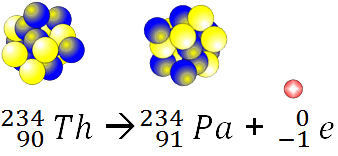
If we start off with element 24X50 after an alpha decay we get another element Y that looks like
a)
22Y50
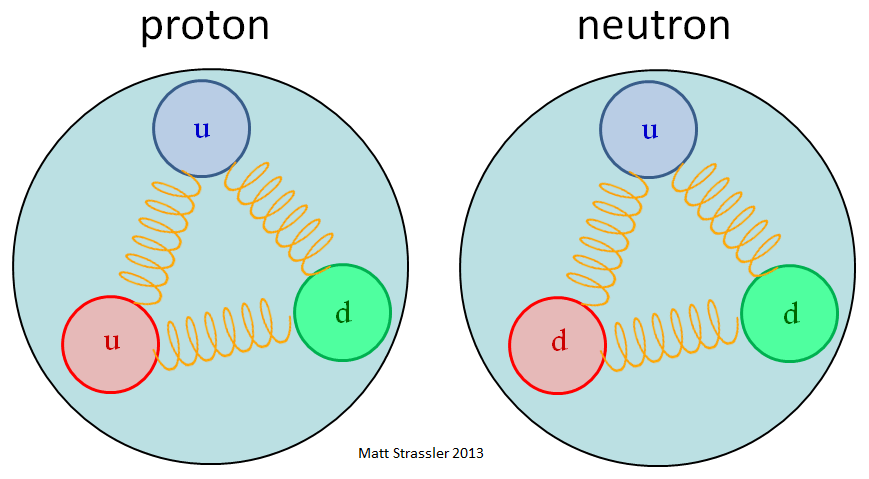
b)
22Y46
c)
20Y48
d)
26Y54
8.
If we start off with element 24X50 after an beta decay we get another element Y that looks like
a)
23Y50
b)
22Y46
c)
25Y50
d)
24Y50
9.
Solve this equation for alpha decay.
85209At = ___ + 24He
a)
83205Bi
b)
86209Rn
c)
81207Tl
d)
85208At
10.
Balance the following equation:
146C --> 0-1e + ________
a)
145B
b)
146C
c)
147N
d)
42He
11.
Solve this equation for alpha decay.
85209At = ___ + 24He
a)
83205Bi
b)
86209Rn
c)
81207Tl
d)
85208At
12.

Gamma rays have

a)

no mass

b)

a huge mass

c)

a small mass

d)

an average mass

13.
Solve this equation for beta decay.
614C = ___ + -10e
a)
410Be
b)
714N
c)
210He
d)
613C
14.
The diagram shows the path of radioactive rays, S and T. Which of the following shows the type of ray S and ray T?
a)
ray S= alpha.  ray T=beta
b)
ray S= alpha   ray T=gamma
c)
ray S= beta.    ray T=gamma
d)
ray S= gamma.  ray T= beta
15.

An isotope that undergoes B- decay has

a)

too few protons

b)

too many protons

c)

too few neutrons

d)

Too many neutrons

16.

Solve this equation for beta decay.

614C = ___ + -10e

a)

410Be

b)

714N

c)

210He

d)

613C

17.
When an unstable radioactive atom decays, it usually turns into:
a)
a more stable atom
b)
a less stable atom
c)
the exact same atom but with less pure energy
d)
empty space
18.
The time it takes for 50% of the nuclei in a radioactive sample to decay to its stable isotope is called _____.
a)
the daughter product
b)
geologic time
c)
the half-life
d)
the half-time
19.
According to the graph, what fraction of the original parent isotope still exists after 3 half lives?
a)
0,5000 g
b)
0,2500 g
c)
0,1250 g
d)
0.0625 g
20.
You find a rock sample with radioactive atoms present.  If 12.5% of the original radioactive atoms were present, how many half-lives has the rock been around for? (Hint, at Half-Life = 0, you start with 100%)
a)
zero
b)
1
c)
2
d)
3
21.
You find a rock sample with radioactive atoms present.  If 25% of the original radioactive atoms were present, how many half-lives has the rock been around for? (Hint, at Half-Life = 0, you start with 100%)
a)
zero
b)
1
c)
2
d)
3
22.
If the half-life of a radioactive group of atoms is 100 years, then how old is the rock if there have been two half-lives?
a)
25 years
b)
200 years
c)
400 years
d)
800 years
23.
Suppose you found a material in which 12.5% of the original radioactive atoms were still present.  If the half-life of an atom is 60 years, how old is the material?
a)
30 years old
b)
60 years old
c)
120 years old
d)
180 years old
24.
If the  half-life of a radioactive group of atoms is 100 years, then how old is the rock if there have been ten half-lives?
a)
10 years
b)
100 years
c)
1000 years
d)
10000 years
25.
Using ESRT (A) [Radioactive Decay Data], what is the half-life in standard notation of carbon-14?
a)
5,700 years
b)
57,000 years
c)
570,000 years
d)
5,700,000 years
26.
Using ESRT (A) [Radioactive Decay Data], what is the half-life in standard notation of Uranium-238?
a)
4,500 years
b)
450,000 years
c)
4,500,000 years
d)
4,500,000,000 years
27.
The table shows the radioactive decay of carbon-14. Part of the table has been left blank. 
After 22,800 years, approximately what percentage of the original carbon-14 remains? 
a)
15%
b)
12.5%
c)
6.25%
d)
3.125%
28.
The graph shows the generalized rate of decay of radioactive isotopes over 5 half-lives. 
If the original mass of a radioactive isotope was 24 grams, how many grams would remain after 3 half-lives
a)
12
b)
24
c)
3
d)
6
29.
Which radioactive isotope takes the greatest amount of time to undergo radioactive decay? 
a)
Carbon-14
b)
Potassium-40
c)
Uranium-238
d)
Rubidium-87
30.
The graph shows the radioactive decay of a 50-gram sample of a radioactive isotope. 
According to the graph, what is the half-life of this isotope
a)
100 years
b)
150 years
c)
200 years
d)
300 years
31.
Potassium-40 is useful for radioactive dating of Earth's rocks because the half-life of potassium-40 
a)
decreased as the amounts of 40Ar and 40Ca in the rock increased
b)
remained constant during the radioactive decay process
c)
increased as pressure from the overlying sedimentary rock increased
d)
was shortened by the high temperature of the magma that formed the rock 
32.
The graph shows the decay of a radioactive material over time. 
How long does it take for this radioactive material to decay through 2 half-lives
a)
1 x 10years
b)
5 x 10years
c)
10 x 10years
d)
40 x 10years
33.
The characteristic of the radioactive isotope uranium-238 that makes this isotope useful for accurately dating the age of a rock is the isotope’s 
a)
organic origin
b)
constant half life
c)
common 
occurrence in sediment
d)
resistance to weathering
34.

The high-energy electrons given off during radioactive decay are called ____________________.

a)

beta-particles

b)

protons

c)

electrons

35.

The nucleus is held together by the ___________________________force.

a)

The Strong Nuclear Force

b)

The Weak Nuclear Force

c)

Electromagnetism

d)

Gravity

36.

During beta-particle emission, a neutron splits into a____________________.

a)

proton and electron

b)

neutron and electron

c)

neutron and proton

37.

________________________ is used in many smoke detectors.

a)

americium-241

b)

neptunium-237

c)

uranium-235

38.

For a radioactive substance, half-life is determined by the _________________.

a)

decay rate

b)

atomic number

c)

atomic number

39.

______________ is used in the diagnosis of thyroid disease.

a)

iodine-131

b)

phosphorus-32

c)

carbon-14

d)

americium-241

40.

______ is used to determine the age of once-living artifacts.

a)

iodine-131

b)

phosphorus-32

c)

carbon-14

d)

americium-241

41.

A 10-g sample from a healthy 200-year-old redwood would contain _____________________ amount carbon-14 as a 10-g sample from a 20-year-old redwood sapling.

a)

the same

b)

a greater

c)

a lesser

42.

A transmutation involving the release of alpha particles produces atoms whose atomic number has _________________________ .

a)

increased by two

b)

decreased by two

c)

been cut in half

d)

doubled

43.

A transmutation involving the release of beta particles produces atoms whose atomic number has ___________________ .

a)

increased by one

b)

decreased by one

c)

stayed the same

44.

How many grams of Carbon-14 will remain after 17,100 years?

a)

32 g

b)

16 g

c)

8 g

d)

4 g

45.

Which disintigration product is represented on the graph?

a)

206Pb

b)

87Sr

c)

40Ar

d)

14N

46.

How many half-lives have passed if 12.5% 14C remains?

a)

1 Half-life

b)

2 Half-lives

c)

3 Half-lives

d)

4 Half-lives

47.

Which index fossil would Carbon-14 be best for finding the absolute age?

a)

1

b)

2

c)

3

d)

4

48.

What percentage of Rubidium-87 will remain after 4 half-lives?

a)

25%

b)

12.5%

c)

6.25%

d)

3.125%

49.

The shaded boxes represent the undecayed atoms for Isotope "X". If Isotope X has a half-life of 1,000 years, how old is this sample?

a)

1,000 years

b)

2,000 years

c)

3,000 years

d)

4,000 years

50.

A sample of wood that originally contained 100 grams of Carbon-14 now contains 12.5 grams. How old is this sample?

a)

5.7 x 10³

b)

11.4 x 10³

c)

17.1 x 10³

d)

22.8 x 10³

51.
Has a mass of 1/1837 and a charge of -1
a)
Alpha
b)
Beta
c)
Gamma
52.
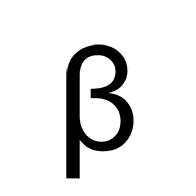
Has the symbol
a)
Alpha
b)
Beta 
c)
Gamma
53.
When an atom loses this particle, the atomic number of the product atom is lower by the two and its mass number is lower by four. 
a)
Alpha 
b)
Beta
c)
Gamma
54.
Has a mass of 0 and a charge of 0
a)
Alpha
b)
Beta
c)
Gamma
55.
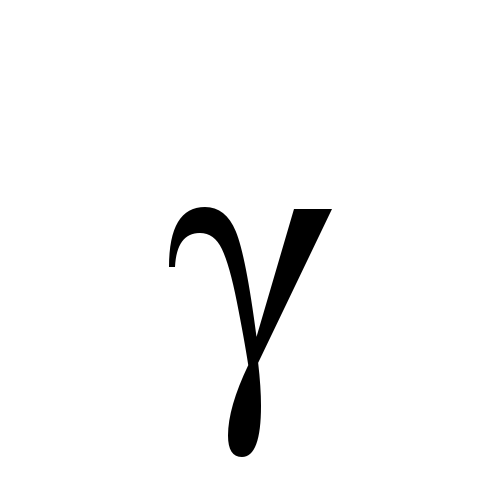
Has the symbol
a)
Alpha
b)
Beta
c)
Gamma
56.
An energized electron resulting from the breaking apart of a neutron in an atom.
a)
Alpha
b)
Beta
c)
Gamma
57.
Electromagnetic radiation made of high-energy photons.
a)
Alpha 
b)
Beta
c)
Gamma
58.
Has the symbol
a)
Alpha
b)
Beta
c)
Gamma
59.
Has the highest penetrating power.  Can penetrate our body.  Even several cm thick of lead or several meters thick of concrete cannot stop all of it.
a)
Alpha
b)
Beta
c)
Gamma
60.
This individual won the 1911 Nobel Peace Prize for Chemistry.
a)
Marie Curie
b)
Antoine Henri Becquerel 
c)
Pierre Curie
61.
What was one of the draw backs of Marie Curie's work?
a)
She missed out on valuable family time
b)
She died from leukemia caused by  her long term exposure to radiation
c)
She was limited in diet and wasn't able to eat chicken
62.

22087Fr —› ____ + 42He

a)

22089Ac

b)

22490Th

c)

21685At

d)

21688Ra

63.

22286Rn —› ____ + 42He

a)

22589Ac

b)

21187Fr

c)

21885At

d)

21884Po

64.

24094Pu —› ____ + 42He

a)

23692U

b)

24796Cm

c)

24493Np

d)

24295Am

65.

13755Cs —› ____ + 0-1e

a)

17872Hf

b)

13753I

c)

14154Xe

d)

13756Ba

66.

3215P—› ____ + 0-1e

a)

3216S

b)

3214Si

c)

1632S

d)

3417Cl

67.

263104Rf —› ____ + 0-1e

a)

268105Db

b)

263105Db

c)

263106Sg

d)

263103Lr

68.

146C —› ____ + 0-1e

a)

126C

b)

147N

c)

148O

d)

145B

69.

18579Au —› ____ + 42He

a)

18580Hg

b)

18775Re

c)

18177Ir

d)

7934Se

70.

What change happens in the nucleus for this radioactive decay example?

a)

loses 2 protons + 2 neutrons

b)

neutron becomes a proton

c)

proton becomes a neutron

d)

no change to nucleus

71.
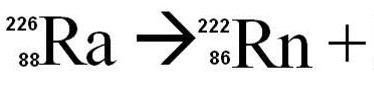
Complete the nuclear equation and determine the type of decay that is occurring in this reaction. 
a)
alpha
b)
beta
c)
gamma
d)
none
72.
What is the term used for describing when an element changes into a new element through radioactive decay?
a)
mutation
b)
transmutation
c)
alchemy
73.
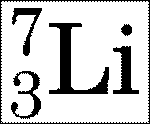
How many protons are in this atom?
a)
3
b)
4
c)
6
d)
10
74.
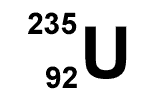
How many neutrons are in this isotope of Uranium?
a)
235
b)
92
c)
327
d)
143
75.
After the nucleus of a radioactive element undergoes changes, the element can transform into ...
a)
  (a)  a different isotope of the same element.
b)
(b) an entirely different element.
c)
Both (a) and (b)
d)
Neither (a) nor (b)
76.
Alpha particles.....
a)
a) are positively charged.
b)
b) consist of two protons and four neutrons.
c)
c) can penetrate any thickness of matter
d)
d) All of the above 
77.
The process of nuclear change in an atom of radioactive material is called... 
a)
nuclear decay
b)
nuclear mass
c)
isotopes
d)
radon
78.
During beta decay, a nucleus .... 
a)
gives up two protons and two neutrons.
b)
  maintains the same number of protons and neutrons.
c)
  loses a proton and gains a neutron.
d)
gains a proton and loses a neutron. 
79.
When a nucleus undergoes nuclear decay by gamma rays, the atomic number of the element....
a)
remains the same
b)
  decreases by one.
c)
increases by one.
d)
increases by two.
80.
The process of the production of lighter nuclei from heavier nuclei is called
a)
mass energy
b)
magneticism
c)
fusion
d)
fission
81.
Radioactive materials have unstable...
a)
electrons
b)
protons
c)
nuclei
d)
neutrons
82.
The type of radioactive particle that can be stopped by a sheet of paper is the ____.
a)
alpha particle
b)
beta particle
c)
gamma ray
d)
uranium
83.
The most penetrating type of radiation is the ____.  
a)
alpha particle
b)
gamma ray
c)
beta particle
d)
uranium
84.
A helium nucleus with two protons and two neutrons is called a(n) ____.  
a)
alpha particle
b)
electroscope
c)
beta particle
d)
gamma ray
85.
Negatively charged particles emitted from a nucleus at a high speed are ____.  
a)
alpha particle
b)
gamma rays
c)
beta particles
d)
X rays
86.
The three types of nuclear radiation in increasing order of penetrating power are ____.  
a)
  alpha, beta, gamma 
b)
X ray, beta, gamma
c)
alpha, gamma, beta 
d)
X ray, gamma, beta 
87.
Radioactive tracers are useful in ____.
a)
calculating the ages of fossils 
b)
fueling nuclear reactions 
c)
determining medical problems 
d)
treating brain tumors 
88.
The process by which nuclei having low masses are united to form nuclei with larger masses is ____.  
a)
a chain reaction 
b)
fission
c)
a chemical reaction 
d)
fusion 
89.
For which of the following problems would a scientist most likely use carbon-14? 
a)
to calculate the age of the Earth's oldest rocks
b)
to calculate the age of a piece of bone 
c)
to identify the elements that make up a rock 
d)
to identify the elements that make up a bone
90.

Earth elements decay and change into another element in a process called_____________.

a)

radiation

b)

isotope

c)

radioactive decay

d)

half-life

91.
Takes two small nuclei and combines them into a larger nucleus
a)
fission
b)
fusion
92.
The splitting of a nucleus into smaller nuclei is
a)
fusion
b)
fission
c)
half-life
d)
gamma radiation
93.
How do nuclear power-plants work?
a)
Fusion
b)
Half-life
c)
Fission
d)
Fusion or fission
94.
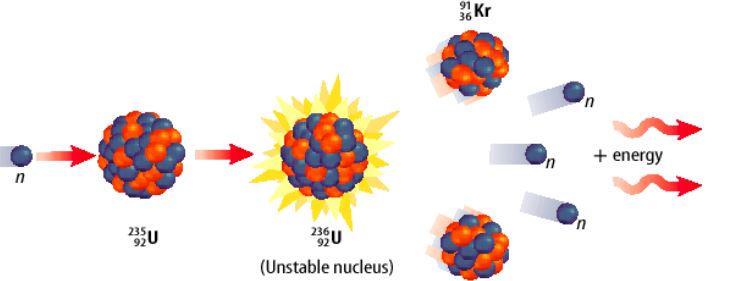
This is an example of...
a)
Fission  reaction
b)
Fusion reaction
c)
Decomposition reaction
d)
Decay
95.
Where does fusion occur naturally?
a)
Underwater
b)
All around us
c)
In the radioactive waste
d)
On the sun
96.
Which atoms combine together during fusion reaction on the sun?
a)
Helium and Hydrogen atoms
b)
Hydrogen atoms
c)
Hydrogen and Lithium atoms
d)
Hydrogen and Carbon atoms
97.
An example of an uncontrolled fission reaction is _______________
a)
Nuclear power plants
b)
Radio active decay
c)
Atomic Bomb
d)
On the surface of the sun
98.
What does it mean that fusion is a "chain reaction?"
a)
many steps or mini-reactions in the process
b)
long chains of elements form in a row
99.
Do all stars make energy through fusion?
a)
Yes
b)
No
c)
Just our sun
d)
Only large stars
100.
Why do scientists most want to learn more about fusion?
a)
To win the Nobel prize
b)
To make energy for people to use
c)
To destroy the world
d)
To know more about stars
101.
_________ happens naturally due to an unstable nucleus.
a)
fission
b)
fusion
c)
radioactive decay
d)
K-capture
102.
Which of these statements correctly describes how the chain reaction occurs in nuclear fission.
a)
Uranium releases electrons to create   electricity
b)
When a nuclear fission reaction occurs, the electrons emitted can strike other nuclei in the sample, and cause them to split
c)
When a nuclear fission reaction occurs, the neutrons emitted can strike other nuclei in the sample, and cause them to split
d)
 Protons and neutrons change to electrons because the nuclei are so big
103.
What is a benefit of nuclear fission?
a)
The ability to absorb energy
b)
The ability to release tremendous amounts of energy
c)
The ability to produce more energy than nuclear fusion
d)
There are no beneficial aspects of nuclear fission
104.
The major drawback to nuclear fission reactors is the difficulty of achieving safe disposal of radioactive waste products.
a)
true
b)
false
105.
Very high temperature and pressure is required for:
a)
Fission
b)
 Fusion
c)
Radioactive Decay
106.
One disadvantage of nuclear energy is ___.
a)
it is a fossil fuel
b)
it leaves behind radioactive waste
c)
it emits large amounts of pollution into the atmosphere
d)
there are no disadvantages
107.
Requires temperatures of millions of degrees?
a)
Fission
b)
Fusion
108.
Which of the following is true about nuclear fusion?
a)
It is easy to implement.
b)
It produces less energy than nuclear fission.
c)
It produces more energy than nuclear fission.
d)
It has the ability to occur easily in everyday life.
109.
Nuclear fusion releases energy when:
a)
heavy ions fuse together
b)
very light nuclei fuse together
c)
uranium splits into two fragments
d)
uranium emits a neutron
110.
The splitting of a nucleus into smaller nuclei is
a)
fusion
b)
fission
c)
decay
d)
gamma radiation