wayground logo

Free Printable Worksheets

Font size

S
M
L
XL
Worksheets

Newton's laws and forces

Total questions: 110

Worksheet time: 2hrs 23mins

Name
Class
Date
1.
A magician pulls a tablecloth out from under dishes and glasses on a table without disturbing them.
a)
Newton's 1st Law
b)
Newton's 2nd Law
c)
Newton's 3rd Law
d)
None of them
2.
A person’s body is thrown outward as a car rounds a curve on a highway.
a)
Newton's 1st Law
b)
Newton's 2nd Law
c)
Newton's 3rd Law
d)
None of them
3.
Rockets are launched into space using jet propulsion where exhaust accelerates out from the rocket and the rocket accelerates in an opposite direction.
a)
Newton's 1st Law
b)
Newton's 2nd Law
c)
Newton's 3rd Law
d)
None of them
4.
A picture is hanging on a wall and does not move.
a)
Newton's 1st Law
b)
Newton's 2nd Law
c)
Newton's 3rd Law
d)
None of them
5.
A person not wearing a seatbelt flies through a car window when someone slams on the breaks because the person’s body wants to remain in continuous motion even when the car stops.
a)
Newton's 1st Law
b)
Newton's 2nd Law
c)
Newton's 3rd Law
d)
None of them
6.
Pushing a child on a swing is easier than pushing an adult on the same swing, because the adult has more inertia.
a)
Newton's 1st Law
b)
Newton's 2nd Law
c)
Newton's 3rd Law
d)
None of them
7.
Acceleration is produced when a force acts on a mass. The greater the mass (of the object being accelerated) the greater the amount of force needed (to accelerate the object).
a)
Newton's 1st Law
b)
Newton's 2nd Law
c)
Newton's 3rd Law
d)
None of them
8.
An object at rest will remain at rest unless acted on by an unbalanced force. An object in motion continues in motion with the same speed and in the same direction unless acted upon by an unbalanced force.
a)
Newton's 1st Law
b)
Newton's 2nd Law
c)
Newton's 3rd Law
d)
None of them
9.
This law is often called "the law of inertia."
a)
Newton's 1st Law
b)
Newton's 2nd Law
c)
Newton's 3rd Law
d)
None of them
10.
A soccer ball accelerates more than a bowling ball when thrown with the same force.
a)
Newton's 1st Law
b)
Newton's 2nd Law
c)
Newton's 3rd Law
d)
None of them
11.
A student leaves a pencil on a desk and the pencil stays in the same spot until another student picks it up.
a)
Newton's 1st Law
b)
Newton's 2nd Law
c)
Newton's 3rd Law
d)
None of them
12.
Two students are in a baseball game. The first student hits a ball very hard and it has a greater acceleration than the second student who bunts the ball lightly.
a)
Newton's 1st Law
b)
Newton's 2nd Law
c)
Newton's 3rd Law
d)
None of them
13.
For every action there is an equal and opposite reaction.
a)
Newton's 1st Law
b)
Newton's 2nd Law
c)
Newton's 3rd Law
d)
None of them
14.
The swimmer moves her hand down and to the left and her body goes forward to the right.
a)
Newton's 1st Law
b)
Newton's 2nd Law
c)
Newton's 3rd Law
15.
A rocket is sent into space.  When the power dies out, the rocket will just keep floating and moving in space forever (unless an unbalanced force, such as a meteor, runs into it).
a)
Newton's 1st Law
b)
Newton's 2nd Law
c)
Newton's 3rd Law
d)
None of them
16.

A lamp sitting on a table is demonstrating Newton's ___ Law.

a)

1st

b)

2nd

c)

3rd

d)

4th

17.

Newton's 3rd Law states that for ever action there is an equal and opposite ________.

a)

reaction

b)

satisfaction

c)

fraction

d)

transaction

18.

A ______ is a push or pull on an object.

a)

force

b)

speed

c)

acceleration

d)

velocity

19.

A force that causes an object to slow down when it touches another object is _________.

a)

gravity

b)

friction

c)

inertia

d)

Newton

20.

Newton's 2nd Law says the acceleration of an object depends on its _______ and ______. (Choose two answers)

a)

force or applied force

b)

weight

c)

gravity

d)

mass

21.

if an object stays still or continues moving at the same speed and in the same direction, it is a _______ force.

a)

weak

b)

strong

c)

balanced

d)

unbalanced

22.

Net force is a combination of all ________ acting on an object.

a)

forces

b)

speeds

c)

accelerations

d)

velocities

23.

What will be the effect on the boy in the picture if the driver stops quickly?

a)

Because of inertia he will remain in the same position.

b)

He will be pushed back into the car seat.

c)

He will move from one side of the car seat to the other.

d)

He will move forward pressing against the seatbelt.

24.

The picture represents the effect of tension on the earth’s crust. Faults and rift valleys are the result of movement in

the crust. What type of force causes these movements in the plates?

a)

Balanced forces

b)

Unbalanced forces

c)

Inertia

d)

Friction

25.

Which of Newton’s Laws explains a rocket’s movement during launch?

a)

Newton's First Law of Motion

b)

Newton's Second Law of Motion

c)

Newton's Third Law of Motion

d)

Newton's Fourth Law of Motion

26.
a)
1st
b)
2nd
c)
3rd
27.
What law is best described by inertia?
a)
1st
b)
2nd
c)
3rd
28.
The sum of all forces acting on an object and direction
a)
Contact Force
b)
Balanced Force
c)
Unbalanced Force
d)
Net Force
29.
Are forces balanced or unbalanced when a car is moving at a constant speed in a straight line?
a)
Balanced
b)
Unbalanced
30.
Are forces balanced or unbalanced when a marble speeds up rolling down a ramp?
a)
Balanced
b)
Unbalanced
31.
Ted is trying to move a fridge through his house, he gets stuck on a carpet and even though he is pushing the fridge, it is not moving. What force is acting against him?
a)
gravity
b)
friction
c)
air
d)
mass
32.
A push or pull exerted on an object
a)
Force
b)
Net force
c)
Momentum
d)
Speed
33.
Balanced or unbalanced?
a)
balanced
b)
unbalanced
34.
Forces have both _________ and direction.
a)
Magnitude
b)
Gravity
c)
Speed
d)
Height
35.
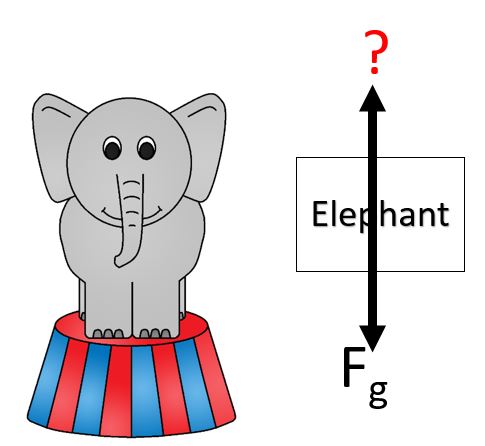
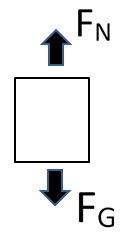
Name the missing force...
a)
weight force
b)
normal force
c)
applied force
d)
frictional force
36.
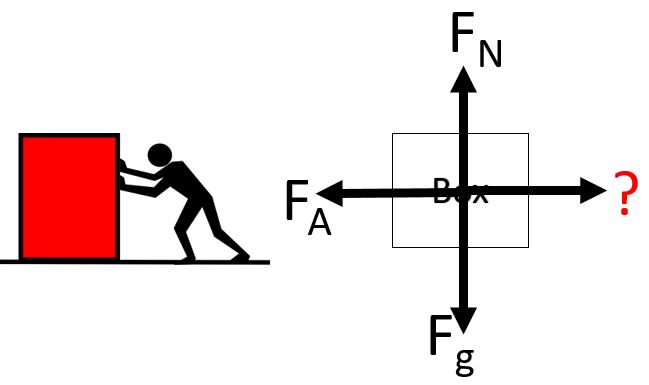
Name the missing force...
a)
frictional force
b)
weight force
c)
thrust
d)
buoyant force
37.
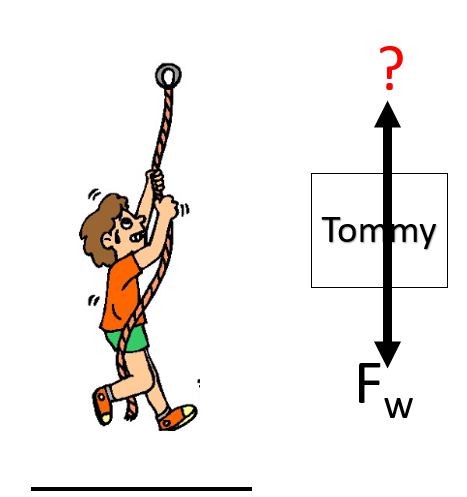
Name the missing force...
a)
tension force
b)
gravitational force
c)
normal force
d)
applied force
38.

A leftward force is applied to a crate to push it across the floor at a constant speed. Which is the correct force diagram?

a)
b)
c)
d)
39.

A rightward force is applied to a dresser to accelerate it to the right across the bedroom floor.

a)
b)
c)
d)
40.

A hockey puck glides to the right across the ice at a constant speed.

a)
b)
c)
d)
41.

A downward-moving skydiver who has just opened the parachute is slowing down.

a)
b)
c)
d)
42.

Whenever an object is moving, there is always this force opposing the motion:

a)

inertia

b)

momentum

c)

friction

d)

applied force

43.

If an object is moving to the right, this force is pushing or pulling to the left:

a)

friction

b)

applied

c)

normal

d)

tension

44.

The force that keeps objects on top of surfaces instead of letting them sink into the surface is known as:

a)

normal

b)

abnormal

c)

static

d)

inertia

45.

The force exerted by ropes and chains is called

a)

tension

b)

normal

c)

elastic

d)

mechanical

46.

With few exceptions, forces

a)

always come in pairs

b)

are always equal

c)

must be balanced

d)

must be unbalanced

47.

Paired forces are

a)

in opposite directions

b)

always equal

c)

not possible

d)

added together

48.

When determining the NET force on an object you should (TWO correct answers)

a)

subtract forces in opposite directions

b)

add forces in the same direction

c)

divide by velocity

d)

multiply by acceleration

49.

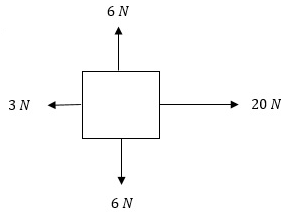
What is the NET FORCE of this diagram?

a)

17 N, right

b)

17 N, left

c)

23 N, right

d)

12 N, up

50.

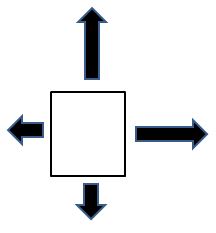
This object would be moving (pick all that are correct):

a)

up

b)

down

c)

left

d)

right

51.

The down-arrow in this diagram is most-likely:

a)

gravity

b)

normal

c)

a push or pull

d)

friction

52.

The up-arrow in this diagram is most-likely:

a)

gravity

b)

normal

c)

a push or pull

d)

friction

53.

If this object were moving right, the left-arrow in this diagram is most-likely:

a)

gravity

b)

normal

c)

a push or pull

d)

friction

54.

Which of the following best describes the object in this diagram.

a)

A box sitting on the floor.

b)

A hockey puck gliding to the right.

c)

An athlete running to the right.

d)

A skateboarding gliding to the left.

55.

Which diagram best shows person pushing a couch (accelerating) across the floor?

a)
b)
c)
d)
56.

This diagram can be used to indicate which of the following? (TWO correct answers)

a)

a object at rest

b)

an object moving at a constant velocity (speed)

c)

an object accelerating

d)

(Trick question -- there is only one correct answer)

e)

an object decelerating

57.

Which of the following is true about this free-body diagram?

a)

the forces are are balanced

b)

the object is free-falling

c)

the object is moving upward

d)

the forces are unbalanced

58.

Which of the following is the same as INERTIA? (pick two)

a)

object at rest

b)

object moving at a constant velocity

c)

momentum

d)

force

59.
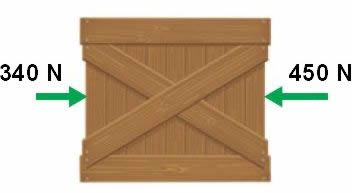
What is the net force
a)
10 N
b)
0 N
c)
25 N
d)
1 N
60.
What is the net force?
a)
40 N left
b)
0 N Balalnced
c)
400 N right
d)
40 N right
61.
Forces that have a net force that is not zero.
a)
Balanced force
b)
Unbalanced force
62.
What is the net force?
a)
400 N Up
b)
400 N Down
c)
- 400 N Down
d)
800 N Down
63.

Which way is the object moving?

a)

it's not , it is balanced or moving at a constant speed

b)

to the right

c)

to the bottom

d)

up

64.
Which way is the object moving?
a)
It is not or moving at a constant speed
b)
moving to the right
c)
moving to the left
d)
going up
65.
Which way is the box moving?
a)
to the right
b)
to the left
c)
going up
d)
going down
66.
Which is moving at a constant speed or not at all?
a)
a
b)
b
c)
c
d)
d
67.
Which is moving up?
a)
a & b
b)
b
c)
b & c
d)
d
68.
What is the net force?
a)
5000 N right
b)
4000 N right
c)
40 N left
d)
4000 N left
69.
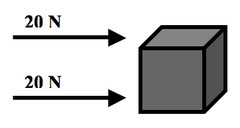
Calculate the net force of the object in the image shown.
a)
20N
b)
35N
c)
5N
d)
25N
70.
Is this a balanced or unbalance force?
a)
Balanced
b)
Unbalanced
c)
Neither one
d)
Both
71.
Which direction will the object move?
a)
Up
b)
Down
c)
Right
d)
Left
72.
Calculate the net force of the object.
a)
10N
b)
2N
c)
15N
d)
5N
73.
Is this a balanced or unbalanced force?
a)
Balanced
b)
Unbalanced
c)
Neither
d)
Both
74.
Which direction will the object move?
a)
Right
b)
Left
c)
Up
d)
Down
75.
What is the net force of this object?
a)
0N
b)
50N
c)
25N
d)
5N
76.
Students are playing tug-of-war. If group B pulls the rope to the right with a force of 400 N and group A pulls the rope to the left with a force of 250 N, what will happen to the ribbon in the middle of the rope?
a)
The ribbon will move to the left and group A will win the tug-of-war.
b)
The ribbon will move to the left and group B will win the tug-of-war.
c)
The ribbon will move to the right and group B will win the tug-of-war.
d)
The ribbon will move to the right and group A will win the tug-of-war.
77.
A cyclist traveling at 25 km/hr turns sharply to the left while continuing to move 25 km/hr. This means the forces involved are_____________________.
a)
Balanced, because the cyclist's speed did not change.
b)
Balanced, because he was still moving forward.
c)
Unbalanced, because it's the same bicycle.
d)
Unbalanced, because his direction changed.
78.
The forces represented by the arrows in the diagrams are applied to the four objects that are at rest on a table. Which object is most likely to remain in place?
a)
Object W
b)
Object X
c)
Object Y
d)
Object Z
79.
An airplane is travelling North through the sky at a constant speed when turbulence causes it to take a different route, changing its direction. Explain the forces at work on this plane.
a)
Unbalanced, because the plane is moving forward, not backwards
b)
Unbalanced, because the speed is constant and there is a change in direction
c)
Balanced, because the plane is not falling to a lower altitude
d)
Unbalanced, because the plane is in motion
80.
Imagine a bat swinging with a force of 1200 N, hitting a ball pitched with a force of 400 N. At what net force does the ball move away from the bat?
a)
1600 N
b)
800 N
c)
400 N
d)
Net force of 0 N
81.
The roller coaster car begins at point W.  At what point along the track will the car have the greatest amount of kinetic energy?
a)
W
b)
X
c)
Y
d)
Z
82.

How many forces are on a leopard laying on a log?

a)

1

b)

2

c)

3

d)

4

83.
An object's velocity can be changed by changing its speed, its direction, or both.
a)
True
b)
False
84.
Accelerations are produced by
a)
forces.
b)
 velocities.
c)
 accelerations.
d)
 masses.
85.
What happens when unbalanced forces act on an object at rest?
a)
the object remains at rest
b)
the object begins moving in an unpredictable direction
c)
the object begins moving in the direction of the net force
d)
the object begins moving opposite to the direction of net force
86.
What is the net force?
a)
40 N left
b)
0 N Balalnced
c)
400 N right
d)
40 N right
87.
What Unit do we Measure Force in? 
a)
Newtons
b)
Joules
c)
Force
d)
Don't know
88.
F=MA
An object of mass 10 kg is accelerated upward at 2 m/s2.  What force is required? 
a)
20 N
b)
2 N
c)
5 N
d)
0 N
89.
An object with a mass of 2.0 kg accelerates 2.0 m/s2 when an unknown force is applied to it. What is the amount of the force?
a)
4 N
b)
0.4 N
c)
1 N
d)
0.1 N
90.
An object with a mass of 5.0 kg accelerates 8.0 m/s2 when an unknown force is applied to it. What is the amount of the force?
a)
40 N
b)
4 N
c)
10 N
d)
0.1 N
91.
An object with a mass of 6.0 kg accelerates 4.0 m/s2 when an unknown force is applied to it. What is the amount of the force?
a)
240 N
b)
24 N
c)
2.4 N
d)
0.24 N
92.
An object accelerates 3.0 m/s2 when a force of 6.0 newtons is applied to it. What is the mass of the object?
a)
2 N
b)
18 N
c)
0.5 N
d)
0.05 N
93.
An object accelerates 12 m/s2 when a force of 6.0 newtons is applied to it. What is the mass of the object?
a)
2 N
b)
18 N
c)
0.5 N
d)
0.05 N
94.
An object accelerates 5 m/s2 when a force of 20 newtons is applied to it. What is the mass of the object?
a)
4 N
b)
20 N
c)
0.5 N
d)
2 N
95.
An object accelerates 2 m/s2 when a force of 12 newtons is applied to it. What is the mass of the object?
a)
24 N
b)
20 N
c)
5 N
d)
6 N
96.
An object with a mass of 2.0 kg has a force of 4.0 newtons applied to it. What is the resulting acceleration of the object?
a)
2 N
b)
8 N
c)
0.5 N
d)
6 N
97.
An object with a mass of 5 kg has a force of 40 newtons applied to it. What is the resulting acceleration of the object?
a)
2 N
b)
8 N
c)
0.5 N
d)
6 N
98.
An object with a mass of 5 kg has a force of 20 newtons applied to it. What is the resulting acceleration of the object?
a)
2 N
b)
8 N
c)
4 N
d)
6 N
99.

Calculate the potential energy of a car with a mass of 2,500 kg that is on a hill 100 meters above sea level.

a)

250,000 J

b)

2,450,000 J

c)

2,451,663 J

d)

248 J

100.

Lilly's cat ran through your yard. The cat has a mass of 5 kg. He is running at a speed of 3 m/s. What is the kinetic energy of the cat as he runs?

a)

8.5 J

b)

45 J

c)

7.5 J

d)

22.5 J

101.

Alice kicks a soccer ball with a mass of 2.1 kg. The ball leaves the ground moving 30 meters per second. What is the kinetic energy of the soccer ball?

a)

567 J

b)

900 J

c)

945 J

d)

30 J

102.

Ty lifts a set of 1250kg weights a vertical distance of 2m in a weight lifting contest. What Potential Energy do the weights now possess?

a)

12,789 Joules

b)

24,500 Joules

c)

4,500 Joules

103.
a)
W
b)
X
c)
Y
d)
Z
104.
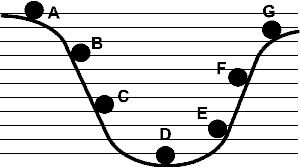
Which point has the most potential energy?
a)
G
b)
f
c)
b
d)
a
105.

A 5 Kg body is having a Kinetic energy of 250 J. What is the velocity of the body?

a)

10 m/s

b)

15 m/s

c)

20 m/s

d)

40 m/s

106.

What is the mass of a ball that has a kinetic energy of 115 J and is traveling at 9 m/s?

a)

1035 kg

b)

23.5 kg

c)

12.8 kg

d)

2.84 kg

107.

A exercise ball is on a table 2.5 m above the ground. What is the mass of the ball if it has a GPE of 56.8 J?

a)

71 kg

b)

22.72 kg

c)

142 kg

d)

2.32 kg

108.

Is it possible for an object to have no potential energy and have no kinetic energy?

a)

no

b)

yes

c)

not if it is on the planet earth

109.
Calculate the KE of a moving 4 kilogram object traveling at a velocity of 3 m/s.
a)
18 J
b)
36 J
c)
12 J
d)
6 J
110.
How much KE does a moving 6 kilogram object have if it moves with a velocity of 3 m/s?
a)
27 J
b)
18 J
c)
9 J
d)
2 J