
 Worksheets
Final Benchmark Review
Total questions: 105
Worksheet time: 2hrs 9mins
Name
Class
Date
1.
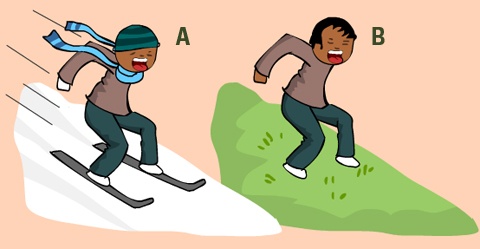
Why is it harder for the boy in Image B to get down the hill?
a)
Motion
b)
Friction
c)
Work
d)
Displacement
2.
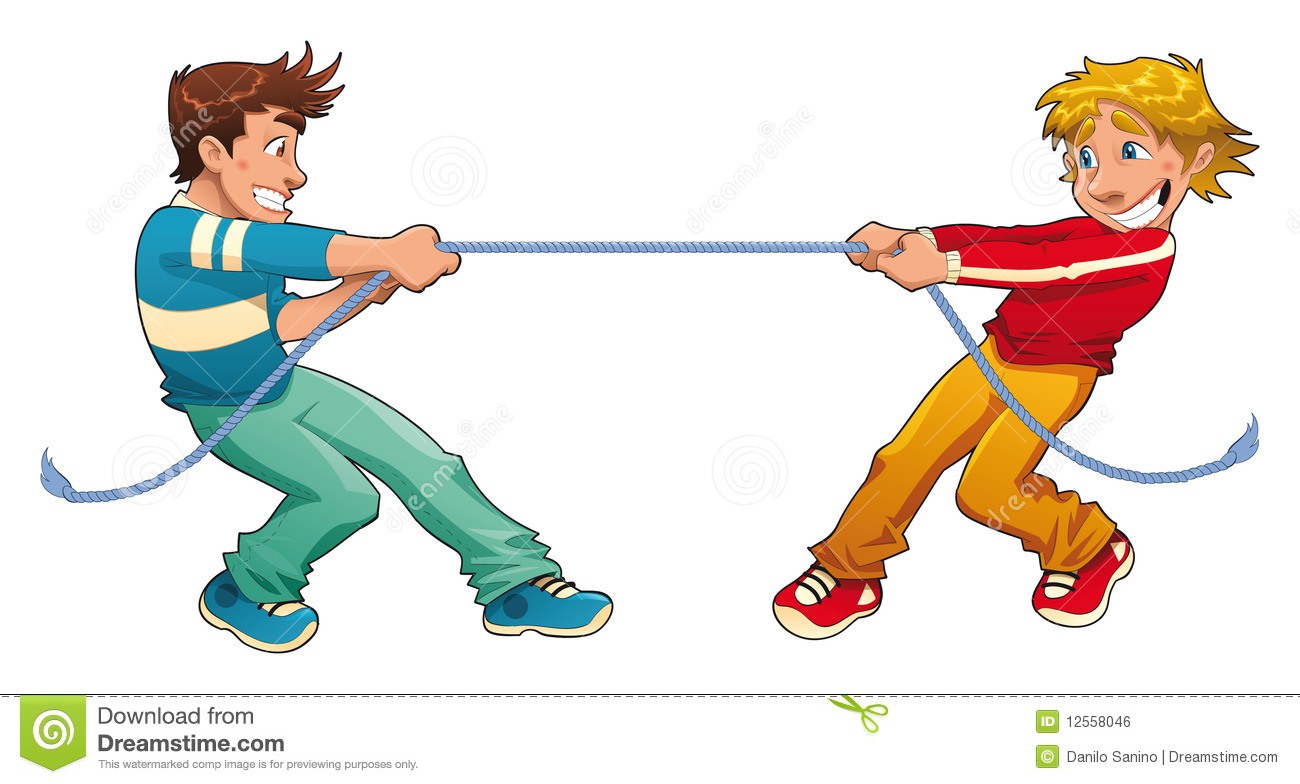
If these boys are pulling with the same amount of force. What will happen?
a)
The boy in blue will win.
b)
They will not move at all.
c)
The boy in red will win.
d)
Both will fall down.
3.
_______________ is how fast an object changes over time.
a)
speed
b)
velocity
c)
momentum
d)
acceleration
4.
What happens when two forces act in the same direction?
a)
They cancel each other out.
b)
The stronger one prevails.
c)
Their strengths are added.
d)
Their sum divided by the two is the total force.
5.
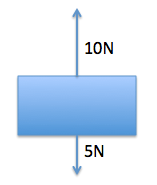
What is the net force on the block? (click on the words to view the picture)
a)
5 Newtons up
b)
5 Newtons down
c)
15 Newtons up
d)
15 Newtons down
6.
Which of the following statements is true?
a)
Balanced forces cause a change in motion.
b)
Unbalanced forces cause a change in motion.
c)
Forces do not effect the change in motion.
7.
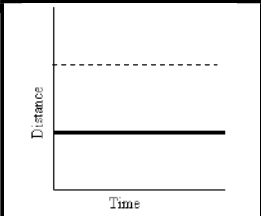
What does this graph represent?
a)
Constant speed
b)
Acceleration
c)
Not moving
8.
A baseball is thrown a distance of 50 meters. What is the speed if it takes 2 seconds to cover that distance?
a)
100 m/s2
b)
25 m/s2
c)
52 m/s2
d)
100 seconds
9.
Speed is equal to
a)
Distance/Time
b)
Time/Distance
c)
Time x Distance
d)
Acceleration
10.

During which interval is the object speeding up?
a)
A to B
b)
B to C
c)
D to E
d)
E to F
11.

What is this graph showing?
a)
Constant Speed
b)
Acceleration (speeding up)
c)
Deceleration (slowing down)
d)
No motion
12.
8 N to the left , and 4 N to the right. Find the net force. Is this balanced
a)
12 N Right No
b)
4 N Left No
c)
12 N Right Yes
d)
4 N Left Yes
13.
1. A type of wave that is not capable of transmitting its energy through a vacuum.
a)
A. transverse
b)
B. longitudinal
c)
C. mechanical
d)
D. electromagnetic
14.
3. Among all the electromagnetic waves (EM), which has the highest frequency?
a)
A. Infrared radiation
b)
B. Radio wave
c)
C. Ultraviolet
d)
D. Gamma rays
15.
4. How does the wavelength of infrared (IR) compare with the wavelength of ultraviolet (UV) waves?
a)
A. Infrared waves have longer wavelength.
b)
B. Infrared waves have shorter wavelength.
c)
C. IR waves have the same wavelength as the UV waves.
d)
D. IR is not comparable in wavelength with the UV waves
16.
5. Which of the following is NOT an electromagnetic wave?
a)
A. Infrared
b)
B. Radio
c)
C. Sound
d)
D. X ray
17.
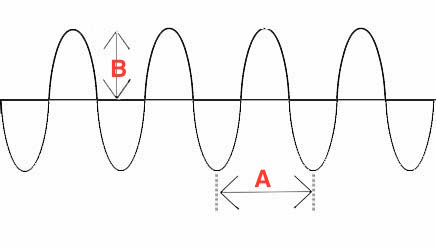
What property of this wave is represented by the letter "A"
a)
amplitude
b)
crest
c)
trough
d)
wavelength
18.
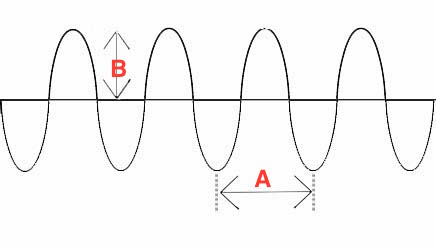
What property of the wave is represented by the letter "B"?
a)
amplitude
b)
crest
c)
trough
d)
wavelength
19.
The lowest point on a wave is the:
a)
Amplitude
b)
Crest
c)
Trough
d)
Wavelength
20.
The type of waves that require medium to pass:
a)
Mechanical Waves
b)
Electromagnetic Waves
21.

Which vocabulary term is used to identify the distance between points C & G?
a)
Amplitude
b)
Crest
c)
Frequency
d)
Wavelength
22.
When the frequency of a wave increases, what happens to the wavelength?
a)
The wavelength is not directly affected by the frequency of a wave.
b)
The wavelength increases.
c)
The wavelength decreases.
d)
More specific information is needed to form a conclusion about the wavelength.
23.
A mechanical wave cannot travel through...
a)
a vacuum(empty space).
b)
water.
c)
air.
d)
glass.
24.
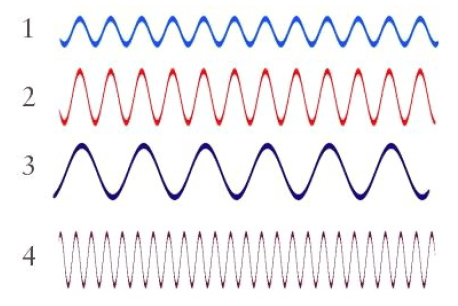
Which wave in the diagram has the greatest frequency?
a)
1
b)
2
c)
3
d)
4
25.
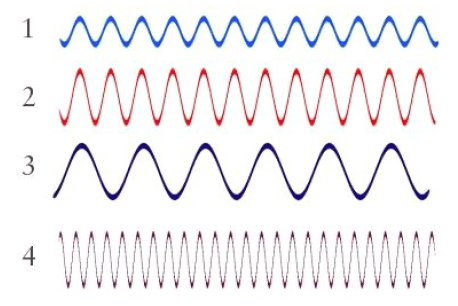
Which wave in the diagram has the greatest wavelength?
a)
1
b)
2
c)
3
d)
4
26.
Which of the following can sound travel through?
a)
solid
b)
liquid
c)
gas
d)
all of the above
27.
which material does sound travel the fastest?
a)
solid
b)
liquid
c)
gases
28.
When a wave strikes and object and bounces off. (example echo)
a)
medium
b)
refraction
c)
reflection
d)
interference
29.
Sound is caused by?
a)
force
b)
vibrations
c)
instruments
d)
medium
30.
This is what you get when sound waves are reflected, or bounce back, off of a hard surface.
a)
Amplitude
b)
Pitch
c)
Volume
d)
Echo
31.
Amplitude reflects the amount of ____________________ in a wave.
a)
energy
b)
compression
c)
rarefaction
d)
speed
32.
The ___________________ of waves can change when the waves move from one medium to another.
a)
altitude
b)
amplitude
c)
speed
d)
compression
33.
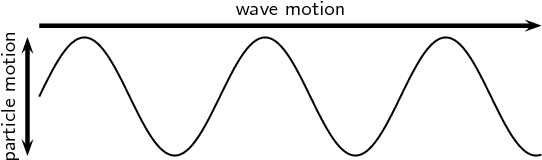
What kind of wave is pictured below?
a)
compressional wave
b)
transverse wave
c)
sound wave
d)
mechanical wave
34.

What are the spaced out sections of this wave called?
a)
Reflections
b)
Rarefactions
c)
Compressions
d)
Wavelengths
35.
Put the visible light colors in order from longest wavelength to shortest wavelength
a)
Violet, Blue, Green, Yellow, Orange, Red
b)
Red, Yellow, Green, Orange, Violet, Blue
c)
Red, Orange, Yellow, Green, Blue, Violet
36.
Select the correct order on the Electromagnetic Spectrum from shortest wavelengths to longest wavelengths
a)
R, M, I, V, U, X, G
b)
G, X, U, V, I, M, R
c)
V, M, I, U, X, G, R
37.

Which letter shows reflection?
a)
Pathway A
b)
Pathway B
c)
Pathway C
d)
Pathway D
38.

What is this image an example of?
a)
Reflection
b)
Diffusion
c)
Refraction
39.

An object appears red because it
a)
reflects light waves of all colors
b)
reflects light waves of red
c)
absorbs light waves of red
d)
transmits light waves of all colors
40.
Through what kind of matter does light move fastest?
a)
liquids
b)
air
c)
matter that is lighter in color
d)
matter that is in larger objects
41.
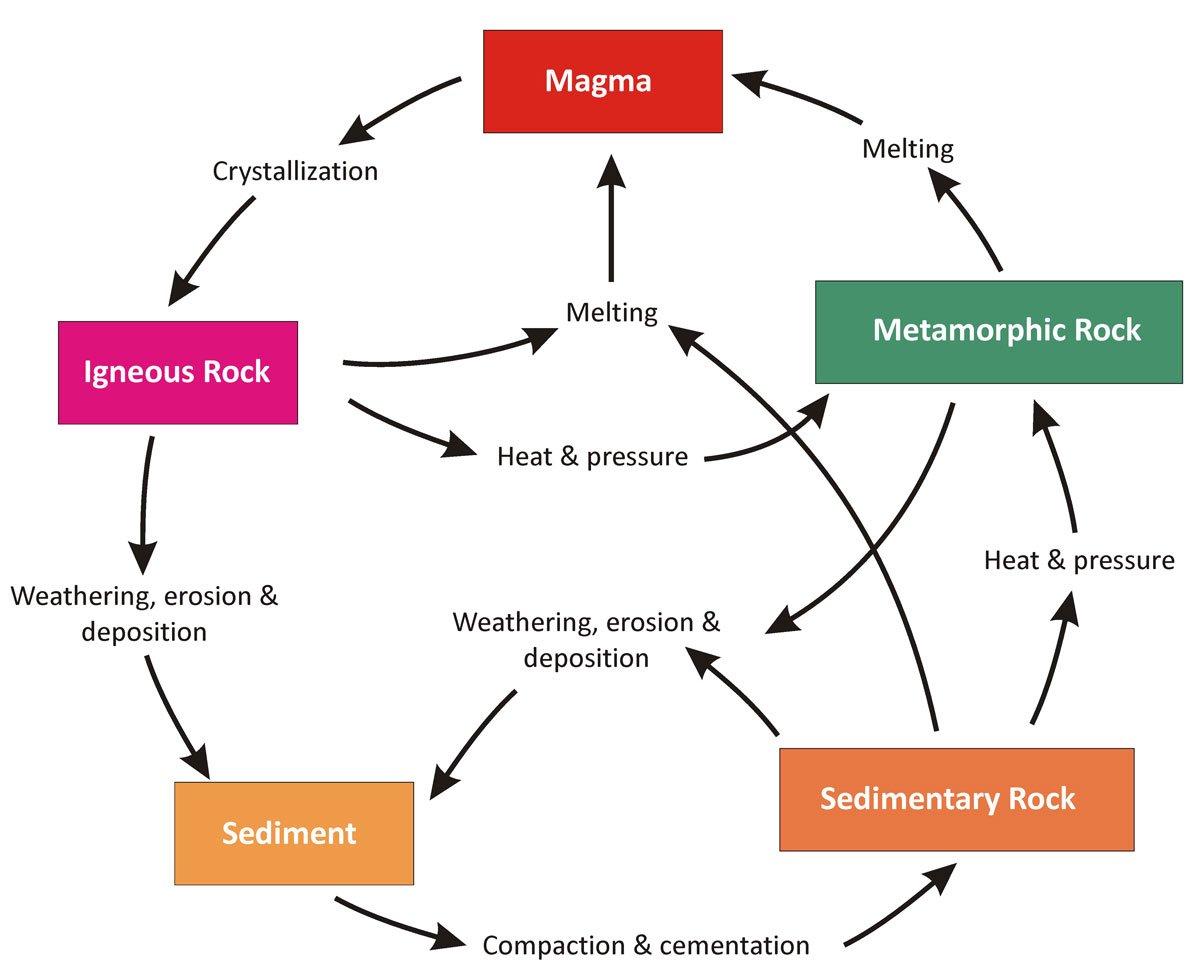
Formed by heat and pressure
a)
Sedimentary
b)
Metamorphic
c)
Extrusive Igneous
d)
Intrusive Igneous
42.

Formed by cooling & solidification of lava
a)
Sedimentary
b)
Metamorphic
c)
Extrusive Igneous
d)
Intrusive Igneous
43.

Formed by cooling & solidification of magma
a)
Sedimentary
b)
Metamorphic
c)
Extrusive Igneous
d)
Intrusive Igneous
44.
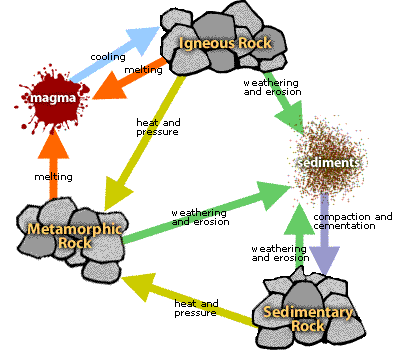
Formed by compacting & cementing of sediments
a)
Sedimentary
b)
Metamorphic
c)
Extrusive Igneous
d)
Intrusive Igneous
45.

Formed by weathering & erosion
a)
magma
b)
sediments
c)
sedimentary rock
d)
intrusive igneous
46.

Has large crystals because of slow cooling
a)
sedimentary rock
b)
metamorphic rock
c)
intrusive igneous rock
d)
extrusive igneous rock
47.

Has small or no crystals because of rapid cooling
a)
sedimentary
b)
metamorphic
c)
extrusive igneous
d)
intrusive igneous
48.

Has wavy bands.
a)
sedimentary rock
b)
metamorphic rock
c)
extrusive igneous rock
d)
intrusive igneous rock
49.
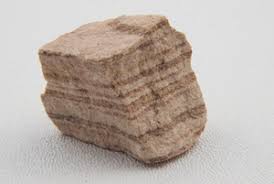
Contains fossils.
a)
sedimentary rocks
b)
metamorphic rocks
c)
extrusive igneous rocks
d)
intrusive igneous rocks
50.
The ________ measures how hard a mineral is.
a)
Miller Scale
b)
Dishong Scale
c)
Curly Scale
d)
Mohs Scale
51.
_________ is how easily something can be scratched.
a)
specific gravity
b)
luster
c)
hardness
52.
___________ describes how the mineral reflects light.
a)
cleavage
b)
magnetic
c)
luster
53.

_____ is if something breaks into smooth flat layers.
a)
fracture
b)
cleavage
c)
streak
54.

__________ is if a mineral breaks apart in a jagged or rough layer.
a)
cleavage
b)
luster
c)
fracture
55.
Dull, silky, waxy, pearly, and earthy are terms that best describe which property of minerals?
a)
luster
b)
color
c)
streak
d)
cleavage
56.
Which of the following is NOT true of minerals?
a)
They are liquids
b)
They are formed in nature
c)
They are inorganic
d)
They have crystalline structure
57.

By definition, a mineral has which of the following characteristic(s)?
a)
chemical composition
b)
crystalline structure
c)
natural
d)
all of the above
58.

Which mineral property is being shown here?
a)
luster
b)
hardness
c)
cleavage
d)
streak
59.

A ranking of a minerals from softest to hardest
a)
streak test
b)
luster test
c)
Mohs hardness scale
d)
fracture
60.
Which has more Inertia? (so need more force to move)
a)
Truck
b)
Ant
c)
A cat
61.
If you kicked a ball in space it would keep going because there is no gravity, friction, or air friction going against it. It will only stop moving in that direction if something comes into contact with it. This is an example of...
a)
Newton's First Law
b)
Newton's Second Law
c)
Newton's Third Law
62.
If you slide a hockey puck on ice, eventually it will stop because of the friction of the ice. This is an example of which Law of Motion.
a)
Newton's First Law
b)
Newton's Second Law
c)
Newton's Third Law
63.
Our galaxy is called the
a)
Earth Nebula
b)
The Hubble Galaxy
c)
The Milky Way
d)
The Snickers
64.
Galaxies are composed of (best answer)
a)
stars
b)
stars and gas
c)
stars, dust, and gas
d)
stars, dust, and gas held together by gravity
65.
The Milky Way Galaxy is a
a)
spiral
b)
lenticular
c)
elliptical
d)
irregular
66.

What type of galaxy is this?
a)
Spiral
b)
Elliptical
c)
Irregular
d)
Irrational
67.

What type of galaxy is this?
a)
Spiral
b)
Elliptical
c)
Irregular
d)
Irrational
68.
How many stars are in a galaxy.
a)
millions or billions
b)
thousands
c)
hundreds
d)
Ten
69.

What type of galaxy is this?
a)
Spiral
b)
Elliptical
c)
Irregular
d)
Irrational
70.
Place these objects in order from smallest to largest.
a)
Planets, solar system, universe, galaxy
b)
Solar system, planets, galaxy, universe
c)
Planets, solar system, galaxy, universe
d)
Galaxy, solar system, planets, universe
71.
The type of galaxy that is the leftovers of two colliding galaxies is called the...
a)
Spiral Galaxy
b)
Elliptical Galaxy
c)
Irregular Galaxy
d)
Constellation Galaxy
72.
5.8C The earth's rotation lasts for _______.
a)
24 hours
b)
24 days
c)
365 days
d)
365 hours
73.
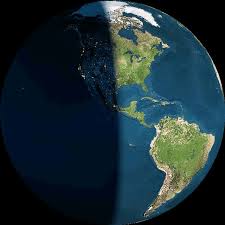
Day and night is caused by the . . .
a)
revolution of Earth around the Sun
b)
orbit of Earth around the Moon
c)
rotation of earth on its axis.
d)
rotation of the Moon on it's axis
74.
The spinning of an object on its axis is called______
a)
orbit
b)
rotation
c)
revolution
d)
tide
75.
Which of the following is a characteristic of both the Earth and the Moon?
a)
Atmosphere containing oxygen
b)
Rocky surface covered with landforms
c)
Flowing water in oceans and rivers
d)
Fossils and fossil fuels under the surface
76.

What is the word for Earth's orbit around the sun?
a)
Rotation
b)
Revolution
c)
Tilt
d)
Eclipse
77.

What does the tilting of the Earth cause the sun's light/heat to do?
a)
Hit different parts of the Earth
b)
Always hit the same spot on the Earth
78.
The Earth's axis is tilted _____ degrees.
a)
23.5
b)
25.3
c)
30.2
d)
24
79.

At position A, which hemisphere would have summer?
a)
Northern hemisphere
b)
Southern hemisphere
80.

What happens when the area in which you live tilts away from the sun?
a)
It is summer.
b)
It is spring.
c)
It is winter.
d)
It is fall.
81.
The term equinox means....
a)
equal amount of day light and equal amount of night
b)
Equal amount of winter and summer
c)
Equal amounts of hot dogs for everyone
d)
The longest day of the year
82.
What is the longest day of the year?
a)
winter solstice
b)
summer solstice
c)
fall equinox
d)
spring equinox
83.
Why do we experience the changing of the season on the earth?
a)
distance from the sun
b)
rotation of the earth
c)
change in solar output
d)
tilt of the earth's axix
84.

Why is the Equator warmest?
a)
Because it is closest to the sun.
b)
Because it receives the most direct sunlight
c)
Because no clouds form here.
d)
Because it is far from the sun
85.
Moving areas of magnetic activity with temperatures that are cooler than the area of the photosphere
a)
Photosphere
b)
Corona
c)
Sunspots
d)
Prominence
86.
Bright arch-like loops that may erupt from the photosphere into the corona
a)
Sunspots
b)
Solar Flares
c)
Prominences
d)
Photosphere
87.

What does #6 represent in the diagram?
a)
Prominences
b)
Sunspots
c)
Solar Flares
d)
Corona
88.
Sudden, intense explosions that result in changes in brightness when magnetic energy is released.
a)
Prominences
b)
Solar Flare
c)
Sunspot
d)
Photosphere
89.
Energy released from _________ can cause damage to the International Space Station, disrupt radio and electrical transmissions on Earth, and cause Auroras in the skies near the North and South Poles
a)
Sunspots
b)
Solar Flares
c)
Prominences
d)
Corona
90.
Emits light that we see
a)
Photosphere
b)
Sunspot
c)
Solar Flare
d)
Prominence
91.
Emits light but is only visible as a white halo during a solar eclipse
a)
Core
b)
Solar Flare
c)
Corona
d)
Sunspot
92.
Occur near sunspots
a)
Prominence
b)
Solar Flare
c)
Corona
d)
Blasts of light
93.

What type of tides would this arrangement of earth-moon-sun create?
a)
neap tide
b)
spring tide
c)
new moon tide
d)
full moon tide
94.

What type of tide would this arrangement of earth-moon-sun create?
a)
full moon tide
b)
new moon tide
c)
neap tide
d)
spring tide
95.
If tides alternate from high to low and there are two of each type of tide a day, about how many hours will generally be between each different tide?
a)
2 hours
b)
6 hours
c)
12 hours
d)
24 hours
96.
During which two moon phases do Spring Tides take place?
a)
New and Full
b)
1st and 3rd Quarters
c)
Waxing and Waning
d)
1st Quarter and Full
97.
When the amount of light we see from the moon appears to be shrinking, it is
a)
Waxing
b)
Waning
c)
Gibbous
d)
Crescent
98.

Name the moon phase
a)
waning crescent
b)
waxing crescent
c)
waning gibbous
d)
waxing gibbous
99.
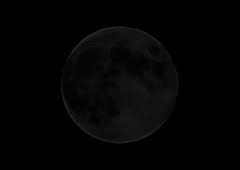
Name the moon phase
a)
First Quarter
b)
Last Quarter
c)
New Moon
d)
Full Moon
100.

Name the phase of the moon for letter a
a)
First Quarter
b)
Last Quarter
c)
Waxing Gibbous
d)
Waning Gibbous
101.

In the summer, many people enjoy going to the beach. There is a beautiful beach in Argentina, which is located in the Southern Hemisphere. Which diagram shows the position of Earth when it is summer in Argentina?
a)
A
b)
B
c)
C
d)
D
102.

This model is showing us a...
a)
lunar eclipse
b)
solar eclipse
c)
phases of the moon
d)
earth eclipse
103.

This image is showing us a.....
a)
solar eclipse
b)
lunar eclipse
c)
phases of the moon
d)
earth eclipse
104.
When the moon passes between the earth and the sun, this results in a.....
a)
Waxing moon
b)
lunar eclipse
c)
solar eclipse
d)
sun rise
105.
When the earth is between the sun and the moon, this results in a...
a)
waxing moon
b)
solar eclipse
c)
lunar eclipse
d)
sun rise
100 %

