
 Worksheets
WEP-Energy: Questions 1-11
Total questions: 111
Worksheet time: 56mins
A 1-kilogram rock is dropped from a cliff 90 meters high. After falling 20 meters, the kinetic energy of the rock is approximately
20 J
200 J
700 J
900 J
If the speed of a car is doubled, the kinetic energy of the car is
quadrupled
quartered
doubled
halved
A constant force is used to keep a block sliding at constant velocity along a rough horizontal track. As the block slides, there could be an increase in its
gravitational potential energy, only
internal energy, only
gravitational potential energy and kinetic energy
internal energy and kinetic energy
As an object falls freely, the kinetic energy of the object
decreases
increases
remains the same
An object weighing 15 newtons is lifted from the ground to a height of 0.22 meter. The increase in the object’s gravitational potential energy is approximately
310 J
32 J
3.3 J
0.34 J
A 0.50‑kilogram ball is thrown vertically upward with an initial kinetic energy of 25 joules. Approximately how high will the ball rise? [Neglect air resistance.]
2.6 m
5.1 m
25 m
13 m
A 45‑kilogram boy is riding a 15‑kilogram bicycle with a speed of 8 meters per second. What is the combined kinetic energy of the boy and the bicycle?
240 J
480 J
1920 J
1440 J
The work done in moving a block across a rough surface and the heat energy gained by the block can both be measured in
watts
degrees
newtons
joules
A 50‑kilogram child running at 6 meters per second jumps onto a stationary 10‑kilogram sled on a level frictionless surface. Calculate the speed of the sled with the child after she jumps onto the sled. [Show all work, including the equation and substitution with units.]
6.0 m/s
5.0 m/s
4.5 m/s
7.5 m/s
Calculate the kinetic energy of the sled with the child after she jumps onto the sled. [Show all work, including the equation and substitution with units.]
675 J
810 J
540 J
405 J
After a short time, the moving sled with the child aboard reaches a rough level surface that exerts a constant frictional force of 54 newtons on the sled. How much work must be done by friction to bring the sled with the child to a stop?
270 J
810 J
540 J
675 J
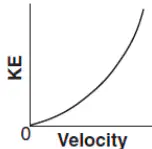
Which graph best represents kinetic energy versus velocity for an object accelerating in a straight line?
KE constant for all velocities
KE proportional to velocity squared curve
KE proportional to velocity linear line
KE decreasing with increasing velocity
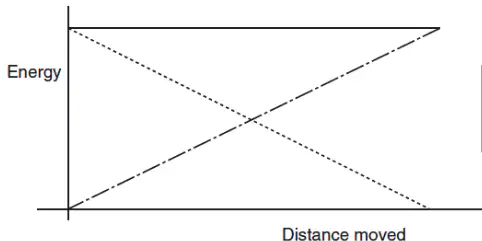
In the Energy vs. Distance moved graph, total mechanical energy remains constant while kinetic energy increases and gravitational potential energy decreases. Which motion of the block is best described?
Falling freely under gravity downward
Being lifted upward at constant velocity
Sliding up a frictionless incline steadily
Accelerating on a flat surface with friction
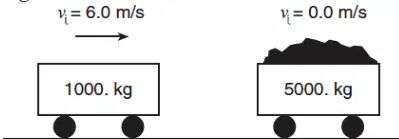
A 1000 kg cart moving at 6.0 m/s collides and locks with a stationary 5000 kg cart. What is the combined speed immediately after the inelastic collision?
6.0 m/s to the right
0.0 m/s after collision
5.0 m/s to the right
1.0 m/s to the right
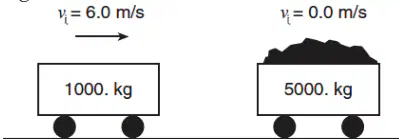
Using your result for speed, what is the kinetic energy of the combined 6000 kg carts after the collision?
3.0×10⁵ joules
3.0×10⁶ joules
3.0 × 10^4 joules
3.0 × 10^3 joules
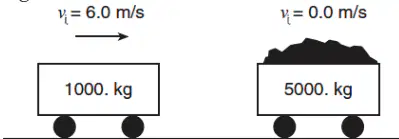
How does the kinetic energy after the collision compare to the total kinetic energy before the collision?
Same because total mechanical energy constant
Less because energy lost as heat and sound
Greater because masses combine into one
Equal because momentum is conserved
When a force moves an object over a rough, horizontal surface at a constant velocity, the work done against friction produces an increase in the object's
momentum
potential energy
internal energy
weight
Base your answers to questions 18 through 21 on the information below. The driver of a car made an emergency stop on a straight horizontal road. The wheels locked and the car skidded to a stop. The marks made by the rubber tires on the dry asphalt are 16 meters long, and the car’s mass is 1200 kilograms.
Information statement only
Scenario describes skidding stop
Horizontal road with locked wheels
Proceed to question 18
Mass given for calculations
Determine the weight of the car
1.20×10^4 N
1.18×10^4 N
1.96×10^4 N
1.20×10^3 N
Calculate the magnitude of the frictional force the road applied to the car in stopping it. [Show all work, including the equation and substitution with units.]
1.6×10^4 N
7.4×10^3 N
4.4×10^3 N
3.7×10^3 N
Calculate the work done by the frictional force in stopping the car. [Show all work, including the equation and substitution with units.]
−7.4×10⁵J
−2.4×10⁵ J
−4.8×10⁵J
−1.2×10⁵ J
Assuming that energy is conserved, calculate the speed of the car before the brakes were applied. [Show all work, including the equation and substitution with units.]
12.9 m/s
19.9 m/s
28.3 m/s
31.6 m/s
A 60-kilogram runner has 1920 joules of kinetic energy. At what speed is she running?
64.0 m/s
32.0 m/s
8.00 m/s
5.66 m/s
As a block slides across a table, its speed decreases while its temperature increases. Which two changes occur in the block's energy as it slides?
a decrease in both kinetic energy and internal energy
an increase in kinetic energy and a decrease in internal energy
an increase in both kinetic energy and internal energy
a decrease in kinetic energy and an increase in internal energy
If the direction of a moving car changes and its speed remains constant, which quantity must remain the same?
kinetic energy
displacement
momentum
velocity
What is the gravitational potential energy with respect to the surface of the water of a 75.0-kilogram diver located 3.00 meters above the water?
2.17×10^2 J
2.21×10^3 J
2.29×10^1 J
2.25×10² J
As a ball falls freely (without friction) toward the ground, its total mechanical energy
remains the same
increases
oscillates
decreases
The gravitational potential energy, with respect to Earth, this is possessed by an object is dependent on the object's
speed
momentum
acceleration
position
A boy pushes his wagon at constant speed along a level sidewalk. The graph shows a constant horizontal force of 30 N over a distance from 0.0 m to 6.0 m. What is the total work done by the boy in pushing the wagon 4.0 meters?
5.0 J
7.5 J
120 J
180 J
A boy pushes his wagon at constant speed along a level sidewalk. As the boy pushes the wagon, what happens to the wagon’s energy?
Gravitational potential energy increases.
Gravitational potential energy decreases.
Internal energy increases.
Internal energy decreases.
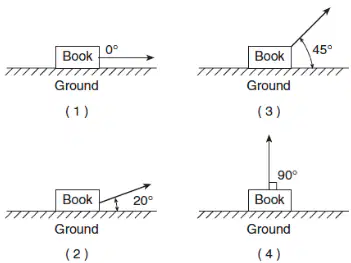
A 1.0‑kilogram book resting on the ground is moved 1.0 meter at various angles relative to the horizontal. In which direction does the 1.0‑meter displacement produce the greatest increase in the book’s gravitational potential energy?
0° above horizontal
90° straight up
20° above horizontal
45° above horizontal
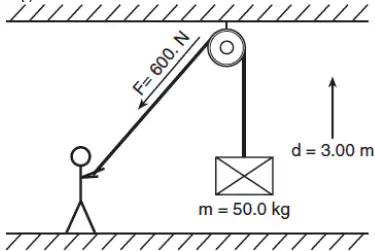
A student exerts an average force of 600 N on a rope to lift a 50‑kg crate a vertical distance of 3 m. Compared to the work done by the student, the gravitational potential energy gained by the crate is
150 J more
330 J more
330 J less
exactly the same
A book sliding across a horizontal tabletop slows until it comes to rest. Describe what change, if any, occurs in the book’s kinetic energy and internal energy as it slows.
Both increase equally
Both decrease to zero
Kinetic increases, internal decreases
Kinetic decreases, internal increases
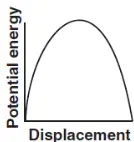
A pendulum is pulled to the side and released from rest. Which graph best represents the relationship between gravitational potential energy of the pendulum and its displacement from its point of release?
Parabolic decrease then increase
Linear increase with displacement
Linear decrease with displacement
Horizontal line at high energy
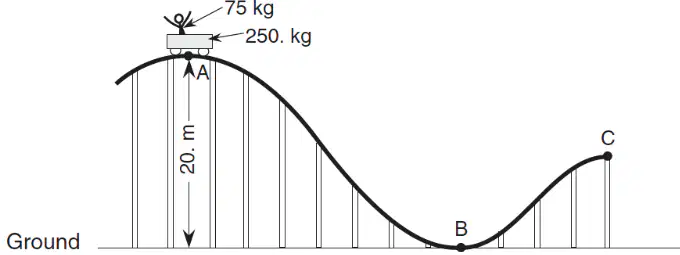
A 250 kg roller coaster car carries a 75 kg passenger and is 20 m above the ground at point A. Neglect friction. What is the total gravitational potential energy of the car-plus-passenger at point A relative to the ground? Use g = 9.8m/s2 .
4.9×10^5 joules
4.9×10^4 joules
6.4×10^5 joules
6.4×10^4 joules
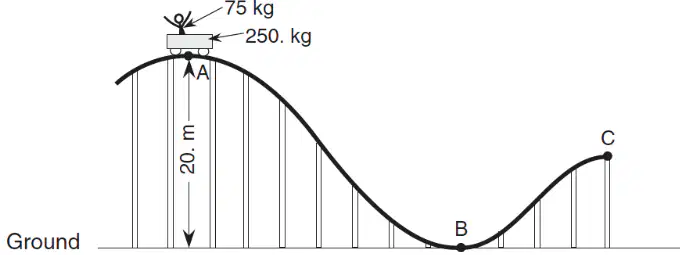
At point B near the bottom of the track, what is the speed of the car-plus-passenger system if it started from rest at A and friction is negligible? Use g = 9.8m/s2 and the height of A is 20m above B.
10 m/s
14 m/s
20 m/s
28 m/s

Compare the total mechanical energy of the car-plus-passenger at points A, B, and C if friction is negligible.
Largest at A, smaller at B, smallest at C
Same at A and B, larger at C
Same at A, B, and C
Largest at B, smaller at C, smallest at A
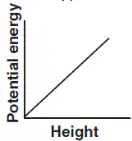
Which graph best represents how gravitational potential energy near Earth’s surface depends on an object’s height above the surface?
Linear increase with height
Horizontal line versus height
Exponential increase with height
Inverse curve decreasing with height
A horizontal 5.0 N force acts on a 3.0 kg mass over 6.0 m on a frictionless surface. What is the change in kinetic energy of the mass over this distance?
6 J
15 J
90 J
30 J
As a ball falls freely toward the ground with negligible air resistance, what happens to its total mechanical energy?
Decreases steadily
Increases steadily
Oscillates with time
Remains the same
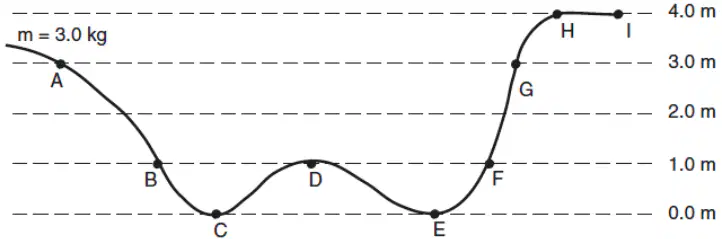
A 3.0 kg object is released from rest at point A on a frictionless track where gravitational potential energy is zero at point C. The vertical heights are marked: A at 3.0 m, B at 1.0 m, C at 0.0 m, D at 1.0 m, E at 0.0 m, F at 1.0 m, G at 2.0 m, H at 4.0 m, and I at 4.0 m. What is the gravitational potential energy of the object at point A relative to point C? Use g = 9.8 N/kg.
88.2 joules
58.8 joules
29.4 joules
14.7 joules
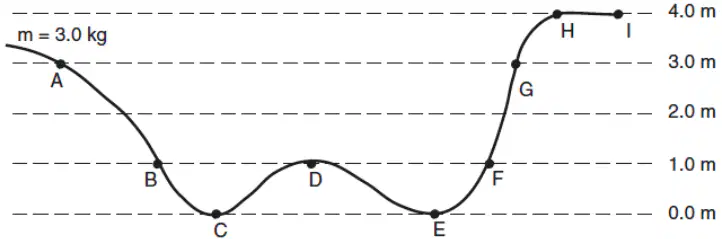
At point B on the same frictionless track, the object has descended from A and has height 1.0 m. What is the kinetic energy of the object at point B? Use g = 9.8 N/kg.
19.6 joules
78.4 joules
39.2 joules
58.8 joules
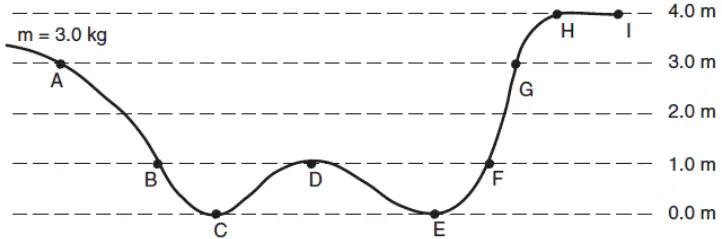
If released from A, what is the farthest lettered point the object can reach on the track without external forces, assuming no friction?
Point F at 1.0 m
Point H at 4.0 m
Point G at 2.0 m
Point I at 4.0 m
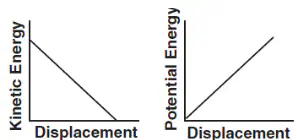
An object is thrown straight up. Which pair of graphs shows kinetic energy decreasing linearly with displacement while gravitational potential energy increases linearly with displacement?
Pair (4) with KE decreasing and PE constant
Pair (1) with both increasing
Pair (2) with KE decreasing and PE increasing
Pair (3) with KE constant and PE decreasing
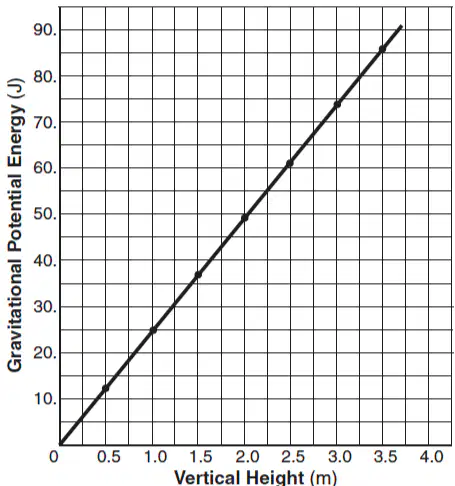
The graph of gravitational potential energy versus vertical height shows a straight line passing through the origin with positive slope, reaching about 90 J at 4.0 m. What is the gravitational potential energy at 2.25 m?
63.0 joules
56.3 joules
50.6 joules
40.5 joules
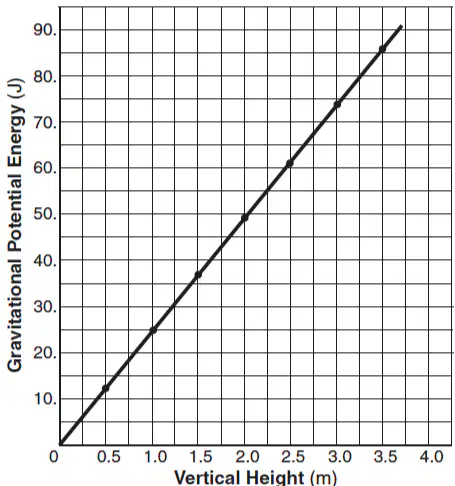
Using the same graph, determine the mass of the object represented. Assume g = 9.8 N/kg.
1.9 kilograms
2.3 kilograms
2.5 kilograms
3.0 kilograms
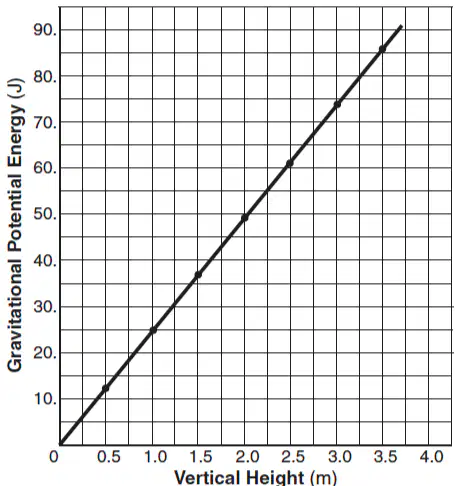
What physical quantity does the slope of the gravitational potential energy vs vertical height graph represent near Earth’s surface?
Gravitational field strength
Potential energy at zero height
Weight of the object
Mass of the object
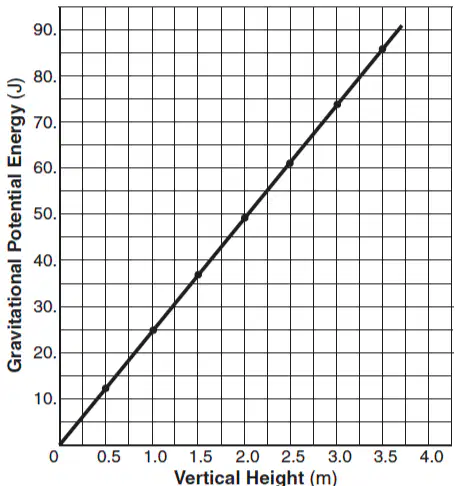
If a heavier object is plotted on the same type of PE vs height graph, which change correctly represents its line compared to the original?
Same slope, lower intercept
Greater slope, same intercept
Lower slope, higher intercept
Curved line, same slope
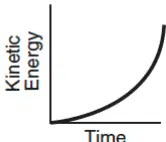
An object falls freely near Earth’s surface. Which graph best represents its kinetic energy as a function of time of fall, neglecting air resistance?
Concave down curve increasing with time
Straight line decreasing with time
Straight line increasing with time
Concave up curve increasing with time
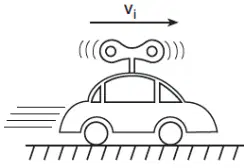
A compressed spring launches a toy cart on a smooth floor. As the spring relaxes, the cart slows to rest. Which energy transformation best describes this process between launch and stop?
Internal energy to kinetic energy then elastic energy
Gravitational energy to kinetic energy then internal energy
Elastic energy to kinetic energy then internal energy
Kinetic energy to elastic energy then gravitational energy
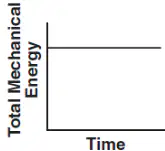
A wooden crate is pushed at constant speed across a level rough floor. Which graph best shows total mechanical energy versus time during the push?
Linearly increasing with time steadily
Quadratically increasing curve upward
Constant line slightly decreasing with time
Horizontal line remaining exactly constant
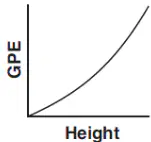
Near Earth's surface, how does gravitational potential energy depend on height above the ground?
Constant independent of height
Exponential growth with height
Inverse proportionality to height
Direct linear proportionality to height
A 75 kg runner covers 1.8 km in 1.2 103 s. What is the average speed in m/s?
2.4 m/s
6.0 m/s
1.5 m/s
0.42 m/s
Using the runner’s speed from the previous question, what is the runner’s average kinetic energy?
84 J
169 J
126 J
356 J
A 6.8 kg block slides on a horizontal frictionless surface at a constant 6.0 m/s. Approximately what is its kinetic energy?
20 J
240 J
41 J
120 J
If the speed of a moving object is doubled, how does its kinetic energy change?
Halved
Doubled
Quadrupled
Unchanged
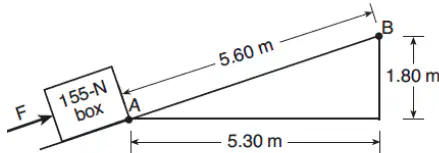
A 155 N box slides up a 5.30 m ramp, rising 1.80 m vertically. Neglect friction. What gravitational potential energy does the box gain?
28.4 J
868 J
2740 J
279 J
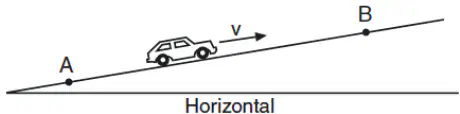
A car travels at constant speed up a hill from point A to B. As it rises, what happens to its gravitational potential energy and kinetic energy?
GPE increases, kinetic energy decreases
GPE remains same, kinetic energy decreases
GPE remains same, kinetic energy remains same
GPE increases, kinetic energy remains same
A student makes a simple pendulum by attaching a mass to the free end of a 1.50-meter length of string suspended from the ceiling of her physics classroom. She pulls the mass up to her chin and releases it from rest, allowing the pendulum to swing in its curved path. Her classmates are surprised that the mass doesn’t reach her chin on the return swing, even though she does not move. Explain why the mass does not have enough energy to return to its starting position and hit the girl on the chin.
The pendulum length shortens during the swing reducing energy
The mass loses speed because tension removes kinetic energy
Some energy is lost to air resistance and internal friction
Gravity decreases on the return causing less potential energy
A 65-kilogram pole vaulter wishes to vault to a height of 5.5 meters. Calculate the minimum amount of kinetic energy the vaulter needs to reach this height if air friction is neglected and all the vaulting energy is derived from kinetic energy.
5.5×10^2 J approximately
3.5×10^3 J approximately
9.8×10^3 J approximately
6.5×101 J approximately
Calculate the speed the vaulter must attain to have the necessary kinetic energy to reach 5.5 meters, assuming all energy converts to gravitational potential at the top.
20 m/s approximately
6.5 m/s approximately
9.8 m/s approximately
13 m/s approximately
Which pair of quantities can be expressed using the same units?
Impulse and potential energy
Power and momentum
Work and kinetic energy
Acceleration and weight
A car with mass m possesses a momentum of magnitude p. Which expression correctly represents the kinetic energy, KE, of the car in terms of m and p?
KE = p/m
KE = mp/2m
KE = mp/2
KE=2mp2
Which statement best explains why a “wet saw” used to cut through fine optical crystals is constantly lubricated with oil?
Lubrication decreases friction and minimizes internal energy increase
Lubrication decreases friction and maximizes internal energy increase
Lubrication increases friction and minimizes internal energy increase
Lubrication increases friction and maximizes internal energy increase
A 55-kilogram diver falls freely from a diving platform that is 3.00 meters above the surface of the water in a pool. When she is 1.00 meter above the water, what are her gravitational potential energy and kinetic energy with respect to the water’s surface?
PE = 1620 J and KE = 0 J
PE = 1080 J and KE = 540 J
PE = 540 J and KE = 1080 J
PE = 810 J and KE = 810 J
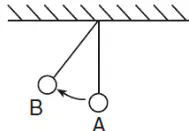
As the pendulum swings from position A to position B, what happens to its total mechanical energy? Neglect friction.
It becomes zero
It increases
It decreases
It remains the same
Which situation describes a system with decreasing gravitational potential energy?
A bicyclist riding up a steep hill
A rocket rising vertically from Earth
A girl stretching a horizontal spring
A boy jumping down from a tree limb
A 55-kilogram diver falls freely from 3.00 m above a pool. When she is 1.00 m above the water, what are her gravitational potential energy and kinetic energy with respect to the water surface? Take g = 10 N/kg.
PE=540 J and KE=1080 J
PE=1620 J and KE=0 J
PE=1080 J and KE=540 J
PE=810 J and KE=810 J
As a box is pushed 30 meters across a horizontal floor by a constant horizontal force of 25 N, the kinetic energy of the box increases by 300 J. How much total internal energy is produced during this process?
750 J
450 J
250 J
150 J
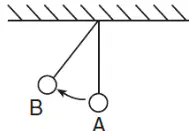
As the pendulum swings from position A to position B, what happens to its total mechanical energy? Neglect friction.
It decreases.
It increases.
It remains the same.
Which situation describes a system with decreasing gravitational potential energy?
a rocket rising vertically from Earth
a bicyclist riding up a steep hill
a boy jumping down from a tree limb
a girl stretching a horizontal spring
Which statement describes the kinetic energy and total mechanical energy of a block as it is pulled at constant speed up an incline?
Kinetic energy decreases and total mechanical energy increases.
Kinetic energy decreases and total mechanical energy remains the same.
Kinetic energy remains the same and total mechanical energy remains the same.
Kinetic energy remains the same and total mechanical energy increases.
A 75-kilogram bicyclist coasts down a hill at a constant speed of 12 m/s. What is the kinetic energy of the bicyclist?
5.4 × 10^3 J
1.1 × 10^4 J
9.0 \times 10^2 J
4.5×10² J
An electrical generator in a science classroom makes a lightbulb glow when a student turns a hand crank. During its operation, this generator converts
chemical energy to electrical energy
mechanical energy to electrical energy
electrical energy to chemical energy
electrical energy to mechanical energy
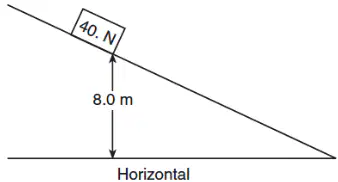
A block weighing 40 N is released from rest on an 8.0 m high incline. If 50 J of heat is generated as the block slides down the incline, the maximum kinetic energy of the block at the bottom is approximately
50 J
270 J
320 J
3100 J
A 75 kg bicyclist coasts down a hill at 12 m/s. What is the bicyclist’s kinetic energy?
1.1 × 10^4 J
5.4 × 10^3 J
9.0 \times 10^2 J
4.5×10² J
An electrical generator turned by a hand crank converts which type of energy to which output?
electrical to mechanical
mechanical to electrical
electrical to chemical
chemical to electrical

A 40 N block is released from rest on a rough incline 8.0 m above the horizontal. If 50 J of heat is generated as it slides, what is the maximum kinetic energy at the bottom?
270 J
3100 J
50 J
320 J
A child starts from rest and reaches 7.0 m/s at the bottom of a frictionless slide. What is the vertical height of the slide?
2.5 m
3.5 m
0.71 m
1.4 m
Two equal-weight students go from the first to the second floor: one via elevator, one via stairs. Compare the gravitational potential energy gained by the walker to the elevator rider.
less
cannot be determined
greater
the same
During an emergency stop, a 1.5×10³ kg car loses 3.0×10⁵ J of kinetic energy. What was its speed when the brakes were applied?
14 m/s
20 m/s
25 m/s
10 m/s
A 55 kg skier is raised 370 m by a chairlift. What is the change in gravitational potential energy?
2.0×10⁵ J
5.4 × 10^2 J
2.0 × 10^4 J
5.4 × 10^1 J
A box at the top of a rough incline has 981 J more gravitational potential energy than at the bottom. As it slides, 245 J of heat is produced. Determine the kinetic energy at the bottom.
245 J
1226 J
981 J
736 J

A pendulum with a 7.50 kg mass is released from a position 1.5 m above equilibrium. Neglect friction. What total kinetic energy does the mass have as it passes equilibrium?
110 J
94 J
11 J
920 J
During braking on a level road, a car’s kinetic energy is converted primarily into which form?
light energy
nuclear energy
gravitational potential energy
internal energy

Using the given data table of speed versus kinetic energy for a runner, which mathematical relationship between kinetic energy and speed is most consistent?
KE proportional to speed cubed
KE proportional to speed squared
KE independent of speed
KE proportional to speed

From the runner’s data, estimate the mass of the runner.
35 kg
280 kg
70 kg
140 kg
A soccer player with less mass than the runner accelerates to 8 m/s. Compare their kinetic energies at the same speed.
less massive has less KE
cannot be compared
less massive has equal KE
less massive has greater KE
A car uses its brakes to stop on a level road. During this process, kinetic energy is primarily converted into which form?
light energy in headlights and road
gravitational potential energy due to height gain
nuclear energy within brake materials
internal energy as heat in brakes
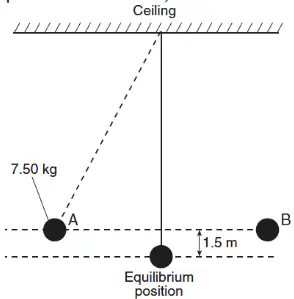
A 7.50 kg pendulum bob is released from rest at position A, which is 1.5 m above equilibrium. Neglect friction. What is the kinetic energy of the bob as it passes through equilibrium?
920 J at bottom of swing
11 J at equilibrium position
94 J as it passes equilibrium
110 J as it passes equilibrium
Using the table: at speeds 0, 2, 4, 6, 8 m/s the kinetic energies are 0, 140, 560, 1260, 2240 J. What is the best-fit mathematical relation between kinetic energy K and speed v?
K is proportional to v squared
K is proportional to v
K is inversely proportional to v
K increases logarithmically with v
From the runner data, estimate the mass m of the runner using K=21mv2 . Use the 8m/s , 2240J data point.
35 kg based on calculation steps
70 kg based on K = 21mv2
140 kg from linear relation K∝v
280 kg due to doubling speed rule
A less massive soccer player and a more massive runner both reach the same speed of 8 m/s. How do their kinetic energies compare?
More massive has greater kinetic energy
Cannot determine without acceleration
Less massive has greater kinetic energy
Equal because speed is the same
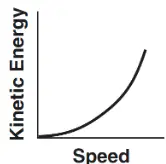
Which graph correctly shows the relationship between kinetic energy and speed for a freely falling object?
Straight line rising with speed
Curve decreasing with speed
Curve rising steeper than linear
Horizontal constant with speed
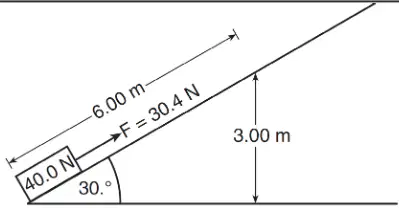
A 30.4 N force slides a 40.0 N crate 6.00 m along a 30° incline at constant speed to a vertical height of 3.00 m. What is the total work done by the 30.4 N applied force over the incline distance?
486 J including height change
182 J from W = Fd
304 J from force component only
1216 J from W = Fh
For the same crate motion, what is the total increase in gravitational potential energy after sliding 6.00 m to a vertical height of 3.00 m?
40 J using weight times height
120 J from mg times height
200 J from F times distance
486 J matching applied work
As the crate slides up the incline at constant speed, what happens to its kinetic energy?
Increases steadily along the incline
Decreases steadily along the incline
Remains constant along the incline
Oscillates due to friction changes
As the crate slides up the incline at constant speed, what happens to its internal energy due to friction?
Becomes zero at the top only
Remains unchanged throughout motion
Decreases because speed is constant
Increases as work is dissipated as heat
A photocell shines light onto a fan, making the blades turn faster with brighter light. Which energy conversion is demonstrated?
light to thermal to mechanical
light to nuclear to thermal
light to electrical to mechanical
light to mechanical to chemical
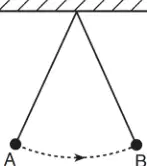
In an ideal pendulum swinging freely from A to B with no friction, what happens to the total mechanical energy?
Decreases, then increases mid-swing
Increases only throughout swing
Remains the same throughout motion
Increases, then decreases by the end
Two pieces of flint rock produce a visible spark when they are struck together. During this process, mechanical energy is converted into
elastic potential energy and nuclear energy
electromagnetic energy and internal energy
internal energy and nuclear energy
nuclear energy and electromagnetic energy

Which graph best represents an object in equilibrium moving in a straight line?
Distance vs time increasing curve
Kinetic energy vs time increasing line
Momentum vs time increasing line
Velocity vs time horizontal line
When a mass is placed on a spring with a spring constant of 60.0 newtons per meter, the spring is compressed 0.500 meter. How much energy is stored in the spring?
60.0 J
30.0 J
7.50 J
15.0 J
A shopping cart slows as it moves along a level floor. Which statement describes the energies of the cart?
The kinetic energy increases and the gravitational potential energy remains the same.
The kinetic energy increases and the gravitational potential energy decreases.
The kinetic energy decreases and the gravitational potential energy remains the same.
The kinetic energy decreases and the gravitational potential energy increases.
A 25-gram paper cup falls from rest off the edge of a tabletop 0.90 meter above the floor. If the cup has 0.20 joule of kinetic energy when it hits the floor, what is the total amount of energy converted into internal (thermal) energy during the cup’s fall?
2.2 J
0.22 J
0.02 J
220 J
A 3.00-newton force causes a spring to stretch 60 centimeters. Calculate the spring constant of this spring.
5.0 N/m
0.50 N/m
0.20 N/m
20 N/m
Regardless of the method used to generate electrical energy, the amount of energy provided by the source is always greater than the amount of electrical energy produced. Explain why there is a difference between the amount of energy provided by the source and the amount of electrical energy produced.
More energy is stored as chemical bonds.
Power lines increase total energy output.
Energy is lost to friction as heat.
Voltage sources create energy from nothing.
Which quantities are scalar?
distance and acceleration
speed and work
velocity and force
momentum and power
Which energy transformation occurs in an operating electric motor?
electrical --> chemical
chemical --> electrical
mechanical --> electrical
electrical --> mechanical
A block slides across a rough, horizontal tabletop. As the block comes to rest, there is an increase in the block–tabletop system’s
gravitational potential energy
elastic potential energy
kinetic energy
internal (thermal) energy
A compressed spring in a toy is used to launch a 5.00-gram ball. If the ball leaves the toy with an initial horizontal speed of 5.00 meters per second, the minimum amount of potential energy stored in the compressed spring was
0.0125 J
0.0250 J
0.0625 J
0.125 J

