Wayground logo

Free Printable Worksheets

Font size

S
M
L
XL
Worksheets

AP Chemistry Entropy and Gibbs Free Energy

Total questions: 20

Worksheet time: 19mins

Name
Class
Date
1.

Which process is accompanied by a decrease in entropy?

a)

boiling of water

b)

condensing of water vapor

c)

subliming of iodine

d)

melting of ice

2.

Systems in nature tend to undergo changes toward

a)

lower energy and less disorder

b)

lower energy and more disorder

c)

higher energy and less disorder

d)

higher energy and more disorder

3.

Given the change of phase:

CO2(g) —> CO2(s)

As CO2(g) changes to CO2(s), the entropy of the system

a)

decreases

b)

increases

c)

remains the same

4.

Which phase change represents a decrease in entropy?

a)

solid to liquid

b)

gas to liquid

c)

liquid to gas

d)

solid to gas

5.
Which one of these would result in a decrease in entropy?
a)
A solid solute dissolves in water.
b)
A gas is released.
c)
A liquid freezes.
d)
A liquid boils.
6.
Entropy always increases when
a)
enthalpy decreases.
b)
temperature decreases.
c)
temperature increases.
d)
volume increases.
7.
Spontaneous reactions are driven by
a)
increasing enthalpy and increasing entropy.
b)
decreasing enthalpy and decreasing entropy.
c)
increasing enthalpy and decreasing entropy.
d)
decreasing enthalpy and increasing entropy.
8.
Solid magnesium dissolves in a hydrochloric acid, releasing hydrogen gas and heat from a solution of magnesium chloride. What is the sign on ΔH for this reaction?
a)
Negative because it is exothermic
b)
Negative because it is endothermic
c)
Positive because it is exothermic
d)
Positive because it is endothermic
9.
Solid magnesium dissolves in a hydrochloric acid, releasing hydrogen gas and heat from a solution of magnesium chloride. What is the sign on ΔS for this reaction?
a)
Negative because it is becoming more ordered.
b)
Negative because it is becoming more disordered.
c)
Positive because it is becoming more ordered.
d)
Positive because it is becoming more disordered.
10.
A reaction has a positive ΔH and a positive ΔS. Which of the following is true?
a)
It will be spontaneous at all temperatures.
b)
It will be nonspontaneous at all temperatures.
c)
It will be spontaneous at low temperatures.
d)
It will be spontaneous at high temperatures.
11.
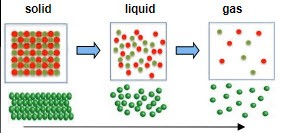
Entropy increases from solid, liquid to gas. Why?
a)
Molecular disorder increases
b)
Molecular randomness decreases
c)
Molecules are more energetic
d)
Molecules are more reactive
12.
Solid magnesium dissolves in a hydrochloric acid, releasing hydrogen gas and heat from a solution of magnesium chloride. What is the sign on ΔG for this reaction?
a)
Negative because it is spontaneous
b)
Negative because it is nonspontaneous
c)
Positive because it is spontaneous
d)
Positive because it is nonspontaneous
13.

Identify whether the following result in an increase or decrease in entropy:


3 moles of gas (on reactant side) --> 6 moles of gas (product)

a)

increase

b)

decrease

14.
What type of reaction is shown in the reaction pathway?
a)
endothermic reaction
b)
exothermic reaction
15.
ΔH value in an endothermic reaction is a positive number.
a)
True
b)
False
16.
The reaction
A + 2 B2 + C --> CAB4
has an enthalpy change of -104 kJ and a change in entropy of -60.8 J/K at 30 °C. What is the free energy and spontaneity of the reaction?  
a)
-85.6 kJ, spontaneous
b)
-18.3 kJ, not spontaneous
c)
+18.3 kJ, spontaneous 
d)
+85.6 kJ, not spontaneous 
17.
True/False: The rate of a chemical reaction is unrelated to the spontaneity of the reaction.
a)
True
b)
False
18.
When a liquid boils what are the signs for Δ H  and  Δ S  ? (Think about H2O as an example!)
a)
Δ H  =  +   Δ S  =  +
b)
Δ H  =  -   Δ S  =  -
c)
Δ H  =  +   Δ S  =  -
d)
Δ H  =  -   Δ S  =  +
19.

Predict the signs of Δ H , Δ S and Δ G for the reaction:

Mg(s) → Mg(g)

a)

Δ H= - , Δ S = + and Δ G = - (all temps)

b)

Δ H= + , Δ S = + and Δ G = - (At all temps)

c)

Δ H= + , Δ S = + and Δ G = - (At low temps)

d)

Δ H= + , Δ S = + and Δ G = - (At high temps)

20.

What signs of Δ H and Δ S will always yield a reaction that is non-spontaneous ? (Think of the equation for ΔG°!!)

a)

Δ H = + Δ S = +

b)

Δ H = - Δ S = -

c)

Δ H = - Δ S = +

d)

Δ H = + Δ S = -