
 Worksheets
TCI Magnetism
Total questions: 61
Worksheet time: 38mins
Which effect does the right hand rule identify?
The direction of lines of force surround a current carrying conductor
the direction for reluctance in a current carrying conductor
the direction for retentivity in a current carrying conductor
the direction for residual magnetism in a current carrying conductor
Which poles are attracted? (mark 2 correct answers)
North and North
South and South
North and South
South and North
None of these, only magnetic monopoles will attract.
Which poles repel? (mark 2 correct answers)
North and South
South and North
North and North
South and South
None of these, only magnetic monopoles will repel.

The magnetic domains in this substance are not highly aligned. This substance is therefore
magnetized
unmagnetized
positively charged
negatively charged

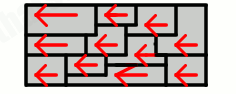
You know this substance is magnetized because
all the domains have right angles
the arrows are drawn in red
the domains are highly aligned
the domains are random
Earth acts like a giant magnet due to ______________________.
gravity
geothermal activity
convection currents in the molten core
solar radiation

This large crane magnet functions only when the electrical current is ON. The crane magnet is an example of what type of magnet?
NIB magnet
ceramic magnet
electromagnet
funnel magnet

In this image, matching north poles from two magnets are introduced. What do you predict will be the outcome?
There will be no interaction. The poles of magnets do not have an effect on one another.
The two north poles will attract each other
The two north poles will repel each other
The two magnets will combine and become one magnet
The compass's NORTH needle will always point to geographic ___________ because Earth's magnetic ____________ pole is there.
East / West
Nonsense, Earth does not have a magnetic field!
West / East
North / South
Mark all TRUE statements regarding magnets. (2 correct answers)
Magnets have North and South seeking poles.
If a bar magnet is broken in half, one half will be completely North pole, and the other will be completely South pole.
If a bar magnet is broken in half, each half will be a complete magnet, containing both North and South poles.
Iron is ALWAYS magnetic.
ALL metallic elements are magnetic.
If a compass is placed in a magnetic field, its NORTH seeking needle will point ____________.
Toward magnetic South (which is geographic North on Earth)
Toward magnetic North (which is geographic South on Earth.)
East
West
Mark 2 correct answers: Which is true farther from a magnet?
Field lines are closer together.
Field lines are farther apart.
The magnetic field is weaker.
The magnetic field is stronger.
Which letter is the symbol for the magnetic field?
A
B
N
U
True or False: The magnetic field of Earth may at some time may change direction, making the magnetic North pole the magnetic South pole.
True
False
Which of the following do we use as evidence of Earth's changing magnetic field over time? (only 1 correct answer.)
Earth's tilt on its axis.
The vernal equinox.
Iron deposits become magnetized in the direction of Earth's magnetic field.
Formation of new crust at the mid-ocean ridge.
Within the atom, which subatomic particle acts as a tiny bar magnet?
Electron
Neutron
Proton
Lepton
In a magnetic material, whole regions of the material in which the electrons are aligned in the same direction are called ______________.
electronic colonies
magnetic field generators
magnetic domains
polarized magnetite
In our study of electricity and magnetism, we use the RIGHT hand rule. We point our thumb in the direction of the ____________, our fingers show us the direction of the ___________.
current / magnetic field
field / current
compass / needle
needle / compass
Nonsense, there is no right hand rule!
Magnetic fields pointing into a page are represented by a(n) ______, while out of the page are represented by a(n) ______.
b / c
heart / flower
dot / x
x / dot
shaded region / white region
Which of the following can increase the strength of an electromagnet? (mark 2 correct answers.)
Increase the number of loops of current-carrying wire.
Decrease the number of loops of current-carrying wire.
Increase the current in the wire by increasing the voltage of the battery.
Decrease the current in the wire by increasing the resistance of the wire.
A simple ______ ______________ is a good example of magnetism.
electric field
bar magnet
north pole
field line
One end of a bar magnet is referred to as its ________ ________ and is labeled _____. (mark 2 answers)
south pole, N
north pole, S
north pole, N
south pole, S
If you suspend a bar magnet from a string, the N pole will point to Earth’s ________ ______________ ________. (mark 2 answers)
south magnetic pole
north magnetic pole
north geographic pole
south geographic pole
Magnets always have __________ pole(s).
one
two
three
four
Magnets produce _________________ fields.
electric
magnetic
baseball
corn
The arrows of magnetic field lines are directed _________________ the N pole.
perpendicular to
toward
regardless of
away from
The arrows of magnetic field lines are directed _________________ the S pole.
perpendicular to
toward
regardless of
away from
In a diagram of a magnetic field, the stronger the force of the magnetic field, the ___________ the field lines.
further apart
closer
thicker
thinner
In a diagram of a magnetic field, field lines _____________ cross.
always
rarely
frequently
never
The north geographic pole of Earth is actually near the _______ pole of Earth’s magnetic field.
north
primary
secondary
south
The Earth’s magnetic axis is ______________ aligned with Earth’s geographic axis.
perfectly
not perfectly
exactly
Earth’s magnetic field is strongest at the ___________ and weakest at the ______________.
equator, poles
north pole, south pole
poles, equator
south pole, north pole
The magnetic field of a magnet is due to the magnetic fields produced by its ______________.
protons
neutrons
quarks
electrons
What pole of Earth's magnetic field would you be close to if you visited Alaska?
north
south
Neither. Alaska is not close to any pole.
A current-carrying wire produces a ____________ field.
thermal energy
potential energy
magnetic
dark matter
A stationary electric charge produces ___________________________________________________.
a magnetic field but not an electric field.
an electric field but not a magnetic field.
both an electric field and a magnetic field.
neither an electric field nor a magnetic field.
A ________________ electric charge produces a(n) _______________ field.
moving, magnetic
stationary, magnetic
moving, empty
stationary, empty

This symbol indicates that a part of a magnetic field is moving __________________.
into the page/screen/whiteboard
out of the page/screen/whiteboard
around the circle
quickly

This symbol indicates that a part of a magnetic field is moving __________________.
into the page/screen/whiteboard
out of the page/screen/whiteboard
around the circle
quickly

This diagram shows a magnetic field caused by an electric current. In which direction is the electric current moving?
right to left
left to right
into the screen
out of the screen
The strength of a magnetic field generated by an electric current is ____________________________.
equal to the current
not related to the current
directly proportional to the current
inversely proportional to the current
The strength of a magnetic field generated by an electric current is ____________________________.
equal to the distance from the wire
not related to the distance from the wire
directly proportional to the distance from the wire
inversely proportional to the distance from the wire
Current flowing through a wire is generating a magnetic field. The further away from the wire, the _______________ the magnetic field.
stronger
weaker
faster
slower
Current flowing through a wire is generating a magnetic field. The greater the current, the _______________ the magnetic field.
stronger
weaker
faster
slower
All magnetism is caused by ____________________.
stationary electric charges.
gravitational fields.
moving electric charges.
magnetic fields.
The needle of a compass lines up ______________________.
parallel to the lines of the magnetic field.
randomly.
always pointing towards magnetic north.
perpendicular to the lines of the magnetic field.
Magnetism is caused by ______________.
moving electric charges
any material
a compass needle
a tiny piece of iron
A substance becomes magnetic when ________________.
positive ions gather at one end and negative ions at the other end
positive charges line up on one side and negative charges on the other side
magnetic domains are created by the alignment of spinning electrons
Magnetism is caused when electrons ____________________.
decay
spin and move around the nucleus of an atom
remain stationary
change into protons
The needle of a compass lines up in a direction ________________________ the field lines of the magnetic field.
perpendicular to
parallel with
opposite to
without regard to
The closer you are to a magnetic, the _____________ the magnetic field.
weaker
stronger
brighter
dimmer
A loop of wire is carrying electric current, which creates a magnetic field. The magnetic field is strongest ______________________.
near the wire
near the source of the electric current
far away from the loop
at the center of the loop
Moving a magnet near a wire will __________________.
magnetize the wire
induce a current in the wire
have no effect
cause the wire to cool
Causing a current to flow through a wire by changing the magnetic field near the wire is called ________________.
radiation
convection
induction
conduction
The strength of a magnetic field inside a coil of wire can be increased by:
increasing the current through the wire coil
increasing the number of loops in the coil
wrap the coil around and iron wood
all of the above
The electric and magnetic fields in an electromagnetic wave travel _________________ each other.
parallel to
perpendicular to
at right angles to
in spite of
The electric and magnetic fields in an electromagnetic wave move ___________________ the direction of wave motion.
parallel to
perpendicular to
opposite to
without regard to
A(n) _________________ is a cylindrical coil of wire acting as a magnet when carrying electric current.
insulator
actuator
monopole
solenoid

