
 Worksheets
Unit 6 AP Biology Review
Total questions: 42
Worksheet time: 2hrs 11mins

Which of the following best describes a DNA molecule?
antiparallel double helix
contains ribose
made of amino acids
contains Uracil
ATG TGA CAG
This repetitive sequences of DNA on the ends of chromosomes (TTAGGG) for protection.
telomeres
telomerase
Okazaki fragments
primer

Transcribe the following DNA sequence:
TAT GGC ACT
TAT GGC ACT
ATA CCG TGA
AUA CCG UGA
UAU GGC ACU

Translate the following RNA sequence:
AUG AAU UGU UGA
Met-Phe-Cys-STOP
Met-Asn-Cys-STOP
Met-Asn-Cys-Trp
Tyr-Leu-Thr-Thr
Mutation: ATC GCAT
What mutation occurred?
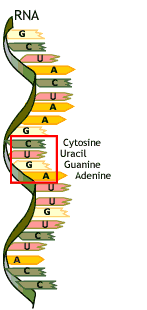
Which of the following does not occur in prokaryotic gene expression but does occur in eukaryotic gene expression?
mRNA, tRNA, and rRNA are transcribed
RNA polymerase binds to the promotor
a poly-A tail is added to the ends of the mRNA
Translation can begin as soon as transcription has begun even a little


5'-AUG-UCU-UCG-UUA-UCC-UUG-3'

Students subjected three samples of five different molecules to gel electrophoresis as shown in the Figure.
Which of the following statements best explains the pattern seen on the gel with regard to the size and charge of molecules A and B?
Molecules A and B are positively charged, and molecule A is smaller than molecule B.
Molecules A and B are positively charged, and molecule A is larger than molecule B.
Molecules A and B are negatively charged, and molecule A is smaller than molecule B.
Molecules A and B are negatively charged, and molecule A is larger than molecule B.
Which of the technologies listed below is a valuable method for mass-producing genes and other useful proteins?
gene targeting
recombinant DNA technology
gel electrophoresis
metabolism
What is a restriction enzyme?
An enzyme that cuts DNA
An enzyme that add to the DNA strand
An enzyme that builds proteins
An enzyme that breaks down lipids


In gel electrophoresis, the largest DNA fragment will appear
closest to the starting wells
farthest from the starting wells
three quarters away from the starting wells
it depends on how many fragments there are
Manufacturing recombinant DNA molecules involves cutting a gene from its normal location, inserting it into a circular piece of DNA from a bacterial cell, and then transferring the circle of DNA to cells of another species. Which of the tools below is used to cut the gene from its normal location?
bacteriophage
restriction enzyme
vector
plasmid

In a transformation experiment, a sample of E. coli bacteria was mixed with a plasmid containing the gene for resistance to the antibiotic ampicillin (ampr). Plasmid was not added to a second sample. Samples were plated on nutrient agar plates, some of which were supplemented with the antibiotic ampicillin. The results of E. coli growth are summarized above. The shaded area represents extensive growth of bacteria; dots represent individual colonies of bacteria.
Plates that have only ampicillin-resistant bacteria
growing include which of the following?
I only
III only
IV only
I and II

In a transformation experiment, a sample of E. coli bacteria was mixed with a plasmid containing the gene for resistance to the antibiotic ampicillin (ampr). Plasmid was not added to a second sample. Samples were plated on nutrient agar plates, some of which were supplemented with the antibiotic ampicillin. The results of E. coli growth are summarized above. The shaded area represents extensive growth of bacteria; dots represent individual colonies of bacteria.
Which of the following best explains why there is no growth on plate II?
The initial E. coli culture was not ampicillin resistant.
The transformation procedure killed the bacteria.
Nutrient agar inhibits E. coli grow
The bacteria on the plate were transformed.

In a transformation experiment, a sample of E. coli bacteria was mixed with a plasmid containing the gene for resistance to the antibiotic ampicillin (ampr). Plasmid was not added to a second sample. Samples were plated on nutrient agar plates, some of which were supplemented with the antibiotic ampicillin. The results of E. coli growth are summarized above. The shaded area represents extensive growth of bacteria; dots represent individual colonies of bacteria.
Plates I and III were included in the experimental
design in order to
demonstrate that the E. coli cultures were viable.
demonstrate that the plasmid can lose its ampr gene.
demonstrate that the plasmid is needed for E. coli growth.
prepare the E. coli for transformation.

In a transformation experiment, a sample of E. coli bacteria was mixed with a plasmid containing the gene for resistance to the antibiotic ampicillin (ampr). Plasmid was not added to a second sample. Samples were plated on nutrient agar plates, some of which were supplemented with the antibiotic ampicillin. The results of E. coli growth are summarized above. The shaded area represents extensive growth of bacteria; dots represent individual colonies of bacteria.
Which of the following statements best explains why there are fewer colonies on plate IV than on plate III?
Plate IV is the positive control.
Not all E. coli cells are successfully transformed.
The bacteria on plate III did not mutate.
The plasmid inhibits E. coli growth.

In a transformation experiment, a sample of E. coli bacteria was mixed with a plasmid containing the gene for resistance to the antibiotic ampicillin (ampr). Plasmid was not added to a second sample. Samples were plated on nutrient agar plates, some of which were supplemented with the antibiotic ampicillin. The results of E. coli growth are summarized above. The shaded area represents extensive growth of bacteria; dots represent individual colonies of bacteria.
In a second experiment, the plasmid contained the gene for human insulin as well as the ampr gene. Which of the following plates would have the highest percentage of bacteria that are expected to produce insulin?
I only
III only
IV only
I and III

