
 Worksheets
electrical installation and maintenance exam unit test
Total questions: 81
Worksheet time: 56mins

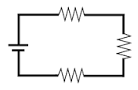
What is the commercial unit of electrical energy?
Joules
Kilojoules
Kilowatt-hour
Watt-hour
If the current in a specific copper wire increases this can be due to _____________________.
An increase in the charge carrier density
An increase in the electron drift speed
An increase in its cross sectional area
An increase in the charge of electrons
If the current at a given point in a circuit is 2.5 Amp, then how many electrons pass that point on the circuit in a time period of 1 minute.
Answer:
9.375 x 10²⁰ electrons
9.375 x 10²¹ electrons
9.375 x 10¹⁹ electrons
9.375 x 10¹⁸ electrons
Drift velocity is
The average velocity with which the electrons are drifted towards the positive terminal of the battery.
Velocity of an electron in a conductor
Average thermal velocity
None of these

A wire has a resistance R.
What is the resistance when both the length and radius of the wire are doubled?
R/2
2R
R/4
4R
Silicon
Conductor
Insulator
Semi-Conductor

Which bulb will be the brightest?
Bulb A
Bulb B
Bulb C
They will all be the same

In a parallel circuit, if one connection is broken, all of the connections stop working.
True.
False.

Which of the following is an ohmic conductor?
transistor
vacuum tube
nichrome wire
electrolyte
What instrument is used to measure the electric current that flows through a wire?
voltmeter
galvanometer
ammeter
electric meter
What happens when there is no voltage in a circuit?
The circuit becomes superconductive
The circuit will work just perfectly fine
The free electrons move randomly between atoms
The resistance of the circuit increases
How is voltage represented in a voltmeter when measuring electrical circuits?
With the symbol W and a horizontal line above it
With the symbol R and a vertical line above it
With the symbol V and dashes above it
With the symbol A and a wave line above it
What happens if a 110-volt device is plugged into a 220-volt socket?
The device will work normally
The device will burn out
The device will be dimmer
The device will flicker but works perfectly fine
Which of these schematic symbols best represent an AC voltage source?


Which of these schematic symbols best represent an DC voltage source?

In the circuit diagram above, Rx and Ry are identical ohmic resistors connected in parallel. When the switch is open, the ammeter reading is 0,1 A and the voltmeter reading is 3 V. Ignore the internal resistance of the battery.
What will be the reading on the AMMETER and VOLTMETER when the switch is closed?
READING ON AMMETER: Equal to 0,1
READING ON VOLTMETER: Equal to 3 V
READING ON AMMETER: Greater than 0,1
READING ON VOLTMETER: Equal to 3 V
READING ON AMMETER: Less than 0,1
READING ON VOLTMETER: Less than 3 V
READING ON AMMETER: Greater than 0,1
READING ON VOLTMETER: Greater than 3 V

Consider the three circuit components represented above. Which ONE of the options below best represents the names of the components in the correct sequence, from left to right?
Light bulb, resistor, cell
Resistor, light bulb, cell
Cell, light bulb, variable resistor
Cell, variable resistor, light bulb

Two like charges
attract each other.
repel each other.
neutralize each other.
have no effect on each other.
must be neutrons.
A charged comb will attract a neutral piece of paper.
True
False
Metal sphere A is neutral. Metal sphere B is negatively charged. The two spheres come into contact briefly. What type of charge does sphere A have after contact?
neutral
positive
negative
A positive charge and a negative charge held near each other are released. As they move, the force on each particle
increases.
decreases.
stays the same.
Objects can be charged by
friction
contact
induction
all of the above
Electrical forces between charges are strongest when charges are
close together.
far apart.
the electrical force is constant everywhere.
After a balloon is rubbed against wool, the two objects will ________ each other because they have ___________ charges.
attract; like
attract, opposite
repel; like
repel; opposite
What is the end result of charging by contact?
Objects have the same charge, so they will attract one another.
Objects have the same charge, so they will repel one another.
Objects have opposite charges, so they will attract one another.
Object have opposite charges, so they will repel one another.
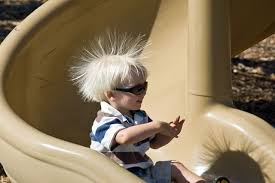
What method of charging is shown in this picture?
Contact
Friction
Grounding
Electron Shifting
What is the end result of charging two objects by friction?
Object have the same charge, so they will attract one another.
Object have the same charge, so they will repel one another.
Object have opposite charges, so they will attract one another.
Object have opposite charges, so they will repel one another.
You charge a balloon by rubbing it on your hair. This is an example of what method of charging?
Friction
Conduction
Grounding
Induction
What are the charges of a proton, neutron, and electron (in order)
positive, negative, neutral
negative, neutral, positive
neutral, positive, negative
positive, neutral, negative
Electric charge is _____________.
found only in a conductor
conserved
found only in insulators
not conserved
It is the complete loop through which an electrical current flows.
electrical current
electrical charge
electrical circuit
It is the unit used to measure electrical tension
V
A
Ω
A situation in which a faulty connection or damaged wire causes electricity to travel along the wrong route and damage an electrical device
resistance
short circuit
voltage
Materials that allow the electrical current to flow
(a)
Italian physicist who invented the first electric battery
(a)

Why doesn't the light bulb work?
Because the batteries are flat
Because the switch is closed
Because the switch is open
Because the wires are too long

What happens to a series circuit if a lamp is broken?
The other bulb will be brigther
The other bulb will stop working
Both bulbs will be dimmer
Both bulbs will be bright
What type of circuits do we have in our houses?
parallel
series
both
What are solar cells?
They convert light energy into electrical energy
They generate electricity
They do not generate electricity
They heat up water
A ____________________________ circuit is a circuit in which electrical current has more than one path to follow.
simple
open
closed
parallel



