
 Worksheets
SMI: Bones & Soft Tissue: Bones
Total questions: 50
Worksheet time: 37mins
What is the average number of bones in the human skeleton?
200
206
210
215
Which of the following is a function of the human skeleton?
Producing red blood cells
Forming a protective framework for muscles
Digesting food
Regulating body temperature
What is one gender difference in the skeletal system?
The question has a diagram associated with it. The diagram has been stored separately.
Males generally have larger and heavier bones than females.
Females have a more rounded pelvic cavity compared to males.
Males have a longer rib cage than females.
True or False: Women's bones are heavier and larger than men's bones.
True
False
What are the two main parts of the skeletal system?
Which bones are included in the axial skeleton?
What essential minerals does the skeletal system store?
(a)
How does the skeletal system support the body?
What are the microscopic cells in bones called?
Osteocytes
Chondrocytes
Erythrocytes
Leukocytes
What gives the bone its hardness and durability?
Calcium phosphate
Collagen fibers
Bone marrow
Cartilage
Label the parts of the long bone shown in the diagram.
What does the embryonic skeleton initially consist of?
Cartilage
Bone
Muscle
Tissue
At birth, the bones are very soft and pliable.
True
False
As bones ossify, they become hard and more capable of bearing weight.
True
False
What is the shaft of a typical long bone called?
Epiphysis
Diaphysis
Medullary Canal
What is found at the end of the diaphysis?
A) Epiphysis
B) Medullary Canal
C) Compact Bone
In the center of the inner portion of the shaft of a long bone, there is a _________.
medullary canal
epiphyseal plate
periosteum
trabeculae
What is the function of the medullary canal in a long bone?
Filled with bone marrow, serves as a fat storage center.
Supports the bone structure and provides rigidity.
Connects muscles to the bone.
Produces red blood cells.
What is the outside of the bone called, which is a tough fibrous tissue containing blood vessels, lymph vessels, and nerves?
(a)
Where less strength is needed in the bone, some of the hard bone is dissolved away, leaving ________ bone.
spongy bone
compact bone
dense bone
solid bone
What covers the ends of the epiphysis?
(a)
What is the area called where bones grow from the center toward the ends?
Which cells are responsible for the addition of more bone to increase its circumference?
As girth increases, bone is dissolved from the ________.
periosteal surface
endosteal surface
medullary cavity
epiphyseal plate
What is the role of osteoclasts in bone growth?
They build new bone cells
They break down hard bone
They fill the medullary canal with bone marrow
They ossify the growth plate
The medullary canal eventually fills with _________.
bone marrow
water
air
blood
Until when will the bone continue to grow?
Until the medullary canal is filled
Until the growth plate is ossified
Until osteoclasts are active
Until 18 years of age
Average growth in females continues for about how many years?
15-16 years
18-19 years
20-21 years
22-23 years
The _______ is responsible for the production of blood cells within the bone.
bone marrow
cartilage
ligament
tendon
The function of the growth plate in a bone is to:
support the bone structurally
facilitate the lengthening of the bone
protect the bone from fractures
store minerals for the bone
Which type of bone is the femur or thigh bone?
Flat bone
Long bone
Irregular bone
Short bone
Which type of bone is the parietal bone from the roof of the skull?
Flat bone
Long bone
Irregular bone
Short bone
The amount of movement at a joint is determined by bone shape and ________.
the type of joint
muscle strength
ligament flexibility
cartilage thickness
Where are Long Bones found?
A) Bones of the skull and ribs
B) Bones of the wrist and ankle
C) Found in the upper and lower extremities
D) Bones of the spinal column
Flat Bones are bones of the ______ and the ribs.
skull
arm
leg
hand
Irregular Bones are bones of the spinal column. True or False?
True
False
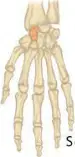
Short Bones are bones of the wrist and ankle, and they appear cube-like in shape. True or False?
True
False
What happens to bones when external force is applied and the force is too great?
They become stronger
They break
They bend
They dissolve
Fractures result from direct blows in which type of sports?
Contact sports
Water sports
Winter sports
Motor sports
Stress fractures are:
a type of complete bone break
a type of partial bone break
a type of muscle injury
a type of joint dislocation
What is a characteristic of a simple or closed fracture?
The fracture site breaks the skin
The fracture can be either complete or incomplete
The fracture is always incomplete
The fracture is always complete
What is a compound fracture?
A) A fracture where the bone does not penetrate the skin
B) A fracture where the bone penetrates the skin
C) A fracture with no danger of infection
D) A fracture that is not open
What is a Greenstick Fracture?
A complete break of the bone
An incomplete break, breaking only the outer part of the bone
A fracture that affects the joint
A fracture that occurs in the skull
What is a comminuted fracture?
All of the following are functions of the skeletal system EXCEPT:
movement
blood cell formation
bone marrow production
body temperature regulation
Identify yellow bone marrow
Identify the periosteum:
Identify the epiphyseal plate:
Identify the spongy bone:
Identify the articular cartilage:

