
 Worksheets
Radioactivity and Nuclear Chemistry Quiz: Decay and Fission
Total questions: 46
Worksheet time: 2hrs 22mins
Explain the process of alpha decay and identify the changes in the atomic number and mass number of the original nucleus.
The atomic number decreases by 2, and the mass number decreases by 4.
The atomic number increases by 2, and the mass number remains the same.
The atomic number decreases by 1, and the mass number decreases by 2.
The atomic number remains the same, and the mass number decreases by 4.
A certain isotope undergoes beta decay. Describe the change in the atomic number and mass number of the isotope.
The atomic number decreases by 1, and the mass number remains the same.
The atomic number increases by 1, and the mass number remains the same.
The atomic number remains the same, and the mass number decreases by 1.
The atomic number increases by 1, and the mass number decreases by 1.
Describe the role of neutrons in a nuclear fission chain reaction.
Neutrons slow down the reaction by absorbing energy.
Neutrons initiate and propagate the chain reaction by causing further fission.
Neutrons have no role in a chain reaction.
Neutrons convert into protons during the reaction.
Calculate the remaining amount of a 100g sample of a radioactive substance after 3 half-lives.
12.5g
25g
50g
6.25g
A radioactive isotope has a half-life of 5 years. How much of a 200g sample will remain after 15 years?
100g
50g
25g
12.5g
Explain why gamma radiation does not change the atomic number or mass number of a nucleus.
Gamma radiation involves the emission of protons.
Gamma radiation involves the emission of neutrons.
Gamma radiation involves the emission of energy, not particles.
Gamma radiation involves the emission of electrons.
Given a nuclear reaction: 92235U+01n→56141Ba+3692Kr+301n . Explain the significance of the neutrons produced in this reaction.
They are absorbed by the products, stopping the reaction.
They escape the reaction, having no further effect.
They can initiate further fission reactions, sustaining a chain reaction.
They convert into protons, increasing the atomic number of the products.
A sample of a radioactive isotope decays to 81 of its original amount in 24 years. What is the half-life of the isotope?
3 years
6 years
8 years
12 years
Compare and contrast alpha and beta decay in terms of their effects on the atomic number and mass number of a nucleus.
Alpha decay increases atomic number; beta decay decreases it.
Alpha decay decreases both atomic and mass numbers; beta decay increases atomic number but not mass number.
Both alpha and beta decay decrease atomic number.
Alpha decay does not change atomic number; beta decay decreases mass number.
Calculate the number of half-lives required for a sample to decay to 161 of its original amount.
2 half-lives
3 half-lives
4 half-lives
5 half-lives
A radioactive isotope has a half-life of 10 years. If you start with a 160g sample, how much will remain after 30 years?
80g
40g
20g
10g
Explain how the concept of half-life is used to determine the age of an archaeological artifact.
By measuring the current amount of a radioactive isotope and comparing it to its original amount.
By measuring the increase in mass of the artifact over time.
By determining the color change in the artifact.
By measuring the amount of energy emitted by the artifact.
A radioactive substance has a half-life of 2 years. If you have a 32g sample, how much will remain after 6 years?
4g
8g
16g
2g
What is the primary reason for using control rods in a nuclear reactor?
To decrease the energy output of the reactor.
To convert neutrons into protons.
To absorb excess neutrons and regulate the chain reaction.
To increase the rate of fission reactions.
How does beta decay affect the atomic structure of an element?
The atomic number decreases by 1, and the mass number decreases by 1.
The atomic number remains the same, and the mass number decreases by 1.
The atomic number decreases by 1, and the mass number remains the same.
The atomic number increases by 1, and the mass number remains the same.
Calculate the remaining amount of a 50g sample of a radioactive substance after 4 half-lives.
25g
12.5g
6.25g
3.125g
Finish the following:
55Fe → β + _____
55Co
51Cr
55Cr
51Co
Is this alpha or beta decay?
60Co → _____ + 60Ni
Alpha
Beta
Gamma
Grandpa
Is the following alpha or beta decay?
243U → ____ + 239Th
Alpha
Beta
Gamma
Gramma
Which choice is the correct alpha decay of uranium-238?


Solve the nuclear decay reaction:


Solve the nuclear decay reaction:


finish the equation
18173Ta --> ____ + 18174W
42He
0-1e
y
finish the equation
18173Ta --> ____ + 18174W
42He
0-1e
y
Solve this equation for alpha decay.
88226Ra --> ___ + 24He
86222Rn
89226Ac
84224Po
88225Ra

How many protons does this isotope have?
131
53
184
78
What is the mass number of this isotope?
131
53
184
78
85209At = ___ + 24He
614C = ___ + -10e
If we start off with element 5024X after an alpha decay we get another element Y that looks like
5022Y
4622Y
4820Y
5426Y
22087Fr —› ____ + 42He
22089Ac
22490Th
21685At
21688Ra
22286Rn —› ____ + 42He
22589Ac
21187Fr
21885At
21884Po
13755Cs —› ____ + 0-1e
17872Hf
13753I
14154Xe
13756Ba
3215P—› ____ + 0-1e
3216S
3214Si
1632S
3417Cl
Is the following alpha or beta decay?
243U → ____ + 239Th
Alpha
Beta
Gamma
Gramma
Is this alpha or beta decay?
60Co → _____ + 60Ni
Alpha
Beta
Gamma
Grandpa
Finish the following:
55Fe → β + _____
55Co
51Cr
55Cr
51Co
Match the radioactive decay particle with its description.
A helium nucleus (2 p+, 2 n0)
alpha particle
an electron
beta particle
wave of energy
gamma ray
Match the symbol to each type of radiation

alpha particle

beta particle
00γ
gamma ray
Each type of radioactive decay particle can be stopped by different materials. Match the particle with the type of material needed to stop its movement.
paper
alpha particle
aluminum
beta particle
lead/concrete
gamma ray
During beta decay, a neutron in the nucleus of an atom is transformed into:
A proton and emits a gamma ray
A proton and emits an electron
An alpha particle
A proton and a neutron
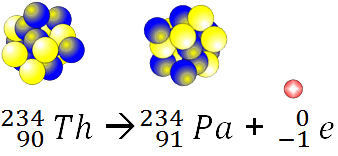
What is the product of beta decay of Carbon-14?
Carbon-13
Nitrogen-14
Oxygen-14
Hydrogen-14
What is the product of alpha decay of Uranium-238?
Thorium-234
Uranium-235
Plutonium-239
Neptunium-237
Balance the following nuclear equation:
1327Al + 01n ⟶ 1124Na + ?
24He
25H
1342 Al
1425Si

