Font size
 Worksheets
Pratice For Test 1 ( Physics Motion
Total questions: 64
Worksheet time: 3hrs 45mins
The slope of the line on a position-time graph represents (a) .
A horizontal line on a position-time graph represents an object that has (a) velocity.
On a position-time graph, a line with a (a) slope shows a change in direction.

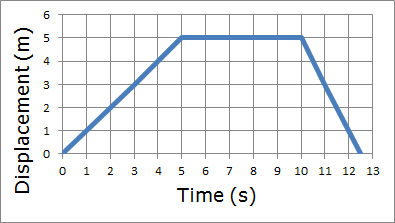
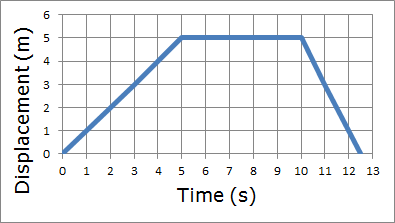
Calculate the speed of the entire trip.
0.9 m/s
0.3 m/s
2 m/s
-1 m/s
Calculate the velocity of the entire trip.
0.9 m/s
0.3 m/s
2 m/s
-1 m/s
The slope of the line on a velocity-time graph represents (a) .
A horizontal line on a velocity-time graph represents an object that has a (a) velocity.
On a velocity-time graph, a line (a) the x-axis shows a change in direction.

Calculate acceleration of line C.
5 m/s2
2.5 m/s2
6.7 m/s2
6.25 m/s2
A car has an initial velocity of 28 m/s. After 4 seconds, it has a velocity of 16 m/s. Calculate the acceleration of the car.
-8 m/s2
12 m/s2
1.5 m/s2
-3 m/s2
A car has an initial velocity of 28 m/s. After 4 seconds, it has a velocity of 16 m/s. Using the acceleration calculated in the previous question, what would the car's velocity be after 3 seconds?
8 m/s
22 m/s
19 m/s
25 m/s

What type of motion does the object have between times 90 to 100 seconds?
positive acceleration
negative acceleration
constant fast velocity
fast negative velocity

Which dot diagram matches the motion on the graph?


Which dot diagram matches the motion on the velocity-time graph?
Both considered "positive" directions
north & south
north & east
south & east
south & west
Constant velocity and being at rest are _________
positive acceleration
zero acceleration
negative acceleration
Displacement is the __________ path of motion between 2 points.
longest
hardest
shortest
cannot be determined
Speed and ________ are scalar quantities.
acceleration
displacement
distance
all of these
SI unit for speed and velocity
m
m/s
m x s
m/s^2
Slowing down in the negative direction is ________ acceleration
positive
negative
zero
cannot be determined
Distance / time is _________
speed
velocity
acceleration
Displacement / time is _____
speed
acceleration
velocity
The SI unit for distance is ________
meters
miles
kilometers
yards
Both considered "negative" directions
north & south
north & east
south & east
south & west
On a P vs. T graph, a diagonal line indicates .....
at rest
speeding up
slowing down
constant speed
True or False. Total path of motion is distance.
TRUE
FALSE
SI unit for acceleration
m
m/s
m x s
m/s^2
A curved line on a P vs. T graph indicates.....
at rest
speeding up or slowing down
constant speed
none of these
To be at rest on a V vs. T graph, a horizontal line must be.....
above 0 m/s
below 0 m/s
at 0 m/s
anywhere on graph
On V vs. T graph, moving towards 0 m/s indicates ....
increasing velocity
decreasing velocity
zero velocity
none of these
To be at rest on a P vs. T graph, a horizontal line must be.....
above 0 m
below 0 m
at 0 m
anywhere on graph

Calculate the displacement traveled in section B. Hint: Remember the area under a v-t graph = displacement!
150 m
50 m
100 m
200 m

Calculate the displacement traveled in section C. Hint: Remember the area under a v-t graph = displacement and you will need to use TWO shapes!
200 m
100 m
50 m
400 m
The area under a velocity-time graph represents __________.
displacement
velocity
acceleration
length x width
The slope of a velocity-time graph represents __________.
acceleration
displacement
speed
distance

Select the description of motion from A - B.
Slowing down away from the origin
Speeding up away from the origin
Constant velocity away from the origin
Constant velocity towards the origin

What segment of the graph shows no motion, or standing still?
A - B
B - C
C - D
None

Which segment of this v-t graph show a constant velocity.
AB
BC
CD
DE

Describe motion of C - D.
Constant velocity away from the origin
Slowing down away from the origin
Slowing down away from the origin and then slowing down towards the origin
Slowing down away from the origin and then speeding up towards from the origin

Describe the motion from B - C.
Standing still
Constant velocity of 60 m/min
Constant velocity of 0 m/min
Accelerating
What does a horizontal line (not on the x-axis) mean on a V-T graph?
No movement
Constant velocity
Changing velocity
Change in direction
Calculate the displacement traveled in section D. Hint: Remember the area under a v-t graph = displacement!
250 m
50 m
100 m
200 m
150 m
Calculate the displacement traveled in section A. Hint: Remember the area under a v-t graph = displacement!
75m
50 m
100 m
125 m
150 m



What is the speed of a cheetah that travels 112.0 m in 4.0 s?
0.0357 m/s
30 m/s
0.036 m/s
28.0 m/s

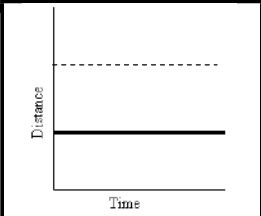
Which is true about their motions?

Which statement is true about velocity?
Must have measurement of speed.
Must have a measurement of speed and direction.
Must have only direction.
Has neither a measurement of speed or direction.