
 Worksheets
College m2
Total questions: 88
Worksheet time: 7hrs 59mins

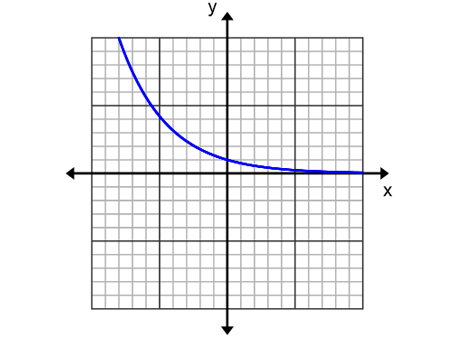
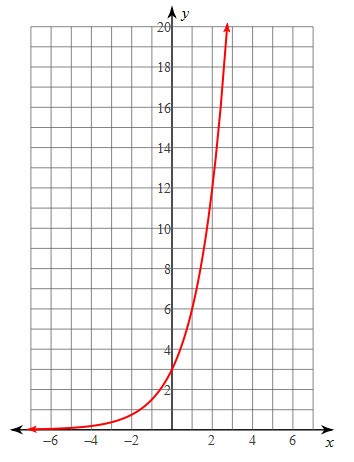
This is an example of:
Linear Growth
Linear Decay
Exponential Growth
Exponential Decay

This is an example of:
Linear Growth
Linear Decay
Exponential Growth
Exponential Decay
This is an example of: f(x)= 25 ( 0.20)x
Linear Growth
Linear Decay
Exponential Growth
Exponential Decay
How do you know that this was exponential decay? f(x)= 25 ( 0.20)x
Because the 25 was bigger than one
Because the 0.20 was bigger than one
Because the 25 was less than one
Because the 0.20 was less than one
This is an example of: f(x)= 0.25 ( 1.3)x
Linear Growth
Linear Decay
Exponential Growth
Exponential Decay
How do you know that this was exponential growth? f(x)=0 .25 ( 1.3)x
Because the 0.25 was bigger than one
Because the 1.3 was bigger than one
Because the 0.25 was less than one
Because the 1.3 was less than one
This is an example of: f(x)=90 ( 21)x
Linear Growth
Linear Decay
Exponential Growth
Exponential Decay
How do you know that this was exponential decay? f(x)=90 ( 21)x
Because the 90 was bigger than one
Because the 1/2 was bigger than one
Because the 90 was less than one
Because the 1/2 was less than one
This function represents the number of ants in a colony f(x)=3 ( 2)x How many ants did you begin with?
There was 2 ants
There was 3 ants
The equation doesn't tell us
This function represents the number of ants in a colony f(x)=3 ( 2)x What is the growth rate?
The ants are growing by 3 times
The ants are growing by 2 times
The equation doesn't tell us
If the decay rate is 20%, which of the following represent the decay factor?
0.2
0.8
1.2
1.8
If the growth rate is 80%, what is the growth factor?
0.2
0.8
1.2
1.8
A flea medicine breaks down at a rate of 20% per hour. This is the rate of decay of the medicine. The initial dose is 60 milligrams. Which of the following represent the equation the models the amount of flea medicine left in an animal?
y=60(.2)x
y=20(60)x
y=60(.8)x
y=60(1.2)x
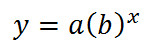

Which of the followings functions shows an initial amout of $15 and an increase of 35% ?
y=15(35)x
y=15(1.35)x
y=15(0.35)x
y=35(15)x
What is the growth factor of the situation represented by f(x)=10(0.3)x?
10
0.3
1
3
LNe
log53 + log56 + log59
log 6 - log 3 + 2 log 7
Which graph best represents the following logarithmic function?
y=log4x


Which graph best represents the following logarithmic function?
y=log2x
Which of the following graphs is NOT an exponential function?


Which function best describes the following graph?
y = Log2 X
2x = y
y = 1/(2x)
(1/2)x = y
log416
log636 = 2
log416
Find the corresponding graph of
−log2(x)+3


Find the corresponding graph of
log3(x−1)+4


3x = 27
5x = 1
Logarithmic functions have...
Vertical asymptote at x=0
Vertical asymptote at x=1
Horizontal asymptote at y=1
Horizontal asymptote at y=0
log6(x+4)= log6(2x−5)
Solve the given equation:
{-9)
(9)
(-1}
()
e4x= 5
Solve the given equation:
x=4lne
x=54
x=5ln (4)
x=4ln(5)
y=log(3x−9)
Find the domain of the function:
x∈(−∞,3]
x∈(−∞,3)
x∈[3,+∞)
x∈(3,+∞)
log(x−1)+log(x+1)=log(3)
Solve for x
x={−2,2}
x={2}
x ={1001}
x={}
2log5y − 21log5x
Write it as a single expression
2log5xlog5y
log5(xy2)
log5y2+log5x
log5(2xy2)
What is the vertical asymptote for the graph of :
y = ln (7 - 14x)
x = 2
x =− 21
x =21
y = 21
Write the logarithmic equation in the exponential form:
log (x-2) = -1
10−1= x−2
10 x−2 =−1
ln (x−2) =−1
(x−2)−1=10
5(x+1)=7
Write the exponential equation as a logarithmic form
log5(x+1)=7
log7(x+1) =5
log5(7)=x +1
log7(5)= x+1
f(x) = e(2x−5)−9
Write the domain of the function:
x∈(−∞,+∞)
x∈(−∞,25)
x∈(25,+∞)
x∈(−9,+∞)
m(x) =e 7x −8
Determine the horizontal asymptote of the function:
y =7x
y = 8
y=− 8
y= 0

A
B
C
D


Solve log2 (2 - 2x) + log2 (1 - x) = 5
4
5
-2
-3
Solve log5 (x + 3) = log5 x + log5 3
3/2
9/2
2/3
No Solution
Solve ln (x - 2) - ln (3x) = 0
-1
2
e
e5

log x - log 8 = 3
x = 1000
x = 800
x = 8000
x = 100
According to the logarithmic properties: elnx=x
True
False
Use the logarithmic properties to condense the expression correctly. 6logx+2logy
logx6y2
log6xlog2y
logy2x6
12logxy
log4 x = 3


