wayground logo

Free Printable Worksheets

Font size

S
M
L
XL
Worksheets

Plate Tectonics Test Review

Total questions: 58

Worksheet time: 35mins

Name
Class
Date
1.
Seafloor spreading occurs at ___________ plate boundaries
a)
divergent oceanic - oceanic
b)
convergent oceanic - contiental
c)
transfrom
d)
divergent contiental - contiental
2.
Select the correct statement below,
a)
Rocks in the oceanic crust tend to be younger than rocks in the in continental crust
b)
Rocks in the continental crust tend to be younger than rocks in the oceanic crust
c)
Rocks in the continental and oceanic crust tend to be the same age
3.
Mid-ocean ridges are found at which type of plate boundary?
a)
divergent oceanic- oceanic plate boundaries
b)
convergent continental- continental plate boundaries
c)
transform continental plate boundaries
d)
passive plate plate boundaries
4.
Rift valleys are found at which type of plate boundary?
a)
divergent oceanic-oceanic plate boundaries
b)
convergent oceanic- oceanic plate boundaries
c)
transform continental plate boundaries
d)
passive plate plate boundaries
5.
The lithosphere is mainly __________________, the asthenosphere is mainly ____________
a)
solid, solid
b)
liquid, solid
c)
liquid, liquid
d)
solid, liquid
6.
What occurs when two plates collide (convergent boundary) and one subducts (moves under the othe)r?
a)
Mid-Ocean Ridge
b)
Rift Valley
c)
New Ocean floor formation
d)
Volcanoes
7.
The rock that makes up most oceanic crust is _________ and is _____________
a)
Basalt, Magnetic
b)
Granite, Magnetic
c)
Basalt, Not Magnetic
d)
Shale, Not Magnetic
8.
Every few hundred thousand years, the magnetic poles of Earth reverse. Rocks that contain iron provide a record of both normal and reversed magnetic poles. The pattern of normal and reversed magnetic poles as recorded in the ocean floor rock on either side of the Mid-Atlantic Ridge provides evidence supporting a model of convection currents in the mantle below that move in which way?
a)
Option 1
b)
Option 2
c)
Option 3
d)
Option 4
9.
Earth’s magnetic field is evidence for which of its following features?
a)
Solid iron inner core surrounded by fluid iron
b)
Crust made up of iron oxygen, silicon and magnesium
c)
Crust made up of iron, oxygen, silicon, and magnesium
d)
variable density and composition based on depth
10.
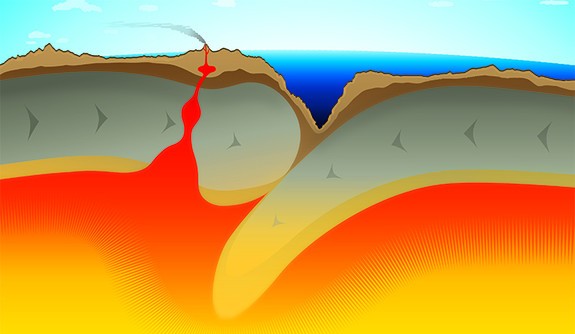
The image shows a _________________
a)
Convergent boundary
b)
Divergent boundary
c)
Transform boundary
11.
The image shows a _________________
a)
Convergent boundary
b)
Divergent boundary
c)
Transform boundary
12.
The west coast of South America falls along a boundary where two tectonic plates move toward each other. This convergent plate boundary explains which feature of South America?
a)
The warm, moist climate that dominates the region
b)
The shape of the continent and its fit into the African coast
c)
The diversity of plant and animal species native to the area
d)
The mountain-building and volcanism that occur there
13.
Which of the following best describes where the youngest and oldest crustal rocks can be found on the Earth?
a)
The oldest crustal rocks are found high in the mountains and the youngest at sea level.
b)
The oldest crustal rocks are found at the edges of continents and the youngest in the center.
c)
The oldest crustal rocks are found on continents and the youngest on the ocean floor.
d)
The oldest crustal rocks are found at the North and South Pole and the youngest at the equator.
14.
Not all the crustal rock found on the earth is the same age. Some of it is younger than 200 million years old, while other crustal rock can be as old as 4 billion years. Which Earth processes are most responsible for the difference in ages?
a)
Destruction and renewal of rock at tectonic plate boundaries
b)
The different rates at which molten minerals cool and form crystals
c)
Changes that rocks experience when exposed to heat and pressure
d)
Weathering and erosion by moving wind, water, and ice
15.
The table shown here provides information on the ages of samples of crustal rocks taken from different locations on Earth. Which of the following is the best prediction of where these rock samples were taken from?
a)
Samples 2 & 4= Continental Rock; Samples 1 & 3 Ocean Floor Rock
b)
Samples 1 & 4= Continental Rock; Samples 2 & 3 Ocean Floor Rock
c)
Samples 1 & 2= Continental Rock; Samples 3 & 4 Ocean Floor Rock
d)
Samples 2 & 3= Continental Rock; Samples 1 & 4 Ocean Floor Rock
16.
Which of the following observations can be explained by plate tectonics?
a)
The difference in ages of crustal rock in different locations on the earth
b)
The sorting of sediments from smaller to larger particles on coastlines
c)
The shapes and sizes of rock formations found in caves
d)
The layering of sedimentary rock with youngest on top and oldest on the bottom
17.
Which of the following pieces of evidence was not used by Alfred Wegener to construct the theory of continental drift?
a)
Identical rocks and fossils were found on opposing coastlines.
b)
The coastlines of South America and Africa look complementary.
c)
The magnetic orientation of rocks is symmetrical on either side of mid-ocean ridges.
d)
If the continents were placed together, glacial striations would match.
18.
Which statement correctly defines a geologic plate?
a)
A small part of the core Earth's core
b)
A location of high volcanic activity
c)
A location where new crust is formed
d)
A section of crust that moves as a unit
19.
Which of the following statements regarding a convergent plate boundary between continental crust and oceanic crust is not true?
a)
Oceanic crust changes into continents.
b)
Hot spots that may create volcanoes are formed.
c)
Oceanic crust reenters the mantle.
d)
Mountain ranges are formed.
20.
Rock A contains a high percentage of radioactive uranium and a small percentage of lead. Where would you be more likely to find Rock A?
a)
Near an oceanic ridge
b)
In a subduction zone
c)
Far from an oceanic ridge
d)
In one of the oldest continental rocks
21.
Symmetrical magnetic stripes in the ocean floor on either side of a mid-ocean ridge support–
a)
the spreading of ocean floor on both sides of oceanic ridges.
b)
the radioactive decay of uranium into lead.
c)
the subduction of oceanic crust into the mantle.
d)
the formation of the supercontinent Pangea.
22.
How has the Earth's magnetic field changed over time
a)
The magnetic field has reversed over time
b)
The magnetic field has never changed over the last 4.6 billion years
c)
Earth recently "gained" a magnetic field over the last 1,000 years due to human activity
d)
The magnetic field has been slowly declining in strength
23.
The process of an unstable isotope changing into a stable isotope is known as...
a)
radioactive decay
b)
bathymetry
c)
conduction
d)
convection
e)
absolute age dating
24.
What type of energy transfer drives plate movement
a)
conduction
b)
radiation
c)
advection
d)
convection
25.
The amount of time for half of an isotope's nuclei to decay is its-
a)
half-life
b)
absoulte age
c)
parent to daughter ratio
d)
relative age
26.
_____________ recycle oceanic crust and produce volcanoes
a)
subduction zones
b)
mid-ocean ridges
c)
divergent plate boundaries
d)
transform plate boundaries
27.
What is the relationship between seafloor spreading and the Earth's magnetic field?
a)
Seafloor spreading creates new oceanic crust, which is magnetic, and the Earth's magnetic field causes the crust to spread.
b)
The Earth's magnetic field is unaffected by seafloor spreading.
c)
The Earth's magnetic field causes the seafloor to spread, creating new oceanic crust.
d)
The cooling of magma during seafloor spreading creates magnetic stripes in the ocean floor, which reflect the Earth's magnetic field at the time of cooling.
28.
How does seafloor spreading influence sea levels?
a)
Seafloor spreading causes sea levels to rise by creating new ocean floor.
b)
Seafloor spreading has no effect on sea levels.
c)
Seafloor spreading causes sea levels to fall by creating new ocean floor.
d)
Seafloor spreading causes sea levels to fall as the newly formed ocean floor cools and sinks.
29.
What happens at a passive plate margin?
a)
areas where a single tectonic plate transitions from oceanic lithosphere to continental lithosphere
b)
areas where two tectonic plates collide (run into each other)
c)
areas where two tectonic plates diverge (move away from each other)
d)
areas where two tectonic plates move past each
30.

Match the following

a)

1.

Convergent

b)

2.

Transform

c)

3.

Divergent

d)

4.

Subductive

31.
What is happening at point B?
a)
subduction
b)
a divergent boundary
c)
convection
d)
an earthquake
32.
a)

Convergent?

b)

Divergent?

c)

Transform?

d)

Classic

33.

Label the diagram.

34.

What is the correct order (starting from the surface) of Earth’s layers?

a)

crust, outer core, inner core, mantle

b)

mantle, outer core, inner core, crust

c)

crust, mantle, outer core, inner core

d)

outer core, inner core, crust, mantle

35.

Select the two types of crust

a)

continental

b)

pacific

c)

oceanic

d)

botanical

36.

What kind of crust is densest?

a)

oceanic crust

b)

continental crust

c)

tectonic crust

d)

asthenospheric crust

37.

What kind of crust is the MOST dense and will Subduct?

a)

oceanic crust

b)

continental crust

c)

tectonic crust

38.

Which of the following statements is true about the ocean floor?

a)

It is older than the continents.

b)

It is constantly being recycled.

c)

It is composed mainly of granite.

d)

It is static and unchanging.

39.

What role do ocean trenches play in the process of plate tectonics?

a)

They are sites where new crust is formed.

b)

They are locations where crust is destroyed.

c)

They are areas of high volcanic activity.

d)

They are regions of crustal expansion.

40.

Which feature is commonly found at divergent plate boundaries on the ocean floor?

a)

Ocean trenches

b)

Mid-ocean ridges

c)

Volcanic arcs

d)

Fold mountains

41.

A long chain of undersea mountains

42.

Which type of plate boundary is most likely to cause earthquakes?

a)

Passive plate boundaries

b)

Convergent plate boundaries

c)

Divergent plate boundaries

d)

Transform plate boundaries

43.

What is the primary force that drives the movement of tectonic plates?

a)

Solar radiation

b)

Convection currents in the mantle

c)

Magnetic fields

d)

Gravitational pull from the moon

44.

Which geological feature is typically formed at a convergent boundary between two oceanic plates?

a)

Mid-ocean ridge

b)

Fold mountain

c)

Ocean trench

d)

Volcanic island arc

45.

How does the age of oceanic crust compare to continental crust?

a)

Oceanic crust age varies greatly and cannot be compared

b)

Oceanic crust is generally younger than continental crust

c)

Oceanic crust is generally older than continental crust

d)

Both have the same age

46.

Which type of plate boundary is associated with the creation of new oceanic crust?

a)

Divergent plate boundaries

b)

Passive plate boundaries

c)

Convergent plate boundaries

d)

Transform plate boundaries

47.

What geological feature is commonly found at a transform plate boundary?

a)

Ocean trench

b)

Earthquake fault line

c)

Mid-ocean ridge

d)

Volcanic island arc

48.

Which process is primarily responsible for the recycling of oceanic crust?

a)

Seafloor spreading

b)

Subduction

c)

Continental drift

d)

Weathering and erosion

49.

Which type of plate boundary is characterized by plates sliding past each other?

a)

Convergent boundary

b)

Subduction zone

c)

Divergent boundary

d)

Transform boundary

50.

What geological feature is commonly found at divergent boundaries?

a)

Mid-ocean ridges

b)

Volcanic island arcs

c)

Fold mountains

d)

Deep ocean trenches

51.

If the Earth did NOT have a liquid outer core, how would earthquake waves travel differently.

a)

P and S waves would both be absorbed.

b)

Only S waves would travel through the Earth's core.

c)

Shadow zones would not exist.

d)

S waves would travel faster than P waves.
52.
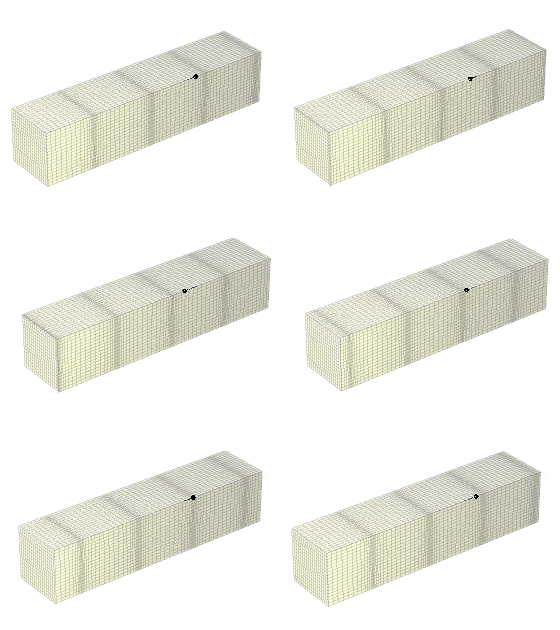
Which body wave is pictured?
a)
P-Wave
b)
S-Wave
c)
Rayleigh Wave
d)
Love Wave
53.
What causes the tectonic plates of Earth to continually move?
a)
convection currents in the mantle
b)
volcanic and seismic activity in the crust
c)
strong winds and storms
d)
rotation of the solid core
54.

The diagram shows a

a)

S wave

b)

P wave

55.
These are the secondary, or second waves to be released. They cannot travel through the liquid outer core
a)
S waves
b)
Surface Waves
c)
P waves
56.
These are the first waves released during an earthquake
a)
S waves
b)
Surface Waves
c)
P waves
57.

Which of these describe interactions between tectonic plates? (Choose 3)

a)

plates collide

b)

plates explode

c)

plates spread apart

d)

plates slide past each other

58.
The diagram shows what can occur when two continental plates collide.Which characteristic of the Indian Plate explains why it moves under the Eurasian Plate?
a)
It is larger.
b)
It is denser.
c)
It is molten.
d)
It is younger.