
 Worksheets
5.6 HW Mid-Winter Break Cumulative Review 2308
Total questions: 56
Worksheet time: 5hrs 40mins
Which particles surround the nucleus of a neon atom?
electrons
neutrons
positrons
protons
Which conclusion was proposed as a result of an experiment during which some alpha particles were deflected while passing through a thin sheet of gold foil?
Atoms are hard, indivisible spheres
Atoms have small, dense, positive nuclei
Atoms contain negatively charged particles
Atoms have electrons with wavelike properties
The mass of each proton and each neutron is approximately equal to
1 g
1 mL
1 u
1 mol
Which statement describes the relationship between two electrons in an atom of magnesium in the ground state?
An electron in the first shell has the same amount of energy as an electron in the second shell.
An electron in the first shell has a greater amount of energy than an electron in the second shell.
An electron in the second shell has the same amount of energy as an electron in the third shell.
An electron in the third shell has a greater amount of energy than an electron in the second shell.
Which element in Period 2 has the highest first ionization energy?
boron
lithium
neon
nitrogen
As an atom in the ground state changes to an atom in an excited state, the atom
absorbs energy
releases energy
increases in mass number
decreases in mass number
Which statement describes a chemical property of copper?
Copper has a red-orange color
Copper can be flattened into sheets
Copper reacts with oxygen
Copper conducts an electric current
At STP, two forms of solid carbon, diamond and graphite, have different properties because
diamond has a different percent composition than graphite
diamond has more electrons per atom than graphite
diamond has stronger hydrogen bonding than graphite
diamond has a different crystal structure than graphite
Which phrase describes a specific compound?
can contain only one element
can be physically separated into elements
is composed of elements chemically combined in a definite ratio
is composed of elements mixed in proportions that can vary
Which type of chemical formula shows the arrangement of the atoms in a molecule?
empirical formula
general formula
molecular formula
structural formula
A 2.5 L sample of SO₂(g) at STP and a 2.5 L sample of CO₂(g) at STP can be differentiated by comparing their
masses
phases
temperatures
volumes
Which terms identify the two different major categories of compounds?
covalent and molecular
covalent and thermal
ionic and molecular
ionic and thermal
Which molecule of an element contains a multiple covalent bond?
Br₂
F₂
H₂
O₂
Which molecule is symmetrical in both shape and distribution of charge?
HCl
H₂O
NH₃
CH₄
What occurs when two atoms of bromine react to form a molecule of bromine?
A bond is broken as energy is released
A bond is broken as energy is absorbed
A bond is formed as energy is released
A bond is formed as energy is absorbed
Atoms of which element have the strongest attraction for electrons in a chemical bond?
fluorine
nitrogen
phosphorus
potassium
Heat flows from an object at a temperature of 20.°C to an object at a temperature of
15°C
25°C
35°C
45°C
All chemical systems at equilibrium have equal
masses of reactants and products
concentrations of reactants and products
rates of forward and reverse reactions
activation energies of forward and reverse reactions
Which expression represents the heat of reaction for a chemical change?
(PEₚᵣₒdᵤcₜₛ) + (PEᵣₑₐcₜₐₙₜₛ)
(PEₚᵣₒdᵤcₜₛ) – (PEᵣₑₐcₜₐₙₜₛ)
(PEₚᵣₒdᵤcₜₛ) ÷ (PEᵣₑₐcₜₐₙₜₛ)
(PEₚᵣₒdᵤcₜₛ) × (PEᵣₑₐcₜₐₙₜₛ)
Which phase change represents an increase in entropy?
liquid to gas
liquid to solid
gas to solid
gas to liquid
Systems in nature tend to change toward
lower energy and less disorder
lower energy and greater disorder
higher energy and less disorder
higher energy and greater disorder
Which formula represents an electrolyte?
H₂O
CCl₄
H₂SO₄
C₆H₁₂O₆

Which elements are present in the mixture?
L and G
L and J
E and G
E and J

Which particle model diagram represents a noble gas at STP?
A
B
C
D
Determine the molecular formula for a compound that has the empirical formula CH₂O and a molar mass of 180. grams per mole.
A student determines the density of a copper sample at room temperature to be 9.46 g/cm³. Based on Table S, what is the student's percent error in determining the density of copper?
0.50%
5.0%
5.3%
5.6%
What is the gram-formula mass of Mg(NO₃)₂?
86 g/mol
134 g/mol
148 g/mol
172 g/mol
Compared to a rubidium atom, a Rb⁺ ion has
one more electron and a larger radius
one more electron and a smaller radius
one fewer electron and a larger radius
one fewer electron and a smaller radius
Which ion in the ground state has the same electron configuration as an atom of neon in the ground state?
K⁺
Li⁺
F⁻
Cl⁻
Which substance can not be broken down by a chemical change?
barium
butanal
methane
methanol
The difference in which property allows the separation of a sample of water and sand by using filter paper and a funnel?
boiling point
melting point
particle size
sample volume
What is the temperature, in degrees Celsius, of a sample of matter at 35 K?
–238°C
–308°C
35°C
308°C
Which equation represents a physical change?
H₂(g) + I₂(g) → 2HI(g)
N₂(g) + 2O₂(g) → 2NO₂(g)
I₂(s) → I₂(g)
3O₂(g) → 2O₃(g)
Which combination of reactants would result in the fastest reaction rate?
a 1.0 g strip of zinc with 10 mL of 0.20 M HCl(aq)
a 1.0 g strip of zinc with 10 mL of 2.0 M HCl(aq)
1.0 g of powdered zinc with 10 mL of 0.20 M HCl(aq)
1.0 g of powdered zinc with 10 mL of 2.0 M HCl(aq)
State the trend in atomic radius for bromine, chlorine, fluorine, and iodine as they are considered in order of increasing atomic number.
Determine the mass of a sample of iodine that has a volume of 2.5 cm³ at room temperature and standard pressure.
State, in terms of electrons, why bromine, chlorine, fluorine, and iodine have similar chemical properties.
State the molecular polarity of a CO₂ molecule.
Based on Table S, determine the electronegativity difference between oxygen and calcium in calcium oxide.

State evidence from Table I that indicates that this dissolving process is endothermic.
State, in terms of particle distribution, why a solution is classified as a homogeneous mixture.
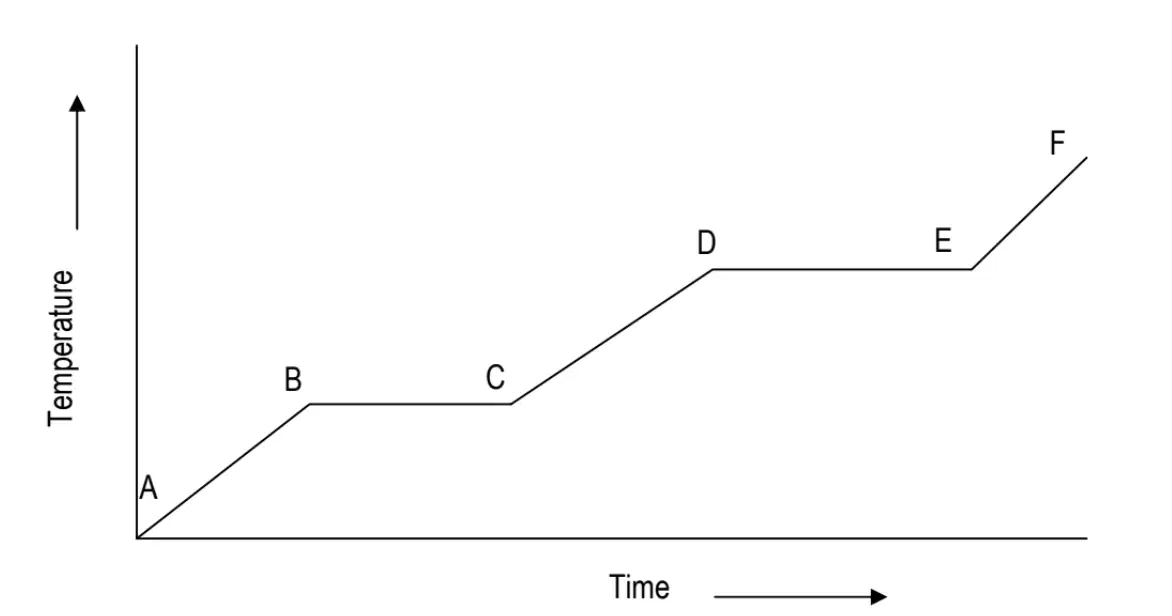
Identify the interval during which the average distance between the particles is the greatest.
State what happens to the potential energy of the particles during the melting of the substance.
Base your answer to the following question on the information below and on your knowledge of chemistry. A 30.0-milliliter sample of HCl(aq) was exactly neutralized by 18.0 milliliters of 0.10 M KOH(aq). During this laboratory activity, appropriate safety equipment was used and safety procedures were followed. State the number of significant figures used to express the concentration of KOH(aq).
Compare the number of protons to the number of electrons in an atom of oxygen-18.
Draw a Lewis electron-dot diagram for an atom of oxygen.

State, in terms of neutrons, why a water molecule containing an O-18 atom has a greater mass than a water molecule containing an O-16 atom.

Show a numerical setup for calculating the percent composition by mass of oxygen in the sodium hydrogen carbonate (gram-formula mass = 84 g/mol).

Determine the number of moles of K₂CO₃ produced when 3.50 moles of KO₂ completely reacts, as represented in equation 1.

Balance equation 2 for the heating of NaHCO₃(s), using smallest whole-number coefficients.
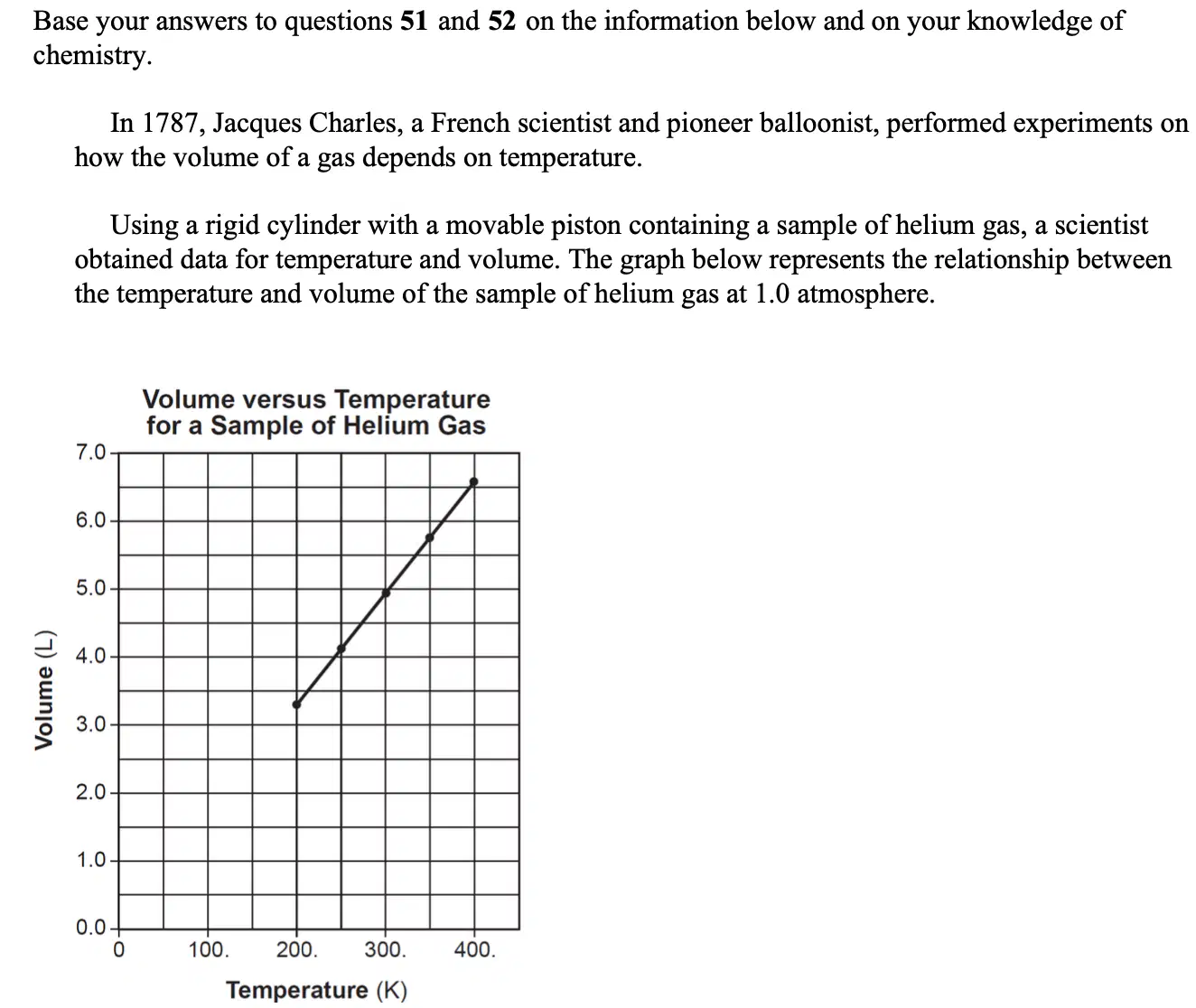
Determine the volume of this sample of helium gas at 350 K.

Compare the average kinetic energy of the helium atoms in the sample at 200 K to the average kinetic energy of the helium atoms at 300 K.

Explain, in terms of collision theory, why reacting hydrogen and nitrogen at high temperature increases the rate of the reaction.

Determine the net quantity of heat released when 1.0 mole of ammonia gas, NH₃(g), is produced by this reaction.
Using the axes below, draw a potential energy diagram for the reaction.
N2(g) + 3H2(g) 2NH3(g) + 91.8 kJ
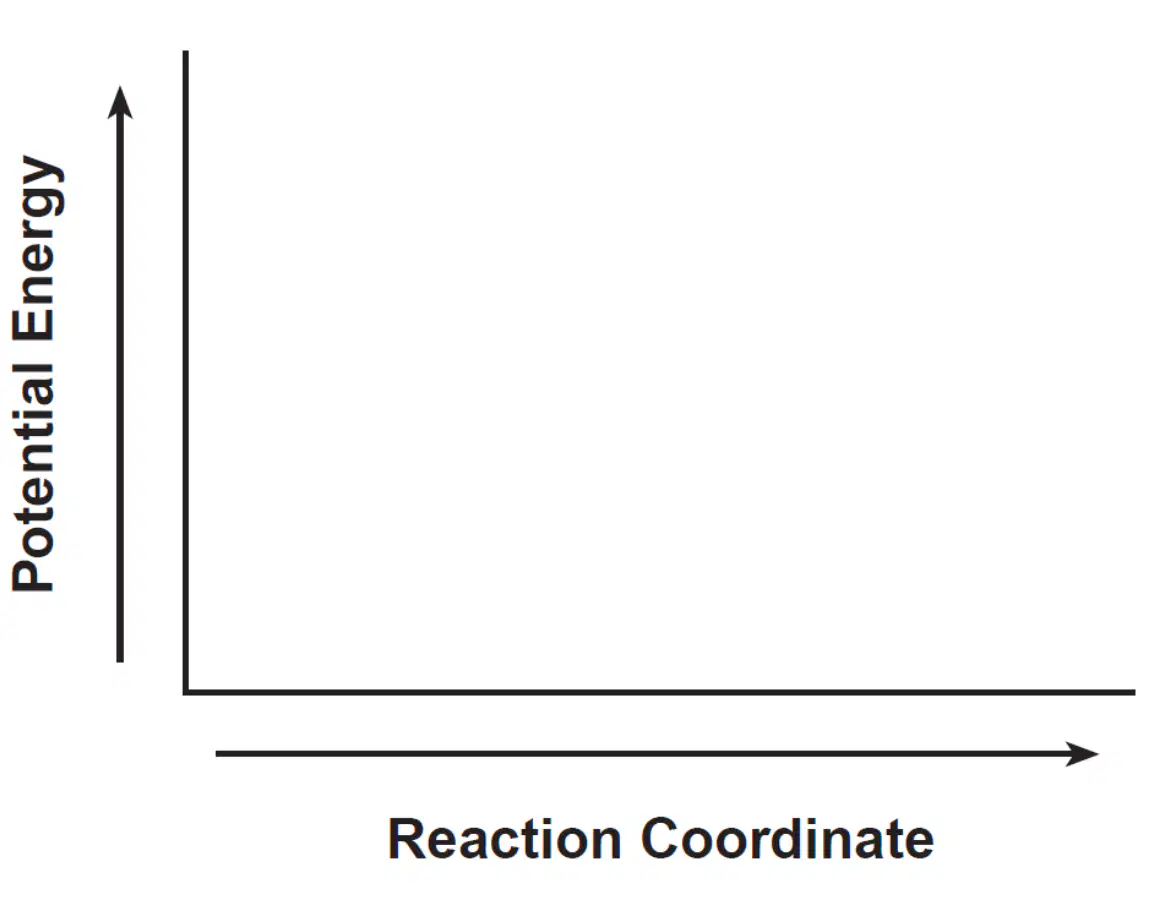

State, in terms of activation energy and reaction pathway, why the addition of a catalyst increases the rate of production of ammonia.

