
Font size
 Worksheets
Seasons 2.0
Total questions: 60
Worksheet time: 1hrs 12mins


Match the positions with the corresponding seasons in the Northern hemisphere.
Summer
Position A
Fall
Position B
Winter
Position C
Spring
Position D
An Equinox is when there is (a)

At position D in the Southern hemisphere it would be _____?

The light is more concentrated at angle (a) .

What season is represented by this diagram?
Fall
Summer
Winter
Spring

(a) sunlight causes more heat.


The location receiving more direct (and thus intense) insolation is (a) .
What season is represented by this diagram?
Fall
Summer
Winter
Spring
The light is more concentrated at angle (a) .
What is the primary reason Earth experiences different seasons?
The distance from the Sun changes significantly.
The tilt of Earth's axis.
The speed of Earth's rotation.
The shape of Earth's orbit.
Which of the following best describes the tilt of Earth's axis?
15 degrees
23.5 degrees
45 degrees
90 degrees
During which season is the Northern Hemisphere tilted towards the Sun?
Winter
Spring
Summer
Fall


During winter, the sunlight covers (a) of Earth's surface area.

During summer, the sun's rays are ____________________________.
Direct
Indirect

During winter, the sun's rays are ____________________________.
Direct
Indirect
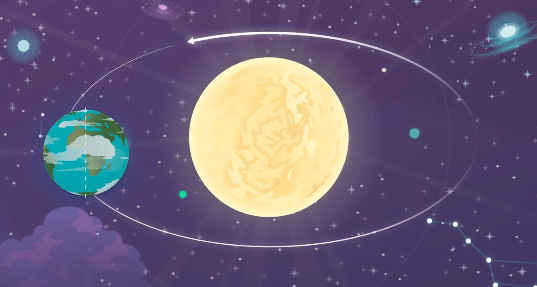


The Earth sits straight up and down (NO TILT).
true
false

The Earth is rotating AND revolving.
True
False

The Earth’s rotation and revolution happen at the same time: (a)

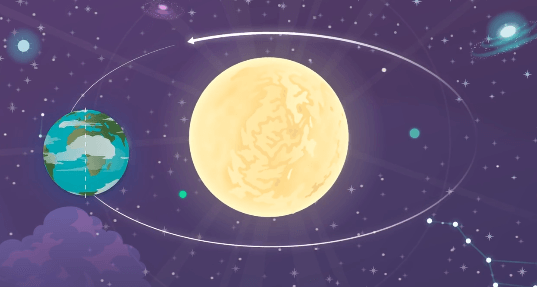
The force of gravity gets weaker as the distance between objects increases.
True
False
How many hours does the Earth take to complete one rotation?
48 hours
365 hours
24 hours
1 hour
Objects with higher mass have _______.
weaker gravitational pull
stronger gravitational pull
no gravitational pull
ability to float in space
As the distance between two objects increases, ____.
the gravitational force between them increases
the gravitational force between them decreases
the gravitational force between them remains the same
the objects will collide
The two days of the year when the day and night are of equal length are called (a) .
What is the term for the longest and shortest days of the year?
Solstices
Equinoxes
The spinning movement of a celestial body's axis is called __________.
revolution
rotation
seasons

Amani is visiting South America in July. He should pack
summer clothes
winter clothes
no clothes
it's impossible to guess

Jaylon is visiting Europe in July. He should pack...
winter clothes
summer clothes.
there's no way to know
both summer and winter clothes

Which of the following statements best compares the seasons in the northern hemisphere to the seasons in the southern hemisphere?
The seasons in the northern hemisphere are the same as the seasons in the southern hemisphere.
The seasons in the northern hemisphere are opposite from the seasons in the southern hemisphere.
There is no way to compare the seasons in the northern hemisphere to the seasons in the southern hemisphere.
Both the northern and southern hemisphere only have two seasons, rainy and dry.

Earth’s tilt on its axis causes which condition at location Y on its surface?
short daylight hours
low tides
summer
winter
On what day does Earth have the fewest hours of sunlight?
Summer Solstice
Autumnal Equinox
Winter Solstice
Vernal Equinox
On this day, the Northern hemisphere is tilted at its maximum towards the sun. This day is known as (a) .
On this day, daylight and nighttime hours are nearly equal.
Summer Solstice
Spring Equinox
Summer Equinox
Winter Solstice
What occurs when the sun shines equally on the Northern and Southern hemispheres?
Solstice
Equinox
Spring
Summer
In which direction does the Earth rotate and revolve?
Clockwise
Counterclockwise
Elliptically
23°

When the Earth is at Position A, what season is the Northern hemisphere experiencing?
Spring
Summer
Winter
Fall
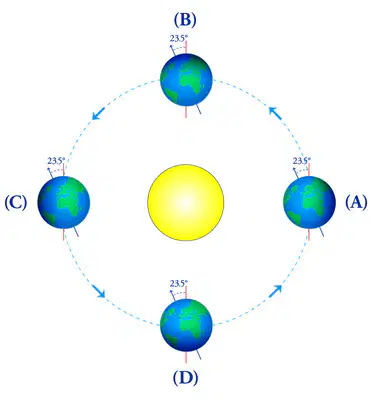
When the Earth is at Position A, what season is the Southern hemisphere experiencing?
Spring
Summer
Winter
Fall

What season is the Southern hemisphere experiencing at Position B?
Spring
Summer
Winter
Fall
Label the Northern and Southern Hemispheres.
Northern Hemisphere
Southern Hemisphere
Label the Northern and Southern Hemispheres.
Northern Hemisphere
Southern Hemisphere
Label the Northern and Southern Hemispheres.
Northern Hemisphere
Southern Hemisphere
This word describes how the earth spins.
rotation
revolution
orbit
hemisphere
This word describes how the earths travels around the sun.
solstice
axis
rotation
revolution
If we split the earth into two halves at the equator then we would have two........
equinox
solstice
axis
hemispheres

