wayground logo

Free Printable Worksheets

Font size

S
M
L
XL
Worksheets

Classification Review

Total questions: 46

Worksheet time: 2hrs 32mins
Name
Class
Date
1.
Term given to describe the 2 name naming system is:
a)
dichotmous key
b)
binomial nomenclature
c)
2 scientific names
d)
binomial key
2.
The 8 levels of classification, most broad to most specific.
a)
Domain, Genus, Family, Order, Class, Phylum, Kingdom, Species
b)
Domain, Species, Kingdom, Genus, Phylum, Family, Class, Order
c)
Domain, Kingdom, Phylum, Class, Order, Family, Genus, Species
d)
Order, Kingdom, Species, Domain, Phylum, Family, Class, Genus
3.
A dichotomous key for trees is provided. Hikers found a tree that has large brown cones and single sharp needles. What species of tree have the hikers found?
a)
Juniper
b)
Pine
c)
Spruce
d)
Fir
4.
A dichotomous key for insects is given. To what order does an insect with two pairs of scaly wings belong?
a)
Coleoptera
b)
Heteroptera
c)
Diptera
d)
Lepidoptera
5.
What step do we always start with when using dichotomous keys?
a)
1
b)
2
c)
3
d)
4
6.

The first word in a scientific name is the

a)

species

b)

phylum

c)

genus

d)

class

7.

Which of the following is the CORRECT form of a scientific name?

a)

canis lupus

b)

Canis Lupus

c)

Canis lupus

d)

canis lupus

8.

A FAMILY of organisms would be grouped into a LARGER taxonomic level of a

a)

phylum

b)

class

c)

genus

d)

order

9.

A FAMILY of organisms would be divided into a SMALLER taxonomic level of a

a)

phylum

b)

genus

c)

class

d)

order

10.
Which domain includes all multicellular plants and animals?
a)
Archaea
b)
Eukarya
c)
Eubacteria
d)
Protista
11.
Examine the phylogenetic tree.
Which two organisms are most closely related?
a)
wolves and sharks
b)
starfish and sharks
c)
protists and sharks
d)
gorillas and sharks
12.
Which organisms are most closely related?
a)
Equus caballas (Horse) & Equus burchellii (Zebra)
b)
Cyanea artica (Jellyfish) &
Ctenodiscus crispatus (Mud Starfish)
c)
Naja naja (cobra) & Glycine max (soya bean)
d)
Ophiocomina nigra (black brittle star) & Brassica nigra (black mustard)
13.

Which letter represents the most recent common ancestor of sponges and mushrooms?

a)

A

b)

B

c)

C

d)

D

e)

E

14.
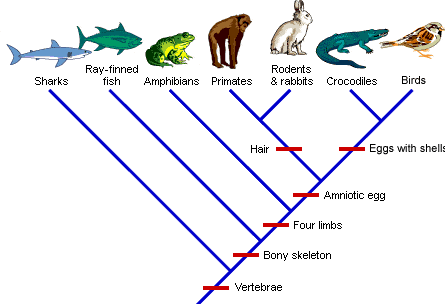
Which two orgainsms have hair? 
a)
Sharks & Ray Finned Fish
b)
Primates & Rodents
c)
Birds & Crocodiles
d)
Rabbits & Birds
15.

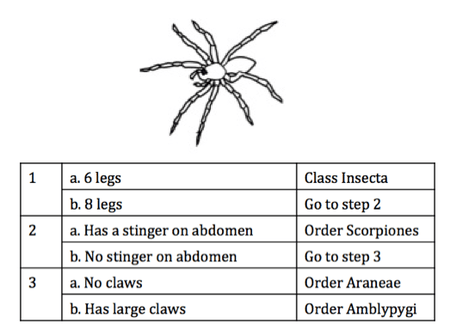
An illustration and a dichotomous key are given. What is the correct classification for this organism?HINT (no stinger, no claws)

a)
Class Insecta
b)
Order Amblygygi
c)
Order Araneae
d)
Order Scorpiones
16.

Here is a table that shows the level of classification for a dog. What is the correct label for X?

a)

Domain

b)

Genus

c)

Order

d)

Phylum

17.

How can you know that two organisms are two different species?

a)

How they feed

b)

Where they live

c)

Their mating and reproducing abilities

d)

When they are active

18.

What is the correct scientific name for the organism in the table?

a)

Reptilia testudines

b)

Chordata reptilia

c)

Emydidae terrapene

d)

Terrapene carolina

19.
Which of the following is the study of how scientists classify organisms?
a)
Taxonomy
b)
Division
c)
Canis
d)
Identification
20.
Which of the following is the study of how scientists classify organisms?
a)
Taxonomy
b)
Division
c)
Canis
d)
Identification
21.
Organisms that are multicellular, photosynthetic autotrophs, reproduce sexually or asexually belong to this Kingdom:
a)
Animalia
b)
Fungi
c)
Monera
d)
Plantae
22.
Fungi are different from plants primarily because they
a)
are nonmotile.
b)
contain chlorophyll.
c)
are heterotrophic.
d)
have cell walls.
23.

A single celled prokaryote that lives in extremely hot thermal springs in Yellowstone National Park would be in which kingdom?

a)

Virus

b)

Protista

c)

Archaebacteria

d)

Eubacteria

24.

Plants make their own energy molecules (food) using photosynthesis. What do we call this type of organism?

a)

Prokaryote

b)

Eukaryote

c)

Autotroph

d)

Heterotroph

25.

Unicellular organisms that lack a nucleus and other cellular organelles are known as...

a)

Prokaryote

b)

Eukaryote

c)

Heterotroph

d)

Autotroph

26.
 You would find mushrooms in which kingdom?
a)
Plantae
b)
Protists
c)
Fungi
d)
Animalia
27.
What are the three domains?
a)
Archaea, Bacteria, and Eubacteria
b)
Archaea, Protists, and Eubacteria
c)
Archaea, Bacteria, and Eukarya
d)
Archaea, Fungi, Animalia
28.
How do animals reproduce? 
a)
Sexually
b)
Asexually
c)
Both 
29.

What is another name for an internal balance that must be maintained for life to continue?

a)

Energy

b)

Metabolism

c)

Homeostasis

d)

Positive feedback

30.

What is the name of the scientist that invented the classification system that we use today?

a)

Aristotle

b)

Bohr

c)

Linneaus

d)

Hooke

31.

The combination of chemical reactions through which an organism builds up or breaks down materials as it carries out its life processes is called ...

a)

absorption

b)

metabolism

c)

digestion

d)

consumption

32.

Green plants produce their own food through the process of photosynthesis. Which characteristic of life does this represent?

a)

All living things use energy

b)

All living things contain cells

c)

All living things maintain homeostasis

d)

All living things grow

33.

Over three years, Tim's height has increased from 5'4" to 5'11". Which characteristic of life does this represent?

a)

All living things contain cells

b)

All living things maintain homeostasis

c)

All living things use energy

d)

All living things grow

34.
Modern classification relies on _________________ to determine degrees of relatedness.
a)
evolutionary descent
b)
similarities of structures
c)
differences of anatomical structures
d)
clades
35.
The first part of a scientific name is an organism's _______________ and the second part is its ________________.
a)
species, genus
b)
phylum, order
c)
class, spices
d)
genus, species
36.
A ___________________ is a trait that arose in the most recent common ancestor of a particular lineage and was passed along to its descendants.
a)
taxon
b)
derived character
c)
binomial nomenclature
d)
mango
37.
Which two kingdoms are entirely multicellular?
a)
Animalia and Plantae
b)
Animalia and Protista
c)
Protista and Plantae
38.

Scientists use the scientific name of organisms to prevent________ while sharing information with other scientists.

a)

understanding

b)

confusion

c)

double naming

d)

communication

39.

Tool used by a taxonomist to identify an unknown organism by it's physical features is a:

a)

dichotomous key

b)

binomial nomenclature

c)

scientific name

d)

binomial key

40.
In Linnaeus’s system of classification, how many taxonomic categories were there?
a)
one
b)
three
c)
five
d)
seven
41.
In taxonomy, a group at any level of organization is referred to as a
a)
cladogram
b)
binomial.
c)
taxon.
d)
system.
42.
An organism made up of more than one cell would be called:
a)
multicellular
b)
unicellular
c)
heterotroph
d)
autotroph
43.

Members of these 2 kingdoms can never make their own food:

a)

animal & fungi

b)

animal & plant

c)

fungi & protist

d)

archaebacteria & eubacteria

44.
According to this cladogram, sharks are MOST closely related to which organism? 
a)
Amphibians
b)
Ray finned fish
c)
Crocodiles
d)
Birds
45.
Which two orgainsms have hair? 
a)
Sharks & Ray Finned Fish
b)
Primates & Rodents
c)
Birds & Crocodiles
d)
Rabbits & Birds
46.
According to this cladogram, birds are LEAST related to: 
a)
Amphibians
b)
Sharks
c)
Ray Finned Fish
d)
Crocodiles