
 Worksheets
2024-2025 Properties of Waves
Total questions: 68
Worksheet time: 2hrs 39mins
What is the frequency of light when it interacts with matter and its wavelength changes?
Reflection
Absorption
Refraction
Diffusion
What is the term for the number of wave crests passing a point per unit time?
Wavelength
Frequency
Amplitude
Speed
What is the arrangement of molecules in a longitudinal wave that is spread out?
A) Rarefaction
B) Compression
C) Diffusion
D) Dispersion
What type of waves travel as longitudinal waves?
An example is sound waves.
Light waves
Radio waves
X-rays
Calculate the wave frequency based on the given question.
The speed of the wave is 15 m/s and the wave length is 30m
15m/s x 30m = 45Hz
30m /15m/s =2m
15m/s /30m = .5Hz
What happens to the frequency of light when it spreads out after passing through another medium?
It increases
It decreases
It remains the same
It scatters
What type of waves are able to travel all different types of medium and no media at all?
Light waves from the electromagnetic spectrum.
Sound waves
Water waves
Seismic waves
Calculate the wave frequency based on the equation V=f x λ, which describes the relationship between which of the following wave properties?
Velocity, frequency, and wavelength
Voltage, force, and length
Volume, force, and distance
Viscosity, flow rate, and length
What is the term used to describe the number of wave crests passing a fixed point per second, often measured in Hertz?
Frequency
Amplitude
Wavelength
Velocity
What does a higher amplitude indicate in a wave in terms of energy?
Increased energy
Decreased frequency
Longer wavelength
Lower speed
How can media affect the frequency of electromagnetic waves?
By changing the wavelength of the wave
By altering the amplitude of the wave
By modifying the speed of the wave
By changing the medium through which the wave travels
How can media affect mechanical wave frequency?
By changing the wavelength of the wave
By altering the amplitude of the wave
By modifying the medium's properties
By increasing the wave's speed
Calculate the wave frequency based on the given information about waves where particles oscillate parallel to the direction of wave propagation.
Use the wave speed and wavelength
Use the wave speed and amplitude
Use the wavelength and amplitude
Use the amplitude and frequency
Calculate the wave frequency based on the given question.
The speed of the wave is 15 m/s and the speed of the wave is 20 Hz
Calculate the wave speed based on the given question.
The wave frequency is 22Hz and the wave length is 15m
Calculate the wave frequency based on the wave speed 8m/s and wavelength 22m.
What do you need to calculate the speed of the wave?
Frequency and wavelength
Color and brightness
Speed and direction
Temperature and pressure

Which color of light has the longest wavelength, and what is its frequency?
Red
Blue
Green
Yellow
Why would light not travel through water as well as air?
water is denser than air
water is less dense than air
sound frequency is higher in water
sound frequency is lower in water

Which of the following has the highest frequency?
Radio Waves
Microwaves
Ultraviolet
Infrared
The wave frequency of visible light is measured in (a) .
Hertz
Nanometers
Joules
Meters
Calculate the wave frequency based on the relationship between wave speed, frequency, and wavelength.
Frequency = Wave Speed / Wavelength
Frequency = Mass x Acceleration
Frequency = Distance / Time
Frequency = Force / Area
If a wave has a speed of 20 m/s and a wavelength of 4 meters, what is its frequency?
5 Hz
40 Hz
10 Hz
20 Hz
If you know speed and wave length - what can you calcualte?
Amplitude
Speed
Medium properties
Frequency
Waves transfer (a)
Which waves require a medium (matter) to travel?
x-ray
microwave
sound
water

Which letter represents amplitude? (a)

2. What property of a wave is represented by letter B? (a)
6. Which of the following can act as media for a wave? (a)
8. The lowest part of a transverse wave is known as a (a) .

What does point C represent? (a)
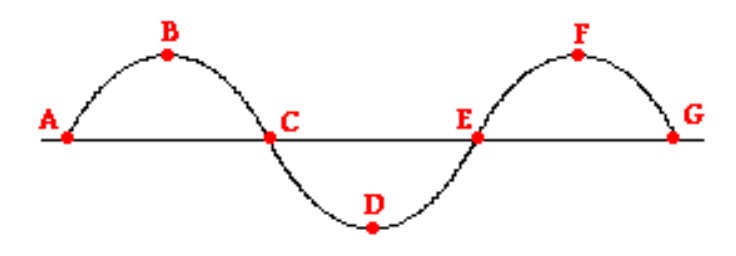
Which letter(s) represent the trough of the wave? (a)
What types of waves carry energy at a right angle or perpendicular to the direction of the energy flow? (a)
What are the parts of a longitudinal wave? (a)

Which wave is pictured? (a)
What types of waves can travel through empty space AND mediums? (a)
A wave has frequency of 50 Hz and a wavelength of 10 m. What is the speed of the wave? (a)
Light bending as it passes through a raindrop is an example of (a)
The ____________ of a wave is a direct measure of its energy. (hint: you measure from the resting point to the crest or trough!)
frequency
wavelength
period
Ethan is observing waves at the beach. The frequency of a wave represents the
wave amplitude divided by the period of the wave.
wave crest in relationship to the wave trough.
number of waves that pass a certain point in a second.
loudness of the sound.

During a science experiment, Aria noticed a part of a slinky wave where the coils were close together. What is this part of the wave called?
compression
crest
trough
rarefaction

Mia and Anika are playing with a slinky. They notice that in some parts of the slinky, the coils are spread apart. What is this part of a longitudinal wave called?
compression
crest
trough
rarefaction
Tom and Jerry are playing with a slinky. They notice that when they push and pull the slinky, the particles of the slinky move parallel (side to side). What type of waves are they observing?
Longitudinal waves
transverse waves
Harper and Aiden are at the beach watching the waves. They notice that the waves move the particles of the water up and down, perpendicular to the direction of the wave's travel. What type of waves are these?
Transverse waves
Longitudinal Wave

Which wave has a greater wavelength?
wave A
wave B
they are the same

Which wave has a greater amplitude?
wave A
wave B
they are the same
Michael and Aiden are watching a thunderstorm from their window. Why do they see lightning before they hear thunder?
You hear thunder before you see lightning
Your eyes react faster than your ears
Light travels faster than sound
Sound travels faster than light
Dan is playing with a tuning fork and a glass of water. He noticed that the sound from the tuning fork travels differently through various materials. Which medium does sound travel the fastest?
solid
liquid
gas
empty space

Identify the wave with the shortest wavelength.
Wave A
Wave B
Wave C
Wave D

What is the frequency of the wave above?
5
2
3
4

Reflection
Refraction
Transmission
Absorption

Reflection
Refraction
Transmission
Absorption

Reflection
Refraction
Transmission
Absorption
The wave passes through a medium with little change to the wave.
Reflection
Refraction
Transmission
Absorption
The wave bends because the speed of the wave changes.
Reflection
Refraction
Absorption
Transmission
The wave bounces off the surface.
Reflection
Transmission
Refraction
Absorption
The wave does not move or reflect off the medium and the energy is passed to the medium.
Absorption
Transmission
Reflection
Refraction
Which of the following properties make a light wave different from all mechanical waves?
A light wave slows down in a vacuum
A light wave is able to transmit energy
A light wave is exists as a transverse wave
A light wave can travel without a medium

Which measurement in the diagram shows amplitude and why?
measurement A, amplitude can be measured from the bottom of the trough to the top of the crest
measurement B, amplitude can be measured from crest to trough
measurement C, amplitude can be measured from trough to equilibrium
measurement D, amplitude can be measured from crest to crest
A student stands in a school hallway. A wall separates a classroom from the student. The student in the hallway cannot see inside the classroom but hears noises from with the classroom. Which of these best explains why the student hears the noises but cannot see in the classroom?
Sound waves are absorbed by the wall, and visible light waves are transmitted through the wall
Sound waves are transmitted through the wall and visible light waves are reflected by the wall
Sound waves are reflected by the wall, and visible light waves are refracted by the wall
Sound waves are reflected by the wall and visible light waves are absorbed by the wall
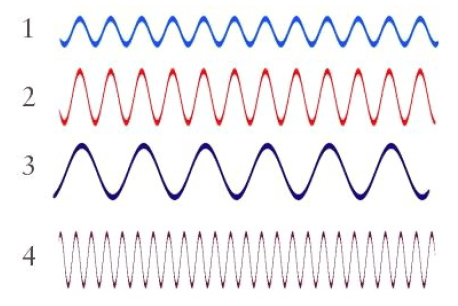
If all waves were measured for a period of 5 seconds, which wave had the highest frequency?


Why are electromagnetic waves able to reach our satellite devices in space?
They need a medium to travel.
They convert into sound waves.
They ride on the orbit of the planet.
They can move through the vacuum of space.
Two students are talking about what happens when light and sound move from air to water.
Student 1 states that light slows down in the water, but sound speeds up in the water.
Student 2 states that both light and sound slow down in water.
Which student is right?
Student 2, because a denser medium slows down all kinds of waves.
Student 1, because the particles in a denser medium can transfer sound waves faster but slow down the light.
Both students are incorrect because all kinds of waves speed up when moving from a rarer to a denser medium.
Both students are incorrect because light speeds up, but sound slows down when moving from a rarer to a denser medium.
When a wave bounces off of something and moves in a different direction (a)
Which wave is pictured? (a)
A wave has frequency of 50 Hz and a wavelength of 10 m. What is the speed of the wave? (a)

