
Font size
 Worksheets
Grade 7 Biology Revision (Final)
Total questions: 90
Worksheet time: 1hrs 21mins

Which two bio molecules have only Carbon, Hydrogen, and Oxygen?
Carbohydratess/Nucleic Acids
Lipids/Carbohydrates
Proteins/Nucleic Acids
Carbohydrates/Proteins


The entire molecule shown is a(n) ____ the part circled in red is a(n) ___.
polymer, macromolecule
polymer, monomer
macromolecule, monomer
monomer, polymer


Large molecules in living cells are known as ___________.
macromolecules
monomers
atoms
elements
The three types of carbohydrates are
sugars, starches, cellulose
sugars, lipids, cellulose
cellulose, glycogen, lipids
amino acids, nucleic acids, lipids
_______ is the storage form of excess glucose in plants.
cellulose
glycogen
sugar
starch
_________ is the storage form of excess glucose in animals.
sugar
cellulose
starch
glycogen
_________ is the stringy, fibrous material that serves as a strengthening tissue in the cell walls of plants.
glycogen
sugar
cellulose
starch
A _________ contains one molecule of sugar.
disaccharide
polysaccharide
lipid
monosaccharide
A __________ contains 3 or more monosaccharides.
simple sugar
polysaccharide
disaccharide
water molecule

Which choices below describe lipids.
fats
oils
waxes
muscle
Monomers of lipids are _____________.
amino acids
fatty acids
neucleotides
simple sugars
Monomers of neuclic acids are _____________.
amino acids
fatty acids
neucleotides
simple sugars
Each of the following is a primary tissue type except one. Identify the exception
muscle tissue
nervous tissue
bone tissue
connective tissue
epithelial cells
The basic unit of structure and function in life -
organ
organism
organelle
cell
A structure made up of different types of tissue and performs a specific job.
cells
tissue
organ
organ system
A group of similar cells that perform the same function.
organelle
tissue
cells
organ system
A group of organs that work together to perform a major function is an organ
organ
organ system
cell
organism
Which of the following is the correct order of organization in living things from most basic (smallest) to most complex (biggest)?
Organism, cell, tissue, organ, organ system
Organ system, organ, tissue, cell, organism
Cell, tissue, organ, organ system, organism
Cell, organ, tissue, organ, organism, organ system
Which of the following statements describes an
organ?
The basic unit of structure and function in
living things.
A group of cells that work together to perform a
specific function.
A structure in the body that is composed of
different kinds of tissue.
A group of organs that work together to perform a major function in the body.
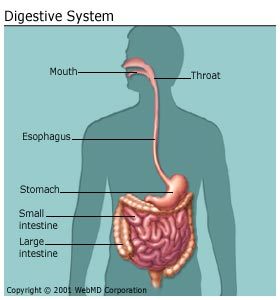
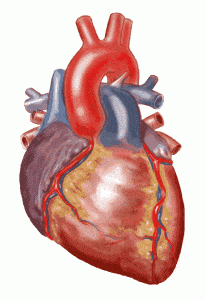
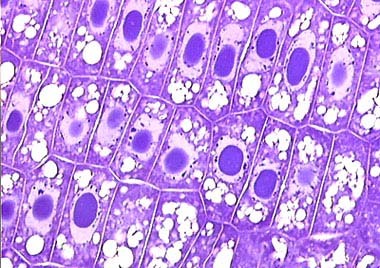

This picture represents which of the levels of organization?
atom
organ
organelle
cell
Where does the digestion of proteins take place?
Mouth and stomach
Stomach and small intestine
Mouth and small intestine
Mouth, stomach and small intestine
Which of these nutrients are digested in the mouth using enzymes?
Carbohydrates and proteins
Proteins
Carbohydrates
Fats
What is the enzyme contained in the saliva?
Amylase
Pepsine
Hydrochloride acid
Lipase
Where is the pancreatic juice released?
Small intestine
Stomach
Large intestine
Mouth
Where is the bile stored?
Liver
Gall bladder
Pancreas
Small intestine
What is the nutrient that bile facilitates its digestion?
Proteins
Lipids
Carbohydrates
Protein and lipids
Where is the bile released?
Pancreas
Liver
Stomach
Small intestine
Mouth
What is the function of the villi?
To increase the absorption surface
To digest the last nutrients
To form feces
To comb the small intestine
Digestive organ where most chemical digestion and absorption of food takes place is the...... .
pancreas
small intestine
liver

..............produces bile to break up fat particles.
Pancreas
Large intestine
Liver

............produces enzymes for the small intestine that help break down starches, proteins, and fats.
pancreas
large intestine
liver
The process of breaking down food into smaller molecules is called......
absorption
digestion
peristalsis
villi
Which organ connects the mouth to the stomach?
esophagus
small intestine
large intestine
pancreas
Amylase in saliva changes starch into...
maltose sugar
waste
stomach acid
chyme
Chemical digestion happens inside....
stomach
liver
pancreas
large intestine
The removal of undigested food and other wastes from your body is called...........
digestion
absorption
ingestion
elimination
What are the main functions of the excretory system?
deliver oxygen to the body
deliver nutrients to the body
remove water and waste from the body
remove disease from the body
Which organs help to remove waste from the body?
Lungs, stomach, bladder, and kidneys
Lungs, heart, bones, and bladder
Lungs, large intestine, bladder and kidneys
Lungs, esophagus, bladder and kidneys
Which organ(s) remove waste gases?
Bladder and kidneys
Lungs
Large intestine
Which organ filters blood?
Kidneys
Large Intestine
Lungs
Bladder
Which organ(s) absorb excess water and store solid waste?
Bladder and kidneys
Large Intestine
Lungs
What are the main functions of the excretory system?
deliver oxygen to the body
deliver nutrients to the body
remove water and waste from the body
remove disease from the body

What is organ is #1?
Kidney
Stomach
Bladder
Heart
What organ is #3?
Kidney
Stomach
Bladder
Heart
True or False:
Kidneys filter waste from blood.
True
False

Which of the following is NOT part of your excretory system?
Heart
Lungs
Kidneys
Skin

The job of your kidneys is to...
Create feces
Take carbon dioxide out of your blood
Put oxygen into your blood
Clean blood, sending waste to bladder
When you breathe, your lungs take in ___ and remove ___.
air, oxygen
oxygen, carbon dioxide
carbon dioxide, waste
waste, air
When you breathe in, the lungs _________ in order to _________ air pressure, so that air will flow in.
expand, decrease
shrink, decrease
expand,increase
shrink, increase
The Lymphatic System is a one way system. True or false?
True
False
Check all that apply.
The Lymphatic System's function is...
To return tissue fluid to the blood.
To transport oxygen.
To help defend the body against infection
To transport fat
The lymphatic system consist of?
Lymph and lymph vessels
Lymph and water
Lymphocytes and arteris
Which of the following is NOT a function of the lymphatic system?
removes excess fluid from around organs
circulates blood
absorbs/transports fats
produces white blood cells
Which of the following cells are responsible for fighting diseases?
White blood cells
Red blood cells
The lymphatic system consist of?
Lymph and lymph vessels
Lymph and water
Lymphocytes and arteris
lymph is a colourless watery fluid that contains lymphocytes.
True
False
Lymph nodes are located in
armpits
shoulder
neck
back
groin
Two main organs of the lymphatic system are:
Thymus & Pancreas
Spleen & Thymus
Pancreas & Thyroid
Tonsils & Thyroid

Drains tissue fluids, waste products & flights against infection
Removes toxins & waste
Prevent swelling
Fights against infection

