
 Worksheets
MOTION, FORCES, AND NEWTON'S LAWS ASSESSMENT
Total questions: 50
Worksheet time: 26mins
Name
Class
Date
1.
Tommy was walking at a rate of 4 miles/hour at noon and at 12:30 pm he was walking at a brisk rate of 6 miles/hour. Two hours later Tommy was walking at a leisurely rate of 2 miles/hour. Which statement about Tommy's acceleration is true?
a)
A) Tommy had an acceleration of zero the entire time.
b)
B) Tommy had a positive acceleration between noon and 12:30 pm.
c)
C) Tommy had a positive acceleration between 12:30 and 2:30 pm.
d)
D) Tommy had a negative acceleration between noon and 12:30 pm.
2.
Which example best represents an object with balanced forces acting upon it?
a)
A) A boat moving through the water.
b)
B) A book sitting on a high shelf.
c)
C) A wagon rolling down a steep hill.
d)
D) A baseball thrown in the air.
3.
When net forces are not equal on an object, the object moves in the direction of:
a)
A) The lesser force
b)
B) It does not move
c)
C) The greater force
d)
D) Towards the center of the Earth
4.

Which BEST compares the motions of dots C and D?
a)
A) Both C and D are speeding up.
b)
B) Both C and D are moving at a constant velocity.
c)
C) C is speeding up and D is moving at a constant velocity.
d)
D) C is slowing down and D is moving at a constant velocity.
5.
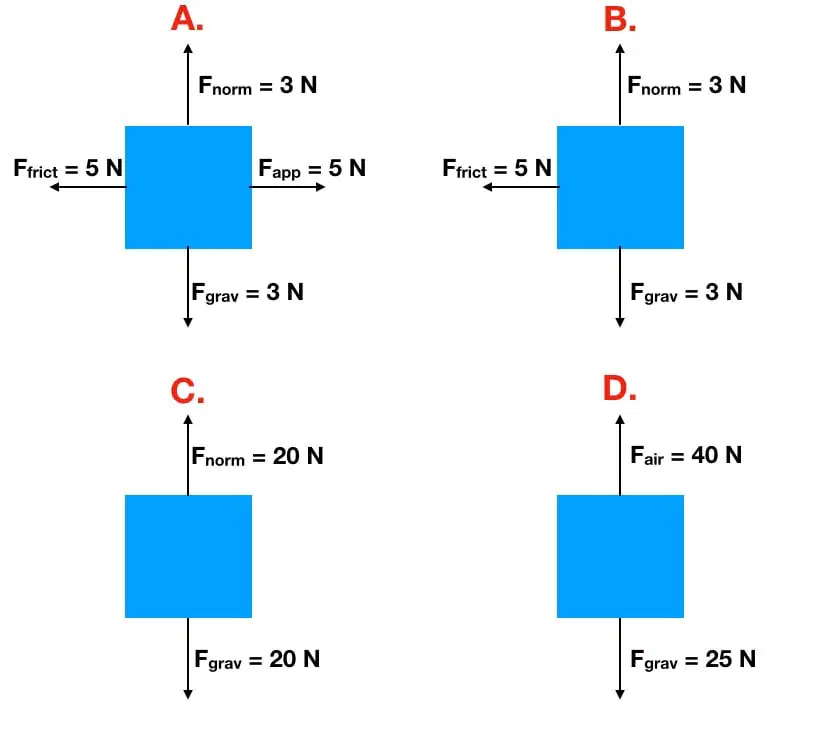
Consider the four free body diagrams. Free-body diagrams are diagrams used to show the relative magnitude and direction of all forces acting upon an object in a given situation. Do any of the free body diagrams indicate motion? If yes, which one(s). Explain.
a)
A) No. In each case, the forces are balanced.
b)
B) Yes. In B the book is slowing down because of the friction force opposing motion.
c)
C) You cannot tell if there is any motion. You can only determine how much force is acting on the objects.
d)
D) Yes. In B and D. In both cases, there is a net force. In B, there is a net force to the left; in D there is a net force upward.
e)
Option 5
6.
A child had a 600g basketball, a 500g football, a 150g baseball, and a 50g yo-yo. If the child had to throw one of the four, which one would take the MOST force to throw?
a)
A) baseball
b)
B) basketball
c)
C) football
d)
D) yo-yo
7.
In baseball, a home run means the batter has hit the baseball into the stands, beyond the baseball field. Bunting means that the batter has lightly made contact and the ball stays on the in-field. Compare the force of the batter when bunting the ball into the in-field versus hitting a home run.
a)
A) There is no way to estimate the batter's force.
b)
B) The force is much less when bunting into the in-field.
c)
C) The force of the batters in each case is about the same.
d)
D) The force of the batter is much less when hitting the ball out of the park.
8.
Car A travels from New York to Miami at 25 m/s (from North to South). Car B travels from New York to Chicago, also at 25 m/s (from East to West).
Car A and Car B have ___________ speeds and ____________ velocities.
a)
A) equal, equal
b)
B) equal, different
c)
C) different, equal
d)
D) different, different
9.
A train engineer started the train from a standstill and sped up to 5 meters per second, she then rounded a corner at a constant speed. She then sped the train up to 10 meters per second on the next straightaway. Next, the train chugged around another bend at 10 m/sec, and then its speed slowed to 5 meters per second after coming out of the bend. Finally, the train reached the station, and the engineer applied the brakes and brought the engine to a stop. How many times did the train accelerate?
a)
A) 2
b)
B) 4
c)
C) 5
d)
D) 6
10.

The graph shows the speed of a car during a trip along the highway. What can you say, in general, about the speed of the car?
a)
A) The speed of the car is constant during the trip.
b)
B) The car is moving at a slow rate of speed.
c)
C) The speed of the car is increasing throughout the trip.
d)
D) The speed of the car varies at different times during the trip.
11.

The image below shows two opposite forces acting on a box, what can we say that is true about the affect of the forces on the box?
a)
A) It cannot be determined without knowing which man is stronger.
b)
B) It cannot be determined without knowing the surface the box is on.
c)
C) The forces are balanced. But, the forces acting on the box have increased and the box’s motion is affected.
d)
D) The forces are balanced. Thus, there is no change in forces acting on the box and the box's motion is not affected.
12.

John and Caroline go out for a drive one day. This graph represents the distance they traveled over time.
During what part of their drive are they not moving?
a)
A) From 0 to 0.75 hours
b)
B) From 1.25 to 2.0 hours
c)
C) From 0.75 to 1.25 hours
d)
D) They are moving the entire time.
13.

Based on the graph, how would you BEST describe the speed of the racehorse?
a)
A) constantly decreasing speed
b)
B) both increasing and decreasing speed
c)
C) stopped, starting, and then stopped again
d)
D) starting to move and then increasing speed
14.

The image below shows two opposite forces acting on a rolling cart, what can we say is true about the affect of the forces on the cart?
a)
A) It cannot be determined without knowing which man is stronger.
b)
B) It cannot be determined because one man is taller than the other.
c)
C) The forces are unbalanced, and net force on the cart moves it to the left.
d)
D) The forces are unbalanced, and net force on the cart moves it to the right.
15.
James is trying to prove Newton's 2nd law of motion. He tries to move four different objects with different masses, shapes, and sizes from point A to point B. The objects are a toy car, a car, a refrigerator, and a kitchen table. After some experimentation, he finds that force is dependent on the mass of the object, rather than it's size or shape. The object that takes the most force to move is the ______________.
a)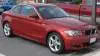
Option 1
b)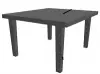
Option 2
c)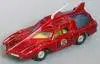
Option 3
d)
Option 4
16.
Ramon is playing soccer. The ball comes straight at him, and he kicks it to a player on his right. His kick is an example of ___________.
a)
A) a pull that stops the ball.
b)
B) a force that changes the roll of the ball.
c)
C) a pull that creates the motion of the ball.
d)
D) a force that changes the direction of the ball.
17.
Meg and Rachel each have bowling balls with the same mass. They both roll them as hard as they can and then measure the speed of the balls.
Meg's ball and Rachel's ball were measured to have the exact same speed.
What do you know about the forces applied by the girls?
a)
A) Meg applied more force than Rachel.
b)
B) Rachel applied more force than Meg.
c)
C) They applied an equal amount of force.
d)
D) They applied a almost the same amount of force.
18.
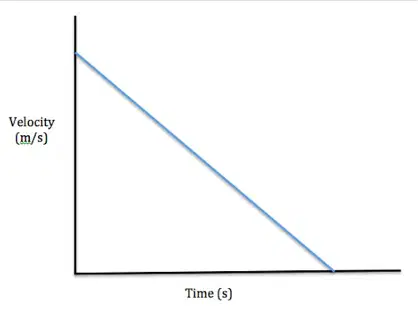
The graph above represents an object moving with a __________________.
a)
A) constant velocity
b)
B) constant acceleration
c)
C) positive acceleration
d)
D) negative acceleration
19.
A train rolls to a stop along a horizontal track without the conductor applying the brakes. What answer choice BEST explains why this occurred?
a)
A) The train ran out of momentum.
b)
B) The opposing force of friction stopped the train.
c)
C) The natural state of the train is not to be in motion.
d)
D) The force of gravity slowed the train until it stopped.
20.
You are sitting in a car that isn't moving; suddenly, the car quickly accelerates. Your body seems to be pushed back against the seat. Which word best explains why your body seemed to be pushed backward against the seat?
a)
A) newton
b)
B) vector
c)
C) inertia
d)
D) gravity
21.
A basketball rolls to a stop along a gym floor without anyone touching it. What answer choice BEST explains why this occurred?
a)
A) The initial force that started the ball ran out.
b)
B) The opposing force of friction stopped the ball.
c)
C) The natural state of the ball is not to be in motion.
d)
D) The force of gravity slowed the ball until it stopped.
22.
Jawanda was playing with her new Superman bobble head. She noticed that after she pushed Superman's head it would vibrate, but after a while it would bobble less and then stop. Which of Newton's laws best explains why this happened?
a)
A) The first law - The head moves until a force stops it.
b)
B) The third law - The head is reacting to a action force.
c)
C) The first law - The head is in motion and it will remain in motion.
d)
D) The second law - The head was not pushed hard enough to keep the head moving.
23.
The law of inertia states that an object in motion will stay in motion, and an object at rest will stay at rest unless acted upon by an unbalanced force. Which law of motion is this describing?
a)
A) Newton's First Law
b)
B) Newton's Third Law
c)
C) The law of gravity
d)
D) Newton's Second Law
24.
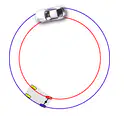
Consider the car driving around a circular track. Once started, the driver maintains a speed of 45 m/h. Compare the driver's velocity with his acceleration in this case.
a)
A) The car is accelerating because it is changing direction but the velocity is constant.
b)
B) The car is traveling at a constant rate of speed so it is not accelerating and the velocity does not change.
c)
C) Acceleration is the change in velocity so the car is experiencing a change in velocity and it is accelerating.
d)
D) The car is traveling at a constant rate of speed so it is not accelerating but the velocity changes because the direction the car travels is constantly changing.
25.
Julio hit a baseball. What caused the ball to change direction at the time of impact?
a)
A) the force of gravity
b)
B) the speed of the ball
c)
C) the force of his swing
d)
D) the weight of the air
26.
Net force is the total of all forces acting on an object. When a force is balanced and the object does not move, the net force is equal to what:
a)
A) 0
b)
B) 10
c)
C) 100
d)
D) The weight of the object
27.

The image below shows two opposite forces acting on a rolling cart, what can we say is true about the effect of the forces on the cart?
a)
A) It cannot be determined without knowing which man is stronger.
b)
B) The forces are not balanced, because one man is taller than the other.
c)
C) The forces are balanced. But, the forces acting on the cart have increased and the cart’s motion is affected.
d)
D) The forces are balanced. Thus, there is no change in forces acting on the cart and the cart’s motion is not affected.
28.
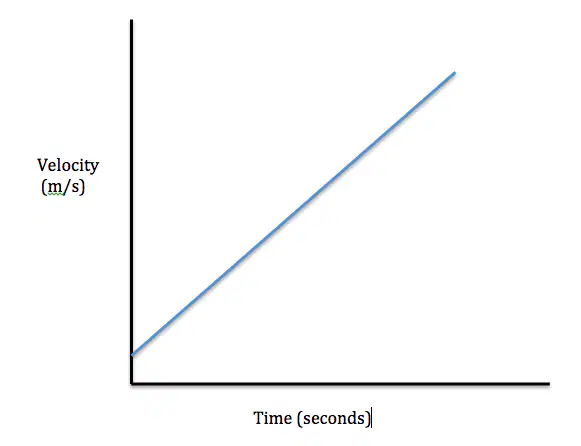
The graph above represents an object moving with a __________________.
a)
A) constant velocity
b)
B) constant acceleration
c)
C) positive acceleration
d)
D) negative acceleration
29.

While studying balanced and unbalanced forces, Jose and Gina test what they have learned by Jose applying 10 Newtons of force to one side of a box and Gina applying 8 Newtons of force to the other side of the box.
a)
A) The box does not move.
b)
B) The box moves toward Gina.
c)
C) The box moves toward Jose.
d)
D) The force crumples the box.
30.

Students in Ms. Bailey's class were studying speed. Four students rolled balls across the floor a distance of 30 cm. Their times are seen here. Put the times in order from fastest to slowest.
a)
A) Ball 1 - Ball 2 - Ball 3 - Ball 4
b)
B) Ball 1 - Ball 2 - Ball 4 - Ball 3
c)
C) Ball 2 - Ball 1 - Ball 4 - Ball 3
d)
D) Ball 4 - Ball 3 - Ball 2 - Ball 1
31.
Students in Ms. Sawyer's class built balloon cars. The balloon car works this way. As the gas in the balloon is released, the car moves in the opposite direction. The bigger the balloon initially, the farther the car moves. This balloon car is a good model of Newton's _________.
a)
A) first law of motion.
b)
B) second law of motion.
c)
C) third law of motion.
d)
D) law of gravitational attraction.
32.
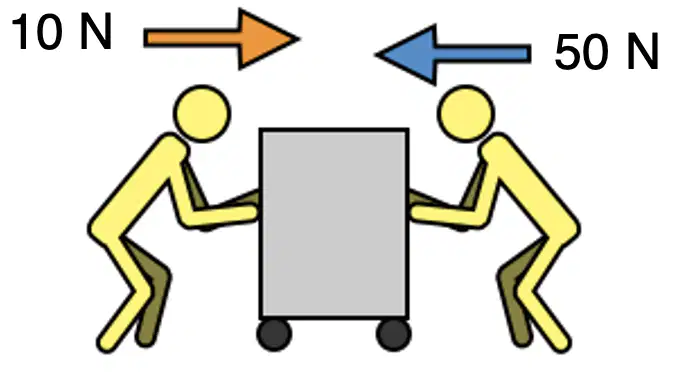
The image below shows two opposite forces acting on a rolling cart, what can we say is true about the effect of the forces on the cart?
a)
A) It cannot be determined without knowing which man is stronger.
b)
B) It cannot be determined because one man is taller than the other.
c)
C) The forces are unbalanced, and net force on the cart moves it to the left.
d)
D) The forces are unbalanced, and net force on the cart moves it to the right.
33.
Sam is pushing a cart. How can he make the cart move faster?
a)
A) He can add weight to the cart.
b)
B) He can push the cart up a ramp.
c)
C) He can take the wheels off the cart.
d)
D) He can increase the force of his push.
34.
Seat belts have been a requirement in vehicles for decades. They prevent injuries and reduce fatalities during car crashes that involve collisions while the car is in motion. Which of these concepts explains why seat belts are effective against injuries due to car collisions? Select ALL that apply.
a)
A) Seat belts reduce inertia.
b)
B) Seat belts prevent collisions between human bodies and the windshield.
c)
C) Seat belts prevent an object in motion from continuing to move forward.
d)
D) Seat belts increase the momentum of the vehicle but not the person within the vehicle.
e)
E) Seat belts prevent an object in a circular motion will continue to move in a circular motion.
35.
The acceleration of an object would increase if there was an increase in the
a)
A) mass of the object.
b)
B) force on the object.
c)
C) inertia of the object.
d)
D) friction on the object.
36.
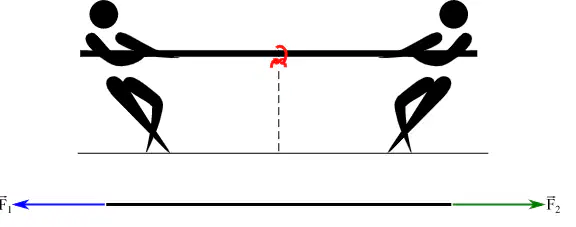
A simplified model of a tug of war scenario is shown here. A student is designing an experiment to test the impact of unbalanced forces using the scenario shown. Which of these modifications to the scenario is correctly matched with its correct outcome? Select ALL that apply.
a)
A) If force 1 is 75 N and force 2 is 95 N, there will be no winner of tug of war.
b)
B) If force 1 is 75 N and force 2 is 50 N, the winner of tug of war will be the player on the left.
c)
C) If force 1 is 25 N and force 2 is 50 N, the winner of tug of war will be the player on the left.
d)
D) If force 1 is 50 N and force 2 is 80 N, the winner of tug of war will be the player on the right.
e)
E) If force 1 is 75 N and force 2 is 150 N, the winner of tug of war will be the player on the right.
37.
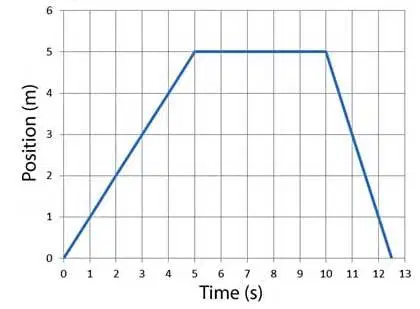
A dog named Rascal leaves his home and travels a short distance and then returns home. The graph shows his position as a function of time.
a)
A) His velocity was slower when compared to the first 5 seconds.
b)
B) His velocity was positive on the return trip when compared to the first 5 seconds.
c)
C) His velocity on the return trip was twice as slow when compared to the first 5 seconds.
d)
D) His velocity on the return trip was twice as fast when compared to the first 5 seconds.
38.
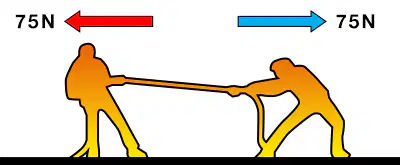
The image below shows two opposite forces acting on a rope. What can we say is true if the forces on each side of the rope is doubled to 150 Newtons?
a)
A) It cannot be determined without knowing which man is stronger.
b)
B) The forces are not balanced, because one man is standing taller than the other.
c)
C) The forces are balanced. But, the forces acting on the rope have increased and the rope’s motion is affected.
d)
D) The forces are balanced. Thus, there is no change in forces acting on the rope and the rope’s motion is not affected.
39.

According to the diagram, the block should be moving in which direction?
a)
A) The block should not move at all.
b)
B) The block should move to the left.
c)
C) The block should move to the right.
d)
D) There is no way to tell which way the block should move.
40.
Forces that are equal in strength and opposite in direction are ______________.
a)
A) balanced forces.
b)
B) unbalanced forces.
c)
C) always result in motion.
d)
D) always the result of motion.
41.
A firefighter turns on the high-power hose and is thrown backwards.
a)
Newton's First Law
b)
Newton's Second Law
c)
Newton's Third Law
42.
It takes less force to move a book than a book bag full of books.
a)
Newton's First Law
b)
Newton's Second Law
c)
Newton's Third Law
43.
You have to throw a heavy ball harder to get it to move as fast as a lighter ball.
a)
Newton's First Law
b)
Newton's Second Law
c)
Newton's Third Law
44.
A kickball will not move until the player kicks it.
a)
Newton's First Law
b)
Newton's Second Law
c)
Newton's Third Law
45.
When you add more force to an object, it accelerates more.
a)
Newton's First Law
b)
Newton's Second Law
c)
Newton's Third Law
46.
If you let the air out of a balloon, the balloon flies away.
a)
Newton's First Law
b)
Newton's Second Law
c)
Newton's Third Law
47.
Force = mass x acceleration
a)
Newton's First Law
b)
Newton's Second Law
c)
Newton's Third Law
48.
Your feet push down on the floor and the floor pushes back up on your feet with the same force.
a)
Newton's First Law
b)
Newton's Second Law
c)
Newton's Third Law
49.
When your friend slams on brakes, your seatbelt prevents you from going forward.
a)
Newton's First Law
b)
Newton's Second Law
c)
Newton's Third Law
50.
When you push a small box and a large box with the same force, the small box accelerates faster.
a)
Newton's First Law
b)
Newton's Second Law
c)
Newton's Third Law
100 %

